|
|
The River Suir, as most of our readers are aware, rises on the slopes of the 480m (1575 ft) high Bearnan Eile (Translation from the Irish – “Devil’s Bit”) mountain, just north of Templemore here in Co. Tipperary. It flows southwards, merging along the way with the rivers Aherlow and further on with the river Tar, before entering the sea at Waterford.
This same river is now under threat of serious pollution, partly due to the laid-back attitude and total inactivity of Tipperary Co. Council personnel.
Back in August of 2016 the Anner Hotel had been the appointed venue for a River Suir Community meetings. The purpose of these meetings was supposedly to open up serious discussion on the river Suir; with regard to water quality and other natural water issues, while also exploring possible opportunities regarding what this river and its tributaries could provide for local communities. The importance of the river Suir, from a European perspective, was explained at such meetings, including why the river had been selected as a ‘Special Area of Conservation’, based on the myriad of wildlife being supported therein and thereon. Almost two years later, all planning; to use more liquid expressions, appears to have evaporated, dissolved, melted and even became vaporised.
Here, on both sides of Barry’s Bridge, Blue Green algae covers most of the surface of the water. The growth of this algae is rapidly encouraged by the current bright sunlight and existing warm temperatures. This when added to nutrient enrichments including phosphorus and nitrogen; latter found in animal waste; human waste; fertilizers used by the farming community; the improper located of septic tank systems; waste water conveyed in sewers, (Issue first raised by us on November 7th, 2013 and cleaned up first in 2018), now has further exacerbated an already rapid, deteriorating condition within the Suir’s river water.
A stainless-steel water pump, driving water in the form of a fountain (Gifted to the people of Thurles town, courtesy of Cantwell Engineering Ltd), and which had previously aerated the water and down stream in this area, was switched off without explanation by Tipperary Co. Council some 10 years ago, thus further adding to the problems being experienced today.
This blue-green algae (Cyanobacteria bacteria) appears to have now become a harmful algal bloom producing toxins (such as microcystins and anatoxins) that can affect not just humans, but more especially livestock (e.g. Horses, Cows, dogs and wild fowl) latter that frequently swim in and drink this contaminated algae soup; with the levels of this toxicity regarded to be generally moderate to severe.
The presence of the algae is confirmed by the foamy water appearing; washed downstream, which we had privately tested, believing it to be some form of industrial chemical pollution. This foam or “bloom scum” uses up the oxygen in the water, which in turn causes major problems for all other aquatic life.
Common signs in animals to watch out for, include:- Vomiting; Diarrhoea; Coma Shock; Disorientation; Seizures; Muscle tremors; Muscle Rigidity; Paralysis; Difficulty in Breathing; Blue Discolouration of the Skin and Death. Unfortunately, for animals there is no antidote for the toxins produced by blue-green algae, however immediate veterinary care should be considered an imperative.
We learn last week that Templemore Thurles Municipal District Manager, Mr Matt Shortt agrees with Local Council Representatives, that the river Suir currently looks like a cesspool, but adds that officials would have to take advice on what the best course of action should be. “We have to be very careful about what we do and will have to take advice, so that we do not cause any problems down the line. We don’t have the expertise here, but we will make inquiries and take it from there,” he stated.
This statement however is not satisfactory and akin to quotes from builder Mr O’Reilly (Actor David Kelly) in a Faulty Towers script. In previous years this weed was removed from the river by the simple act of “deskuzzing”. Laughingly, (God Help Us), the building overlooking this current cesspit, namely “The Source”, was selected as the launch pad for a Tipperary Heartland Tourism unveiling just last weekend. Senior officials attending, including at least one Tipperary Labour TD (Mr Alan Kelly) and one Fianna Fáil Co. Councillor (Mr John Hogan), both appear to have lost two of their basic five senses, namely in this case smell and vision.
Human Health Concerns
This Blue-green bloom can pose a human health threat to those entering the river. Symptoms experienced from drinking contaminated water that contain blue-green algae can include:- Dizziness, Diarrhoea, Stomach Cramps, Nausea, Headaches, Fever, Sore Throats, Abdominal Pain, Muscle Aches, Mouth Ulcers, and Blistering of the Lips. Skin coming into contact with the water can develop severe rash like symptoms.
Surely the time has come to claim our town back from those who now govern within the Templemore / Thurles Municipal District.
More on this deliberate destruction of “the town we love so well” in the coming day.
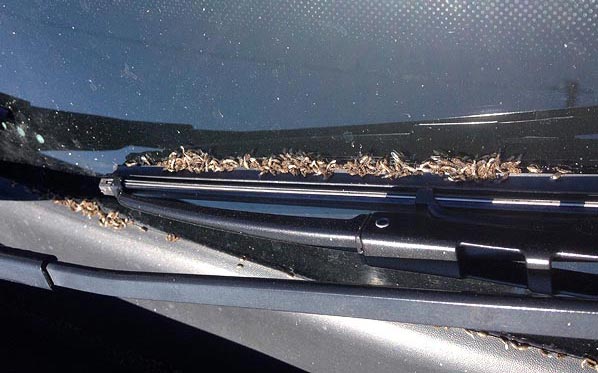
It is estimated that 200 million cars being driven in America, with each vehicle driven an average of 20116.8 kilometres (12,500 miles) each year. The entire nation therefore travels approximately 2.5 trillion miles annually, and will kill off an estimated 32.5 trillion insects in this travelling process.
Here in North Co. Tipperary Ireland, cars, particularly those black in colour, don’t have to travel at all, to kill our insect life. Due to unprecedented sunshine raising our heat levels, (averaging between 27° and 30°), millions of insects. who choose to land on black car windscreens, are being tricked into committing suicide.
Dark colours absorb heat, most especially that from the sun’s rays; while light colours reflect about 60% of this same sunlight. Less than 10 years ago the state of California in the USA, actually considered banning the sale of new black cars. Had this rule been introduced, same would have translated to a 2% decrease in fuel economy savings, due to a related decrease in air conditioner use, thus in turn further reducing carbon dioxide emissions by 1.9%.
So far as I am aware the forced mass suicide of insects was not considered; however here at home, do check your car windscreens to avoid your car’s fan system sucking these dried, fried insect into your vehicle.
 We refer to our recent posts, published on June 8th last and June 18th respectively, which highlighted the failure by Tipperary Co. Council to protect our local environment. We refer to our recent posts, published on June 8th last and June 18th respectively, which highlighted the failure by Tipperary Co. Council to protect our local environment.
For the past six months RTÉ Investigates have similarly reconnoitred the ever increasing problem of illegal dumping here in Ireland and how Co. Councils have set about regulating and prosecuting waste offenders.
Remember when illegal dumpers pollute our environment, the Irish taxpayer, solely, is left to shell out the associated cost of any future clean up. It follows therefore that we must rely on our Co. Councils to investigate and regulate our thriving waste industry, and to this end we fund their activities.
A documentary by RTÉ Investigates; entitled Ireland’s Wild Waste will be broadcast tonight, Monday 18th June on RTÉ One at 9.35pm, following the 9.00pm News
This programme will investigate and publish analysed environmental data from the Environmental Protection Agency (EPA) and the Department of Housing, to determine which councils take waste offences seriously and who are left seriously trailing behind.
By examining rates of inspections, enforcement action, prosecutions and staffing levels between 2014 and 2016. RTÉ have created a ranking of the best (1) and worst (30) Councils at managing our waste industry. They have also compared how dynamic Councils have been, acting on our behalf, in these areas in relation to the number of waste permits held in 2016.
Towards the bottom of a page found by CLICKING HERE you can find an interactive map to see how Tipperary Co. Council compares on a similar scale with other local authorities.
Note:
Rank = Ranking per category. (1 = most active, 30 = least active)
Rate = Rate of activity per number of waste permits held.
Nat. Avg. = National average rate of activity per number of waste permits.
So, where is Tipperary currently positioned in Ireland’s Wild Waste rankings?
Alas, Tipperary Co. Council is ranked in a mere 28th place, of the 30 councils analysed by RTÉ; where 1 is ranked as the most active Co. Council for regulating and enforcing waste services per number of waste permits held in the local authority and 30 as the least active.
Between 2015 and 2016 Tipperary spent €10.64 per person on waste services, or €6.58 less than the national average of €17.22. [Note: Tipperary is one of just a few Irish counties, where our public representatives increased property tax by 10% for the coming year]
Tipperary is in the bottom 3 for non routine inspections, with the council conducting 294 inspections between 2014 and 2016, over 1,000 inspections less than the national average.
Highly recommended viewing for this evening.
Inspector Mr David O’ Connor, Inniscarra, Co. Cork, representing the Environmental Protection Agencies Water Enforcement Team [Waste Water (Southern Region)], has forwarded us a copy of their report received from |Irish Water, regarding the River Suir close to Barry’s Bridge here in Thurles.
The River Suir – Tipperary’s New Cesspit from George Willoughby on Vimeo.
Dear George,
Irish Water issued the following response in relation to your complaint, “Irish Water can confirm that the complaint was investigated and the complainant contacted. Weed growth in river Suir downstream of the storm water overflow (SWO), trapped some general river debris plus SWO material, making it more visually evident, than might normally occur. There had been rainfall in days prior to the complaint and SWO appears to have been functioning as normal. The litter and debris material have been removed from the river.”
Mr O’ Connor goes on to state that as a preventative action, Irish Water have committed to Water Services Personnel visually monitoring this storm water overflow and report / remedy the problem, should it arise again.
“As I mentioned to you during our first conversation, Irish Water is in the process of conducting an Area Drainage Plan on the Thurles network. The purpose of this assessment is to identify any issues and faults that require re-mediation within the network, including the SWOs. Any required rehabilitation works will be carried out following this assessment.”
The engineer responsible for forwarding the above report to Mr O’Connor at the EPA, is quite obviously not a reader of Thurles.Info and is not aware of the evidence forwarded to the EPA. No explanation whatsoever was given by Irish Water, as to the source and content of the chemical causing the thick, frothy, soapy, substance, which was being expelled into the water, early each morning.
Be assured, however, that we like our Irish Water Services Personnel, will be visually monitoring this storm water overflow and will be reporting back to the Environmental Protection Agency, and, if deemed necessary, we will also be taking water samples for analysis.
We now ask that those elected to represent us at Municipal District level raise this matter at their next meeting.
It is June 8th 2018, and 6 months later the 2017 Christmas decorations still hang from the sky above Thurles. This week a well meaning group contacted me. “Can you describe Thurles in a very few words; perhaps 3 or 4 in a tag-line to summarise the Thurles experience?” “Does Thurles have a unique selling point for visitors/business investors”? they ask.
It would appear that yet another talking shop, “Thurles Town Centre Forum” are working towards creating a ‘Thurles Brand’ and will implement this brand in a new dedicated website for Thurles.
Note: Our last website “Thurles.ie”, was being cybersquatted by Mardukas Technologies Limited, latter who were a Swedish casino site when Tipperary Co. Council forgot to pay for the host name.
Note however, if “Thurles.ie” is presently typed into a Google search, it redirects to Tipperary Co. Council, implying that it may have been re-purchased and is now back in our Municipal district hands. (This being the case, one wonders what was the financial cost of this transaction, to our local taxpayers).
We do have a couple of suggestions for “Thurles Town Centre Forum”. How’s about; “It’s Christmas Everyday In Thurles” or instead of the Southern Italian town of Naples, let’s substitute Thurles instead, as in “Smell Thurles And Die”, for here also we have a rubbish-clogged river walk and a river into which we allow storm type drains to dispose of raw sewage and other as yet unidentified chemicals, which with the hot weather and the low river levels has the potential to cause serious damage and health issues.
Added to the current Crayfish Plague, last Wednesday marked the third fish kill here in North Tipperary rivers over the past 14 days. During the month of May, over 100 trout and juvenile salmon stocks died, when a greyish coloured foul smelling substance entered the Mill River in Ballina. Just last week there was yet another fish kill on the Ballintotty River, which left the entire trout and salmon population wiped out for a long stretch of the river. The latest incident, which occurred on Wednesday evening last, happened at Ballycrinode, Ballinalough, when supposedly slurry accidentally spilled into the river.
Three of Dublin’s best known beaches have also been closed, due to a sewage spill, with bathers being ordered to keep away from Dollymount, Sandymount and Merrion beaches. This water become polluted after an issue emerged at the Spencer Dock pumping station, resulting in sewage also leaking into the River Liffey.
Back to Thurles and the River Suir
Back to Thurles and the River Suir; can anyone explain what is the thick, frothy, soapy, substance being expelled into the water early each morning, same which clings to the moss-like algae growth in the Suir river?
Last week, having highlighted the problem of sewage many times, first back in 2013 I contacted the Environmental Protection Agency, who in turn contacted Tipperary Co. Council’s Irish Water. Within two days men were sent in to clean up the mess.
I now await a copy of the detailed report or at least an explanation from the EPA, which should have been sent by the examining engineer.
Town Centre Forum
Meanwhile, we are requested to ask; Do you find Thurles to be “Warm and Welcoming, Spirited, Sporting, Creative, Ancestral” ? Are there other aspects of the town that need to be highlighted?
Yet another failed Thurles logo must now be developed as part of this work. “Are there colours/fonts/style – descriptive or abstract that you prefer for this representation of Thurles” ?
If you are interested, please attend at any time between 3pm – 7pm in the Source Arts Centre Building on June 12th. Members of the Town Centre Forum will be on hand to give further details about the project and the agency undertaking this work will have a representative present from 6pm – 7pm. So if you can stand the current aroma, rising from the river water, do take this opportunity to contribute your opinion about your town.
For further details please contact Ms Kathleen Prendergast at the Community & Economic Development Department of Tipperary County Council.
|
Support Us Help keep Thurles.info online by donating below. Thank you.
Total Donated 2026: €300.00
Thank You!
Daily Thurles Mass Livestream
|



Recent Comments