Climate Change Advisory Council warns that government measures are not enough to prevent industrial emissions rising again.
Industry is projected to be Ireland’s second worst-performing sector after transport, with emissions set to rise again between now and 2030
Ireland is significantly off track on biomethane production, while delays in approving low-carbon cement technologies are holding back progress.
Ireland generated 16.7 million tonnes of waste in 2024, while 37% of municipal waste was exported for final treatment highlighting significant gaps in Ireland’s ability to manage its own waste.
Ireland has the second-lowest circularity rate in the EU.
Ms Jillian Mahon. (Climate Change Advisory Council).
Launching the Industry and Waste chapter of its Annual Review 2026 today, the Climate Change Advisory Council has warned that much stronger Government action is needed to reduce industrial emissions, which are projected to rise again over the coming years.
The Council said that while industrial emissions have fallen for four consecutive years and are now 15.9% below 2018 levels, emissions from this sector are now expected to stagnate until 2030. Industry has already provisionally exceeded its emissions ceiling for 2021–2025 by 9.1% and is projected to be the second worst-performing sector after transport against its next emissions ceiling. By 2030, emissions are projected to be just 11.6% below 2018 levels, well short of the Government’s 35% reduction target.
The Council said it is particularly concerning that EPA projections show almost no difference between projected industrial emissions under existing Government measures and those including additional planned measures, demonstrating that there is an absence of clear additional Government measures to meet 2030 decarbonisation targets.
A key priority for the sector is electrification and fuel switching away from fossil fuels to renewables such as biomethane, which can provide a renewable energy for industrial processes that are difficult to electrify. However, Ireland remains significantly off track against its target to produce 5.7 TWh of biomethane by 2030. Just seven projects, worth €19 million, were approved under the first €40 million Biomethane Capital Grant Scheme.
With up to €200 million in further capital supports planned between 2026 and 2030, the Council says lessons must be learned from the first scheme. It is calling for the Renewable Heat Obligation to be finalised urgently, alongside a separate support scheme to accelerate indigenous bio-methane production.
The Council has also warned that a growing backlog in the approval of low-carbon cement and concrete technologies is holding back emissions reductions in the sector. Some proposed solutions have been awaiting decisions from the National Standards Authority of Ireland’s Concrete Committee for several years.
The Review also finds that Ireland’s progress towards a circular economy is stalling. Ireland generated 16.7 million tonnes of waste in 2024 – around 8.5kg per person every day – with annual waste generation increasing by more than 20% over the past decade. A significant reduction in the generation of waste is required to meet Ireland’s EU commitments, supported by increased recycling rates and spending on new circular economy infrastructure. More than a third (37%) of municipal waste was exported for final treatment, highlighting significant gaps in Ireland’s ability to manage its own waste.
Ireland’s circularity rate – a measure of how much material is recycled back into the economy – was just 2% in 2024, the second lowest in the EU and significantly below the EU average of 12.2%. The municipal recycling rate has also remained largely unchanged over the past decade and Ireland will miss the EU target to recycle 55% of municipal waste.
The Council is calling on the Government to use Ireland’s Presidency of the Council of the EU to provide greater leadership on the circular economy. The
Government should translate this into decisive national action and accelerate the delivery of the Whole of Government Circular Economy Strategy 2026–2028.
Ms Jillian Mahon, Member of the Climate Change Advisory Council, said:“Industry has made real progress in reducing emissions in recent years, but we cannot assume that progress will continue. The projections are a clear warning that the measures currently planned are not enough to deliver the change needed by the end of this decade.“
In her 100th year and pre-deceased by her husband Pat and her brother Jerry; Mrs Ryan passed away peacefully, surrounded by her loving family, while in the care of staff at The Residence Nursing Home, Bohernatounish Road Roundabout, Loughboy, Co. Kilkenny.
Her passing is most deeply regretted, sadly missed and lovingly remembered by her sorrowing family; loving daughter Norah (Keogh), sons Tom, EJ, Gerard (Bishopstown) and Dermot (Kiltoom), son-in-law Kevin, daughters-in-law Phil, Alma, Irene and Helen, grandchildren, great grandchildren, sister Mollie (Bourke), sister-in-law Eileen (Dunne), nieces, nephews, extended relatives, neighbours and many friends.
Requiem Mass for Mrs Ryan will be offered on Saturday morning, October 10th, at 11:00am, followed by interment, immediately afterwards in Kilbride Cemetery, Callan, Co. Kilkenny.
For those persons who would wish to attend Requiem Mass for Mrs Ryan, but for reasons cannot, same can be viewed streamed live online, HERE.
The extended Ryan and Dunne families wish to express their appreciation for your understanding at this difficult time, and have made arrangements for those persons wishing to send messages of condolence, to use the link shown HERE.
Mr Oliver O’Grady, the convicted child abuser and former Roman Catholic priest; defrocked in 2001, and who previously lived and studied in Thurles, Co. Tipperary, has reportedly returned to Ireland since August of this year, 2026.
Defrocked Priest Mr Oliver O’Grady.
The Irish Sun newspaper, reporting on September 15th last, stated that the 81-year-old had completed a one-year sentence at Carregueira prison in Portugal for possessing child sexual abuse material. It reported that Portuguese police alerted Irish Gardaí before his arrival at Dublin Airport, where officers questioned him about his accommodation plans. He reportedly intended to remain in Dublin.
Mr O’Grady’s connection with Thurles dates back to 1964, when he entered St Patrick’s College, to study for the priesthood. According to the Irish Catholic Bishops’ Conference, his studies were sponsored by the Diocese of Stockton, California. He completed his training and was ordained in 1971, before moving back to California. Irish Catholic Bishops’ Conference states that he was never a priest of an Irish diocese.
He later returned to live in Thurles following imprisonment in the United States. A contemporary Associated Press report dated May 12th 2005, confirmed he had been living in the town since 2003, in rented accommodation on its outskirts. Local people described him as keeping very much to himself and regularly going for walks.
That report followed publicity surrounding his videotaped testimony in an American civil case. Neighbours would later report that Mr O’Grady had gone to Dublin to avoid the publicity. The precise length of his residence remains uncertain, although a later American news account stated that he possibly resided four years in Thurles.
His criminal history includes a 1993 California conviction for sexually abusing two brothers and a three-year Irish prison sentence in 2012 for possessing child sexual abuse material. In October 2020, Waterford Circuit Court sentenced him to a further 22 months after a jury convicted him of possessing a child abuse video.
His Thurles seminary connection also featured in litigation against the Cashel and Emly diocese. In January 2007, the Bishops’ Conference reported that a California court had dismissed claims against the archdiocese, finding no admissible evidence that it knew of his propensity to molest children.
Pre-deceased by his parents Edmond and Kitty, his brother Michael and his brothers-in-law Jimmy Arrigan and Noel McNulty; Mr Hennessy passed away peacefully, after a short illness, while in the care of staff at The Oak Ward, University Hospital Waterford
His passing is most deeply regretted, sadly missed and lovingly remembered by his sorrowing family; loving wife Bridie, sons Paul and David, grandson Evan, brother Eamon, sisters Connie, Moira, Rose and Ann, brothers-in-law, sisters-in-law, nieces, nephews, extended relatives, neighbours and a wide circle of friends.
The extended Hennessy family wish to express their appreciation for your understanding at this difficult time, and have made arrangements for those persons wishing to send messages of condolence, to use the link shown HERE.
“The extended Hennessy family would also like to express their sincere thanks and gratitude to everyone who cared for John during his illness”.
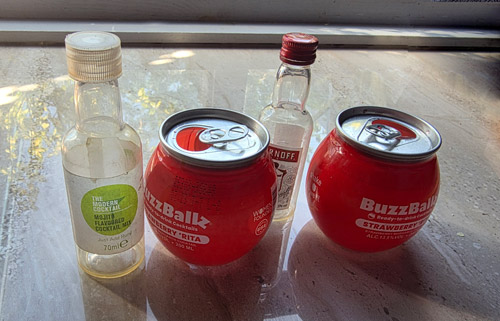
The photograph hereunder accompanying this post shows several small ready-to-drink alcohol and cocktail containers of a kind increasingly found discarded on streets, roadsides and public spaces around Thurles and other Irish towns. They include round aluminium BuzzBallz cocktail cans and plastic miniature bottles used for spirits or cocktail mixes.
BuzzBallz containers sold hereunder in Ireland are imported American products, rather than drinks manufactured in Ireland.
Ireland’s new litter menace – same rejected byReverse Vending Machines, since no Re-turn logo.
Ireland’s Deposit Return Scheme accepts aluminium and steel drinks cans, and PET plastic drinks bottles, holding between 150ml and three litres. However, a container must be registered in the Irish scheme and normally carry the Re-turn logo and an appropriate barcode. It must also be empty, undamaged and retain its original shape. Therefore, although a BuzzBallz container may be made from aluminium and fall within the correct volume range, an imported or unregistered version without the required Irish markings will be rejected by a Reverse Vending Machine. Miniature glass bottles and bottles made from plastics other than PET are also outside the scheme.
This creates an obvious weakness. Consumers have become accustomed to receiving a deposit refund for cans and bottles. When an unusually shaped container or miniature bottle is rejected, some people may simply abandon it beside the machine or throw it on the street. That behaviour is completely unacceptable, but manufacturers, importers, retailers and the operators of the recycling system must also recognise the emerging problem.
Retailers selling these products should provide clearly marked recycling bins and explain how each container should be disposed of. Producers and importers should also be required, wherever technically possible, to register eligible aluminium containers with Re-turn. Attractive, brightly coloured, single-serving packaging should not become tomorrow’s litter merely because it falls through a gap in the system.
There is also a public-health issue. The BuzzBallz Strawberry ’Rita, shown, is a small 200ml drink, but it contains 13.5% alcohol by volume. Despite its compact, colourful appearance, that represents approximately two Irish standard drinks in one container. The manufacturer lists more than 230 calories and almost 20 grams of carbohydrate in a single Strawberry ’Rita.
These products can taste sweet and fruity, potentially disguising their alcoholic strength. Drinking several in a short period could cause rapid intoxication, impaired judgement, accidents, blackouts or alcohol poisoning. The HSE advises adults not to consume more than six standard drinks on any one occasion. Its weekly low-risk guidance is no more than 11 standard drinks for women or 17 for men, spread across the week, with at least two or three alcohol-free days. These are low-risk limits, not completely safe limits.
It should also be made clear that alcohol may only be sold to people aged 18 or over in Ireland – not 16. Alcohol is a carcinogen, and the HSE states that it increases the risk of at least seven cancers, including cancers of the breast, bowel, liver, mouth and throat. The less alcohol consumed, the lower the risk.
Towns across Ireland should not have to choose between cleaner streets and convenient novelty drinks. Every container placed on the market should have a practical, clearly explained route back into recycling and every consumer must take responsibility for using it.
This website uses cookies to improve your experience. We'll assume you're ok with this, but you can opt-out if you wish.AcceptRead More
Privacy & Cookies Policy
Privacy Overview
This website uses cookies to improve your experience while you navigate through the website. Out of these, the cookies that are categorized as necessary are stored on your browser as they are essential for the working of basic functionalities of the website. We also use third-party cookies that help us analyze and understand how you use this website. These cookies will be stored in your browser only with your consent. You also have the option to opt-out of these cookies. But opting out of some of these cookies may affect your browsing experience.
Necessary cookies are absolutely essential for the website to function properly. This category only includes cookies that ensures basic functionalities and security features of the website. These cookies do not store any personal information.
Any cookies that may not be particularly necessary for the website to function and is used specifically to collect user personal data via analytics, ads, other embedded contents are termed as non-necessary cookies. It is mandatory to procure user consent prior to running these cookies on your website.







Recent Comments