Most of Cabragh Road in Thurles was resurfaced over the past week, following the deterioration and collapse of sections of the road surface after water-service works were carried out some years ago.
Much of the new surface appears to have been finished to a good standard. However, several sections near homes and businesses; including the area entrance to O’Meara Oil, now appear to be incomplete and potentially hazardous.
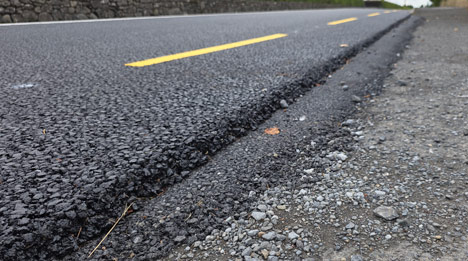
As our photographs show, the newly laid asphalt ends in a rough, abrupt and raised edge beside an uneven pedestrian margin. Anyone walking out from town may suddenly encounter a section where the resurfacing covers only part of the available roadside space.
Pic: G. Willoughby.
This presents particular difficulties for:
► wheelchair and mobility-scooter users; ► parents pushing children in buggies; ► people using walking aids; ► older pedestrians and those with impaired balance; ► cyclists moving close to the road edge; and ► residents entering or leaving adjoining properties.
Small wheelchair castors or buggy wheels could catch against the raised lip or loose stone. A pedestrian attempting to avoid the uneven surface could also be forced closer to moving traffic.
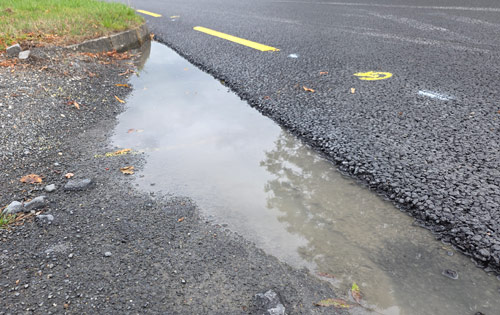
Pic: G. Willoughby.
The unfinished edge may create further problems if it is not corrected promptly. Water could collect along the change in level instead of draining freely, increasing the risk of puddles, splashing and deterioration. Water entering an unsealed pavement edge can weaken it, while passing traffic may loosen the exposed aggregate and cause the asphalt to ravel or break away progressively.
The resulting loose stones could become an additional slipping or skidding hazard. Repeated vehicle loading may also widen the damaged edge, leaving potholes, crumbling margins and an even greater difference in level.
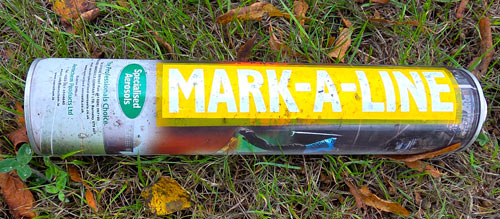
Pic: G. Willoughby.
Serious questions therefore arise: Why were these sections left at a different level? Was pedestrian and wheelchair access assessed before the work was accepted? Were drainage and connections to entrances properly examined? Has the resurfacing received a final inspection? Is the contractor expected to return and complete the margins?
Fresh road markings and a new running surface do not make a project complete if unsafe edges remain beside homes, businesses and pedestrian routes.
These locations should now be inspected urgently by Tipperary County Council, made safe without delay and brought to a properly finished, accessible and well-drained standard. The council provides an official service for reporting damaged roads and footpaths, including an online “Fix-it”facility, [which today same consultation portal, despite every attempt, refused access].
Which begs another question; Where have “Refresh Thurles” members vanished to? Note: Refresh Thurles members have failed to note that those working on this re-surfacing project, forgot to take their litter with them.
The public should not have to wait until somebody falls, a wheelchair becomes trapped or the newly laid surface begins to disintegrate before action is taken.
Stena Line and Irish Ferries are introducing stricter identification requirements for passengers travelling by ferry between the Republic of Ireland and Britain.
From Monday, September 28th, 2026 next, passengers, including children, will need to present a valid passport when checking in for affected sailings. Stena Line says the requirement will apply in both directions on its Dublin–Holyhead route and Rosslare–Fishguard route. No alternative forms of identification will be accepted by Stena Line. The company is contacting customers who already have bookings.
Irish Ferries has similarly announced that all passengers, including Irish and British citizens, travelling between the Republic of Ireland and Britain in either direction must carry a valid passport. Its announcement also advises Irish passengers to check that their passport or Irish passport card is in date. The operators say the change is required to comply with UK Border Force rules concerning the accuracy and integrity of passenger information collected before boarding.
This new passport rule appears to be part of the UK’s move towards a more digital, automated border system, requiring ferry operators to provide accurate, verifiable passenger information before departure. Passports make it easier to confirm travellers’ identities, nationalities and immigration permissions, so the measure is connected to immigration and border security in that operational sense; however, authorities have not linked it to any particular immigration incident or increase in illegal migration. It does not alter the Common Travel Area rights of Irish and British citizens, who remain exempt from visas and the UK’s Electronic Travel
What were the previous rules? Under the Common Travel Area, Irish and British citizens are not generally legally required to present a passport when travelling between the two countries. UK government guidance still says that Irish and British citizens travelling from Ireland to Great Britain may establish their identity and nationality using documentation other than a current passport.
Previously, ferry companies could accept alternative identification from Irish and British passengers. Depending on the operator and passenger’s age, this could include a driving licence or other official photographic ID. Irish Ferries’ earlier guidance also said that British and Irish passengers under 18 without photographic identification could usually travel with a birth certificate.
This new requirement is therefore principally a stricter carrier check-in policy. It does not remove the travel and residency rights enjoyed by Irish and British citizens under the Common Travel Area. Government guidance also makes clear that ferry operators may impose their own documentary requirements.
The change does not affect Stena Line’s services from Belfast to Liverpool, Cairnryan or Heysham. Passengers using other routes or operators should check the identification rules applying to their particular booking before travelling.
Government leaders are considering whether to recall the Dáil ahead of schedule as renewed instability in the Middle East raises concerns about fuel prices.
Temporary excise reductions introduced in April are due to be withdrawn gradually from September. The relief amounts to 32 cent per litre of diesel and 27 cent per litre of petrol and formed part of a €750 million package of business supports and cost-of-living measures.
Enterprise Minister Mr Peter Burke indicated that the timetable is being actively reassessed. The international outlook has worsened since the withdrawal schedule was agreed, with developments around the Strait of Hormuz contributing to uncertainty in global energy markets.
The Dáil is currently scheduled to return on September 16th next,. however, an earlier sitting may be required if the Government decides that legislation is needed to postpone the planned excise increases. Rising costs are already placing additional pressure on agriculture and the wider economy. The net price of marked gas oil, commonly known as green diesel, has increased from about 94 cent to €1.24 per litre, a rise of approximately 30%. Any extension of the fuel-tax relief would also have budgetary implications. The Government is preparing an overall Budget 2027 package worth more than €8 billion, including €1.5 billion for income-tax measures and an anticipated spending increase of around 6%.
Ministers are also examining ways to lower grocery prices by reducing transport, production and distribution costs. Because fuel expenses affect farming, manufacturing and the movement of goods, further increases could feed through to prices paid by consumers.
No final decision has been made on either the excise timetable or an early Dáil recall. Both options remain under consideration as the Government monitors international developments and prices at Irish fuel pumps.
‘Not simply an equality issue’ – Network Ireland seeks Budget 2027 investment in women-led businesses.
Women-led businesses should be given greater priority in Budget 2027, with targeted measures needed to help female entrepreneurs overcome barriers to growth and support Ireland’s wider economic performance, according to Network Ireland.
Ms Karen Ronan(Network Ireland National President)
The organisation, which represents more than 1,400 members through 17 branches nationwide, has called on Government to recognise women-led enterprise as a key driver of productivity, resilience and sustainable economic growth.
In its first national pre-Budget submission, Ireland’s longest-established women-only business network has identified seven priority areas for Budget 2027, including reducing the cost of doing business, improving access to finance for female entrepreneurs, expanding childcare supports, investing in skills and artificial intelligence, strengthening innovation, and addressing housing and infrastructure challenges.
The submission is based on a survey of members which found inflation and rising operating costs remain among the biggest challenges facing businesses. It also highlighted the growing use of artificial intelligence, with almost seven in ten members already using the technology and many expecting to increase their use of the technology in 2027.
Network Ireland National President Ms Karen Ronan said women-led businesses were making a significant contribution to the Irish economy but continued to face barriers that limited their ability to grow.
“Women-led businesses are creating jobs, driving innovation and making a significant contribution to Ireland’s economy. Budget 2027 is an opportunity to remove barriers that continue to limit business growth while unlocking the full potential of female entrepreneurship,” she said. “Investing in women in business is not simply an equality issue; it is an economic one. The right supports will strengthen businesses, increase workforce participation and enhance Ireland’s competitiveness.”
Among its recommendations, Network Ireland is calling for targeted tax measures for SMEs, improved access to finance, increased investment in childcare, and stronger supports for innovation and skills development.
Ms Ronan, who is also CEO of Galway Chamber, said the measures would help create the conditions for more women to start, grow and scale successful businesses.
“Our recommendations are practical and achievable and focused on helping businesses thrive. By investing in female entrepreneurship, childcare, innovation and workforce participation, Government can deliver lasting benefits for businesses, communities and the wider economy,” she said.
Founded in 1983, Network Ireland supports entrepreneurs, SME owners, professionals and business leaders through 17 regional branches and a virtual branch. See www.networkireland.ie.
Employment in IDA Ireland client companies across the Mid-West has increased by 18% over the past five years, according to figures provided to Clare TD Mr Joe Cooney.
Mr Joe Cooney TD.
There are now 28,125 people directly employed by 158 IDA client companies across Tipperary, Limerick and Clare, A further 22,500 jobs are estimated to be supported indirectly in the region. Co, Clare accounts for 67 of the companies, employing 6,136 people directly and supporting an estimated 4,909 indirect jobs.
The Department of Enterprise, Tourism and Employment said IDA Ireland recorded 55 facilitated site visits across the three Mid-West counties during 2025. Co.Tipperary recorded only three visits; while Limerick recorded the highest number with 33 visits, followed by Co. Clare with 19 visits. A further 17 visits were recorded across the region in the first quarter of 2026, including two in Tipperary, nine in Limerick and six in Clare.
Deputy Cooney said the increase in employment demonstrated the continued strength of the Mid-West in attracting foreign investment. “An 18% increase in employment among IDA client companies across the Mid-West over the past five years is very positive news for the region, he said. “It shows that the Mid-West is continuing to attract and retain major international employers and that the region has the skills, infrastructure and business environment needed to support high-value jobs.”
He said Co. Clare was playing a significant role in that growth, with more than 6,000 people now directly employed by IDA client companies in the county.
The Department said the Mid-West had attracted significant investment across technology, life sciences, international financial services, and engineering and industrial technologies. It said the availability of suitable property and strategic sites remained critical to attracting new investment.
The Department also cautioned that IDA site visits were only one measure of investor interest and did not necessarily translate into an investment. Potential investors may visit more than one county or return to a location more than once, while final decisions on where to locate an investment are made by individual companies. The Department said IDA Ireland’s regional strategy aims to secure 550 foreign direct investment projects outside Dublin between 2025 and 2029. Deputy Cooney said continued investment in infrastructure, skills and enterprise supports would be important if the Mid-West is to build on the growth of recent years.
This website uses cookies to improve your experience. We'll assume you're ok with this, but you can opt-out if you wish.AcceptRead More
Privacy & Cookies Policy
Privacy Overview
This website uses cookies to improve your experience while you navigate through the website. Out of these, the cookies that are categorized as necessary are stored on your browser as they are essential for the working of basic functionalities of the website. We also use third-party cookies that help us analyze and understand how you use this website. These cookies will be stored in your browser only with your consent. You also have the option to opt-out of these cookies. But opting out of some of these cookies may affect your browsing experience.
Necessary cookies are absolutely essential for the website to function properly. This category only includes cookies that ensures basic functionalities and security features of the website. These cookies do not store any personal information.
Any cookies that may not be particularly necessary for the website to function and is used specifically to collect user personal data via analytics, ads, other embedded contents are termed as non-necessary cookies. It is mandatory to procure user consent prior to running these cookies on your website.










Recent Comments