|
|
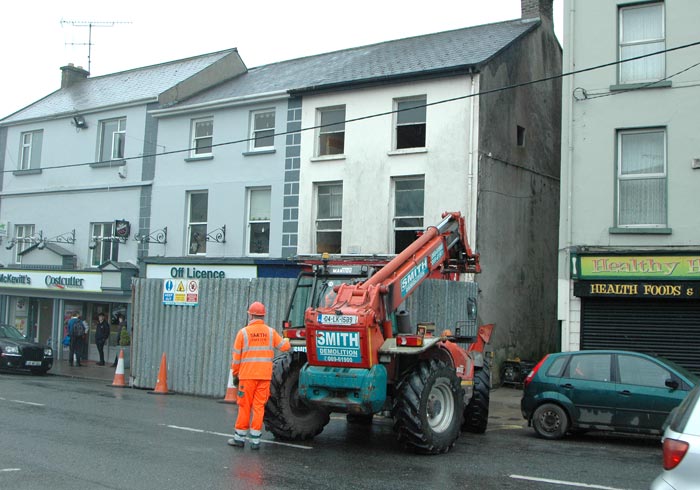
The opening of the proposed new car park to the rear of Jackie Griffin’s shop, here in Thurles central, moves yet another step closer, as a steel hoarding is erected to the front of the building on Liberty Square.
The erection of the hoarding began at 8.15am this morning.
The demolition of the shop building behind the protective barrier is expected to take place over the coming days, creating an opening into the new proposed car park, from the Liberty Square side.
Same, it is hoped, will bring new life to the businesses within the centre of Thurles town, and further progress the long promised revitalisation of the Liberty Square area.
More on the background to this news during the week.
Today, Sunday 20th May, marks the first ever global “World Bee Day”, and Bee experts are expected to highlight the need for an EU ban on certain insecticides, same which are knowingly, together with other avoidable factors, linked to a drastic decline in our Bee populations.
Why is our Honey Bee so important?
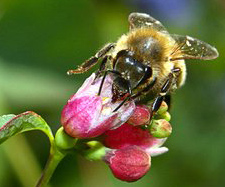 Honey bees collect pollen and nectar from a variety of wild and garden flowering plants and trees. These plants and trees, include Milkweed, Dandelion, Clover, Goldenrod, Sunflowers, Roses, Catmint, etc. together with Buddleja, and a variety of garden fruit trees. Honey bees collect pollen and nectar from a variety of wild and garden flowering plants and trees. These plants and trees, include Milkweed, Dandelion, Clover, Goldenrod, Sunflowers, Roses, Catmint, etc. together with Buddleja, and a variety of garden fruit trees.
Only workers in the colony forage for food, and while consuming as much nectar from each flower as they can, they then return to the hive and pass collected nectar to others. The worker holds this nectar on its tongue until the liquid evaporates, thus creating honey. The honey is then stored within the colony for winter consumption.
Pollen remains one of the purest and richest natural foods, containing all of the nutritional requirements for a Honey Bee, i.e. sugar, carbohydrates, protein, enzymes, vitamins and minerals.
These same Bees become the pollinators vital to our own food chain. Imagine that at least one third (⅓) of the food we eat today would not remain available, were it not for the existence of these, our busy Bees.
Today these flying insects, who are closely related to wasps and ants are in serious danger of disappearing completely from our environment. Farming practices continue to disturb their natural habitats, and over ⅓ of our Irish Bee species are being threatened with extinction, with the Bumblebee population also continuing to decline each year.
This drop in population is due mainly to three factors; the unnecessary removal of ditches and hedgerows; the use of pesticides (Used In the killing of insects, small animals, unwanted plants, fungi, bacteria and viruses), and insecticides (latter includes snail bait, ant killer and wasp killer), and lastly through climate change, also attributed to mankind. Bees require food all year round, and this means we are required to allow a diversity of flowering plants to grow on our landscape.
Our farming community can help Bees and their own crops by intervention through good husbandry, by simply allowing space for a diversity of wild flowers to grow and more importantly to flower. This can happen when:-
- Field margins can be fenced off from livestock, then allowed to either be cut or grazed after flowering.
- Do not use fertilisers or sprays on non-farmed areas around the farmyard, e.g. in field corners, along farm roadways. Again here, do not consider cutting until after the period of flowering.
- If you are spraying Pesticides or Insecticides, consider spraying in the early morning or late evening, when our Honey and Bumble Bee populations are less active. Such spraying can kill Bees quickly or slowly through carrying contaminated pollen back to their particular colony, (Latter which could hold 45,000 to 75,000 individual bees), where it will becomes entered into the food chain to slowly kill the assembled insects.
- Plant Whitethorn and Blackthorn hedging, whose early blooms are valuable to Bees, and stop removing natural hedgerows.
- Our Government, our Local Authorities (Ministers, TD’s, Councillors take note), and we as home owners, can also assist by planting Bee-friendly bulbs and plants, in our gardens, including Snowdrops, Crocuses (or Croci), Wallflowers and Lavender etc. etc..
Our present attitude to our environment must needs be changed and our new growing generations of humans, through our schools, must be educated on the value of Bees and the unnecessary threat currently to their very existence.
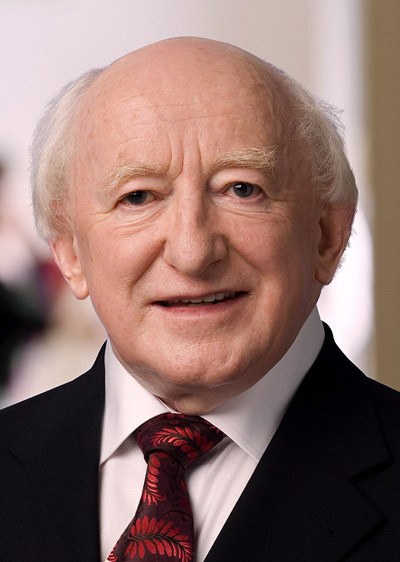 We previously stated in a recent news report that our Irish President, Mr Michael D. Higgins would be visiting Thurles on Saturday next, May 19th, 2018. We previously stated in a recent news report that our Irish President, Mr Michael D. Higgins would be visiting Thurles on Saturday next, May 19th, 2018.
While the date for his visit, (we are happy to relate), remains as previously stated; due to the unfortunate death of Irish playwright Mr Tom Murphy, the president’s visit has been unavoidably delayed by just some two hours.
As most people are aware President Michael D. Higgins had the great pleasure of presenting Mr Murphy, during his lifetime, with the Aosdána Gold Torc; presented at his home just last year; latter a massive acknowledgement by Mr Murphy’s contemporaries, with regard to his singular and sustained distinction to the arts, as a writer.
The President is now scheduled to arrive at 6.00pm, to Cabragh Wetlands instead of the previously stated 4.00pm time-line, for which the President offers his most sincere apologies.
Cabragh Wetlands Trust, would now ask that all visiting guests on Saturday next, be in place by 5.00pm, one hour before the ceremony.
Note: As already stated, there will be no parking at the Visitor Centre Site, due to outdoor standing space required for visitors and necessary security; however allowances will be made for persons requiring to be dropped at the centre’s main gates, and wardens will direct drivers of vehicles to specially provided car parking areas nearby, latter made available courtesy of obliging local landowners.
On Saturday May 19th next, 2018, the recently erected Visitor Centre on the lands of the Cabragh Wetlands Trust, here in Thurles, will be officially opened by the President of Ireland, Mr Michael D. Higgins.
The outdoor event is expected to take place at 4.00pm and all are invited to attend.
Do note that all attendees are expected to be in place one hour before the ceremony. There will be no parking at the Visitor Centre Site, however allowances will be made for persons requiring to be dropped at the centre’s main gates, and wardens will direct drivers of vehicles to specially provided parking areas, latter made available by local landowners.
The Cabragh Wetlands Trust was first registered in 1993 in an effort to save a vast area of wetland habitat from destruction, following the filling-in of settling pools once used by the now closed Thurles Sugar Factory. These settling pools, locally known as “The Lagoons” were once an oasis for all varieties of wildlife, particularly birds.
Following the formation of this Wetlands Trust and the acquisition of the land adjacent to The Lagoons, a resting place for these migratory birds was assured once more and up to the present day.
The Centre is currently operated by a group of committed volunteers, who provide exciting field trips for students and adults of all age groups. These wetlands boast some 15 different wildlife habitats including ponds, reed swamps, hedgerows, streams and wild flower meadows. Footpaths; raised walkways; and a large bird hide, are also provided, make this area an ideal, future preserved, knowledge location for school children to discover the sights and sounds generated by mother nature, while ensuring a safe and friendly environment.
EPA Climate Change Lecture Series
 Lord John Krebs Lord John Krebs is presenting an EPA Climate Change Lecture at the Mansion House, Dawson Street, Dublin 2 today Tuesday 15th May, as part of the National Dialogue on Climate Action and in conjunction with the Royal Irish Academy.
The Climate Change Lecture is now booked out. However, Tipperary people can watch the lecture which will be ‘Live Streamed‘ at 7.00pm, followed by a Questions and Answers Session at 7.45pm.
In this public lecture, Lord Krebs will discuss the challenges of adapting to climate change and will draw on the UK’s experience since enacting the 2008 Climate Change Act.
Laura Burke, EPA Director General stated,
“Ireland is not alone in facing the unprecedented challenge of addressing climate change. Part of this challenge involves how we adapt and build resilience in the face of the effects of climate change. Lord Krebs is a member and founding Chair of the UK Climate Change Committee Adaptation Sub-Committee and as such, we are looking forward to hearing his experience of addressing this task and how this can inform Ireland’s own response to the impacts of a changing climate and environment.”
People can also follow the discussion on Twitter using the hashtag #climatelecture2018
|
Support Us Help keep Thurles.info online by donating below. Thank you.
Total Donated 2026: €300.00
Thank You!
Daily Thurles Mass Livestream
|



Recent Comments