There was great excitement in Thurles yesterday as Minister for Public Expenditure and Infrastructure Mr Jack Chambers arrived to inspect some of the town’s important infrastructure projects.
Accompanying him were Deputies Mr Ryan O’Meara and Mr Michael Lowry, and Cllr Sean Ryan, naturally an occasion of such national significance required that essential piece of modern infrastructure without which no Irish public project can possibly proceed: The camera. Lots of cameras. Photographs here. Photographs there. Video at the junction. Video beside the road. Possibly another photograph just in case the first photograph failed to adequately demonstrate the seriousness of looking into a field.
The Minister viewed the proposed Thurles Inner Relief Road. He viewed the proposed Turtulla Cross roundabout. The issues at the M8 junction at Two-Mile-Borris were also highlighted. All very worthwhile projects. And somewhere in the middle of this magnificent infrastructure expedition, one elderly local issue apparently went missing, vanished even. It was not a person. It was a project – THE THURLES BYPASS.
Yes, it was the legendary Thurles Outer Bypass. Older readers may remember it. Younger readers may have heard the stories about it from their great-great-great grandparents. Archaeologists believe even references to it may exist in ancient Department of Transport documents. There was even a selected route. There was a reserved corridor, and in 2026 it received a whole €50,000 to prepare a Phase 0 Project Outline document. Yes, Phase Zero. After all these years, Thurles has achieved the infrastructure equivalent of reaching the starting line and discovering that somebody still has to fill out the form, allowing us to approach the starting line.
Ireland’s 3 Day Working Power House.
Still, €50,000 is not to be sniffed at, particularly when Dublin’s MetroLink now has a central estimated construction cost of approximately: €15,750 billion. So while Dublin prepares for 19 kilometres of mostly underground railway, 16 stations, trains every few minutes and tunnelling on a scale rarely seen in Ireland, since the Irish Civil War 1922 era, when 112 republican prisoners successfully crawled to freedom through a secretly dug tunnel to a connected sewer system, toescape from Newbridge Barracks, Co. Kildare.
Project Outline Document. Steady now. We don’t want to rush these things. At this rate, by the time MetroLink passengers are travelling underneath Dublin; Thurles may have advanced triumphantly to: Phase 0.5 – Preliminary Consideration of the Possibility of Considering Phase 1. I forecast, there may even be another photocall.
Of course, the Inner Relief Road and Turtulla Cross are important projects. Congestion and road safety are indeed serious issues and investment is badly needed. But the remarkable thing about the Thurles Bypass is its extraordinary ability to remain permanently present, while simultaneously being almost completely invisible. It has a route. It has a corridor. It has appeared in plans. It has disappeared from plans. It has been discussed. It has been revived. It has been allocated money and yet somehow, whenever the cameras always arrive… POOF – the Thurles Bypass enters stealth mode. Perhaps Cllr Sean Ryan should put a large sign on the reserved corridor, “Minister — Project This Way ➡️”; preferably with a photographer taken of him standing beside it. Because judging by the speed at which infrastructure sometimes progresses, the most effective piece of road-building equipment available to Thurles, may not be a bulldozer at all. It may be a Canon EOS with a telephoto lens.
Finally, we can only hope that everyone travelled together yesterday in that one electric vehicle. After all, with €15.75 billion required for MetroLink, every small saving counts. One car. Four politicians. Three road schemes. Several cameras and one Thurles Bypass apparently hiding behind a hedge whispering: “Any chance ye might take a photograph of me while ye’re here?”
At this stage the people of Thurles don’t necessarily need another photograph of somebody looking thoughtfully, with their backs at a road. They’d probably settle for the extraordinary novelty of eventually being able to drive on one.
Oh my God I forgot; then there’s the small matter of the funding that was already… er… funded. Veteran followers of the Thurles infrastructure cinematic universe may remember a previous episode. Back in October 2021, former retired TD Jackie Cahill announced that Thurles was “finally receiving the funding we need” for the Inner Relief Road. Excellent. Funding secured. Champagne on ice. Start warming up the diggers. Except things subsequently became just a tiny bit confusing. Because by June 2023, Tipperary County Council’s own management report listed the next stage of the Inner Relief Road as: “SECURE FUNDING TO DELIVER THE INNER RELIEF ROAD PROJECT.”
Yes, we had apparently entered that fascinating branch of public finance, where funding can be secured before the funding that still needs to be secured has actually been secured. A remarkable rural Ireland innovation. Schrödinger’s Road Funding. The money is simultaneously there and not there until somebody opens the Department of Transport envelope. Perhaps this explains why infrastructure takes so long. We’ve been using ordinary mathematics. Maybe Thurles road projects operate under quantum mechanics.
In 2021: Funding secured ✅. In 2023: Next step: Secure funding ✅. In 2026: Minister photographed looking at project ✅.
Presumably the next headline will be: “GOVERNMENT DELIGHTED TO CONFIRM FUNDING TO DETERMINE WHETHER PREVIOUSLY SECURED FUNDING REQUIRES FURTHER FUNDING BEFORE FUNDING CAN OFFICIALLY BE DESCRIBED AS FUNDED.” There will naturally be a photograph. Possibly several; and somewhere nearby, leaning patiently against its reserved corridor, the Thurles Bypass will be watching the entire performance with the weary expression of a project that has seen governments come and go and knows better than to get excited.
The poor Bypass must be thinking: “Hold on lads… before ye announce that money, could somebody check whether I’ve already been funded as well?” Because at this stage, anything is possible. Perhaps the Thurles Bypass was actually completed in 1987 and nobody remembered to tell us. Maybe it’s invisible. Maybe you require a special pair of Department of Transport glasses to see it. Or perhaps – and this is the really radical idea – one day we might dispense with the announcements, the rediscoveries, the re-announcements, the photographs of people pointing thoughtfully into the middle distance and the ceremonial securing of money that apparently requires subsequent securing……and simply build the bloody road.
Until then: Smile everyone. The camera is ready. The politicians are assembled. The funding is simultaneously secured and awaiting securing, and the Thurles Bypass remains exactly where generations of Thurles people have learned to expect it:- COMING SOON.
Meanwhile, on behalf of the people of Thurles, allow me to congratulate all the local Press Correspondent; Access Journalists; all the “Stenographers To Power”, who failed miserably to critically question our visiting politicians yesterday, on what was truly a slow news day.
A former member of the White House press corps, Kevin lives in Sand Springs, Oklahoma, with his wife, Caroline. He is the son of Seanie Ryan, formerly of Kennedy Park and Fianna Road, Thurles, a professional soccer referee in America and former drummer with bands ‘Tweed’ and ‘The Kenny Ryder Superband’.
Kevin’s Irish heritage runs through the collection, with many stories set in Ireland or featuring Irish characters. He credits both his family background and his appreciation of Irish literature with influencing his fiction.
Reflecting on the book, he says: “My loftiest goal is to create a piece of art, a spiritual and cultural force that comes to life when it’s read. Sunbather is the closest I’ve gotten.”
The collection emerged from two decades of experimenting with different forms and styles. Some stories appeared in journals that have since closed, while others underwent repeated workshopping and editing.
Among those who helped shape his writing was George Getschow, the Pulitzer Prize-nominated journalist and former Wall Street Journal bureau chief, under whom Ryan trained as part of the Archer City writing community.
The selection process was demanding. At least 30 other stories and two abandoned novels did not make the final cut. Ryan spent more than ten years working on individual stories, including “Sunbather”, “Isidro, Our Friend”, “Visitations” and “Marianne”.
“The scenes, the words, the setting, the characters’ voices and mannerisms: They live in my head like a world of their own,” he says.
Through years of revision, Ryan sought to create characters who would stay with readers long after the final page. He also describes the collection as containing some of his funniest and most poetic writing.
“I only ever wanted to be a poet, but verse doesn’t pay the bills,” he says. The road to publication brought numerous rejections, but Ryan now regards those setbacks as valuable.
“I pitched the collection many times, to many different publishers, and thankfully, they all declined. It needed time to grow, and so did I.”
Life experience also brought new material. “Thoughts While Holding The Newborn” followed his becoming a father, while “Expatriations” drew on his years in politically charged journalism.
A journalist, essayist, podcaster and feature writer, Ryan spent nearly a decade at Glenn Beck’s media company. He now writes for Bridget Phetasy’s Dumpster Fire podcast alongside his magazine work and his Substack publication, FREEDRIFT.
His reporting has covered subjects as varied as strongman competitions, experimental hip-hop, quantum mechanics, philosopher Simone Weil, stand-up comedy, the Chili Bowl Nationals and American politics.
Despite concerns about the impact of artificial intelligence on creative work, Ryan remains optimistic about literature’s future.
“In fact, I think we’re on the verge of a whole new literary movement, a whole new way to tell stories,” he says. “AI slop be damned, no algorithm could ever dream something as weird and visceral and compassionate as ‘Sunbather’.”
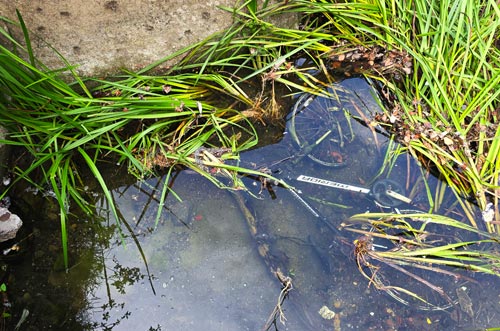
Anyone looking for a ride in Thurles, tonight, then an unwanted, submerged Crossway Merida bicycle could be your best bet.
Local wildlife was left baffled this week after a bicycle was discovered taking an unscheduled bath in the River Suir.
The bike, believed to be a Crossway Merida variety, was found lying beneath the water with all the dignity of a cyclist who had confidently shouted, “Watch this!” moments before disaster. As yet no body has been located.
Competition – Spot the Bike. Pic: G. Willoughby.
Witnesses say the bicycle may have entered the river after misunderstanding Ireland’s new transport policy. “It heard everyone talking about greener travel,” one duck explained, “and apparently decided to join the actual green overgrown rush bed.”
The River Suir is already famous for its salmon and brown trout. Now it can add mountain bikes to the list, although anglers are reminded that bicycles must be returned to the water if they are under eighteen gears. Fishing in Ireland has yet to confirm the correct bait, but experts recommend using a fluorescent jacket and shouting, “Who left this here?” The bicycle itself declined to comment, although one wheel appeared distinctly tired. Its chain is reportedly rusty, its brakes are feeling pressured, and the saddle has requested immediate relocation to somewhere less damp.
Thurles Municipal Council officials and local Councillors are considering several explanations; illegal dumping, a dramatic relationship breakup, or an ambitious attempt to cycle directly to France without paying ferry charges. Environmental campaigners “Refresh Thurles” have stressed that rivers are no place for unwanted bicycles. Anyone wishing to dispose of an old bike should use a proper recycling facility, or give it to someone who promises not to test whether it can swim.
At press time, and for several months previous the bicycle has remained submerged at low tide, awaiting rescue, repair, and a very stern lecture about not wearing its water wings.
Now with public transport prices being increased by 15% from January, an immediate rescue could be advantageous.
The cheerful online mischief-makers (View “Meanwhile in Ireland” Here), Ireland’s digital equivalent of a lad leaning over a pub counter saying, “I’m only telling you what everyone else is thinking”, have declared Thurles “a quiet railway town that feels dead on non-match days.”
This is precisely the sort of reckless investigative journalism we feared. For generations, the people of Thurles have worked tirelessly to create the impression that absolutely nothing happens here. It is one of Ireland’s most successful covert operations, surpassed only by the mystery of where county councils store road signs before deploying eleven thousand of them around a tiny pothole.
Now meanwhile in Ireland, that lovable online hornet with a laptop, has come dangerously close to exposing the entire scheme. Yes, Thurles looks quiet. That is the point. The objective is simple: keep excessive tourism at bay.
We have seen what happens when a perfectly pleasant Irish town is discovered by lifestyle journalists. First come the travel bloggers. Then come the ring lights. Before long, somebody is charging €19 for avocado on a roofing slate and describing Liberty Square as “Thurles’s answer to Montmartre*.” [*Montmartre, for the benefit of “Meanwhile in Ireland” website, is a historic hilltop neighbourhood in northern Paris known for its steep cobblestone streets, artistic heritage, and the iconic Sacré-Cœur Basilica.]
We cannot allow this. Every resident therefore receives extensive anti-tourism training. When an unfamiliar car enters town, locals are instructed to look mildly inconvenienced. Anyone asked, “Is there much to do around here?”, must stare thoughtfully into the middle distance and reply: “Depends what you’d call doing.” This is not rudeness. It is perimeter security.
The Traffic Is a Defensive Installation. “Meanwhile in Ireland” website; our nation’s premier supplier of lists designed to start arguments in family WhatsApp groups, also mentions traffic congestion and poor road surfaces. Again, allow me to inform you this is deliberate. Those cars are not stuck. They have been strategically positioned by the Thurles Tourism Deterrence Unit. The road surfaces, meanwhile, are calibrated to shake loose anyone carrying a selfie stick, a drone or a notebook containing the phrase “ten authentic experiences.” If your suspension survives Liberty Square, you may proceed, but you will be monitored. The cleverest part of the operation is that nobody can prove the congestion was planned, because even the people allegedly planning it, have been trapped in the traffic since 2017.
“Dull and Dated,” Says “Meanwhile in Ireland” Correct. Absolutely. Please tell everyone. Do not notice that Liberty Square has witnessed centuries of Irish life. Ignore Hayes’ Hotel, where the GAA was founded in 1884. Pay no attention to the architecture, history or independent businesses. Most importantly, do not enter the building containing the official Thurles visitor-information point. That would only give you ideas.
The apparently vacant buildings are decoys. Behind one of them are six musicians, a retired county hurler, two women organising a fundraiser, a committee discussing another committee and a man capable of explaining the entire history of Tipperary politics without even drawing breath. We cannot disclose which building. National security.
“Meanwhile in Ireland” website, having peered briefly over the digital hedge with all the forensic rigour of a man reviewing a pub through its letterbox; has declared the place empty. Excellent. The camouflage is working.
“Nothing to Do After Dark” This is our favourite accusation. Yes, there is allegedly nothing to do after dark, apart from theatre, comedy, music, dance, cinema and exhibitions at The Source Arts Centre, which describes itself as Tipperary’s cultural and entertainment venue. But apart from all the entertainment, there is no entertainment.There are also pubs, restaurants, community events, racing and the occasional conversation that begins with the weather and ends four hours later with a frame-by-frame analysis of the 2001 Munster hurling championship. If you hear laughter coming from a crowded pub, it is probably a recording. If you see people leaving a performance, they are actors portraying an audience. If thousands turn up for the Liberty Music Festival, kindly assume they are commuters whose train has been severely delayed. “Meanwhile in Ireland” may be Ireland’s cheekiest electronic parish newsletter, but even it cannot expect us to believe several thousand people accidentally wandered into a music festival.
Cold and Unwelcoming? Naturally, Thurles people are exceptionally friendly, which is precisely why they must sometimes pretend otherwise. A genuinely warm welcome could trigger a catastrophic chain reaction: A visitor enjoys Thurles. The visitor tells friends. The friends arrive. A travel magazine publishes “Ten Secret Irish Towns You Must Visit.” Liberty Square acquires an oat-milk queue visible from space.
Consequently, friendliness must be rationed.
A local may give you directions, recommend somewhere to eat, explain the history of the GAA and ask who your people are, but this should not be mistaken for hospitality. They are gathering intelligence. If somebody buys you a pint, you have penetrated the inner defences. Do not mention it to “Meanwhile in Ireland”. They will turn it into “Ten Irish Towns Where Strangers Recklessly Purchase Beverages.”
Semple Stadium: The Approved Distraction We admit that maintaining the dead-town illusion becomes difficult on match days, when Semple Stadium fills and Thurles temporarily produces enough noise to alter migratory bird patterns. That is why outsiders are encouraged to believe the stadium is our only attraction. While everyone is watching the hurling, residents quietly enjoy everything else: the River Suir, local walks, cafés, shops, arts, history and the reassuring absence of tour guides waving umbrellas. There is even Lár na Páirce, the museum of Gaelic games, in the town where the GAA began. Naturally, we tell tourists it is merely a sophisticated warehouse for elderly sliotars.
The wider tourism authorities describe Thurles as a town blending sporting heritage, culture, scenery and history. But what would they know? They have presumably never assembled a slideshow entitled Ireland’s Most Miserable Places while rubbing their hands together like cartoon landlords.
A Warning About the Surrounding Area. Under no circumstances should visitors use Thurles as a base for exploring Holycross Abbey, Cabragh Wetlands or the wider Tipperary countryside. The scenery is terribly scenic. The history is excessively historic. The wetlands contain birds that refuse to perform on demand and have shown no interest whatsoever in becoming Instagram influencers. You would hate it.
Our Official Response to Meanwhile in Ireland So, to our friends at website “Meanwhile in Ireland” that delightful digital gobshite, forever throwing verbal fireworks into quiet towns and running away giggling we say this:- You are completely correct. Thurles is miserable. There is nothing here. Please encourage your readers to continue directly to somewhere with a souvenir leprechaun every nine metres. Do not stop for coffee. Do not attend a show. Do not explore the town. Do not enter a good pub. Above all, do not ask a local about hurling unless you have cleared the remainder of your afternoon and possibly the following morning. And definitely do not discover that Thurles is a warm, lively, historic and deeply characterful Irish town that simply has no interest in dressing itself up like a theme park for anyone’s approval. Nothing to see here. Move along for God’s sake now; before somebody offers you a pint.
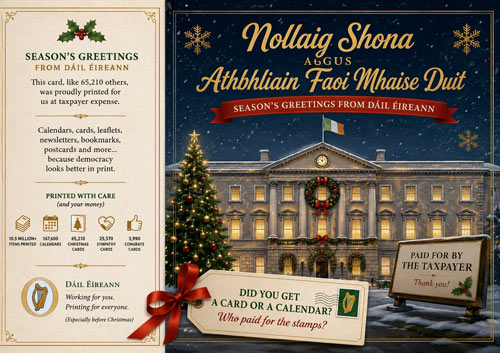
Did you get your taxpayer-funded Christmas card, calendar, sympathy card, congratulations card, bookmark, postcard, or perhaps a handy copy of the 1916 Proclamation?
No? Strange. Because since the start of last year, TDs and Senators managed to produce more than 10.5 million customised print items through the Oireachtas print facility, all in connection, we are told, with “parliamentary duties”.
Deck the Halls with Public Money.
Among the highlights from this festival of ink and entitlement were: – 167,600 calendars, 65,210 Christmas cards, 45,225 greeting cards, 25,570 sympathy cards, 3,990 congratulations cards, customised bookmarks, postcards, and 8,700 copies of the 1916 Proclamation.
Nothing says “Republic” quite like printing the Proclamation at public expense while 85,000 newsletters and leaflets end up being pulped because they were never collected.
One batch of 35,000 newsletters apparently had an error. Another 30,000 booklets were printed in double the required amount. A further 20,000 were not collected after illness and, understandably, “went out of his head”.
Of course, mistakes happen. Usually, when ordinary people make them at work, there is a cost. In Leinster House, the cost appears to be paper, ink, staff time, recycling and the taxpayer’s patience.
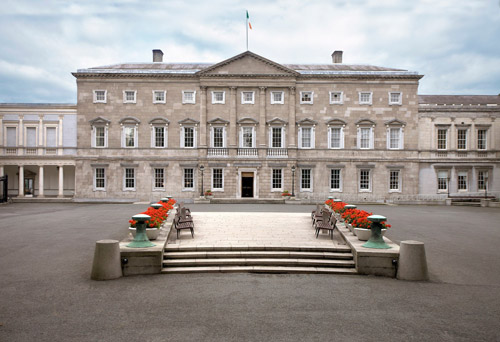
From Leinster House with Love – Postage Included?
And here is the real festive question: if all these cards and calendars are being printed at our expense, who is paying for the stamps? Did TDs and Senators have access to prepaid Oireachtas envelopes?
So, did you get a card? Did you get a calendar? Did you get a bookmark? Did you get a sympathy card before you even knew you needed sympathy?
This website uses cookies to improve your experience. We'll assume you're ok with this, but you can opt-out if you wish.AcceptRead More
Privacy & Cookies Policy
Privacy Overview
This website uses cookies to improve your experience while you navigate through the website. Out of these, the cookies that are categorized as necessary are stored on your browser as they are essential for the working of basic functionalities of the website. We also use third-party cookies that help us analyze and understand how you use this website. These cookies will be stored in your browser only with your consent. You also have the option to opt-out of these cookies. But opting out of some of these cookies may affect your browsing experience.
Necessary cookies are absolutely essential for the website to function properly. This category only includes cookies that ensures basic functionalities and security features of the website. These cookies do not store any personal information.
Any cookies that may not be particularly necessary for the website to function and is used specifically to collect user personal data via analytics, ads, other embedded contents are termed as non-necessary cookies. It is mandatory to procure user consent prior to running these cookies on your website.




Recent Comments