|
|
The Environmental Protection Agency (EPA) has today published its Industrial and Waste Licence Enforcement Report for the year 2017. This report gives details of compliance levels and enforcement activities across the 800 licensed facilities during 2017.
The Food and Drink sector had the poorest compliance, including the most number of non-compliances and the highest number of prosecutions.
 Key findings for 2017 were:- Key findings for 2017 were:-
Over 1500 site inspections were completed.
Unannounced were 91% of inspections.
Six sites were inspected 20 or more times.
In 2017, 22 prosecutions were concluded.
One Director of Public Prosecutions (DPP) case concluded.
Over €374,000 in fines and costs were awarded.
Over 1000 complaints were received about licensed facilities.
Odour complaints decreased by 42% – Noise complaints increased by 68%
Commenting on the report Mr Gerard O’Leary, EPA Director of the Office of Environmental Enforcement stated: “The EPA targets its enforcement efforts at the most non-compliant facilities. The publication of the National Priority Sites system last year has driven environmental compliance and seen much needed investment in environmental infrastructure. Over half of the sites who have appeared on the Priority Sites list have been convicted or are facing prosecution.”
Three Tipperary companies were amongst those prosecuted by the EPA in recent years.
Rosderra Irish Meats of Carrig, Roscrea were fined for failing to ensure emissions to sewer did not exceed permitted limits. (Fines & Charges amounted to €18,500)
Arrabawn Co-Operative Society, Nenagh, September 2017. (Fined €16,000)
Bord na Mona Fuels, Littleton, Thurles, in 2016. (Fines & Charges in 2017 nearly €12,000).
The EPA has also published the latest National Priority Sites List for Enforcement today. Five sites (See below 1) are on the latest list for failing to meet the necessary environmental standards. These companies face further enforcement action.
Four of the five sites are from the agri-food sector; this sector has accounted for almost half of all priority sites since publication last year.
Of the 19 sites published on the list since it commenced, 13 have either been convicted or now face prosecution.
Four sites have come off the previous National Priority Site List following improvements in compliance.
Ms Mary Gurrie, Programme Manager, EPA’s Office of Environmental Enforcement commented:
“The National Priority Sites system has exceeded our expectations as a tool to drive environmental compliance. Companies have come off the list in the past year by improving operational practices or making significant investment in infrastructure. Sites in the agrifood sector have dominated the list (11 of 19 sites) and compliance in this sector needs to improve.”
1 The following are the National Priority Sites for January – June 2018.
[ The EPA will update the National Priority Sites list, on a quarterly basis.]
Reg. No. P0812-01 – Arrow Group – Co. Kildare.
Reg. No. P0815-02 – Lacpatrick Dairies Limited – Co. Monaghan.
Reg. No. P0180-02 – Rosderra Irish Meats Group (Edenderry) – Co. Offaly.
Reg. No. W0136-03 – Starrus Eco Holdings Limited (Munster) – Co. Cork.
Reg. No. P0831-01 – Western Brand Group Limited – Co. Mayo.
Licensed facilities are identified as National Priority Sites for enforcement, using a system developed by the EPA. Points are allocated to each site based on compliance data such as complaints, incidents and non-compliances over the previous six months. Sites which exceed a certain threshold become a National Priority Site and are targeted by the EPA for further enforcement action.
The National Priority Sites for Enforcement system was launched by the EPA in July 2017 to drive further environmental compliance at industrial and waste facilities.
Further details of the National Priority Sites scoring system and the list of sites can be found here National Priority Sites :: Environmental Protection Agency, Ireland.
Enforcement information on all sites can be found under the Licence Search pages at www.epa.ie.
Complaints about licensed sites can be made on-line or by contacting the EPA at Tel: 053-9160600.
It is not by accident that Thurles.Info have been raising environmental issues and concerns regarding important and desirable biodiversity; while highlighting the failure by this present minority Fine Gael government, supported by Fianna Fáil, to protect the quality food producers and the employment they support, here in Co. Tipperary.
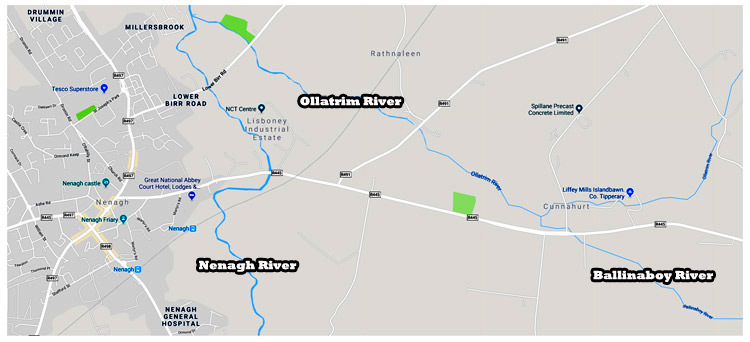
The Ollatrim River rises in North Co. Tipperary and flows through the Townland of Ollatrim, joining the Ballinaboy River and Nenagh River east of the town of Nenagh.
Together all flow into Lough Derg, just north of the picturesque village of Dromineer. Indeed a short section of this river indicates the perimeter between Co. Tipperary and our near neighbours, Co. Offaly.
It took eight days for Officers from Inland Fisheries Ireland to notify the public that an investigation has now begun after some 15,000 fish were killed, over a 5km stretch, in the above named Ollatrim River. Officers had attended the scene at Ballinahemery Bridge, close to Ballymackey, Nenagh on Monday 9th July last, having been alerted to a major fish kill.
Inland Fisheries Officers estimate that some 10,500 Lamprey (Latter a protected species), 1,400 Brown Trout, 805 Stoneloach, 1,820 Minnow, 70 Salmon, 70 Crayfish and 84 Stickleback were numbered in this extermination.
Inland Fisheries confirm that this is the largest kill of Lamprey in recent years and now believe it may take some years for stock numbers to at least partially recover.
Herbicide or pesticide or some other Agricultural chemical is understood to have caused this major fish kill. This latest incident will be investigated but no findings will be made public.
Fourth Major Fish Kill In North Tipperary In Less Than Eight Weeks
Not including the current Crayfish Plague, this latest major fish kill in North Tipperary rivers comes to four since late May last. During that month, over 100 trout and juvenile salmon stocks died, when a greyish coloured foul smelling substance entered the Mill River in Ballina. In early June we learned of yet another fish kill on the Ballintotty River, which left the entire trout and salmon population wiped out along a stretch of the river. Then another incident, which occurred at Ballycrinode, Ballinalough, when supposedly slurry accidentally spilled into the river.
Nothing accidentally spills into our Rivers. Accidents do not happen they are caused and offenders must at least be seen to be prosecuted.
Blue Cap; Blue Bonnet; Nun, and Tree babbler are just some of the names given to our native Irish Blue Tit.
Here in Thurles, Co. Tipperary, this year, two such Blue Tits, whom we affectionately came to know as Thomas Tit and Sharon Tit, moved in quite unexpectedly to a newly installed Tit box.
Blue tits are small, lightweight, short legged, acrobatic and highly intelligent birds, with a somewhat convivial nature, most often found hanging upside down from branches and bird feeders, in their endless search for insects and seeds.
Once the removers of foil milk bottle caps; from once door to door milk bottle deliveries; stealing the energy rich non-lactose cream; the sturdy beaks of these little birds are well suited to their diet of fruit, seeds and berries in the autumn and winter; while changing to mostly larvae, insects and spiders, found in abundance during spring and summer.
Sharon Tit remained in total command with regard to family matters, especially when it came to choosing not just a mate, but also a home/nest site. The breeding season for Tits usually starts in early to mid-April. In the weeks before egg laying, Sharon Tit increased her weight by 50%, aided by food collected and shared with the help of partner Thomas Tit.
Tits will usually build their nests in holes and crevices in trees, walls or in this case a nest box purchased from O’Driscoll’s Garden Centre, here in Thurles. But Tits have been known to nest in such places as rural ‘An Post’ letter boxes.
Sharon Tit formed a deep hollow in her chosen, soft hair nest materials, by simply wriggling and continuously twisting around and around, while continued to erect higher sides. The nest when complete saw Sharon Tit producing nearly her own weight in eggs, laying one egg each day for 12 days.
Her eggs took 14 to 16 days to hatch completely and both Sharon and Thomas, together, made up to 300 daily visits to and from the nursery, during the first few days. Together these visits rose to some 800 or more each day, prior to the youngsters leaving the nest.
As can be seen in the video above, Tits will collect caterpillars, feeding themselves only the smallest; while feeding the larger ones, containing the most energy, to their siblings. No need for pesticides here, as the dietary practises of Sharon and Thomas Tit made them extremely effective pest controllers in the gardens; feeding their babies as many as 15,000 flies, spiders and green caterpillars in the first three week as parents.
Three weeks on, with all children left the nursery, Sharon and Thomas Tit continued to support this family roaming freely for a further two weeks, but at five weeks old they were abandoned to fend for themselves, as is normal Tit family practise.
The ‘Silent Spring’ Heritage Bill
Poem “Death of a Naturalist”.
[Extract courtesy of former Nobel laureate and the late great poet Mr Seamus Heaney]
“Bubbles gargled delicately, bluebottles
Wove a strong gauze of sound around the smell.
There were dragonflies, spotted butterflies,
But best of all was the warm thick slobber
Of frog-spawn that grew like clotted water
In the shade of the banks”.
Definition of a Politician: One who shakes your hand before an election and your confidence afterwards.
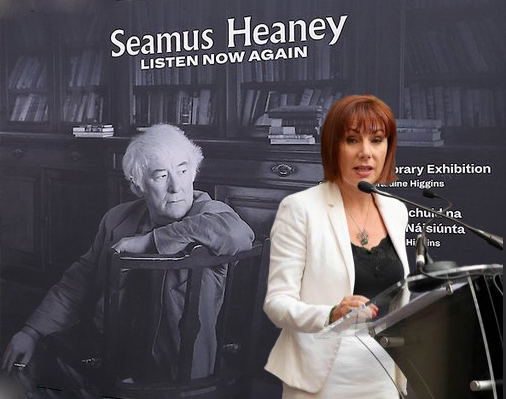 Fine Gael Party Vote Catcher Josepha Madigan, at the opening, this month, of the new Cultural and Heritage Centre at the Bank of Ireland, College Green, Dublin. A dark day for Irish biodiversity
The new ‘Silent Spring’ Heritage Bill; now passed into law and which allows for the burning of vegetation in March and hedge-cutting in August under a pilot project, will now encompass the entire country; with July 5th 2018 surely one of the most despondent of days for Mother Nature.
Sole Fine Gael T.D. and Minister for Culture, Heritage & the Gaeltacht, Josepha Madigan together with her predecessor “Burn the Heather” Humphreys, had cited road safety concerns as the reason behind this Bill. This need to fix the unbroken, however, was more akin to an F.G election gimmick and a hoped-for increased farming vote, rather than the remedying of any slight contradiction existing between the Road Traffic Act and the Wildlife Act.
Name me one road traffic incident, in the last five years, which involved an overgrown hedge and what has the burning of heather (not Humphreys) and gorse to do with health and safety?
Needless to say, Fianna Fáil were not going to lose out on any attempt to sway farming voters either and to their shame, supported this unnecessary Bill.
Sinn Féin opposed the Bill and Co. Kerry party member Martin Ferris associated the declining bird populations to excessive burning. However, local Sinn Féin Templemore/ Thurles Municipal District councillor Mr David Doran has gone against the views of his party, on local TippFM radio, demanding a pro-active approach by Tipperary County Council in the cutting of hedges out of season in Co. Tipperary.
Let’s be honest, what would Josepha and her sweaty constituency of Dublin/Rathdown, actually know or understand, when it comes to the burning of heather and gorse and the cutting back of rural hedge-rows. Some 32,500 Irish people had signed a petition opposing this Bill, while conservationists, environmental groups, wildlife non-governmental organisations, and smart farmers supporting biodiversity, claimed this Bill was not based on any scientific basis whatsoever.
“When gorse is out of blossom, kissing’s out of fashion”.
Rural people should ask the question, “Have I heard the cry of the Curlew in recent years?” “No”, I hear you say! Well currently, there are only some 125 pairs of breeding Curlew’s left in Rural Ireland (None I hasten to add in Dublin / Rathdown) and there is now a real risk that Josepha’s Heritage Bill will sound the death knell for not just Curlews, but for many other species of wildlife, including our already depleted bee population, which hugely depend from February to May on Gorse yellow pea-flowers as their early food source. Currently one third of Ireland’s 98 wild bee species are under threat of extinction.
The Bill will also result in severe consequences for late-nesting birds, such as the endangered Yellowhammer, latter Red-listed (Latter being the world’s most comprehensive inventory of the global conservation status of plant and animal species here in Ireland.), due to a decline in the breeding range and population, (Incidentally have you seen one in Co. Tipperary recently?).
Interesting to note that in England the penalties that can be imposed for criminal offences in respect of a single endangered bird, a nest or an egg, under the Wildlife and Countryside Act 1981, deservedly levies an unlimited fine, or up to six months imprisonment or both.
One wonders if Josepha, while taking on the role of priest and leading the prayers in the Church of St Therese in Mount Merrion, Dublin recently, did she recite the Apostles Creed, you know the line; “Maker of Heaven and Earth,” or perhaps come across the Dublin born Mrs Cecil F. Alexander’s hymn, “All things bright and beautiful”?
All things bright and beautiful, All creatures great and small,
All things wise and wonderful, The Lord God made them all.
Each little flower that opens, Each little bird that sings,
He made their glowing colours, He made their tiny wings.
We agree with you Josepha, No Votes for Fine Gael here.
Just when we are about to acknowledge, both at home and globally, that our natural world is on its bare knees environmentally, this Fine Gael government, (whom thank God, we have successfully rid ourselves totally here in Co. Tipperary), has decided to weaken the very basic of conservation rules; despite the knowledge that we are incapable and incompetent in attempts to enforce current basic environmental laws, already existing.
Josepha’s legal motto, carried on her twitter account page states the Latin phrase; “Per tenebras lucem quaero”. [ Translation, “Through the darkness (or from darkness), I seek the light”]. Perhaps in Josepha’s case the legal phrase; “Qui male agit, odit lucem” might be considered more appropriate. [ Latter translated, “The one who commits evil shuns the light”.]
First Click on Link (A) http://www.thurles.info/2018/07/02/polution-of-river-suir-continues/
Second Click on Link (B) http://www.thurles.info/2018/07/09/st-patricks-cemetery-gates-reflect-an-image-of-thurles/
Third Click on Link (C) http://www.thurles.info/2018/07/10/thurles-administration-their-fitness-to-practise-in-question/
Back on August 27th, 2017, we asked a simple ‘yes’ or ‘no’ question, “Does the Thurles Town closed-circuit television (CCTV) , latter used in public area surveillance, actually work?”
The question was then raised because of malicious damage caused within the Thurles town centre, during that period and prior to that date which had gone undetected.
News of CCTV being introduced into our towns public areas had been initially welcomed back in December 2012. This new public area surveillance system was costed as being in the region of one hundred thousand euro (€100,000), with 70% of the cost to be covered by “Pobal”. (Pobal: a not-for-profit company managing programmes on behalf of the Irish Government and the EU; supporting communities and local agencies in their efforts to achieve social inclusion, reconciliation and equality.) A further 20% of the cost was provided by Thurles Town Council, while the final 10% was aided by local business through Thurles Chamber of Commerce.
Back then we were informed that the entire system would be designed, installed and maintained by three Tipperary companies named as:- Hall Alarms based in Clonmel, Co. Tipperary; Future Security in Nenagh, Co. Tipperary and Amarach Technologies, latter also based in Nenagh, Co. Tipperary.
Hall Alarms was awarded the tender to install the Thurles town centre CCTV system.
Relevant Legislative Pertaining to the Introduction of CCTV.
Section 38 of the Garda Síochána Act, 2005 requires the Garda Commissioner to authorise the installation and operation of CCTV in public places for security and public safety reasons. Section 38(3) describes three categories of persons who may be authorised by the Garda Commissioner to install and operate CCTV systems in public places – (a) members of An Garda Síochána; (b) person s retained under contract by An Garda Síochána; and (c) “persons who meet established criteria and whose application for authorisation in respect of a specified area within the administrative area of a local authority who has been approved by the local authority after consulting with the joint policing committee for that administrative area”.
This is the fundamental legal basis for CCTV in the Thurles community
In November 2015 we were informed that the local authority was required to assume responsibility for the management and operation of the CCTV system in compliance with Data Protection legislation, [See pdf page 3].
Three years on, we now understand that this CCTV system has not properly functioned since early 2017, and while just some of the cameras continue to work today, the actual recording equipment has fully ceased in its capacity to function.
In June 2017 we became aware that the server for this CCTV was not operating and remained at the old Council offices, at Slievenamon Road, following the move by staff and officials to their new offices in Mathew Avenue.
In the words of William Shakespeare, “Ah, there’s the rub!”. Were Gardaí to seek Co. Council management’s permission to view this now presently non-existent recorded footage, we learn that the council’s access operator / administrator, is presently not available due to sick leave issues.
Yet, back in October 2017 we were informed that discussions were ongoing with Gardaí with regard to CCTV in Thurles and that cameras would be installed at Thurles Town Park , which would have covered the Skateboard Park shown in video above, [See pdf page 7 and page 8]. In that same month it was known that the system was not functioning properly.
Today Gardaí would have to be actually sitting in front of a screen watching a crime, in order to make an arrest, however without CCTV recorded footage, the possibility of obtaining a prosecution would be “slim and none.”
Thurles Skateboard Park
From the video above we glean that the two-year-old Skateboard Park is now unsightly, with graffiti everywhere in abundance. In fact, the area rarely sees an actual skateboard. Instead, in the late evenings, youths are using the previous days uncollected supermarket trolleys to create their fun on the skateboard ramps.
‘The Source’ Car Park
Next door in the car park situated under the newly built Source Arts Centre & Library, (Again see Video) youths gather in small groups. This €10 million Thurles Regional Arts Centre; Branch Library; a 250 seat Theatre boasting a large, shared, exhibition space, and Restaurant; situated in Cathedral Street, first opened in the late summer of 2006, (less than 12 years ago), bringing a contemporary urban design to the medieval fabric of our town. This accessible, non-CCTV monitored building with its dirty neglected wooden façade, has become the target of idle hands. Insulation positioned on the low ceilings within this car park area is slowly being ripped apart over the entire vast area, with the bodies of parked and vacant vehicles often used as scaffolding, and for this same reason.
Street Landscapes.
Street furniture and other items existing on our thoroughfares are the constant target of graffiti vandals. One Latvian man currently living in Thurles has been arrested by Gardaí and indeed has pleaded guilty to some 18 charged of criminal damage and having in his possession a number of markers, with intent and without lawful excuse, to further damage property at unknown locations, but this arrested man is not acting alone and without our inactive €100,000 CCTV system’s recordings, well…………
It will be interesting to read the 2018 Tidy Towns Report this year, that is if we have applied to be judged at all. Last year they gave us, most certainly out of an act of kindness, a mark of 293, out of a maximum of 450 marks. You can read their report for 2017, by clicking HERE.
This Thurles community are not blaming Councillors and Municipal District Management for acts of vandalism and criminal damage through graffiti; [We raised the growing matter of graffiti in August 2011, October 2012, September 2017], however, Councillors and Municipal District Management must accept fully, responsibility for their gross failure in delivering and dispensing even the simplest modicum of rudimentary administration.
A voice crying in the wilderness!
Right now the Thurles.Info website remain, to use the words of the prophet Isaiah, “The voice that crieth in the wilderness” with regard to the neglect of Thurles. Surely there must be some other strong voices who are saddened by the fact that the major assets of this once prosperous town are being squandered and wastefully discarded, by those whose wages we pay.
|
Support Us Help keep Thurles.info online by donating below. Thank you.
Total Donated 2026: €300.00
Thank You!
Daily Thurles Mass Livestream
|



Recent Comments