Motorists travelling through Tipperary are being advised to prepare for significant disruption as a five-week resurfacing programme gets underway on the M8 motorway.
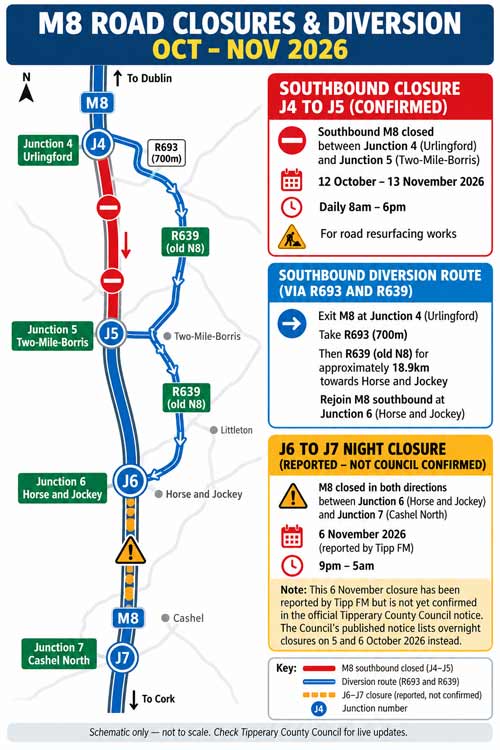
The southbound carriageway between Junction 4 at Urlingford and Junction 5 at Two-Mile-Borris will be closed daily from 8am to 6pm until Friday, November 13th, 2026.
The restrictions, which began on Monday, 12 October, are part of planned road resurfacing works aimed at maintaining and improving the motorway. During the closures, southbound motorists will be diverted off the M8 at Junction 4, travelling via the R693 before joining the R639, formerly the N8.
Drivers will continue along the R639 towards Horse and Jockey, where they can rejoin the M8 southbound at Junction 6. The diversion covers approximately 19 kilometres along the R639 and may result in additional journey times, particularly during busy commuting periods.
Additional closures around Cashel Further traffic disruption has also been reported between Junction 6 at Horse and Jockey and Junction 7 at Cashel North.
As already reported a night-time closure on November 6th, between 9:00pm and 5:00am, will affect both directions. However note, this November closure has not yet been verified against an official council notice. Motorists are therefore encouraged to check the latest official announcements before travelling.
Advice for motorists Drivers using the M8, particularly those heading towards Cashel, Cork and surrounding areas, should allow extra travelling time and follow designated diversion signs. Local traffic on the R639 may also experience increased congestion while motorway resurfacing continues. Road users are advised to remain alert, drive carefully through affected areas and monitor updates from Tipperary County Council.
Please share this information with anyone regularly travelling on the M8.
Thurles Deserves Delivery – Not More Delays, Excuses And Failed Announcements.
The continuing delay recently announced on the redevelopment of Liberty Square, (Part 2) and Slievenamon Road raises a much wider question about infrastructure delivery in Thurles town, and about what our political representatives are actually achieving for the town in Dáil Éireann. How much longer is Thurles expected to wait for basic infrastructure that other major towns would regard as essential?
The first phase of the Liberty Square redevelopment commenced in August 2020 and was officially opened in June 2022. Yet the adjoining N62 Slievenamon Road Phase 2 project; from Liberty Square to the Shopping Centre roundabout, is now not expected to begin until 2027 at least, with completion potentially stretching to the the final weeks of 2028. That is an extraordinary timescale for completing the redevelopment of the centre of one of Tipperary’s largest towns.
Promised completion since 2022 following part one completion in 2022.
Tipperary County Council points to dependencies involving Transport Infrastructure Ireland and Uisce Éireann. But after years of delay, the public is entitled to ask why these issues were not identified, coordinated and resolved far earlier. Even more difficult to understand is the condition of parts of Liberty Square itself. Potholes, eroded road surfaces and deteriorating sections should not have to await another multimillion-euro capital project. Basic maintenance is a separate responsibility. A promise that major works may eventually take place cannot justify leaving existing surfaces in poor condition in the meantime.
There is also another deeply unpleasant issue which deserves a proper public explanation. Sewer pipes were installed during the Liberty Square redevelopment works in 2021. Since then, complaints have been publicly reported about foul odours and what has been described as sewer gas or a sewage-type stench issuing from drains in parts of Liberty Square east. If these odours arose following the drainage works, the obvious questions must be asked; “Were the new drainage and sewer arrangements correctly designed and installed? “Have they been independently inspected and tested?” “What is causing the continuing smell, and why has it not been permanently rectified? Until Tipperary County Council or Uisce Éireann produces the technical evidence, it would be wrong to simply declare defective installation as proven. But equally, persistent reports of sewage-type odours following major drainage works cannot simply be ignored. The people working, shopping and living in the centre of Thurles deserve an explanation and a permanent solution.
Constant traffic congestion caused by failure to provide inner relief road and Thurles bypass.
And Liberty Square is only part of a much bigger infrastructure failure. The Thurles Inner Relief Road has been talked about for years, yet the town is still waiting for the level of funding necessary to turn plans, designs and consultancy work into actual construction. Then there is the Thurles Bypass; another project discussed for decades and repeatedly presented as essential to removing through-traffic and heavy vehicles from the town centre. Announcements, inclusion in plans, feasibility studies and ministerial visits are not roads. Funding, construction contracts, machinery on site and completed infrastructure are what matter.
Which brings us directly to political accountability. Thurles is represented in Dáil Éireann by Mr Michael Lowry TD and Mr Ryan O’Meara TD. Both are entitled to point to representations they have made, meetings attended and projects they have sought to advance.
But voters are equally entitled to ask a much tougher question: What are Mr Michael Lowry and Mr Ryan O’Meara actually achieving in Dáil Éireann for Thurles? Where is the construction funding for the Inner Relief Road? When will there be a fully funded programme and credible construction timetable for the Thurles Bypass? Why has completion of Liberty Square and Slievenamon Road been allowed to stretch towards 2028? And why, after millions of euro have already been spent on Liberty Square, are residents and businesses still having to complain about potholes, eroded surfaces and foul smells apparently emanating from the drainage system?
Political effectiveness should ultimately be measured by results. Not another series of video’s and press releases. Not another photograph taken standing beside a Minister or a wealthy business man. Not another announcement that a project is being “progressed”. Not another promise that funding will be sought.
Thurles needs funding secured, contracts signed, problems fixed and projects delivered. After years of waiting, that is hardly too much to ask.
That is also the test for Tipperary County Council, Mr Michael Lowry TD and Mr Ryan O’Meara TD. Thurles does not need another announcement. It needs delivery.
M7 night closures proposed between Borris-in-Ossory and Moneygall, for resurfacing works.
Motorists are being advised of proposed overnight closures on sections of the M7 between Junction 21 at Borris-in-Ossory(Co. Laois) and Junction 23 at Moneygall, (Co. Offaly), both junctions located in Co. Tipperary.
Tipperary County Council has published a notice of its intention to temporarily close sections of the motorway in both directions to facilitate surfacing works.
The proposed closures are:
M7 westbound from Junction 21 to Junction 22.
M7 westbound from Junction 22 to Junction 23.
M7 eastbound from Junction 23 to Junction 22.
M7 eastbound from Junction 22 to Junction 21.
The closures are proposed to operate nightly from 7:00pm on Thursday, October 22, 2026, until 6:00am on Saturday, December 19th, 2026.
Diversion routes will use sections of the R435, R445 and N62, depending on which section of the motorway is closed.
The works are being planned to allow resurfacing of the M7 in both the eastbound and westbound directions.
Importantly, the council notice is currently an intention to close the road, meaning the temporary closure order has not yet been finalised.
Objections to the proposed closure can be submitted to Tipperary County Council up to 12 noon on Thursday, October 8, 2026.
A new law raising the minimum age for e-scooter users in Ireland has officially come into effect.
From today 2nd October 2026, anyone under the age of 18 is no longer permitted to use an e-scooter in a public place. The minimum age had previously been 16.
The change was introduced by Minister for Transport Mr Darragh O’Brien and Minister of State with responsibility for Road Safety Mr Seán Canney as part of a series of measures aimed at improving safety for e-scooter users and other road users.
According to the Road Safety Authority, e-scooters became legal on Irish public roads in May 2024, subject to a range of conditions. The latest age restriction means 16 and 17 year-olds who were previously allowed to ride compliant e-scooters can no longer do so on public roads or in other public places.
The age change follows new safety requirements introduced on September 4th 2026. E-scooter riders must now wear a securely fastened helmet as well as high- visibility clothing covering at least the front and back of the torso.
Other rules remain in place. E-scooters are limited to a maximum speed of 20km/h, and riders must follow the rules of the road applying to cyclists. They may use cycle lanes, bus lanes and local, regional and national roads, but they are prohibited from footpaths, pedestrianised areas and motorways. Riders are also prohibited from carrying passengers or goods and from holding or using a mobile phone while travelling. E-scooters must have working brakes, lights, reflectors and a bell or other audible warning device.
The new minimum-age requirement represents another significant tightening of Ireland’s rules governing the use of e-scooters.
At what point do individual controversies over public spending stop looking like isolated incidents and start raising a much bigger question about governance, oversight, accountability and value for taxpayers’ money?
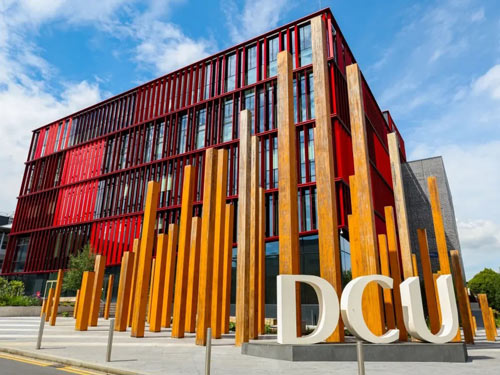
Consider what we now know. €4.38 Million – And Not A Single Student Bed Delivered Dublin City University has written off €4.38 million in professional fees connected with a proposed student accommodation development. Planning permission had originally been secured for 1,235 student beds at DCU. A first phase involving 405 beds received approval in principle for Government support, but following tendering, escalating construction costs raised value-for-money concerns and the development did not proceed. DCU says the €4.38 million included architectural and planning fees, two tender processes and redesign work required to comply with updated building regulations. Planning permission remains valid until 2029 and DCU is continuing to seek a viable funding solution, meaning the provision could potentially be reversed if the project ultimately proceeds. But the position today remains stark; €4.38 million spent – and no additional student accommodation delivered. At a time when students are struggling to find somewhere affordable to live, that deserves serious scrutiny.
Dublin City University.
The National Children’s Hospital — From €987 Million To About €2.24 Billion
Then there is the National Children’s Hospital. Construction began in 2016 and the project has experienced repeated delays and escalating costs. The estimated project cost has risen from approximately €987 million to €2.24 billion. As recently as September 2026, contractor BAM had submitted claims amounting to €983 million in disputed additional costs. These are claims, not established additional liabilities, and there remain substantial contractual disagreements between BAM and the National Paediatric Hospital Development Board. Whatever the eventual outcome of those disputes, the public is entitled to ask how one of the most important infrastructure projects in the history of the Irish State became so expensive and so delayed.
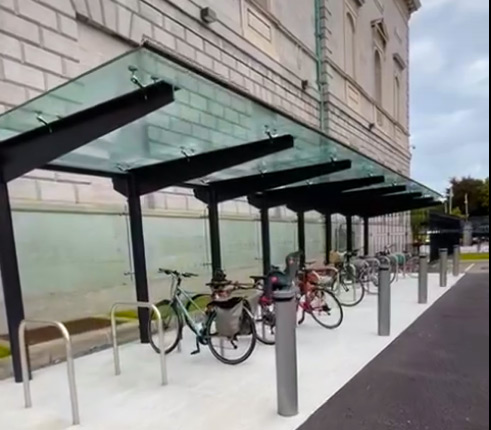
A Bicycle Shelter At Leinster House, €336,000. Then came the €336,000 bicycle shelter at Leinster House. This was not simply a case of members of the public deciding that something looked expensive. A subsequent Deloitte audit found an “absence of some fundamental good practices”, including the absence of a value-for-money assessment before the project proceeded. The audit found that when the decision was taken to proceed in 2021, project costs were neither presented nor discussed. That is precisely the type of governance issue taxpayers should be concerned about. If nobody properly establishes whether a project represents value for money before approving it, how can taxpayers have confidence that their money is being protected?
€336,000 Bicycle Shed
A Security Pavilion, €1.429 Million A separate security pavilion at the Leinster House/Government Buildings complex cost €1.429 million. It is important to acknowledge that this was considerably more than a simple “security hut”. The OPW said the development followed a Garda security review and incorporated extensive security, communications, CCTV, anti-ram protection, mechanical and electrical systems, underground works and the re-routing of existing services. The OPW also stated that the work went through an open competitive tender process. Nevertheless, €1.429 million remains an extraordinary amount of public money for a relatively small structure, and its cost understandably became another focus of questions over value for money in public construction.
Up To €3.9 Million In EV Grant Overpayments – Only About €109,000 Recovered Now here we have another troubling example. The Comptroller and Auditor General has examined overpayments under the State scheme supporting electric vehicle purchases. When the scheme was extended to demonstration vehicles purchased by dealerships, EU State-aid limits applied. But the administration of the scheme relied heavily on self-declaration to establish whether individual dealerships were connected to larger dealership groups for the purposes of those limits.
That system failed to identify all of the relevant linked businesses.
The potential overpayments were subsequently estimated at up to €3.9 million.
As of September 2026, only approximately €109,000 had been recovered.
Some dealerships are contesting SEAI’s assessment, so it would be wrong to imply that every disputed euro has definitively been improperly retained.
But the Comptroller and Auditor General’s findings raise a fundamental governance question:- Why were sufficiently robust verification controls not in place before millions of euro in public money were paid out?
See also previous post:-“€20m Armoured Vehicle Fleet Raises Serious Questions Over Value For Money”. View HERE.
The Common Thread: Governance Before Spending These projects and schemes are very different. They involve different organisations, different circumstances and different explanations. It would therefore be unfair to suggest that every euro involved represents “waste”. But taken together, they raise legitimate and serious questions about how the Irish State protects taxpayers’ money:-
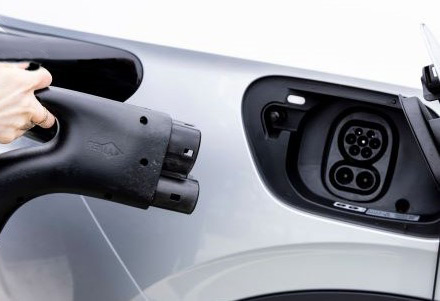
Electric Charging Station.
€4.38 million in professional fees on student accommodation that has yet to produce a bed.
€336,000 for the Leinster House bicycle shelter, followed by an audit identifying shortcomings in fundamental project practices.
€1.429 million for a security pavilion.
Up to €3.9 million in disputed EV grant overpayments, with only about €109,000 recovered so far.
A National Children’s Hospital now estimated at about €2.24 billion, following years of delays and substantial contractual disputes.
The common issue is not whether Ireland should build hospitals, provide student accommodation, improve security, install bicycle facilities or encourage electric vehicles. Of course we should invest in public services and infrastructure. The question is whether we consistently demand the same discipline when spending taxpayers’ money that families and businesses are expected to exercise with their own.
Governance should mean proper business cases before projects begin:-
Independent challenge of costs; Meaningful value-for-money assessments; Strong verification before grants are paid; Clear responsibility for decisions; Continuous monitoring as costs change; Swift action when something goes wrong.
Accountability after money has been spent is important, but prevention is far better. Every million unnecessarily lost to poor planning, inadequate controls, excessive costs or avoidable delays is a million that cannot be spent on housing, healthcare, disability services, education, policing or other essential public services and ultimately there is no mysterious pot of “Government money”. It is “taxpayers’ money”. The public has every right to expect that those entrusted with spending it can demonstrate not merely that procedures were followed, but that value was obtained. Because repeatedly discovering problems after millions, or billions, have already been committed is not enough.
Public money should be protected before it is spent, not simply explained after it is gone.
This website uses cookies to improve your experience. We'll assume you're ok with this, but you can opt-out if you wish.AcceptRead More
Privacy & Cookies Policy
Privacy Overview
This website uses cookies to improve your experience while you navigate through the website. Out of these, the cookies that are categorized as necessary are stored on your browser as they are essential for the working of basic functionalities of the website. We also use third-party cookies that help us analyze and understand how you use this website. These cookies will be stored in your browser only with your consent. You also have the option to opt-out of these cookies. But opting out of some of these cookies may affect your browsing experience.
Necessary cookies are absolutely essential for the website to function properly. This category only includes cookies that ensures basic functionalities and security features of the website. These cookies do not store any personal information.
Any cookies that may not be particularly necessary for the website to function and is used specifically to collect user personal data via analytics, ads, other embedded contents are termed as non-necessary cookies. It is mandatory to procure user consent prior to running these cookies on your website.







Recent Comments