The EPA has published new radon maps for Ireland that update the radon risk assessment for the country.
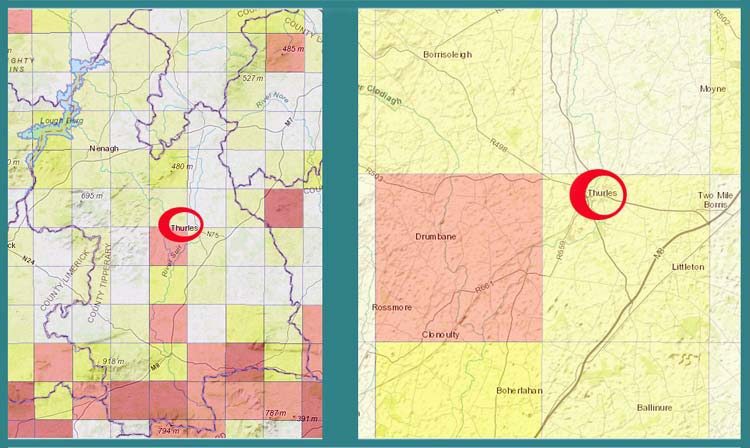
170,000 homes in the country are now predicted to be at risk from radon. This is an increase of 45,000 homes from the previous estimate in 2002.
Radon is a cancer-causing radioactive gas, and every year in Ireland 350 new lung cancer cases are linked to exposure to radon.
You can check if your home is at risk/the level of risk of your home through the new Eircode map search on the EPA website.
The EPA urges all householders and businesses, especially those in high radon areas, to test for radon.
Testing for radon is simple and fixing a radon problem will reduce the risk to your health from this radioactive gas.
New radon maps, launched by the Environmental Protection Agency today, at the National Radon Forum, show an increased risk from radon in Ireland, with 170,000 homes now predicted to be at risk of radon exposure above the national reference level. This is an increase of 45,000 homes, from the previous estimate in 2002. The new maps update the radon risk assessment for the country and show that large parts of the country – particularly in Munster and Connaught – have been found to be at increased risk from radon. The map is based on work completed by Trinity College Dublin, Geological Survey of Ireland and the Economic and Social Research Institute alongside the EPA.
Mr Michéal Lehane, (EPA Director), speaking at today’s National Radon Forum said: “Radon is a serious public health hazard. The new maps combine thousands of radon measurements, with detailed geological information, and are a significant revision of the previous map from 2002. More importantly, the new maps make it easy for everyone to find out the radon risk in their local area using the eircode search on the EPA website. We urge people to test for radon as this is the only way of protecting you and your family from this cancer-causing gas”.
Employers too have a responsibility to ensure that their employees are protected from exposure to this radioactive gas. Ms Yvonne Mullooly, Assistant Chief Executive of the Health and Safety Authority (HSA), welcomed publication of the new radon maps saying: “Employers in high radon areas are obliged to test their workplaces for radon. The new maps enable them to clearly identify where they are legally obliged to test, so allows for targeting of resources in the areas where the risk from radon is highest. The HSA will continue to support employers by providing information, and through our on-line risk assessment BeSMART tool www.BeSMART.ie.” Radon testing is simple and inexpensive and, where necessary, reducing high radon levels in a building is also straightforward. The EPA provides a list of registered radon measurement services and publishes a list of registered contractors who offer a radon remediation service if high levels are found. The maps are now available on the EPA’s website HERE and are searchable by Eircode and by address.
Thurles.Info would like to correct statements made today, by Municipal District Councillors Mr Seamus Hanafin and Mr Jim Ryan, latter who falsely accused the public of littering Liberty Square in Thurles, over last weekend.
The images taken on the above video were photographed on Sunday morning, May 15th, at between 8:00am and 9.30am, before being uploaded around mid-day. View the attempt to cover-upHERE.
Mr Hanafin, the truth is that this administrator observed that all bins within Liberty Square were overflowing on Saturday night, May 14th, last. Early on Sunday morning I checked again, in the vain hope that those we elected at local election time, would arrange to undertake proper administration on our behalf, as indeed you as highly paid councillors are wont to undertake on behalf of the Thurles community, who elected you.
Alas, with no correct action taken by either you or Cllr. Ryan on Saturday evening, people acting totally responsibly, attempted to compact the contents of each bin, with little success. [Cllrs. Pizza Boxes are oversized]. Recyclable items therefore became dislodged, first by a south-westerly breeze and again at first light by crows, latter anxious to glean from the remains of take-away bags and pizza boxes. Councillor Mr Hanafin you owe TippFM Radio an apology and also an apology to your electorate, for attempting to mislead them.
Mr Jim Ryan, you owe the publicans of this town an apology. I covered every inch of Liberty Square on Sunday morning as the video, herewith, shows. Not one piece of broken glass was to be seen on Liberty Square and only three disposable plastic glasses were located. You, sir, should also apologise to TippFM Radio; together with the publicans in Thurles, and your own electorate which each year appear to get less.
The video above shows quite clearly the truth of the matter and confirms that these inferior bins are not fit for purpose in any public setting.
Oh, and bye the way; both of you councillors should stay off TippFM, until you can learn to speak the truth. We now reside; directly because of your failures, in a town long forgotten.
In the meantime these bins need to be emptied last thing on Saturday evening, at least during the Summer months. May I suggest double time off, in lieu, during the week for those who undertake this work. After all, what are we paying Property Tax for or is it just to pay for your inflated salaries, while your tiny workforce work for a pittance.
In the meanwhile, tomorrow would be a good time for you gentlemen to publicaly apologise, before taking back control from your municipal district officials.
Minister Mrs Helen McEntee to further extend legislation for pub and restaurant outdoor seating areas.
Proposed to extend Civil Law (Miscellaneous Provisions) Act 2021 until 30th November 2022.
Provides certainty for licenced premises serving alcohol in outdoor seating areas as summer season approaches.
Minister for Justice Mrs Helen McEntee has moved to further extend the operation of outdoor seating areas, as licensed premises look ahead, to the busy summer months.
The Civil Law (Miscellaneous Provisions) Act 2021 was first introduced in July 2021, bringing about changes to allow for the sale and consumption of alcohol in relevant outdoor seating areas.
Minister McEntee stated: “Government has today approved my proposal to seek an extension to this legislation for a further six months until 30th November 2022. I will bring the necessary Motions before the Houses of the Oireachtas at the earliest opportunity in advance of 31st May.
The Civil Law (Miscellaneous Provisions) Act 2021 gave much needed certainty to licenced premises during the pandemic, allowing publicans and restaurant owners across the country serving alcohol in relevant outdoor seating areas to operate lawfully.
Alcohol may be sold in the applicable areas until 11pm, which is considered reasonable and proportionate as a nationwide approach for private land outdoor seating areas.
While most of the Covid-19 restrictions have now lifted, I am very aware of how hard our pubs, restaurants and nightclubs have been hit by the restrictions of the past two years.
Many of these businesses are still struggling and it’s important that we give them the assistance they need to thrive as the busy summer season approaches. The extension of this legislation is a key support in that regard.”
The legislation applies where those outdoor seating areas have been permitted by the relevant local authority on public land, such as a path, or where they are on private land abutting the licensed premises, such as an abutting yard, as provided for in the Act.
Minister McEntee added that the forthcoming legislation on licensing laws – the Sale of Alcohol Bill – will help to further support and revitalise the hospitality industry and Night-Time Economy.
The Minister said: “I am committed to enacting alcohol licensing laws that reflect the changing expectations and lifestyles of 21st century Ireland. A modernised licensing system will play an important role in revitalising existing Night-Time Economy businesses.
To this end, my Department is currently working on the drafting of the General Scheme of the Sale of Alcohol Bill. This is advancing well, and it is my intention to progress this legislation in the months ahead with a view to enacting it this year”.
The EPA has today published updated Guidelines for preparing Environmental Impact Assessment Reports (EIARs) for projects covered by the EIA Directive.
The Guidelines are a statutory document that should be regarded by those preparing EIARs and the decision makers considering the EIARs.
These guidelines should improve the quality of EIARs, making the overall process clearer and easier to understand and easier for the public to participate.
The Environmental Protection Agency (EPA) today published ‘Guidelines on the information to be contained in Environmental Impact Assessment Reports’. The Guidelines are primarily intended to be an authoritative reference to those preparing Environmental Impact Assessment Reports (EIARs) for projects covered by the EIA Directive.
Clear, concise, unambiguous information is essential throughout these reports. The Guidelines contain the systematic approach, standard descriptive methods and effect descriptions that can be used by developers. This ensures that all the likely significant effects are adequately considered and clearly communicated.
Commenting on the publication of the Guidelines, Ms. Sharon Finegan, (Director, EPA’s Office of Environmental Sustainability) said: “With increased emphasis on the need for meaningful public participation in decisions relating to environmental issues, it is more important than ever to ensure that information is available to the public in a format that is clear, concise and accessible. The Guidelines should improve the quality of EIARs, make the overall process clearer and easier to understand and should make it easier for the public to participate”.
The Guidelines are a statutory document that should be regarded by those preparing EIARs and the decision makers considering the EIARs. The Guidelines will assist competent authorities when considering EIARs during the decision-making processes prior to granting/refusing consent. The EPA’s updated Guidelines will result in better environmental protection by ensuring that the EIA process is more clear, accessible, and identifies effects early and accurately. The Guidelines are available on the EPA’s websiteHERE. Contact: Ms Emily Williamson, (EPA Media Relations Office), Tel: 053 9170770, Email: media@epa.ie
Early this bright, sunny, Sunday morning [as I “watched a small kid cussin’ at a can that he was kicking”.], Liberty Square and along the River Side Walk in Thurles looked like a promotion for the Song “Sunday Morning Coming Down” written by Kris Kristofferson.
The litter was everywhere, 90% caused, once again, more by the type of meaningless litter bins currently provided by our engineers on this €9m to €12m street fiasco, rather than the more irresponsible, prideless individuals we more often are wont to encounter.
Congratulations to the two ladies(representing No. 61Scanlons News Agency(Nuachtanai) and Sos Beag – Coffee Shop), latter who both ventured out early, to clean the litter widely scattered in front of their respective shop fronts.
Here we have a new, admittedly only half updated town centre, now looking filthier than what it had previously replaced. We had previously warned about these tiny litter bins. We and others within our community, had also warned against the use of light grey Chinese granite on a surface accommodating motor vehicles, but council officials and their inexperienced and expensive town planners felt they knew better. Result on Liberty Square today, oil stains, rubber tyre stains and other liquid stain, all beginning to rear their ugly heads.
(Ask yourself; what idiot buys white carpet flooring for the shed?)
Meanwhile, local residents continue to leave bags of household waste beside litter bins on the River Side Walk and Thurles Park areas, south of the town, which would appear to be acceptable to our Municipal District Council officials.
(Where is the Thurles CCTV systemtaxpayers paid €100,000 to install?)
But today, Sunday, May 15th, 2022; it’s all about the Litter Bins and the failure and consistent waste of taxpayer’s money, by our Thurles Municipal District Council.
This website uses cookies to improve your experience. We'll assume you're ok with this, but you can opt-out if you wish.AcceptRead More
Privacy & Cookies Policy
Privacy Overview
This website uses cookies to improve your experience while you navigate through the website. Out of these, the cookies that are categorized as necessary are stored on your browser as they are essential for the working of basic functionalities of the website. We also use third-party cookies that help us analyze and understand how you use this website. These cookies will be stored in your browser only with your consent. You also have the option to opt-out of these cookies. But opting out of some of these cookies may affect your browsing experience.
Necessary cookies are absolutely essential for the website to function properly. This category only includes cookies that ensures basic functionalities and security features of the website. These cookies do not store any personal information.
Any cookies that may not be particularly necessary for the website to function and is used specifically to collect user personal data via analytics, ads, other embedded contents are termed as non-necessary cookies. It is mandatory to procure user consent prior to running these cookies on your website.




Recent Comments