|
|
Relentless implementation of policy needed to combat effects of climate extremes.
“We have, by any measure, experienced an extraordinary year where nature reminded us who is in charge. With our changing climate, the confident predictions are that we can expect extreme events at greater frequency into the future”, said Laura Burke, Director General of the Environmental Protection Agency (EPA), speaking at the annual ‘Environment Ireland’ conference.
 Ms Laura Burke was reflecting on how weather events in the last twelve months – from storms and an ex-hurricane to a prolonged drought and heat wave – severely tested the resilience of Ireland’s infrastructure, economy, health-care services as well as people’s well-being. Ms Laura Burke was reflecting on how weather events in the last twelve months – from storms and an ex-hurricane to a prolonged drought and heat wave – severely tested the resilience of Ireland’s infrastructure, economy, health-care services as well as people’s well-being.
“This last year has been a turning point in the minds of the public and sectors about what we need to do to build and assure resilience. Mitigation is essential, adaptation is necessary, anything less is unsustainable, indeed, irresponsible.”
Ms Burke welcomed the advancement of the National Mitigation Plan and National Adaptation Framework while highlighted that it is now a priority to ensure committed, coherent and relentless implementation of plans and policy measures to meet national and international commitments, thus ensuring the well-being of society; the stability of the economy, and the safeguarding of the environment.
“The systemic nature of the climate challenge emphasises the need to deliver enduring, integrated, all-of-government structures with clear responsibility and accountability. We need to move from a focus on achieving compliance with international commitments to driving the transformational change that is urgently needed across our entire economy and society; so as to deliver on Ireland’s ambition to be a leader in tackling climate change and in doing so protect our health and well being”, stated Ms Burke.
Laura Burke reminded delegates that, for Ireland to grow sustainably, it is essential to safeguard and rigorously implement all areas of environmental policy and to remind every individual of the role they play.
She continued; “The strong growth in our economy and in our population brings with it pressures on how we deal with land, water supply, sewage treatment, raw materials supply and waste management. We must not repeat the mistakes of our past. Implementation challenges remain at national, regional and at societal level,however people can make changes by adhering to regulations and dealing with matters such as litter, waste prevention, water use, use of smoky coal, septic tank management and conspicuous consumerism, all of which impact on our health, the quality of our environment and sustainability of resources use.”
“Our environment, quite literally, sustains us and we all have a role to play in its protection”, Ms Burke concluded.
The Michaelmas Daisy Fairy Song.
By Cicely Mary Barker
“Red Admiral, Red Admiral,
Alighting on my daisies one by one!
I hope you like their flavour and although the Autumn’s near,
Are happy as you sit there in the sun?”
“I thank you very kindly, sir!
Your daisies are so nice,
So pretty and so plentiful are they;
The flavour of their honey, sir, it really does entice;
I’d like to bring my brothers, if I may!”
“Friend butterfly, friend butterfly, go fetch them one and all!
I’m waiting here to welcome every guest;
And tell them it is Michaelmas, and soon the leaves will fall,
But I think Autumn sunshine is the best!”
End
 Michaelmas daisies (Variety Aster macrophyllus ‘Twilight’) together with the bright yellow daisy-like flowers of Rudbeckia (Variety “Goldstrum”); a must for any garden especially those seeking long lasting colour; as our warm Summer slowly now reverts to Autumn. Michaelmas Daisies (Aster macrophyllus ‘Twilight’), together with the bright yellow daisy-like flowers of Rudbeckia (“Goldstrum”) are both hardy perennial garden flowers, (Available at O’Driscoll Garden Centre, Mill Road, Thurles), which emerge from small ever enlarging colonies of underground rhizomes to form clumps some 60cm (around 2ft), in height each Spring, later displaying glorious rich colour, from mid to late Summer right through to the end of Autumn.
While the yellow daisy-like flowers of Rudbeckia are said to symbolizes a farewell or a departure; it is the name associated with the blueish grey daisy that we feature in this article.
Michaelmas is the name of the first term of the academic year. It is also a term name used by the Honorable Society of King’s Inns in Ireland. The Michaelmas term begins in September and ends towards the end of December. The name Michaelmas comes from a shortening of “Michael’s Mass,”, similar to and in the same style as Christmas, “Christ’s Mass” and Candlemas, “Candle Mass”, latter the Mass where traditionally all candles used throughout the year would be blessed.
In the fifth century a basilica near Rome was dedicated in honour of Michael on the 30th September, beginning with celebrations on the eve of that day, and 29th September is now kept in honour of St. Michael and all Angels, throughout some western churches.
Associated in the northern hemisphere with the beginning of Autumn and the shortening of days; during the Middle Ages, Michaelmas was celebrated as a Holy Day of Obligation, but this tradition was abolished in the 18th century. It was also one of the Irish quarter days, when outstanding accounts had to be settled.
Folklore suggests that Michaelmas day is the last day that blackberries can be picked. It is said that when St Michael expelled Lucifer (the devil), from heaven, the latter fell from the sky, landing in prickly blackberry bushes. Satan is said to have cursed the fruit, before scorching them with his fiery breath, then stamping, spitting and urinating on them, so that they would become unfit for human consumption. It was therefore considered ill-advised to pick blackberries after the 29th of September, with a Michaelmas pie being made from the last blackberry fruit of the season.
First observed as a healing angel, and then over time as a protector and the leader of the army of God against the forces of evil; from 1961 to 1965, four young schoolgirls reported several apparitions of the Archangel Michael in their small village of Garabandal, in Spain. The apparitions of the Archangel Michael were mainly reported as announcing the expected arrival of the Blessed Virgin Mary, the mother of Jesus Christ.
These events at Garabandal began on June 18th, 1961, when the four girls aged eleven and twelve years old, [Mari Loli Mazón, Jacinta González, Mari Cruz González and Maria “Conchita” Concepción González], said that they saw an angel. This angel made another appearance on June 25th. Their story quickly spread throughout the village and they subsequently reported seeing the Blessed Virgin Mary. These claims continued for a number of years.
According to the visionaries, the purpose of these visitations was to call for a “conversion of heart”, with these visionaries reporting that they received two ‘messages’; one directly from the Blessed Virgin Mary and the other from the Virgin Mary, by way of St. Michael the Archangel. The first message was revealed on October 18th, 1961, which stated:- “We must make many sacrifices, perform much penance, and visit the Blessed Sacrament frequently. But first, we must lead good lives. If we do not, a chastisement will befall us. The cup is already filling up, and if we do not change, a very great chastisement will come upon us.”
It was on June 18th, 1965, when Conchita, the principal visionary heard the second message, which was televised live by Spanish television. It stated:- “As my Message of the 18th of October has not been complied with, and as it has not been made known to the world, I am telling you that this is the last one. Previously, the Cup was filling; now, it is brimming over. Many priests are following the road to perdition, (latter a state of eternal punishment and damnation into which a sinful and unrepentant person passes after death), and with them they are taking many more souls. Ever less importance is being given to the Holy Eucharist. We should turn the wrath of God away from us by our own efforts. If you ask His forgiveness with a sincere heart. He will pardon you. I, your Mother, through the intercession of St. Michael the Archangel, wish to tell you that you should make amends. You are now being given the last warnings. I love you very much, and I do not want your condemnation. Ask Us sincerely and We shall grant your plea. You must make more sacrifices. Reflect on the Passion of Jesus.
The second message caused particular controversy when it was revealed that Conchita had actually written “many cardinals, many bishops and many priests are following the road to perdition.” She was asked many times to verify this information. The young woman stated many times that Mary stressed the importance of the priesthood, and focused attention on priests above others.
An Status Yellow wind warning will remain in place, here in Co. Tipperary, until at least 5.00pm this evening at the earliest, as strong winds from Storm Ali, leave more than 20,000 homes and businesses without power nationwide. A Status Orange wind warning also remains in effect until 1.00pm for more than half the country due to this storm.

The Electricity Supply Board (ESB) claim that over 20,000 customers currently remain without power, with the areas worst affected being Thurles, Tralee, Killarney, Galway, Sligo and Cork.
Nationally airline passengers are being advised to check with their particular operator, before travelling to their place of departure.
Weather experts warn of further heavy rain, flying debris, fallen trees, power cuts, flooding and travel disruption which continues to remain a danger in the worst-hit areas of the north west of the country.
The opening of the second day of the 87th annual National Ploughing Championships, at Screggan, Co. Offaly, Europe’s biggest outdoor event and the highlight of the Irish agricultural calendar, has been put back by two hours today, as a safety precaution. ‘Wellies’ are expected to be a necessity for visitors, with over 8mm of rain recorded as having fallen in the bordering host county of Offaly, overnight.
O’Dwyer Transport, Littleton, Thurles, Co. Tipperary Make History.
Situated in the picturesque village of Littleton near Thurles, in Co. Tipperary; the family run firm of O’Dwyer Transport & Warehousing Ltd, in the past week has made history, when it facilitated and accommodated the use (for the first time in either the United Kingdom or Ireland) of a towed Voser Wind Turbine Blade-lifting machine.
The Voser Wind Turbine Blade-lifting machine is presently being used to transport massive 45-meter-long Turbine Blades (the longer the blades is, the more the energy that can be generated by the turbine) from Littleton village to the Ballincurry Wind Farm near Killenaule, in Co. Tipperary. This trailer-towed lifting machine is the first of its kind ever to be used here in Ireland and is completely remote controlled, allowing the blade on the trailer to be lifted over trees; hedges; houses and lowered to get under low hanging telephone and electric cables.
Six Gardaí, two in squad cars and four on motorcycles, accompany each load thus guaranteeing complete safety to all road users, while also, for the most part, reducing unnecessary inconvenience to other road users during the 2.5hour period of transportation.
O’Dwyer Transport, who boast a work force of some forty personnel, operating a modern fleet of some 28 DAF Trucks, latter fitted with Moffett mounted forklifts and who are presently storing the German manufactured Wind Turbine Blades; include amongst their valued regular customers Bord Na Mona; Coca-Cola; Hauser etc. and were also actively involved with Electric Picnic and the recent papal visit by Pope Francis.
O’Dwyer Transport & Warehousing Ltd are also short listed (down to the last 5) for the coveted award of “National Haulier of the Year”.
We learned a few lesser known facts about Wind Turbines from Mr Thomas Cooke, (Managing Director) Ballincurry Wind Farm Ltd.
Example: (A) These Wind Turbine blades are not made of metal as they would appear, but are made of fibre-reinforced epoxy or unsaturated polyester.
(B) The blades cannot be carried easily by helicopter, although such rotorcraft are readily available to lift same. The downdraught from the helicopter blades unto the wind turbine blade could cause aerodynamic issues, which in turn could prove to be a danger to both the rotorcraft itself and / or cause serious damage to the actual costly turbine blade.
(C) Wind turbines never have more than 3 blades, since when one blade is in the horizontal position, its resistance to the yaw force is counter-balanced by the two other blades. So, a three-bladed turbine represents the best combination of high rotational speed and minimum stress.
Tipperary County Council proposes to construct a new social housing development on a 0.43 hectare (1.062553 Acre) site at Pound Street, Templetouhy, Thurles, Co. Tipperary.
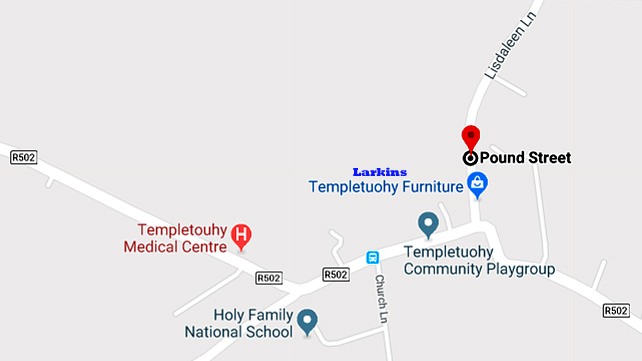
The development will include the demolition of an existing dilapidated single storey dwelling, together with existing sheds, and to construct ten new dwelling houses. Same will comprise of four x 2-bedroomed x two storey dwellings and six x 3-bedroom x two storey dwellings, together with all associated site works including roads, footpaths, underground services, drainage systems, car parking, boundary treatments, landscaping and open spaces, connection to existing sewers and water-mains.
The development has been the subject of an Appropriate Assessment screening in accordance with Article 6(3) of the EU Habitats Directive (Directive 92/43/EEC) and the Planning and Development Act 2000, as amended and which concluded that this proposed development would not be likely to give rise to any significant or indeterminate impact.
The full particulars of this proposed developments, together with the Appropriate Assessment Screening report, will be made available for inspection or purchase, at a fee not exceeding the reasonable cost of making a copy, from: –
Tipperary County Council, Civic Offices, Emmet Street, Clonmel, Co. Tipperary.
Tipperary County Council, Civic Offices, Limerick Road, Nenagh, Co. Tipperary.
between the hours 9:30 a.m. and 4.30 p.m., Monday to Friday until Friday 31st August 2018 and on all days the Offices of Tipperary County Council remain open to the public until that date.
Submissions or observations with respect to this proposed development, dealing with the proper planning and sustainable development of the area in which the development will be situated, may be made in writing to Ms Sinead Carr, Director of Services, Housing, Tipperary County Council, Civic Offices, Emmet Street, Clonmel, Co. Tipperary to be received no later than 4.30 pm on Monday 17th September 2018.
|
Support Us Help keep Thurles.info online by donating below. Thank you.
Total Donated 2026: €300.00
Thank You!
Daily Thurles Mass Livestream
|



Recent Comments