Thurles, Co. Tipperary did not decline overnight. It has been weakened over decades by the loss of major employers, the failure to replace them at scale, and town-centre decisions that have made Liberty Square less convenient for the very businesses it is supposed to support.
Over the past 50 years, Thurles, has lost some of the employers that once gave the town real economic strength. The Sugar Factory closure remains one of the deepest blows in local memory. Later came further losses: GMX, BSN Medical, Erin Foods and others. In the Seanad in 2007, the pattern was described clearly; since the loss of the Sugar Factory, Thurles had suffered repeated job losses in Barlow, BSN Medical, GMX and Erin Foods.
These were not minor losses. BSN Medical announced in 2006 that it would cease manufacturing in Thurles, with 80 jobs to go. Erin Foods, which had operated in Thurles for 46 years, was then marked for closure with the loss of 95 jobs. The closure of GMX / Moulinex had already removed around 230 jobs from the town. When these losses are added to the Sugar Factory and smaller vanished industries, the picture is obvious: Thurles lost a serious employment base and never got it back.
Yes, there have been minor replacements announced and some investment. Dew Valley Foods, Lidl, smaller enterprise supports, the university presence and the Thurles Shopping Centre have all brought activity. But they have not replaced the scale or quality of what was lost. A town cannot lose major factories and long-standing employers and then be told that scattered retail jobs, short-term construction work and small-scale schemes are the same thing. They are not.
[Song hereunder ,“Rust & Rain”, is AI-generated entirely by Dallas Ray Little (operating under the label Crusty Records)]
Even An Taoiseach Mr Micheál Martin appeared to acknowledge this failure in Dáil Éireann on June 10th 2026, when he said he had “often thought Thurles would have done better because of its location” and noted that not everywhere near the motorway had received the same degree of foreign direct investment. That single comment says a great deal. For decades, Thurles was told that its central location, rail access and proximity to major routes should be an advantage. Yet the town watched major employers disappear, while replacement investment went elsewhere. If even the Taoiseach is surprised that Thurles has not benefited properly from its location, then local people are entitled to ask why successive governments, state agencies and elected representatives allowed that failure to continue for so long.
Tipperary County Council’s own Thurles Local Area Plan confirms the weakness of the employment base. It states that Thurles has a relatively low jobs ratio of 1.01 compared with Clonmel at 1.39 and Nenagh at 1.22. It also records that just under half of resident workers are employed in Thurles, while many others work elsewhere in Tipperary or outside the county. That is not the profile of a town that has been properly protected or rebuilt after decades of industrial loss.
The same plan says Thurles is a “Key Town” and speaks of supporting employment, prosperity, regeneration and revitalisation. But people in Thurles have heard plans, strategies and promises for years. What they can see with their own eyes is different; empty premises, weakened footfall, businesses struggling, and employment lands that have not delivered the kind of jobs once provided by the town’s former industrial base.
Liberty Square is the clearest example of the problem. Tipperary County Council’s Phase 2 public realm proposal includes wider footpaths, raised crossings, road-layout changes, a one-way system on Cuchulain Road, and the relocation of 12 parking bays from the central island car park. The Council presents this as enhancement. Many traders see it differently. For a rural market town, convenient short-stay parking is not a luxury; it is part of how the town trades.
The long-awaited Thurles bypass is another example of how the town has been pushed down the road for decades. The need is obvious; heavy traffic and HGVs continue to pass through the heart of Thurles, including Liberty Square, while the town centre is simultaneously expected to become a more attractive public realm. Those two aims are in conflict. Press reported in November 2025 that the “long awaited and badly needed” bypass was back on the Government agenda, noting that it would ease congestion in the heart of the town where heavy goods vehicles regularly clog Liberty Square. Yet Tipperary County Council’s own 2026 budget material stated that while a route had been selected and a reserved corridor was in place, the Council would continue lobbying for the project to be included in the National Development Plan. By March 2026, the project had only received a €50,000 allocation to progress early design work with TII. After so many years, that is not delivery; it is another promise pushed into the future.
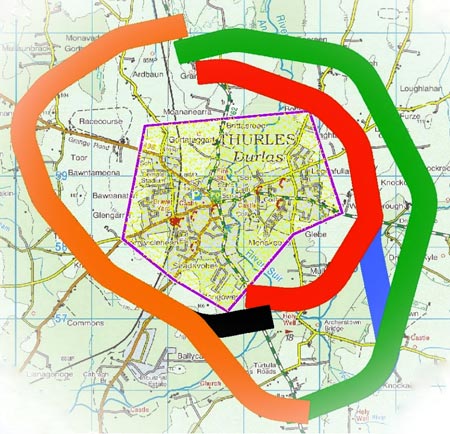
A town centre like Thurles depends on easy access. People call in to collect prescriptions, go to the post office, visit the butcher, chemist, café, solicitor, barber, newsagent or bank, and then move on. If parking is removed, made awkward, pushed away, or controlled in a way that does not suit shoppers, people change habits. They go where parking is free, plentiful and easy. In Thurles, that increasingly means the shopping centre or edge-of-town retail or indeed another nearby town.
The pull of the shopping centre is not imaginary. Thurles Shopping Centre is marketed as having more than 55,000 visitors per week and 550 free multi-storey parking spaces. That is a huge advantage over Liberty Square with its parking charges. When the Council reduces or reconfigures central parking while the shopping centre offers hundreds of free spaces, it should surprise nobody that trade drifts away from the historic core.
Parking charges resulted in the relocation of the post office, seen as yet another major blow. In 2019, An Post moved from Liberty Square to Thurles Shopping Centre. Local concern at the time was that the move would reduce footfall in the town centre. An Post said the old building was not viable and that the new location would provide improved services, but the result for Liberty Square was still the loss of a key daily footfall generator.
This is the core issue; decisions may be justified one by one, but their combined effect has damaged the heart of Thurles. One decision removes jobs, while another fails to replace them. Another moves a key service while another reduces convenient parking and then another produces a plan promising regeneration at some later date. Over time, the town centre is weakened not by one single act, but by a long chain of decisions that fail to protect how a real town works.
It would be unfair to claim that every closure was caused by councillors, the Council or TII. Companies close for many reasons: restructuring, costs, competition, building condition, online shopping and changing consumer behaviour. But it is entirely fair to say that successive politicians, councillors, agencies and planners have failed to secure a proper replacement employment base for Thurles and have failed to protect Liberty Square as a practical commercial centre.
The people of Thurles do not need more glossy language about regeneration. They need jobs, occupied buildings, realistic parking, fair access, active streets and a town centre that serves local traders as well as public-realm theory. A square can look tidier on a drawing and still fail commercially. A plan can sound modern and still damage small businesses. A town can be called a “Key Town” in official documents and still be treated like an afterthought in practice.
Thurles deserves better than managed decline. It deserves leadership that understands the town’s history, its losses, its trading patterns and its people. After 50 years of industrial closures, weak replacement employment and the hollowing-out of Liberty Square, the question is not whether Thurles has been let down. The question is who is finally going to take responsibility for reversing the damage.





Well said.