These photographs were taken on the R659, close to and north of Mid Tipperary Co Operative Livestock Mart at Ballycurrane, Thurles, Co. Tipperary.
Mid Tipp Mart describes itself as a farmer co-operative, “run by farmers for farmers,” and a major cattle-trading centre serving Tipperary and surrounding counties.
Built into this possibly early 19th-century roadside wall is what appears to be a stone stile; a simple arrangement of projecting stones that allowed a person to climb over a boundary without opening a gate. Such features were practical, durable and stock-proof. They belonged to a world of footpaths, fields, fairs, churchyards, wells and farm boundaries, where people moved on foot through a working rural landscape.
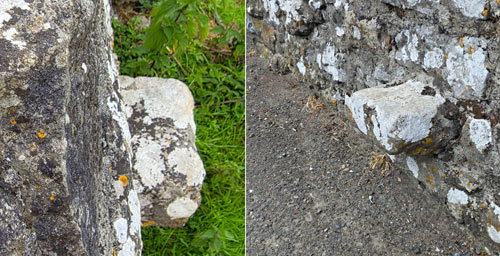
The wall itself cannot be dated from the above photographs alone, but its rough stone construction, weathering, lichens and traces of whitewash suggest considerable age. The projecting step stones are the key detail. They were not decorative, but functional, forming a small built-in ladder through the boundary.
Stone stiles are recorded elsewhere in Tipperary’s architectural heritage. The National Inventory of Architectural Heritage records a double stile in the boundary wall at Ballingarry Church, dated 1855–1860, and also records a random stone boundary wall “with stile” at Castletown near Coolbaun. These examples show that such modest access points were once a recognised part of the county’s built landscape.
A sadly related loss should also be remembered. On Mill Road, Thurles, a stile confirmed locally to have been built in 1846, at the beginning of the Great Famine period of 1845–1849, once stood as part of the historic landscape associated with the Great Famine now eradicated “Double Ditch.” Local reports on Thurles.info recorded warnings about the need to retain this heritage feature and later reported the destruction of the Great Famine Double Ditch area by Tipperary County Council officials and and Thurles Municipal District elected Councillors. Its loss underlines why surviving small structures like this R659 stile deserve notice before they too are dismissed as ordinary roadside stonework.
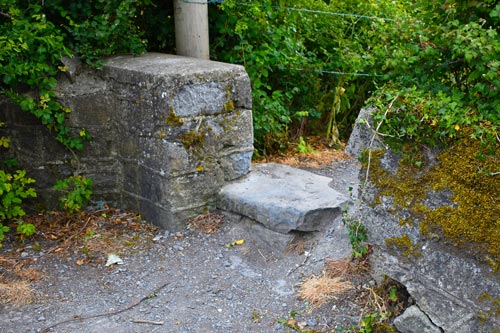
These stiles also belong to the wider Irish tradition of stone walling. Teagasc notes that Ireland has an estimated 400,000 km of dry stone walls and 210,000 km of stone-earthen banks, while in 2024 Ireland’s dry stone construction tradition was officially inscribed by UNESCO on the Representative List of the Intangible Cultural Heritage of Humanity.
This little stile on the R659 is easy to pass without noticing. But it may mark an older line of movement: a field path, a local crossing point, or an access route used before cars, marts and modern road traffic changed the rhythm of the countryside. It is a modest feature, but a valuable one; a reminder that heritage is not only found in castles, churches and big houses, but also in the small, practical details built into ordinary walls.





Leave a Reply