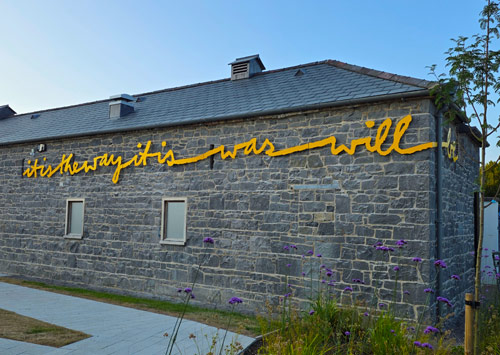
The above words are placed so beautifully and appropriately that it would be difficult to imagine a better setting.
Written in glowing golden script across the weathered limestone, the inscription seems almost to float upon the old walls; not merely as a sign, but as a quiet conversation between what has been, what is now and what is still to come. This striking artwork adorns the carefully restored 1849 stone old farm building in what is now Thurles Market Quarter. Once a modest agricultural shed, shaped by work, weather and generations of local life, it has now been lovingly reborn as ONE19 Coffee House & Restaurant.
West side of “One19 Restaurant”, Cathedral Street,Thurles, Co. Tipperary.
Its transformation has thankfully not erased its past. Instead, the old stone, the traditional form of the building and the marks of age have been allowed to remain, lending great warmth and authenticity to its new life. What was once a place of labour has become a place of welcome; a setting for coffee, food, conversation, friendship and new memories.
Its location gives the inscription an even deeper resonance. The building stands between two other landmarks, both woven into the spiritual and educational heritage of Thurles: the Cathedral of the Assumption and the former St Patrick’s College, now part of Mary Immaculate College. In such surroundings, the words/phrase naturally carry an almost sacred rhythm. They are not a direct quotation from Scripture, yet they gently recall the ancient Christian doxology:-“As it was in the beginning, is now, and ever shall be, world without end.” They also echo the language of the Book of Revelation, which describes God as the one “who is and who was and who is to come.”
Yet the sentiment has travelled beyond religious tradition and into popular culture. A closely related line, “That’s the way it is, was and will be”, introduces the established order of Sneetch society in the 2017 musical adaptation of Dr. Seuss’s “The Sneetches”. Dr. Seuss’s original 1961 story, later adapted for television in 1973, ultimately challenges the belief that society must always remain as it has been. The ‘Sneetches’ learn that inherited divisions are neither natural nor permanent and that even “the way it was”, can be changed.
The wording also appears with a more playful and satirical flavour in the 1974 comedy film “The Groove Tube”, where a fictional television newscaster signs off: “And that’s the way it is, was, and will be.” There, the phrase humorously imitates the certainty and authority of traditional television news.
Placed upon this restored building, however, the words take on a gentler and more romantic meaning. The stone remembers farm carts, tools, harvests and working hands. Today, those same walls shelter laughter, conversation and the aroma of freshly brewed coffee and hastily produced food. Tomorrow, they will hold stories belonging to generations not yet born.
The way it was: A humble building serving the life of the land. The way it is: A beautifully renewed gathering place in the heart of Thurles. The way it will be: A cherished part of Thurles town’s story for many years to come.
At dusk, when the golden lettering shines against the cool grey stone, it feels as though the building itself is speaking. Not mourning what has passed. Not resisting what has changed. Simply acknowledging that the past, present and future can inhabit the same place beautifully. An old building saved rather than forgotten. A historic quarter renewed rather than replaced unlike the towns Great Famine “Double Ditch“. A little philosophy, faith and humour written in golden light.
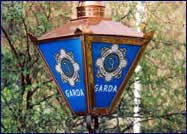
Gardaí have launched an appeal for witnesses after a man in his 50s was killed in a single-vehicle collision in County Tipperary.
The fatal crash happened on the R505 near Dundrum shortly before 5.50pm on yesterday afternoon, July 16th 2026. The driver, who was the only person reported to be involved, was pronounced dead at the scene. His remains were later taken to University Hospital Waterford, where a post-mortem examination is due to be carried out. The local coroner has been informed.
The R505 remained closed following the collision to allow Garda forensic collision investigators to conduct a technical examination of the scene. Diversions were put in place for motorists travelling through the area.
Investigating officers are particularly interested in hearing from anyone who used the road near Dundrum between 5:30pm and 6:00pm on Thursday. Drivers and other road users who recorded footage in the area are being urged to check their devices. Gardaí said dash-cam video, mobile phone recordings or any other camera footage could assist the investigation and should be provided to officers. Anyone who witnessed the crash, noticed the vehicle before the collision, or has information that may help establish what happened, is asked to come forward.
Five people have lost their lives in road traffic collisions within County Tipperary so far in 2026; as of yesterday, July 17th 2026. The confirmed fatalities occurred on:- 8th February: Man in his 70s, single-vehicle collision near Holycross. 8th March: Woman in her 20s, pedestrian collision near Templemore. 12th May: Woman in her 20s, two-car collision near Nenagh. 11th June: Motorcyclist in his 30s, collision near Carrick-on-Suir. 16th July: Man in his 50s, yesterday single-vehicle collision on the R505 near Dundrum.
Information can be given to Tipperary Garda Station by calling Tel: 062 80670. Members of the public may also contact the Garda Confidential Line on Tel: 1800 666 111 or indeed speak with officers at any Garda station.
The investigation into the circumstances surrounding the collision remains ongoing. Gardaí have thanked the public for assistance.
For years, the people of Thurles have heard announcements, assurances and political claims about the Inner Relief Road and the long-promised Outer Ring Road. Yet despite all the publicity and political celebration, Thurles still has no completed Inner relief road, no Outer Ring Road and no binding construction timetable that the public can honestly rely upon.
Mr Michael Lowry TD and Mr Ryan O’Meara TD, who both support the present government, must now accept political responsibility for the continuing lack of measurable progress. Meetings, press releases and statements welcoming developments are not substitutes for an approved budget, completed design, signed construction contract and machinery working on site.
Tipperary County Council describes the Inner Relief Road as approximately 1.1 kilometres of new road linking the N62 at Slievenamon Road with Mill Road. The scheme includes a new bridge over the River Suir, several junctions and associated flood-relief works. However, the council’s May 2026 management report still stated that Department of Transport approval was required before the project could proceed to detailed design and construction.
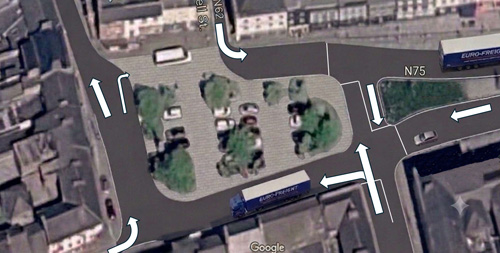
One of our many readers has submitted the suggestion shown above, which they believe could help ease the daily traffic bottleneck in Liberty Square, Thurles. This problem is likely to become even more severe when schools reopen in late August and early September. Any suggestions from other readers?
Inner Relief Road: The public was informed that the Inner Relief Road may be “ready for construction” in 2027. That wording does not provide a guaranteed completion date. If approvals, design work, procurement and funding continue to slip, there is a genuine danger that construction will not commence before 2030.
Outer Ring Road/Thurles Bypass: The situation surrounding the Outer Ring Road is even more concerning. Mr Michael Lowry has said that the Thurles bypass will advance through design and planning and that he will insist it is “ready for construction in 2030.” That is not a promise that the road will be built or opened by 2030. The scheme remains at a very early development stage, despite the need for a bypass having been recognised as necessary, some 40 years ago or more.
If the shorter and more advanced Inner Relief Road cannot be brought promptly to construction, how can the public have confidence that the much larger and longer Outer Ring Road will be construction-ready by 2030?The Thurles electorate are not fools.
There must also be accountability for the loss of the historic Great Famine “Double Ditch” at Mill Road. Local heritage campaigners described and proved it to be a famine-era pathway dating from approximately 1846, constructed as relief work for impoverished and starving people and later used as a right of way and Mass path. Concerns were raised publicly from 2020 onward, that the proposed Inner Relief Road would seriously damage or destroy this locally significant landscape feature. The tragedy now is that part of Thurles’s tangible Famine heritage appears to have been sacrificed for a road that, years later, has still not been delivered. Whatever disagreement may exist about its formal archaeological status, the failure to preserve, commemorate or meaningfully incorporate the “Double Ditch” into the project represents a serious loss to Thurles town’s historical memory.
Meanwhile, HGVs will continue entering Thurles every day. Even after a bypass is eventually constructed, some heavy vehicles will still need to enter the town to supply supermarkets, shops, hotels, restaurants, construction sites and other local businesses. These essential deliveries cannot simply be prohibited.
However, there is an important difference between HGVs that must enter Thurles to supply local businesses and heavy through-traffic that has no business being in the town centre. In the absence of proper alternative routes, both types of traffic continue to use the same narrow medieval streets and junctions.
The council’s own transport planning identifies the effect of through-traffic on Thurles and recognises the need for relief and bypass infrastructure. The Local Transport Plan presents the Inner Relief Road and a town bypass as important elements of the future transport network.
Regrettably, local elected representatives and county councillors have failed to grasp—or act upon—the urgency of this critical issue.
No redesign of Liberty Square can really solve the underlying problem. Wider footpaths, altered parking arrangements, crossings and junction changes may improve the visual appearance and pedestrian environment, but they cannot create a proper alternative route for strategic traffic.
Without the Inner Relief Road and Outer Ring Road, attempts to improve traffic movement in Liberty Square, risk becoming little more than a rearrangement of the same congestion.
Mr Michael Lowry TD and Mr Ryan O’Meara TD must now jointly secure and publish:
►Final Department approval for the Inner Relief Road; ► A fully funded programme for detailed design and construction; ► Firm construction commencement and estimated completion dates; ► Immediate progression of the Outer Ring Road through its formal planning and approval stages; ► An interim HGV-management plan separating essential local deliveries from avoidable through-traffic; ► A permanent memorial or heritage interpretation scheme acknowledging the Great Famine “Double Ditch” and the people whose suffering and labour it represented.
Thurles has already lost an irreplaceable piece of its Famine-era heritage. It must not now be left with neither the historic “Double Ditch” nor the road whose development was used to justify its loss. A plaque of some description must now be constructed recognising its once construction and recent destruction.
Thurles does not need more political celebration of mere preliminary steps, which is all our local politicians have had to offer their electorate over the past 40 years. It needs approvals, funding, contracts, construction and most of all accountability.
Irish Rail and Córas Iompair Éireann have brought High Court proceedings against Tipperary County Council in a dispute over a train signalling mast near the old Cahir railway station.
Irish Rail
The case centres on whether the mast, located about 130 metres from the old Cahir Rail Station, should be treated as exempted development or whether it affects the setting of a protected structure. The station, described in reports as a Gothic revival railway building dating from the 1850s, is at the heart of the planning disagreement.
Tipperary County Council served an enforcement notice in June 2026 under the Planning and Development Act 2000. That notice requires Irish Rail to cease using and remove the signalling mast by September 2026. Irish Rail is now asking the High Court to quash the council’s decision.
Irish Rail argues that the local authority made errors “in law and in fact” when deciding the mast was not exempted development. It also disputes the council’s view of the “curtilage”; the land or setting attached to a protected structure and says the mast is too far from the station building to fall within that protected area.
The rail operator further says it has installed more than 700 similar masts around Ireland without complaint from other planning authorities. It claims the protected status at the Cahir location now applies only to the station building, rather than other nearby railway structures previously listed in older development plans.
The council’s position is that the mast impacts the character and setting of the historic station. The matter is expected to return before the High Court on July 20th 2026.
The Minister for Justice, Home Affairs and Migration, Jim O’Callaghan, will this week undertake a series of bilateral engagements with EU Member States ahead of Ireland assuming the Presidency of the Council of the European Union on 1st July.
Minister O’Callaghan will travel to Prague for meetings with his Czech counterparts, Lubomír Metnar, Minister of the Interior, and Jeroným Tejc, Minister for Justice. He will then travel to Warsaw, where he will meet Waldemar Żurek, Polish Minister of Justice and Prosecutor General, and Marcin Kierwiński, Minister of the Interior and Administration.
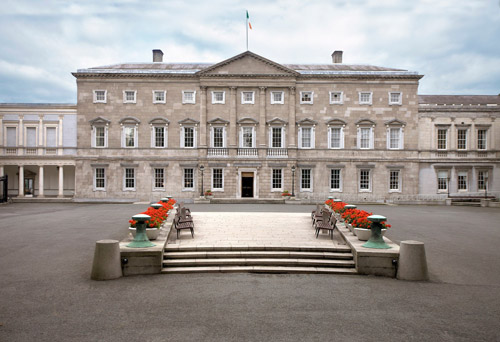
Leinster House, Seat of Ireland’s Parliament.
While in Poland, the Minister will visit the EU’s eastern border with Belarus, where he will receive a briefing on the current border security situation. Discussions during the visit will focus on preparations and priorities for Ireland’s Presidency, as well as areas of mutual interest including migration, organised crime and the rule of law.
Speaking ahead of the meetings, Minister O’Callaghan said: “I look forward to meeting with my Czech and Polish counterparts and building on the already strong relationships Ireland has with both nations. During Ireland’s Presidency of the Council of the European Union, our relationships with other Member States will be crucial to advancing our priorities of competitiveness, values and security. This visit will also provide an opportunity to hear first-hand how Belarus has instrumentalised migration, unacceptably exploiting human beings for political purposes.”
Minister O’Callaghan will conclude the week in Luxembourg at the Justice and Home Affairs Council on Thursday and Friday, where he will continue bilateral engagements with a range of other Member States.
This website uses cookies to improve your experience. We'll assume you're ok with this, but you can opt-out if you wish.AcceptRead More
Privacy & Cookies Policy
Privacy Overview
This website uses cookies to improve your experience while you navigate through the website. Out of these, the cookies that are categorized as necessary are stored on your browser as they are essential for the working of basic functionalities of the website. We also use third-party cookies that help us analyze and understand how you use this website. These cookies will be stored in your browser only with your consent. You also have the option to opt-out of these cookies. But opting out of some of these cookies may affect your browsing experience.
Necessary cookies are absolutely essential for the website to function properly. This category only includes cookies that ensures basic functionalities and security features of the website. These cookies do not store any personal information.
Any cookies that may not be particularly necessary for the website to function and is used specifically to collect user personal data via analytics, ads, other embedded contents are termed as non-necessary cookies. It is mandatory to procure user consent prior to running these cookies on your website.




Recent Comments