The Minister for Justice, Home Affairs and Migration, Jim O’Callaghan, will this week undertake a series of bilateral engagements with EU Member States ahead of Ireland assuming the Presidency of the Council of the European Union on 1st July.
Minister O’Callaghan will travel to Prague for meetings with his Czech counterparts, Lubomír Metnar, Minister of the Interior, and Jeroným Tejc, Minister for Justice. He will then travel to Warsaw, where he will meet Waldemar Żurek, Polish Minister of Justice and Prosecutor General, and Marcin Kierwiński, Minister of the Interior and Administration.
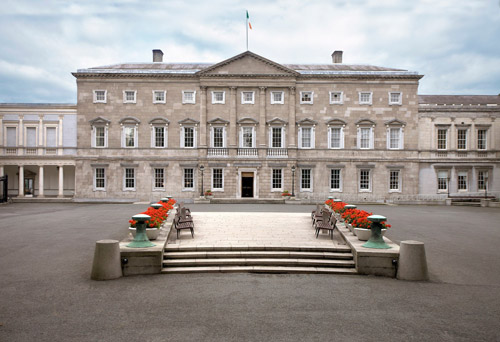
Leinster House, Seat of Ireland’s Parliament.
While in Poland, the Minister will visit the EU’s eastern border with Belarus, where he will receive a briefing on the current border security situation. Discussions during the visit will focus on preparations and priorities for Ireland’s Presidency, as well as areas of mutual interest including migration, organised crime and the rule of law.
Speaking ahead of the meetings, Minister O’Callaghan said: “I look forward to meeting with my Czech and Polish counterparts and building on the already strong relationships Ireland has with both nations. During Ireland’s Presidency of the Council of the European Union, our relationships with other Member States will be crucial to advancing our priorities of competitiveness, values and security. This visit will also provide an opportunity to hear first-hand how Belarus has instrumentalised migration, unacceptably exploiting human beings for political purposes.”
Minister O’Callaghan will conclude the week in Luxembourg at the Justice and Home Affairs Council on Thursday and Friday, where he will continue bilateral engagements with a range of other Member States.
The whole thing kicked off in the Arch Bar in Thurles, Co. Tipperary last Friday night, when Mikey Ryan burst through the door looking like a man who’d just witnessed either a miracle or a tractor on fire.
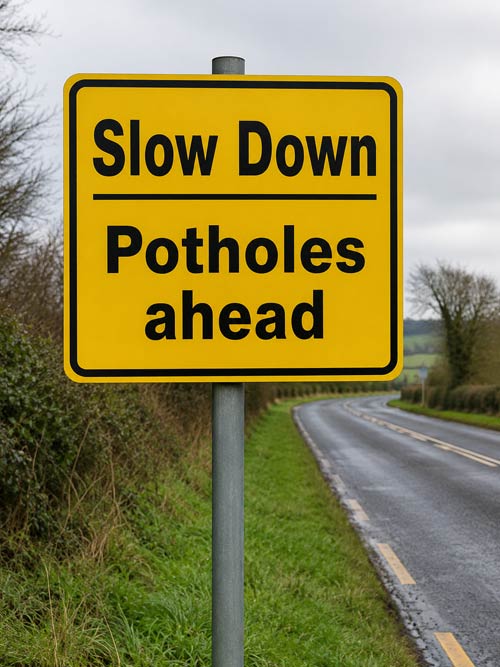
“Lads,” he says, gasping for breath, “Tipperary County Council have given up.” Now that got attention. Even Pat Hayes behind the bar stopped drying glasses. “What d’ye mean given up?” says Pat. “Gone altogether,” says Mikey. “No more speed limits.” The pub fell silent. Jimmy Bourke slowly lowered his pint. “No…” says he in his usual languid manner of speaking turning his single syllables into multiple sounds. “Oh yes,” says Mikey. “They’re replacing every speed sign in the county with signs saying: ‘SLOW DOWN – POTHOLES AHEAD.”
A woman at the corner table crossed herself. Pat blinked twice. “Sure isn’t that just every road in Tipperary?”
“EXACTLY,” says Mikey, lowdly slapping the counter so hard that a bowl of peanuts nearly declared independence.
Apparently the Council realised there was no point changing from 80 km/h to 60 km/h when the average human spine couldn’t physically survive 40 km/h anyway. Mikey claimed he saw three council workers outside Littleton removing a brand-new speed sign only four hours after initially installing it.
“One lad looked exhausted,” says Mikey. “Poor devil, a native of Co. Cork says; ‘What’s the point, bai? The road itself is enforcing the speed limit.”
And according to Mikey, the council has gone fully committed now. Outside Thurles there’s allegedly; a pothole deep enough to baptise a child; another has been classified by NASA as a “seasonal crater,” and one near Templetuohy village that is supposed to have swallowed a Nissan Micra and returned it as a Ford Focus.
“Jaysus,” says Jimmy. “That’s nothing,” says Mikey. “A fella hit one outside Roscrea last week and it activated his airbags, windscreen wipers and Eircode and all at the same time.”
The Council, according to recent rumour, have now stopped measuring potholes in inches. They’re measuring them in sizes; “small dog,” – “washing machine,” and “possible entrance to the underworld.” Meanwhile crews are driving around replacing all official speed signs. 80 km/h sign?Gone. 60 km/h sign? Gone. Now every road in Tipperary just has giant yellow signs reading: “SLOW DOWN – POTHOLES AHEAD”
Mikey says one poor tourist from Ukraine thought it was the county slogan, while another from Gaza asked if “Potholes Ahead” was a village near Cashel. But the best story came from near The Ragg. Council workers arrived with cones, flashing lights, diggers, rollers and enough machinery to invade a small European nation. Locals thought: “Grand. They’re finally fixing the road.” No, they installed six massive warning signs around a pothole before announcing that it was now “part of local Tipperary heritage.” Another engineer apparently referred to it as, “Traffic calming infrastructure.”
At this point the pub was in ribbons laughing. Even the old lad asleep beside the fire woke up laughing and he hadn’t previously been conscious since the 2022 All-Ireland Final.
Mikey took a deep dramatic gulp of Guinness. “But wait till ye hear the newest plan.” “Oh sweet suffering Jaysus,” muttered Pat. “They’re thinking of renaming roads altogether,” announced Mikey “What?” said Pat. “Yeah. Instead of the N62 or the R498…”; He leaned in over the counter. “…they’ll just call them according to the size of the potholes.” Examples include: ‘The Shaky Mile’; ‘Axlebreaker Avenue’; ‘Suspension Lane’ and one outside Nenagh simply called, ‘Abandon Hope All Ye Who Enter Here.” “And what about the speed vans?” an unknown someone asked. “Cancelled,” says Mikey. “Why so?” “No car in Tipperary can physically reach speeding pace anymore,” said Mikey.
At this stage the entire pub was gone completely feral with laughter. Mikey drained the last of the pint, straightened himself proudly and delivered the final line, like a prophet descending from Slievenamon mountain itself; “Mark my words lads… within five years every road sign in Tipperary will simply say: ‘Best of Luck.”
New figures released by the Department of Justice and An Garda Síochána show that the number of Garda members assigned to Roads Policing Units has fallen by almost 40% since 2009. The total number of specialist personnel dropped from 1,046 to 645 by March this year; a reduction of 401 officers dedicated to policing Irish roads.
Dublin experienced some of the steepest declines, with roads policing numbers nearly halving over the period. One Dublin division recorded a 59% drop, leaving just 11 specialist Gardaí and two road policing vehicles covering the area.
Other regions also saw significant reductions, including Sligo/Leitrim, where staffing levels fell from 34 officers to 14. Limerick was the only area to record a slight increase in personnel since 2009.
Road safety advocacy groups described the falling numbers as deeply concerning, warning that reduced enforcement capacity impacts road safety efforts nationwide. Campaigners said roads policing units are struggling due to limited resources and staffing pressures, and believe enforcement on Irish roads has been weakened at a time when offences are increasing. Recent figures show that more than 211,000 vehicles on Irish roads were uninsured or unregistered last year, roughly one in every 15 vehicles nationwide. Despite Gardaí carrying out over one million vehicle checks during the first three months of 2026, more than 5,000 vehicles were still seized for having no insurance during that short period alone. Thousands of additional summonses were also issued.
In response, An Garda Síochána stated that all Garda members contribute to road traffic enforcement, including those outside dedicated Roads Policing Units. According to the organisation, non-specialist personnel accounted for a majority of DUI detections, vehicle detentions, and checkpoints carried out last year.
The force also said there is no policy aimed at reducing roads policing numbers and noted that more than 80 new members have been assigned to roads policing duties over the past 18 months. However, Garda management acknowledged that staffing increases have not yet delivered the “significant uplift” desired in roads policing capacity
If the Roads Around Cashel Fall Silent, Best Turn for Home.
If you find yourself out late around the town of Cashel, Co. Tipperary, take a bit of advice from the old people; go home before the road goes quiet.
Tourists especially beware, because according to the folklore of the Galtee country, there are worse things abroad at night than a Garda checkpoint or a missed Fish & Chipper.
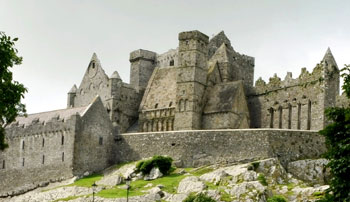
Rock of Cashel, Co. Tipperary.
Long before horror films discovered the headless horseman, Ireland already had the Dullahan, latter a charming individual who travelled the roads carrying his own head under his arm and announcing death wherever he stopped. No door lock kept him out. No gate latch held him back. The only known deterrent was gold, which feels very Irish altogether. Even supernatural evil respects inflation.
The most entertaining version of the tale comes from an old story called “The Good Woman”, collected by Thomas Crofton Croker in the nineteenth century. The story is set around the Galtee Mountains and Cashel, where a horse dealer named Larry Dodd makes the sort of decision that proves Irish folklore exists mainly to warn men against acting the maggot after dark.
Larry is riding home from Cashel one June evening after buying a horse. He’s feeling pleased with himself, no doubt after “just the one pint” that became several. Along the road he meets a mysterious cloaked woman walking alone at twilight.
Now, any sensible person in rural Ireland knows there are only three explanations for a woman silently appearing on a lonely road after sunset; a banshee, a fairy, trouble. Larry, unfortunately, ignores centuries of accumulated wisdom and offers her a lift. She says nothing. Climbs up behind him. Still says nothing, which, to be fair, should have been the first warning sign to any member of the male species.
Eventually the horse stops near the ruins of an old church. The woman slips down soundlessly and glides away across the graveyard. Larry, displaying the sort of judgement that has doomed Irish men since mythology began, chases after her looking for a kiss and catches her, only to discover she has no head.
At this point the story becomes considerably less romantic. Larry faints dead away and wakes among a gathering of Dullahans; headless ladies and gentlemen, soldiers, priests, musicians and skeletons tossing skulls around like hurling balls. Naturally enough, someone offers him a drink. Well this is still Ireland after all.
Things go poorly from there but eventually he escapes with his life, though not with his dignity, and his horse disappears entirely which may be the most authentically Irish ending imaginable. Survive supernatural terror if you like, but someone is still stealing the livestock.
So if you’re around Cashel late at night and happen to see a silent figure on the roadside, perhaps keep driving. Do not offer lifts. Do not flirt. And, absolutely do not follow mysterious women into ruined churches.
The old stories survive for a reason, and mainly because somebody ignored obvious warning signs and succeeded to live just long enough to warn the rest of us.
A new policy approved in Tipperary will ban roadside memorials in areas where speed limits are 60 kilometres per hour and above. The decision follows updated national road safety guidelines aimed at reducing dangers for motorists, pedestrians, and road maintenance crews.
Under the new rules, future memorials will not be allowed along higher-speed roads due to concerns about driver distraction, roadside parking and pedestrian safety. Existing memorials will remain in place, but any damaged memorials requiring replacement must comply with the updated regulations.
While many understand the importance of improving road safety, the decision has sparked debate among communities who see roadside memorials as important tributes to loved ones lost in tragic accidents. The issue is especially sensitive for grieving families and local residents who feel these memorials serve as lasting reminders for drivers to slow down and take greater care on dangerous roads.
At the same time, many people are questioning whether enough attention is being given to other road safety problems across the county. In Thurles, concerns continue to grow about road signage in several busy areas. A number of directional signs have reportedly become loose, damaged, are pointing in the wrong direction, or in some cases have disappeared altogether.
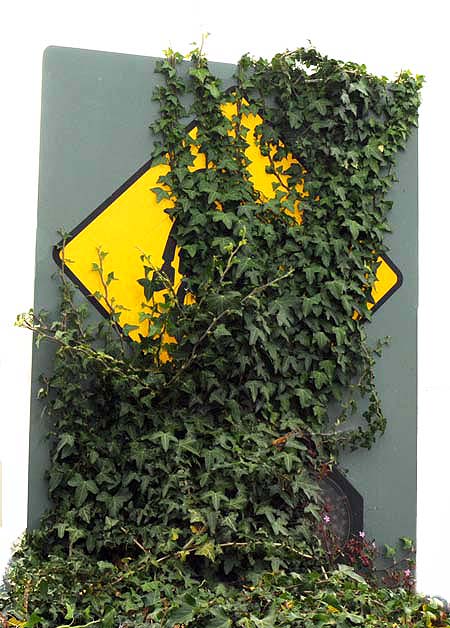
Areas such as Mill Road, Cathedral Street and Liberty Square in Thurles have been highlighted by residents as locations where signage problems are creating confusion for motorists and visitors alike. Many signs are hidden by hedge growth and some locals believe these practical road safety issues should also be prioritised alongside the introduction of any new policies and restrictions.
Road safety campaigners continue to stress that clearer signage, proper maintenance, safer junctions, and responsible driving all play a major role in preventing accidents and protecting lives on local roads.
As discussions continue, many will be watching closely to see how the new memorial policy is implemented and whether wider road safety concerns throughout Tipperary receive the same level of urgency and attention.
This website uses cookies to improve your experience. We'll assume you're ok with this, but you can opt-out if you wish.AcceptRead More
Privacy & Cookies Policy
Privacy Overview
This website uses cookies to improve your experience while you navigate through the website. Out of these, the cookies that are categorized as necessary are stored on your browser as they are essential for the working of basic functionalities of the website. We also use third-party cookies that help us analyze and understand how you use this website. These cookies will be stored in your browser only with your consent. You also have the option to opt-out of these cookies. But opting out of some of these cookies may affect your browsing experience.
Necessary cookies are absolutely essential for the website to function properly. This category only includes cookies that ensures basic functionalities and security features of the website. These cookies do not store any personal information.
Any cookies that may not be particularly necessary for the website to function and is used specifically to collect user personal data via analytics, ads, other embedded contents are termed as non-necessary cookies. It is mandatory to procure user consent prior to running these cookies on your website.




Recent Comments