The water quality of our rivers, lakes, estuaries and coastal areas continues to decline, says Environmental Protection Agency (EPA).
Water quality in Ireland has further declined. While improvements are being made in some areas, these are being offset by declines in water quality elsewhere.
At the current level of progress, Ireland will fail to meet the EU and national goal of restoring all waters to good or better status by 2027.
Only just over half of surface waters (rivers, lakes, estuaries and coastal waters) are in satisfactory condition (that is they are achieving good or high ecological status and are able to sustain healthy ecosystems for fish, insects and plants).
The deterioration in estuaries and coastal waters is mostly along the southeast and southern seaboards and is due to agricultural run-off. Urgent and targeted action is required to reduce nitrogen emissions from agriculture in these areas.
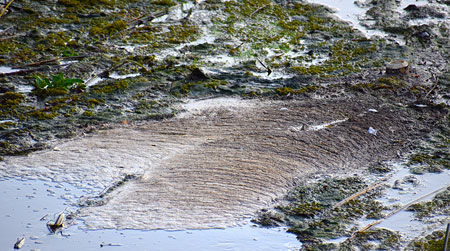
River Suir,Barry’s Bridge, Thurles, Co. Tipperary.
Suir estuary has lost its good water quality. Thurles.Info first raised this issue with Tipperary politicians, Tipperary County Councillors and the EPA, nine years ago, starting on November 7th, 2013. Our claims were denied. See also Here(April 2019). See Here(July 2018) etc. etc. Instead Tipperary County Councillors, lead by Fianna Fáil Councillor Mr Seamus Hanafin, ignored the river Suir, choosing instead to spread a 3 metre wide strip of tarmacadam on the river bank destroying existing biodiversity and local history.
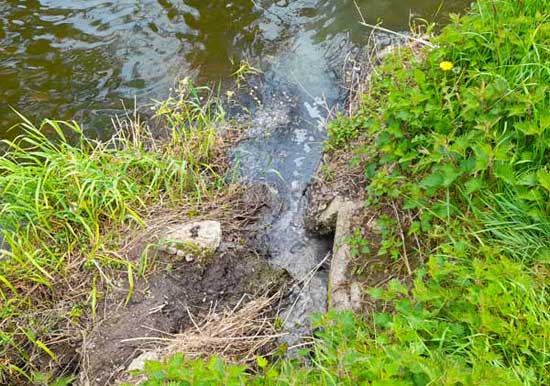
Domestic Sewage water allowed to flow continuously into River Suir, at Thurles , Co. Tipperary.
The Environmental Protection Agency (EPA) has today published the Water Quality in Ireland Report 2016-2021 which provides the latest assessment of the quality of Ireland’s rivers, lakes, estuaries, coastal and groundwaters. The report shows that water quality in Ireland is not as good as it should be. Only just over half of rivers, lakes, estuaries and coastal waters are in satisfactory condition. The overall ecological health of these surface waters has declined across all water body types since the last assessment (2013-2018). This means these water bodies are less able to support healthy ecosystems for fish, insects and plants.
While the decline in water quality of our rivers and lakes is relatively small (1% and 3% of waterbodies respectively), the number of estuaries and coastal water bodies in satisfactory condition has decreased by almost 16% and 10% respectively.
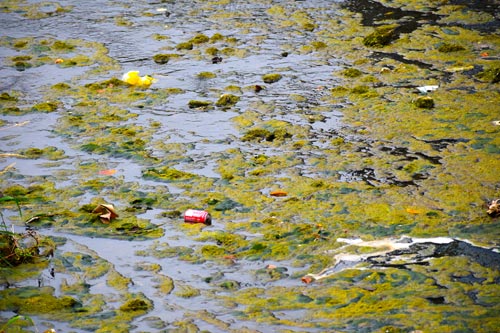
These declines are mostly along the southeast and southern coasts where nitrogen emissions from agricultural activities are having a significant negative impact on water quality. Excess nitrogen causes algal blooms in our estuaries which can damage the ecosystem, and excess nitrogen in drinking water can pose a risk to human health.
Commenting on the report, Dr Eimear Cotter, Director of the EPA’s Office of Evidence and Assessment, said: “The scale of the declines in our estuaries and coastal waters is alarming. In recent years the EPA highlighted that nutrient levels in our rivers and groundwaters are too high and that trends were going in the wrong direction. We are now seeing the impact of these emissions on our estuaries and coastal waters. Areas such as Cork Harbour, Wexford Harbour and the Slaney, Suir and Nore estuaries have lost their good water quality status. This directly impacts the marine biodiversity and ecological value in these areas”.
The report highlights that since the last assessment published in 2019, the number of monitored water bodies in satisfactory condition has declined by:
1% in rivers,
3% in lakes,
16% in estuaries,
10% in coastal waters.
River Suir,Thurles Foot Bridge areanear ‘Swinging Gates’, Thurles, Co. Tipperary.
The main pressures on water quality are agriculture, physical changes such as land drainage and dredging, forestry activities and discharges from urban wastewater. These activities can lead to run-off of nutrients, sediment and pesticides and damage to the physical habitat of waterbodies. The number of waterbodies impacted by urban wastewater remains high, but it is reducing, and the trend is going in the right direction. The number of waterbodies impacted by agriculture has, however, increased in recent years.
Ms Mary Gurrie, Programme Manager, added: “Improvements in water quality are being made, particularly in the priority areas for action where there has been focussed action to restore water quality in the past three years. This shows that improvements to water quality can be made when actions are targeted. However, the gains made are being wiped out by declines in water quality elsewhere”.
The EPA is calling for urgent and targeted action to protect and restore water quality in the next River Basin Management Plan (2022-2027), and full implementation of, and compliance with, the Good Agricultural Practice Regulations.
The full report and a summary report are available on the EPA website. Further information on water quality data and catchment assessments is available HERE.
Minister for Social Protection Mrs Heather Humphreys and Minister for Public Expenditure and Reform Mr Michael McGrath have confirmed the dates of when eight different lump sum payments will be doled out between now and Christmas.
The promised Autumn double payment will take effect from next Monday October 17th, benefitting some 1.4 million Irish residents.
The promised double child benefit payment will be paid on the week beginning November 1st., while the fuel allowance lump sum, of €400, will come into effect during the week commencing November 14th next.
On the same date, (November 14th), the promised €200 living alone allowance lump sum payment will be made to some 234,000 people.
There will be a €500 cost of living payment made to those in receipt of the working family payment, and a €500 disability support grant will also be paid over that same time period.
From November 21st next, a €500 carers support grant payment will be made to over 130,000 carers.
The welcome annual double payment Christmas bonus will be paid on the week commencing December 5th, 2022
With effect from January 2023; welfare increases of €12 per week will come into being, including a major expansion of the fuel allowance scheme.
No specific dates have been agreed yet in relation to the first of 3 promised electricity credits, due to be paid in November/December. Given the level of uncertainty and volatility in ever increasing cost of living, the question of further payments will be kept under continuous review by the Government.
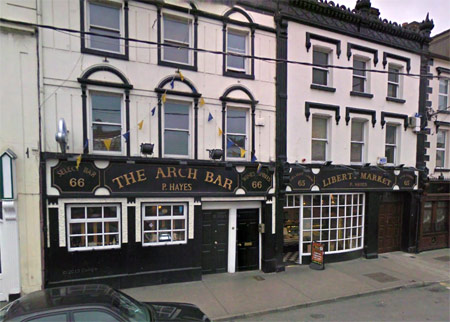
True for Sean O’Casey’s character ‘Captain Boyle’ in ‘Juno and the Paycock’, quote “Th’ whole county of Tipperary is in a terrible state o’ chassis”, said Mikey Ryan. Mikey had just finished reading a copy of one of the local rag newspapers, which he had pulled from behind the counter, when I caught up with him, after his 4th pint of the evening, in The Arch Bar, Liberty Square.
“I believe his phrase wasTh’ whole world’s in a terrible state o’ chassis”, said I, sounding intelligent.
“Same difference”, said Mikey.
“Ah to be fair, Tipperary was the only county in Ireland to show a decrease in the numbers on the Live Register in the last 12 months”, said I, “with an overall drop of some 1%”.
“What that figure really represent is 1% of our residents, anxious to seek work, eventually took the hint and moved overseas”, said Mikey, “Why do you think they’ve sprayed the graffiti image of a Swallow on our town’s cark park wall?They are hoping that the same 1% will come back like the swallows next summer on holidays, and prop up Fáilte Ireland’s imaginary tourist figures. One wonders why we continue to pay Mick Lowry and Jackie Cahill salaries of 2 million Euro’s, including expenses, every 5 year period, despite their consistent inadequacy in producing even one single job in Thurles, during their lengthy period in office”, Mikey continued.
“No argument there Mikey”, said I, “but then that doesn’t stop them from regularly demonstrating their delusions of adequacy. Anyway, tell us this and tell us no more, did you ever think of emigrating yourself Mikey” I continued.
“Several times” said Mikey, “I wanted to move to Australia once, but the immigration officer started asking awkward questions. Have you any criminal convictions? says he. Sure I, as an Irishman wasn’t to know that crime was still an Australian requirement for immigrants, after Michael Collins had helped the British to escape out of this country”.
“I never told you this before”, continued Mikey, “but I tried to get a visa for America, earlier this year. The immigration official asked where was I hoping to go, and when I said San Jose, Northern Californiabefore the immigration officer corrected me saying that San Jose was pronounced ‘San Hose’; It seems their ‘J’ is pronounced as a ‘H’. “So how long do you intend staying in San Hose?” says he. “In my efforts” said I “to impress, I said six months; from Hanuary to Hune. “Then”, said Mikey, “sure in filling out the immigration form I was asked “Sex“. I tried to answer truthfully, as I had already ticked the ‘married‘ box, so I wrote ‘just occasionally’. Then while I was there in the immigration office, disaster, didn’t I interrupt the interviewing officer, who was answering his mobile phone, informing him that “They should be shipped back where they came from, as they have a tendency to cause explosions”. The illegitimate son of a b..ch accused me of being racist and was about to call security, before I eventually persuaded him, that I was referring to the Samsung Galaxy Note 7 phone, he was using. Still he wrote me a lovely letter a few days later, stating that my visa was denied on the grounds of fears that the level of the current IQ, present in ‘San Hose’would double”.
“Tell me this Mikey”, said I, “is Thurles the only town in the world not suffering from a severe energy crisis?”
“Indeed it appears so” said Mikey, “sure aren’t 57 street lights burning currently in Thurles town, during day light hours, and for the last 4 months. Yet, a senior Tipperary council official has beenurging community and business groups elsewhere in the county, to reduce the hours that Christmas lights are left turned on during the forthcoming festive season, (Note: only another 11 Saturdays left until Xmas Eve), as energy costs continue to soar. Thank God the Director of Services Mr Brian Beck doesn’t get up as far as Thurles or he would really “blow a fuse”, Mikey ranted on.
“When you’re ready Pat, you can give Mikey another pint,” said I, “we’ll be walking home every night from now on, since they’ve tripled the width of Thurles town pavements”.
Firstly, shame on Thurles Elected Politicians, Councillors and the senior officials who over-rule them, within Thurles Municipal District and County Council, all of whom have allowed this beautiful river Suir asset, to fall into a state which resembles that of an unkempt sewer, while claiming to have lost the power to control its continuing deterioration.
The Suir From Its Source to the Sea.
Extract from the book by author L. M. McCreith, (Author of “Cashel of the Kings”.)
“………The gentle Suir, that, making way by Sweet Clonmel, adorns rich Waterford”. Quote taken from Spencer’s “Faerie Queene”*.
OriginallyPrinted by the Clonmel Chronicle Newspaper and Printing Works Ltd. (1848 – 1935)
*The “Faerie Queene” referred, is an English epic poem by Edmund Spenser, with over 36,000 lines and over 4,000 stanzas. It remains one of the longest poems in the English language and was presented to Queen Elizabeth I in 1589, probably sponsored by Sir Walter Raleigh, latter who was one of the principal landowners and colonists in Munster and who was later beheaded by English King James I.
This extract written in 1912,(110 years ago)states: –
“Some 8 miles from Templemore, spreading itself on both banks of the Suir, is the ancient town of Thurles. The town has a distinctive, old world, almost ecclesiastical, character of its own.
Its name is a corruption of the Irish Durlas, a fortress. In the “Annals of the Four Masters”, we read of a chief of Durlas, by name Maelduin, who was slain in 660 A.D. Thurles was the scene of one of the few signal defeats of the Danes by the Irish. This took place in the 10th century and was long remembered and recorded locally. As has been said, Thurles was also the scene of the defeat of Strongbow, by a coalition of Irish Chiefs in 1174. When Strongbow heard that Connor and Donal Mor we’re advancing against him, he sent to Dublin for help. A contingent of Danish settlers and Norman soldiers, natural allies, came to his assistance. They endeavoured to join him at Thurles, but there, by the banks of the Suir, 1700 of Strongbow,s men were slain. Donal Mor O’Brien was in command that day and it would seem that the field was a fortunate spot to him; for when he returned to that same place 17 years later, to fight another battle against the English, he was again victorious. In 1197 however, 6 years afterwards the English took Thurles and “burnt many churches and temples”.
Among the many notable Norman’s who established themselves in Ireland (and in time became “more Irish than the Irish”), where the Butler’s. Theobald FitzWalter came in the train of Henry II, in 1172. He was kin to Thomas A’ Becket, and it was part of the King’s accepted penance that he should ennoble all the murdered Archbishop’s relatives. Henry II gave FitzWalter large grants of Irish land, in return for which FitzWalter was to act as the King’s chief Butler and to hand him a cup of wine after his coronation. Hence the name of the family.
The Butlers ever remained loyal to the Sovereign, whose vassals they were and were frequently in opposition to the other powerful Norman House, the Fitzgerald’s or Geraldine’s, who are descended from Strongbow’s Knight, son-in-law and right-hand, Raymond le Gros and were represented by the earls of Kildare and Desmond.
The Butlers obtained large possessions in Wicklow and in fertile Tipperary, and early in the 13th century became possessed of Thurles. The Butlers were ever notable as castle-builders and founders of religious houses. They began to build on the banks of the Suir. Within the last half-century there were remains of no fewer than 9 castles in this town.
James Butler was created Earl of Ireland in 1328. About that time (1324) he caused the Castle to be built, the Norman keep of which still guards the bridge across the slow-flowing river. The Butler’s also built or endowed Carmelite and Franciscan monasteries in Thurles and there, as well as Templemore, the knights Templars established a Preceptory. Viscount Thurles still remains the inferior title of the Marquis of Ormonde, the head of the Butler family.
Thurles today is an important and thriving town of about 5,000 inhabitants. It has a notable horse fair and it is the centre of a rich grazing and grain growing district. It is the seat of the Archbishop of Cashel and diocese of Emly, and contains a magnificent Roman Catholic Cathedral and a handsome archiepiscopal residence. The bells and the organ of the Cathedral are notably fine. There is also a fine Roman Catholic college, two convents and a monastery, the hole forming as it were a, kind of religious quarter.
Thurles was the scene of the famous Roman Catholic synod in 1850. From Thurles onwards the Suir flows through the county of which the poet Spenser (Edmund) said that it was ‘the richest champagne that may ever be rid’.”
Drinking water quality is high but increased vigilance is needed by Irish Water and Local Authorities to protect public health, says EPA.
The quality of drinking water from public supplies remains high, with over 99.7% of samples compliant with bacterial and chemical limits.
Two significant incidents during 2021 at the Gorey and Ballymore Eustace water treatment plants put the health of approximately 885,000 people at risk, highlighting significant failings in oversight and management by Irish Water.
The number of supplies breaching THM standards increased in 2021, reversing all progress seen in recent years.
Progress to remove lead from drinking water networks is too slow, with the need for stronger leadership at national level.
The number of people served by “at-risk” supplies on the EPA’s Remedial Action List (RAL) has reduced, arising from upgrade works at two large water supplies: Leixlip and Vartry water treatment plants.
Our Lady’s Well, Thurles, Co. Tipperary. Pic: George Willoughby
List of water supplies currently on a Boil Water Notice or Water Restriction in Co. Tipperary as of 28/09/2022 are: – Tipperary – Glenary – Population affected 10,564. Tipperary- Horse & JockeyPWS – Population affected 648. Tipperary- Clonmel – Poulavanogue – Population affected 96.
The EPA Drinking Water Quality in Public Supplies Report 2021, released today, shows that the quality of drinking water in public supplies remains high, with over 99.7% compliance with bacterial and chemical limits. The continued high levels of water quality being achieved are positive for consumers and indicate that water is safe to drink.
However, there were two significant incidents during 2021 at the Gorey and Ballymore Eustace water treatment plants that put the health of approximately 885,000 people at risk, with community illness and hospitalisations occurring in the Gorey incident. These highlighted significant failings in oversight and management by Irish Water and local authorities.
The Environmental Protection Agency (EPA) instructed Irish Water to implement a number of actions at all supplies, to prevent the reoccurrence of similar issues. As a result of these actions, more drinking water quality issues were detected and reported, with the number of Boil Water Notices increasing significantly in the last quarter of 2021. The total number of people affected by Boil Water Notices in 2021 was approx. 211,000.
Launching the report, Dr Tom Ryan, EPA Director said: “The serious incidents at Gorey and Ballymore Eustace water treatment plants last year, which resulted in unsafe water being released for consumption, have highlighted Irish Water’s fundamental obligation to ensure our public water supplies are properly operated, and managed, to protect public health. Increased vigilance is needed by Irish Water and Local Authorities in their oversight and management of plant operations to ensure incidents are dealt with appropriately and in a timely manner.”
Dr Ryan added: “Boil water notices are affecting an increasing number of consumers and while we recognise the challenges these present to individuals and communities, they are necessary to protect public health. High incidences of boil water notices will remain with us until Irish Water improves the resilience of drinking water plants.”
While water is safe today, the EPA’s Remedial Action List of “at-risk” supplies identifies where long-term improvements are needed in our drinking water infrastructure to protect public health. Following EPA targeted enforcement, supplies upgraded in 2021 include Vartry (serves approx. 127,000) and Leixlip (serves approx. 590,000) water treatment plants. At the end of 2021, there were 52 “at-risk” supplies serving approx. 375,000 people down from 1,000,000 consumers in 2020. However, the latest publication of the RAL (Sept 2022) has seen some of this progress eroded, with the population served by “at-risk” supplies increasing to approx. 575,000. Furthermore, the length of time it takes to implement improvements at supplies is not acceptable to the EPA, as it means these supplies remain vulnerable for longer. The EPA requires that Irish Water targets investment and resources to both reduce the number of supplies on the RAL, and the time it takes to implement these improvements. Mr Noel Byrne, EPA Programme Manager, said: “It is welcome to see how targeted enforcement has led to significant improvements at large supplies such as Leixlip and Vartry, supporting the security of these critical water supplies into the future. However, in order for supplies to be secure into the future, Irish Water must resolve the “at-risk” supplies on the RAL and ensure that future actions are targeted where they are most needed to protect public health. In particular, the deterioration in compliance with THM standards needs to be addressed as a matter of priority.”
Lead in drinking water causes a cumulative risk to human health. The EPA is highlighting the slow rate of lead replacement by Irish Water, as it will take almost a quarter of a century to address the risks posed to public health from lead in drinking water at the replacement rate observed in 2021. In addition, leadership is required at a national level by relevant Departments to address this issue. A report from these Departments on assessments of lead pipework in public buildings and plans to remove lead from these buildings is overdue. The EPA Drinking Water Quality in Public Supplies Report 2021 and the complete list of public water supplies currently on the Remedial Action List – including details of the proposed remedial measures and associated timeframes – are available HERE on the EPA website.
This website uses cookies to improve your experience. We'll assume you're ok with this, but you can opt-out if you wish.AcceptRead More
Privacy & Cookies Policy
Privacy Overview
This website uses cookies to improve your experience while you navigate through the website. Out of these, the cookies that are categorized as necessary are stored on your browser as they are essential for the working of basic functionalities of the website. We also use third-party cookies that help us analyze and understand how you use this website. These cookies will be stored in your browser only with your consent. You also have the option to opt-out of these cookies. But opting out of some of these cookies may affect your browsing experience.
Necessary cookies are absolutely essential for the website to function properly. This category only includes cookies that ensures basic functionalities and security features of the website. These cookies do not store any personal information.
Any cookies that may not be particularly necessary for the website to function and is used specifically to collect user personal data via analytics, ads, other embedded contents are termed as non-necessary cookies. It is mandatory to procure user consent prior to running these cookies on your website.







Recent Comments