Tipperary County Council’s Chief Executive, Ms Sinead Carr, [latter who took over from Mr Joe MacGrath, following his retirement from the post at the end of May this year (2024)], has submitted her report in relation to Phase 2 of the long awaited Liberty Square upgrade.
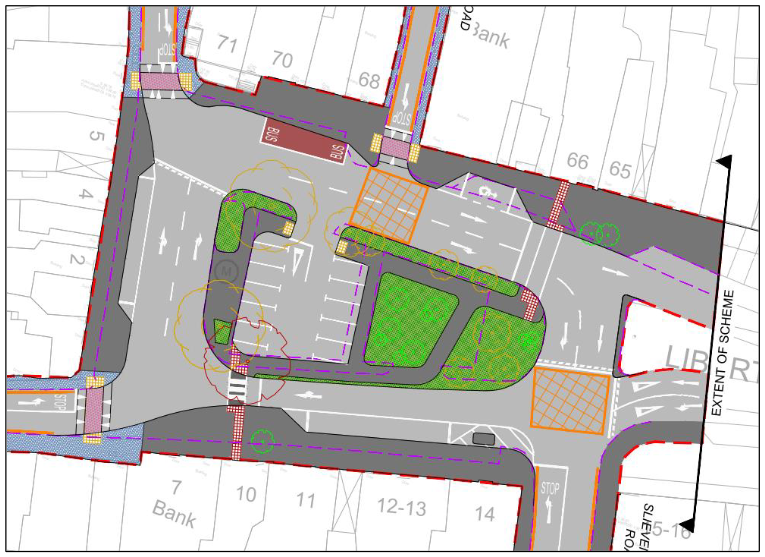
Proposed Liberty Square West Layout (Phase 2).
We understand that all nine of our elected Municipal District Councillors have now received copies of her final deliberations and we further understand that the matter will be considered by same nine councillors at a council meeting on November 18th next (2024).
We understand that a total of 22 submissions were received during the period of public consultation which ended, on August 30th 2024. At least one submission (which is surprisingly included), was forwarded outside the period of public consultation; received on 2/9/2024.
Two submissions were received from one affected family business, sharing Parnell Street with O’Donovan Rossa Street, both bearing the same content. So if honesty was to prevail, only 20 submissions were received. Please read HERE.
Parnell Street (formerly New Street)at the junction (right) withCúchulainn Road (formerly Nicholas Street).
We understand that Tipperary County Council’s Chief Executive Ms Sinead Carr, despite the submissions forwarded by the public and received, is recommending that little or no changes should be made to the original plans initially set out.
Picture Top:Looking West, unto Slievenamon Road, Thurles. Picture Centre:Looking East, unto Emmett Street, Thurles. Picture Bottom:Looking North from rear of Bank of Ireland, facing unto Liberty Square, Thurles.
So, where are those promised extra Thurles car parking spaces that were promised behind Bank Of Ireland, latter facing unto Liberty Square in Thurles?
One is reminded of a remark once used by American showman, businessman (Barnum & Bailey Circus), Mayor (Bridgeport Connecticut), author and anti-slavery Republican politician, Mr Phineas Taylor Barnum. the remark, demonstrates the deep understanding of scepticism, human nature, and the limitations of deceit, including that expended by our local Thurles councillors and politicians. The remark attributed to Mr Barnum states, quote; “You can fool all the people some of the time and some of the people all the time, but you cannot fool all the people all the time.” The adage “There’s a sucker born every minute”, is also frequently attributed to the aforementioned Mr Barnum; latter remembered for promoting celebrated hoaxes.
Truth was that customers drove into the Bank of Ireland (BOI) car park, parked their vehicles, dealt with their banking business, and then walked out to Liberty Square or back unto Emmett Street, entering into the rear of the multinational groceries and general merchandise retailer Tesco, leaving their car free of street parking charges.
Now, with a new wall backing unto BOI, latter moved further northwards, and a second gap opened from what was known as the Slievenamon Road car park (or Checkpoint Charlie) we have actually, once again, lost at least 6 car parking spaces, hitherto available to the town centre. [I base this assumption, noting that the new gaps created, (one leading east unto Emmett Street and the other leading north unto the rear of Bank of Ireland), will no longer offer parking spaces.]
Quote: “Ireland’s towns and villages are an important resource to protect and nurture. We want to ensure that they remain resilient locations with vibrant inclusive communities and a strong cultural and social fabric that deliver a good quality of life for future generations. We (the government) will support them through a strong commitment to ‘place-making’ so that any town centre environment is one in which people want to live, do business, visit and is ultimately successful”.
Why does ‘The Source’ Car Park remain closed.
A 2024 General Election date is to be announced on Thursday November 7th next. The previous disastrous decisions forced on our town centre businesses, (first begun on August 17th, 2020), now leaves our medieval streetscapes fully choked with HGV’s and other traffic; and will not easily be corrected even when, (if ever), a bypass is eventually constructed.
To those canvassing for votes on our doorsteps, the question which should be on the lips of every Thurles resident and remaining, business owner in our town is; “When will ‘The Source’ car park be open again, in an effort to support town centre businesses?
With just 7 weeks until Christmas, why was this presently closed parking benefit, situated under ‘The Source’ library building, not taken in hand, as a greater parking priority, rather than the opening of a new gap in a partially land locked car park, latter which will now lead to even greater frustration, with motorists forced to emerge onto Barry’s Bridge, from this new Emmett Street gap, to take their chances manoeuvering around a totally ‘castle blind’ corner, unto Cathedral Street.
Hardly the work of Banksy, latter that pseudonymous England-based street artist and political activist, whose real name and identity remain, as yet, unconfirmed.
The above 35.56 centimetre (14 inch) high, expletive / salutation has greeted the arrival and departure of those using the new Liberty Square / Slievenamon Road, car park, [aka ‘Checkpoint Charlie’], latter positioned just 20 metres from the Thurles Tourist Office, since June 2021. It appeared prior to the removal of the money wasting, two year old Perspex coated, parking ticket shelter the costings of which remain a closely guarded secret, retained only by Municipal District wasting officialdom.
Former eradicated Perspex coated, parking ticket shelter.
One would have hoped that these two worded expletive could have been removed by Thurles Council, along with the two year old car parking barrier system, or even by the well-meaning ‘Refresh Thurles’ grouping, but, alas, it has gone unnoticed over the past 3.5 years, due to the everyday ‘hussle and bustle’ of a now struggling Thurles town centre market place.
Climbing Hydrangea (Hydrangea petiolaris).
Graffiti, seen by some as a form of visual communication, usually illegal, involving the unauthorized marking of public spaces by individuals or groups, has become a continuing problem here in Thurles and goes unchecked. Could the planting of climbing Hydrangeas (Hydrangea petiolaris) be the answer to this wanton vandalism?
Autumn shade of the Climbing Hydrangea (Hydrangea petiolaris).
This charming, fully hardy, self-clinging, climber enjoys full sun to partial shade, but will still thrive even on a north facing wall. In midsummer white lace-cap-style hydrangea flowers cover the plant, before the leaves turn slowly to yellow in autumn. Same grows best in a sheltered position in soils rich in organic matter, reaching some 3.048 metres (10 ft) – 6.96 metres (20 ft) in height.
It is with great sadness that we share the news with our readers, having learned of the passing of former RTÉ broadcaster and correspondent Mr David Davin-Power, aged 72 years.
Mr Davin-Power first began working for RTÉ News in 1978 and was part of the team that established the Morning Ireland radio programme in 1984.
In 1989 he left RTÉ, for some two years, to head up the newsroom at the now defunct commercial radio station, known as Century Radio, (aka Century 100 and later Century FM), returning to RTÉ as their Northern Editor.
He returned to Dublin, in 2001, again becoming political correspondent; reporting on affairs in Leinster House.
In 2017, Mr Davin-Power retired from RTÉ, having been their political correspondent for some 16 years. However, despite illness, he continued to work as a columnist with The Times Ireland Edition, as well as appearing on RTÉ, Newstalk, and Virgin Media, as a commentator.
Mr Davin-Power is survived by his wife Dearbhla, children Nick, Julia, Caroline, Ben and Emily.
Plan to address barriers to entry to legal professions and early career progression published.
Plan identifies steps needed to widen and increase access to education, training, and career opportunities in the legal professions.
Relevant professional bodies and stakeholders will sit on the Implementation Plan Working Group.
LSRA will provide progress reports every 6 months.
A plan has been published to address the barriers facing many newly qualified and early career solicitors and barristers.
The Legal Services Regulatory Authority (LSRA) were asked to submit a plan to implement the recommendations of its Breaking Down Barriers Report.
This report, which was published in September, examined how a range of issues such as financial means, geography and professional connections can act as obstacles to progression for those studying or starting out in the legal professions.
The plan contains 32 recommendations, and the implementation process will be led by the CEO of the LSRA, who will also chair the Barriers Implementation Working Group.
Relevant professional bodies will be invited to nominate representatives to sit on the Working Group, which will hold quarterly progress update meetings with the legal professional bodies, the Law Society of Ireland, the Honourable Society of King’s Inns and the Bar of Ireland.
Dr Brian Doherty, Chief Executive Officer of the Legal Service Regulatory Authority said: “The LSRA very much looks forward to working with all relevant stakeholders with the common goal of building a more inclusive and diverse legal services sector. The recommendations made in the Breaking Down Barriers report represent an important reform initiative which will build upon measures introduced in recent years by key stakeholders, including the professional bodies for solicitors and barristers, the Law Society of Ireland, the Bar of Ireland and the Honorable Society of King’s Inns.”
The LSRA Breaking Down Barriers Implementation Plan can be accessed HERE.
This website uses cookies to improve your experience. We'll assume you're ok with this, but you can opt-out if you wish.AcceptRead More
Privacy & Cookies Policy
Privacy Overview
This website uses cookies to improve your experience while you navigate through the website. Out of these, the cookies that are categorized as necessary are stored on your browser as they are essential for the working of basic functionalities of the website. We also use third-party cookies that help us analyze and understand how you use this website. These cookies will be stored in your browser only with your consent. You also have the option to opt-out of these cookies. But opting out of some of these cookies may affect your browsing experience.
Necessary cookies are absolutely essential for the website to function properly. This category only includes cookies that ensures basic functionalities and security features of the website. These cookies do not store any personal information.
Any cookies that may not be particularly necessary for the website to function and is used specifically to collect user personal data via analytics, ads, other embedded contents are termed as non-necessary cookies. It is mandatory to procure user consent prior to running these cookies on your website.







Recent Comments