Minister for Rural and Community Development and the Gaeltacht, Mr Dara Calleary TD, will visit Tipperary and Clare on Friday, 24 July, for a full programme highlighting newly completed community, recreational and biodiversity projects.
The Minister’s visit begins at 9:00am with the official opening of Thurles Market Quarter, Town Parks, Thurles. He will then open Loughtagalla Biodiversity Play Park, Thurles at 10.30am, followed by Carrig Community Park, Carrig, Co. Tipperary, at 11.50am.
At 12.35pm, Minister Calleary will travel to Lorrha to view the renovated St Ruadhan’s Hall and visit the SCEAL Community Shop and Café, two facilities supporting local services and community life.
The afternoon programme moves to County Clare, beginning in Bunratty at 3.15pm, where the Minister will launch a new boat for Bunratty Search and Rescue Service.At 5.15pm, he will officially open the upgraded Lahinch Playground and launch the Clare Outdoor Recreation Plan on the town’s promenade. The day will conclude at 6.45pm with the opening of Corofin Community Centre.
This series of engagements will recognise the work of local volunteers, community organisations and public bodies involved in bringing the projects to completion.
Together, the developments provide improved parks, play areas, rescue resources, meeting spaces and community services for residents and visitors. They also demonstrate the important role locally led projects can play in strengthening rural towns and villages, supporting wellbeing, protecting biodiversity and creating welcoming public spaces for people of all ages.
One Council Restores History While Another Erases It – The Loss of Thurles’s Famine Double Ditch.
The decision by Dún Laoghaire-Rathdown County Council to spend approximately €660,000plus VAT restoring a historic ha-ha wall in Marlay Park (latter a sunken landscape boundary that uses a hidden trench and a vertical retaining wall), has understandably generated debate. The 197-metre structure, believed to date from the early nineteenth century, was designed to separate landscaped gardens from grazing animals without interrupting views across the estate. Much of its original locally sourced granite survived beneath vegetation, but the wall had fallen into disrepair. Restoration required specialist conservation work, dismantling and rebuilding sections of dry-stone wall, repairing the ditch and incorporating drainage infrastructure. The original contract was valued at €625,398 excluding VAT, with the final estimate rising to €660,374 following delays, unsuitable ground material, severe weather and difficulties obtaining appropriate stone.
Local construction professionals and taxpayers are entitled to question whether that represents value for money. Public bodies must explain how costs are calculated, why projects exceed their initial budgets and whether procurement arrangements adequately protect the public purse. Dún Laoghaire-Rathdown County Council has already faced criticism over the €753,528 cost of works at an entrance to Deerpark in Mount Merrion. That project is frequently described as the construction of “14 steps”, although the council says it also included a wheelchair-accessible ramp, retaining walls, granite paving, seating, landscaping, pedestrian crossings, road resurfacing, drainage, traffic-signal equipment and other public-realm works. The criticism of these costs is legitimate. Nevertheless, one important fact should not be forgotten: Dún Laoghaire-Rathdown County Council recognised that an historic structure was worth preserving.
That approach stands in painful contrast to what happened in Thurles.
The Thurles Great Famine Double Ditch was regarded locally as a rare surviving famine-era landscape feature. Local historical accounts date its construction accurately to 1846 and associate it with relief work provided to men and boys during the Great Famine. Rather than representing the landscaped elegance of a wealthy Dublin estate, this Double Ditch recalled hunger, poverty and the desperate struggle of local families to survive. It was not simply an old embankment. It was a physical connection with one of the darkest periods in Irish history. For generations, the route was also described locally as a public walkway and Mass path. Campaigners argued that it formed part of the social history of Thurles and should have been incorporated into a protected heritage trail.
Despite repeated warnings, the entire section of the Double Ditch was cleared in March 2022 supported by local councillors, as part of works connected with as yet a non existent, only proposed Thurles inner relief road. Contemporary photographs and local reporting showed mature vegetation being removed and the historic landscape feature being levelled by machinery.
Historic Thurles Double Ditch Eradicated in 2022. Pic. G.Willoughby.
Once such a structure is destroyed, it cannot truly be recreated. A replica might reproduce its approximate appearance, but it cannot restore the original stones, soil, boundaries and physical connection with the people who constructed it during the Great Famine.
This is the real loss suffered by Thurles. Tipperary County Council regularly speaks about protecting heritage and connecting communities with their past. Yet the treatment of the Double Ditch demonstrates the gulf that can exist between heritage policies and decisions taken on the ground. Roads and development are necessary, but heritage protection does not require a complete rejection of progress. It requires imagination, consultation and a willingness to examine alternative designs before destruction becomes inevitable.
The contrast between the two councils is striking. In Dublin, hundreds of thousands of euro are being spent restoring an aristocratic landscape feature. In Thurles, a structure associated with ordinary people surviving the Great Famine was treated as totally expendable. The Marlay Park bill deserves detailed scrutiny. So does every major publicly funded project. But the principle of conserving historic structures should be welcomed.
Led by the denials of elected councillors; mainly Mr Michaél Lowry (Non Party), Mr Sean Ryan (FF) and Mr Seamus Hanafin (FF), together with senior council officials, through wilful ignorance, self-deception, blind persistence and despite knowing better oversaw this reckless destruction. Thus the tragedy in Thurles is that the debate never reached the question of restoration costs.
The Double Ditch was not protected long enough for restoration to become an option. Dún Laoghaire–Rathdown County Council may reasonably be criticised for excessive costs. Tipperary County Council should be criticised for allowing irreplaceable local history to be destroyed.
One council appears willing to spend too much preserving history. The other did too little before all of that history was totally eradicated and lost forever.
Neither approach represents good stewardship of public money or public heritage, and the waste continues without the consent of the Irish taxpayer.
County Tipperary Chamber is calling on every business in Thurles and the surrounding area to complete the Thurles Bypass Business Impact Survey before Friday, 7 August 2026.
For decades, the people and businesses of Thurles have heard proposals, commitments and political assurances regarding essential road infrastructure. However, the town is still waiting for the completed Inner Relief Road and the long-promised Outer Ring Road or Thurles Bypass.
As recently highlighted by Thurles.info, announcements and expressions of political support are not the same as approved funding, a binding construction programme or a completed road.
Thurles businesses need delivery, certainty and measurable progress. Traffic congestion is not merely an inconvenience. It imposes real and continuing costs on local employers. It delays deliveries, wastes staff time, disrupts logistics, restricts customer access and makes it more difficult for businesses to plan, invest and expand. Every delayed journey affects productivity. Every customer discouraged by congestion represents a potential loss to the local economy. Every infrastructure project that remains uncertain can influence future investment and employment decisions.
This aforementioned survey provides businesses with an opportunity to transform those daily experiences into clear, credible and representative evidence. County Tipperary Chamber recently welcomed Thurles native Mr John O’Shaughnessy CDir MBA LL.B (Hons) Dip IOD, Managing Director of Clancy, as its new President. Mr O’Shaughnessy has taken on the presidency at a critical time for business confidence and regional competitiveness. His focus on delivery, effective advocacy and ensuring that the voice of Tipperary business is heard consistently at local and national level is particularly relevant to the infrastructure challenges facing Thurles.
Under his leadership, the Chamber is determined to ensure that the concerns of local businesses are supported by strong evidence and presented directly to Government and other decision-makers.
That effort now requires the support of the Thurles business community. Whether you operate a retail shop, hospitality venue, professional practice, manufacturing company, transport business or family enterprise, your experience matters.
The survey is open to Chamber members and non-members and to businesses of every size and sector.
Government departments require more than general expressions of concern. They require evidence showing how congestion affects operating costs, staffing, deliveries, customer access, competitiveness, investment and future growth.
The greater the response, the stronger the Chamber’s case will be.
This is not about creating another report that sits on a shelf. It is about establishing a compelling business case for action and demonstrating that Thurles cannot continue to compete effectively without modern, dependable transport infrastructure.
A sincere thanks to every business that has already participated. Your time and first-hand knowledge are all helping to build the evidence needed to secure meaningful progress. To those who have not yet responded, please do not assume that another business will speak for you. Every completed survey adds weight, credibility and urgency to this campaign.
Thurles deserves roads, investment and delivery, not more uncertainty or political promises.
McDonald’s has confirmed that its new drive-thru restaurant in Thurles, Co. Tipperary, is scheduled to open on Wednesday, August 19th, 2026.
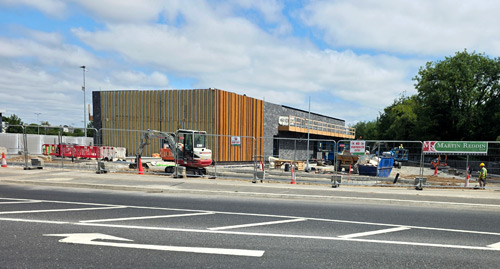
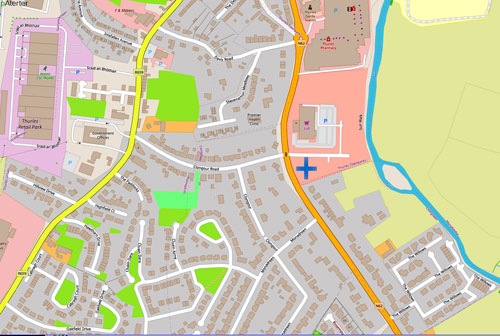
The opening will come almost one year after An Coimisiún Pleanála issued its final approval for the controversial development, bringing a lengthy planning process and months of local debate to an end. The new restaurant is being constructed on a former industrial site at the junction of Slievenamon Road and the now once again delayed “Thurles Relief Road“, close to the Lidl supermarket and approximately 700 metres from Thurles town centre.
Plans provide for a single-storey restaurant measuring almost 479 square metres, together with a drive-thru lane, customer-ordering points, digital menu boards, car parking, accessible spaces, electric-vehicle charging bays and bicycle parking. The development will also include outdoor seating, landscaping, lighting, signage, an electricity substation and changes to the existing vehicle entrance from the relief road.
Recruitment Begins Ahead of August Launch. McDonald’s has begun recruiting full-time and part-time staff members for the new Thurles restaurant. The recruitment advertisement confirms the August 19th opening date and states that successful applicants will receive paid training at other nearby McDonald’s restaurants during the weeks leading up to the launch. Advertised hourly pay for some adult employees is up to €14.25, depending on age and the terms of the new positions. The recruitment drive is expected to create a significant number of new low paid hospitality jobs in the Thurles area, although the company has not publicly confirmed the restaurant’s total anticipated workforce.
Plans Attracted More Than 20 Objections. McDonald’s Restaurants of Ireland submitted its planning application for the Thurles development in September 2024. The proposal proved controversial from the beginning, attracting more than 20 objections from residents and other interested parties. Concerns raised during the initial planning process included the location of the outlet, traffic levels, road safety, litter, noise, opening hours and the proximity of the proposed restaurant to residential properties and childcare facilities. Some objectors also raised public-health concerns relating to fast food and childhood obesity. The development was originally intended to operate around the clock. However, permission ultimately restricted its opening hours to between 6am and 10pm, meaning the Thurles restaurant will not be permitted to trade on a 24-hour basis.
Tipperary County Council initially sought additional information from the applicant, including further details concerning traffic and the proposed operation of the development. Documents submitted during that stage included an analysis indicating that the site would have space for a queue of approximately 32 vehicles, before waiting traffic would potentially reach the adjoining public road.
Council Permission Was Appealed Tipperary County Council granted permission for the restaurant, subject to conditions, on April 9th, 2025. That decision was subsequently appealed to the national planning authority by a third party, while a number of additional observations were submitted for consideration. An Coimisiún Pleanála examined issues including traffic and pedestrian safety, flood risk, residential amenity, visual impact, town-centre development and the site’s proximity to the River Suir and the Lower River Suir Special Area of Conservation. The Commission issued its decision on August 26th, 2025, upholding the council’s decision and granting permission with revised conditions. In its formal order, the planning body determined that the development would not seriously damage the amenities of nearby properties or create unacceptable risks in relation to public health, flooding, traffic, pedestrian safety or visual amenity. It also considered the mixed-use zoning of the former industrial land, Thurles’s status as a key regional town and the planning policies applying to the area.
Construction Work Underway Site-clearance activity began in early 2026, allowing construction of the restaurant and associated infrastructure to proceed. Information published locally indicated that the principal works were expected to take place between February and July, leaving several weeks for completion, staff training and final preparations before the planned August opening. The development represents the latest chapter in efforts to bring a McDonald’s outlet to the former Erin Foods lands. A previous application connected to a proposed drive-thru restaurant at the wider site was submitted as far back as 2020 but was deemed incomplete shortly afterwards.
While the current project has continued to divide opinion locally, the August opening will introduce one of the world’s largest fast-food brands to Thurles and hopefully provide new employment opportunities for the town For supporters, the development represents investment, additional consumer choice and the productive reuse of former industrial land. For critics, concerns about traffic, litter, public health, late-evening activity and the effect of drive-thru development on the character of the area remain.
Barring any construction or operational delays, the first customers are expected to be welcomed through the doors of the new Thurles McDonald’s on August 19th.
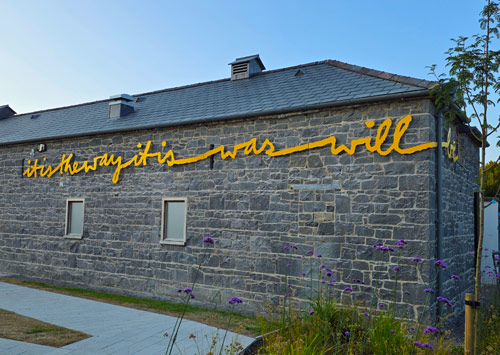
The above words are placed so beautifully and appropriately that it would be difficult to imagine a better setting.
Written in glowing golden script across the weathered limestone, the inscription seems almost to float upon the old walls; not merely as a sign, but as a quiet conversation between what has been, what is now and what is still to come. This striking artwork adorns the carefully restored 1849 stone old farm building in what is now Thurles Market Quarter. Once a modest agricultural shed, shaped by work, weather and generations of local life, it has now been lovingly reborn as ONE19 Coffee House & Restaurant.
West side of “One19 Restaurant”, Cathedral Street,Thurles, Co. Tipperary.
Its transformation has thankfully not erased its past. Instead, the old stone, the traditional form of the building and the marks of age have been allowed to remain, lending great warmth and authenticity to its new life. What was once a place of labour has become a place of welcome; a setting for coffee, food, conversation, friendship and new memories.
Its location gives the inscription an even deeper resonance. The building stands between two other landmarks, both woven into the spiritual and educational heritage of Thurles: the Cathedral of the Assumption and the former St Patrick’s College, now part of Mary Immaculate College. In such surroundings, the words/phrase naturally carry an almost sacred rhythm. They are not a direct quotation from Scripture, yet they gently recall the ancient Christian doxology:-“As it was in the beginning, is now, and ever shall be, world without end.” They also echo the language of the Book of Revelation, which describes God as the one “who is and who was and who is to come.”
Yet the sentiment has travelled beyond religious tradition and into popular culture. A closely related line, “That’s the way it is, was and will be”, introduces the established order of Sneetch society in the 2017 musical adaptation of Dr. Seuss’s “The Sneetches”. Dr. Seuss’s original 1961 story, later adapted for television in 1973, ultimately challenges the belief that society must always remain as it has been. The ‘Sneetches’ learn that inherited divisions are neither natural nor permanent and that even “the way it was”, can be changed.
The wording also appears with a more playful and satirical flavour in the 1974 comedy film “The Groove Tube”, where a fictional television newscaster signs off: “And that’s the way it is, was, and will be.” There, the phrase humorously imitates the certainty and authority of traditional television news.
Placed upon this restored building, however, the words take on a gentler and more romantic meaning. The stone remembers farm carts, tools, harvests and working hands. Today, those same walls shelter laughter, conversation and the aroma of freshly brewed coffee and hastily produced food. Tomorrow, they will hold stories belonging to generations not yet born.
The way it was: A humble building serving the life of the land. The way it is: A beautifully renewed gathering place in the heart of Thurles. The way it will be: A cherished part of Thurles town’s story for many years to come.
At dusk, when the golden lettering shines against the cool grey stone, it feels as though the building itself is speaking. Not mourning what has passed. Not resisting what has changed. Simply acknowledging that the past, present and future can inhabit the same place beautifully. An old building saved rather than forgotten. A historic quarter renewed rather than replaced unlike the towns Great Famine “Double Ditch“. A little philosophy, faith and humour written in golden light.
This website uses cookies to improve your experience. We'll assume you're ok with this, but you can opt-out if you wish.AcceptRead More
Privacy & Cookies Policy
Privacy Overview
This website uses cookies to improve your experience while you navigate through the website. Out of these, the cookies that are categorized as necessary are stored on your browser as they are essential for the working of basic functionalities of the website. We also use third-party cookies that help us analyze and understand how you use this website. These cookies will be stored in your browser only with your consent. You also have the option to opt-out of these cookies. But opting out of some of these cookies may affect your browsing experience.
Necessary cookies are absolutely essential for the website to function properly. This category only includes cookies that ensures basic functionalities and security features of the website. These cookies do not store any personal information.
Any cookies that may not be particularly necessary for the website to function and is used specifically to collect user personal data via analytics, ads, other embedded contents are termed as non-necessary cookies. It is mandatory to procure user consent prior to running these cookies on your website.






Recent Comments