For years, the people of Thurles have heard announcements, assurances and political claims about the Inner Relief Road and the long-promised Outer Ring Road. Yet despite all the publicity and political celebration, Thurles still has no completed Inner relief road, no Outer Ring Road and no binding construction timetable that the public can honestly rely upon.
Mr Michael Lowry TD and Mr Ryan O’Meara TD, who both support the present government, must now accept political responsibility for the continuing lack of measurable progress. Meetings, press releases and statements welcoming developments are not substitutes for an approved budget, completed design, signed construction contract and machinery working on site.
Tipperary County Council describes the Inner Relief Road as approximately 1.1 kilometres of new road linking the N62 at Slievenamon Road with Mill Road. The scheme includes a new bridge over the River Suir, several junctions and associated flood-relief works. However, the council’s May 2026 management report still stated that Department of Transport approval was required before the project could proceed to detailed design and construction.
Any suggestions from other readers?
Inner Relief Road: The public was informed that the Inner Relief Road may be “ready for construction” in 2027. That wording does not provide a guaranteed completion date. If approvals, design work, procurement and funding continue to slip, there is a genuine danger that construction will not commence before 2030.
Outer Ring Road/Thurles Bypass: The situation surrounding the Outer Ring Road is even more concerning. Mr Michael Lowry has said that the Thurles bypass will advance through design and planning and that he will insist it is “ready for construction in 2030.”
That is not a promise that the road will be built or opened by 2030. The scheme remains at a very early development stage, despite the need for a bypass having been recognised as necessary, some 40 years ago or more.
If the shorter and more advanced Inner Relief Road cannot be brought promptly to construction, how can the public have confidence that the much larger and longer Outer Ring Road will be construction-ready by 2030? The Thurles electorate are not fools.
There must also be accountability for the loss of the historic Great Famine “Double Ditch” at Mill Road. Local heritage campaigners described and proved it to be a famine-era pathway dating from approximately 1846, constructed as relief work for impoverished and starving people and later used as a right of way and Mass path.
Concerns were raised publicly from 2020 onward, that the proposed Inner Relief Road would seriously damage or destroy this locally significant landscape feature. The tragedy now is that part of Thurles’s tangible Famine heritage appears to have been sacrificed for a road that, years later, has still not been delivered. Whatever disagreement may exist about its formal archaeological status, the failure to preserve, commemorate or meaningfully incorporate the “Double Ditch” into the project represents a serious loss to Thurles town’s historical memory.
Meanwhile, HGVs will continue entering Thurles every day. Even after a bypass is eventually constructed, some heavy vehicles will still need to enter the town to supply supermarkets, shops, hotels, restaurants, construction sites and other local businesses. These essential deliveries cannot simply be prohibited.
However, there is an important difference between HGVs that must enter Thurles to supply local businesses and heavy through-traffic that has no business being in the town centre. In the absence of proper alternative routes, both types of traffic continue to use the same narrow medieval streets and junctions.
The council’s own transport planning identifies the effect of through-traffic on Thurles and recognises the need for relief and bypass infrastructure. The Local Transport Plan presents the Inner Relief Road and a town bypass as important elements of the future transport network.
Regrettably, local elected representatives and county councillors have failed to grasp—or act upon—the urgency of this critical issue.
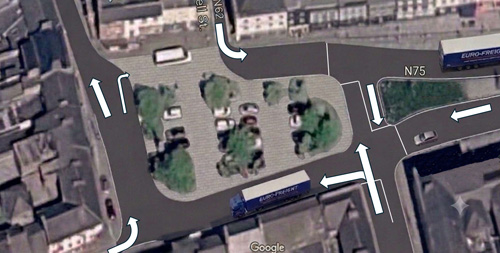
No redesign of Liberty Square can really solve the underlying problem. Wider footpaths, altered parking arrangements, crossings and junction changes may improve the visual appearance and pedestrian environment, but they cannot create a proper alternative route for strategic traffic.
Without the Inner Relief Road and Outer Ring Road, attempts to improve traffic movement in Liberty Square, risk becoming little more than a rearrangement of the same congestion.
Mr Michael Lowry TD and Mr Ryan O’Meara TD must now jointly secure and publish:
► Final Department approval for the Inner Relief Road;
► A fully funded programme for detailed design and construction;
► Firm construction commencement and estimated completion dates;
► Immediate progression of the Outer Ring Road through its formal planning and approval stages;
► An interim HGV-management plan separating essential local deliveries from avoidable through-traffic;
► A permanent memorial or heritage interpretation scheme acknowledging the Great Famine “Double Ditch” and the people whose suffering and labour it represented.
Thurles has already lost an irreplaceable piece of its Famine-era heritage. It must not now be left with neither the historic “Double Ditch” nor the road whose development was used to justify its loss. A plaque of some description must now be constructed recognising its once construction and recent destruction.
Thurles does not need more political celebration of mere preliminary steps, which is all our local politicians have had to offer their electorate over the past 40 years. It needs approvals, funding, contracts, construction and most of all accountability.





Leave a Reply