“Look up at the stars, not down at your feet. Try to make sense of what you see, and be curious.” Quote: late Stephen Hawking [1942 – 2018]. “We are all in the gutter, but some of us are looking at the stars.” Late Irish author Oscar Wilde, [1854 – 1900], (Lady Windermere’s Fan).
Residents across Tipperary are being encouraged to look skyward this evening as Ireland prepares for one of its most memorable astronomical displays in decades.
A deep partial solar eclipse will unfold between approximately 6.10pm and 8.10pm, reaching its maximum shortly after 7pm. Exact timings and the amount of the Sun covered will vary slightly from place to place as the Moon’s shadow travels across the country.
Although Ireland lies outside the path of totality, the spectacle will still be dramatic. The Moon is expected to hide well over 90 per cent of the Sun from Irish observers. Only a thin, bright crescent will remain visible at the height of the event, producing an unusual change in daylight and possibly a noticeable dip in temperature.
The eclipse is especially important because Ireland will not experience another comparable solar event until 2090. It offers families, schools and amateur astronomers a rare opportunity to witness the movements of the Sun, Moon and Earth directly.
People in Tipperary should choose a viewing location with a clear outlook facing towards the western sky. Open countryside and elevated areas may provide better prospects, provided they can be reached safely. Clouds are forecast in parts of the Premier County, but even brief breaks could reveal the shrinking solar crescent.
Eye protection is essential throughout the eclipse. Looking directly at the Sun, even when most of it is hidden, can cause permanent damage to eyesight. Ordinary sunglasses, smoked glass and homemade filters are not safe. Observers should use undamaged eclipse glasses meeting the ISO 12312-2 safety standard or watch indirectly with a pinhole projector. Cameras, binoculars and telescopes require purpose-made solar filters attached securely to the front. Eclipse glasses alone do not make magnifying equipment safe.
Ireland will see a partial eclipse because the narrow path in which the Sun is completely concealed passes through areas including Greenland, Iceland and northern Spain. Nevertheless, the Royal Observatory Greenwich says roughly 90 to 96 per cent of the Sun will be covered across Ireland and the UK, making this the deepest partial eclipse seen from these islands in almost 27 years. Royal Observatory Greenwich
The entertainment will not end at sunset. During the night of August 12th into the morning of August 13th, the annual Perseid meteor shower will reach its peak. The Perseids occur when Earth passes through debris left behind by Comet 109P/Swift-Tuttle. Tiny particles strike the atmosphere at tremendous speed, heat up and produce the bright streaks commonly called shooting stars. Under ideal dark-sky conditions, observers may see dozens of meteors in an hour, although actual numbers can vary.
Conditions are unusually favourable in 2026 because the shower coincides with a new Moon. Thus, with virtually no strong moonlight washing out the fainter meteors, cloud cover and artificial lighting will only be the main obstacles. The strongest viewing window is expected between midnight and dawn.
No telescope is needed for the Perseids. Viewers should find a safe, dark location away from street lights; allow at least 20 minutes for their eyes to adjust and watch as much of the sky as possible. A reclining chair and patience will make the experience more comfortable.
If Tipperary’s clouds cooperate, residents could witness two remarkable spectacles within a matter of hours; an almost vanished Sun in the evening and a stream of meteors after midnight.
One Council Restores History While Another Erases It – The Loss of Thurles’s Famine Double Ditch.
The decision by Dún Laoghaire-Rathdown County Council to spend approximately €660,000plus VAT restoring a historic ha-ha wall in Marlay Park (latter a sunken landscape boundary that uses a hidden trench and a vertical retaining wall), has understandably generated debate. The 197-metre structure, believed to date from the early nineteenth century, was designed to separate landscaped gardens from grazing animals without interrupting views across the estate. Much of its original locally sourced granite survived beneath vegetation, but the wall had fallen into disrepair. Restoration required specialist conservation work, dismantling and rebuilding sections of dry-stone wall, repairing the ditch and incorporating drainage infrastructure. The original contract was valued at €625,398 excluding VAT, with the final estimate rising to €660,374 following delays, unsuitable ground material, severe weather and difficulties obtaining appropriate stone.
Local construction professionals and taxpayers are entitled to question whether that represents value for money. Public bodies must explain how costs are calculated, why projects exceed their initial budgets and whether procurement arrangements adequately protect the public purse. Dún Laoghaire-Rathdown County Council has already faced criticism over the €753,528 cost of works at an entrance to Deerpark in Mount Merrion. That project is frequently described as the construction of “14 steps”, although the council says it also included a wheelchair-accessible ramp, retaining walls, granite paving, seating, landscaping, pedestrian crossings, road resurfacing, drainage, traffic-signal equipment and other public-realm works. The criticism of these costs is legitimate. Nevertheless, one important fact should not be forgotten: Dún Laoghaire-Rathdown County Council recognised that an historic structure was worth preserving.
That approach stands in painful contrast to what happened in Thurles.
The Thurles Great Famine Double Ditch was regarded locally as a rare surviving famine-era landscape feature. Local historical accounts date its construction accurately to 1846 and associate it with relief work provided to men and boys during the Great Famine. Rather than representing the landscaped elegance of a wealthy Dublin estate, this Double Ditch recalled hunger, poverty and the desperate struggle of local families to survive. It was not simply an old embankment. It was a physical connection with one of the darkest periods in Irish history. For generations, the route was also described locally as a public walkway and Mass path. Campaigners argued that it formed part of the social history of Thurles and should have been incorporated into a protected heritage trail.
Despite repeated warnings, the entire section of the Double Ditch was cleared in March 2022 supported by local councillors, as part of works connected with as yet a non existent, only proposed Thurles inner relief road. Contemporary photographs and local reporting showed mature vegetation being removed and the historic landscape feature being levelled by machinery.
Historic Thurles Double Ditch Eradicated in 2022. Pic. G.Willoughby.
Once such a structure is destroyed, it cannot truly be recreated. A replica might reproduce its approximate appearance, but it cannot restore the original stones, soil, boundaries and physical connection with the people who constructed it during the Great Famine.
This is the real loss suffered by Thurles. Tipperary County Council regularly speaks about protecting heritage and connecting communities with their past. Yet the treatment of the Double Ditch demonstrates the gulf that can exist between heritage policies and decisions taken on the ground. Roads and development are necessary, but heritage protection does not require a complete rejection of progress. It requires imagination, consultation and a willingness to examine alternative designs before destruction becomes inevitable.
The contrast between the two councils is striking. In Dublin, hundreds of thousands of euro are being spent restoring an aristocratic landscape feature. In Thurles, a structure associated with ordinary people surviving the Great Famine was treated as totally expendable. The Marlay Park bill deserves detailed scrutiny. So does every major publicly funded project. But the principle of conserving historic structures should be welcomed.
Led by the denials of elected councillors; mainly Mr Michaél Lowry (Non Party), Mr Sean Ryan (FF) and Mr Seamus Hanafin (FF), together with senior council officials, through wilful ignorance, self-deception, blind persistence and despite knowing better oversaw this reckless destruction. Thus the tragedy in Thurles is that the debate never reached the question of restoration costs.
The Double Ditch was not protected long enough for restoration to become an option. Dún Laoghaire–Rathdown County Council may reasonably be criticised for excessive costs. Tipperary County Council should be criticised for allowing irreplaceable local history to be destroyed.
One council appears willing to spend too much preserving history. The other did too little before all of that history was totally eradicated and lost forever.
Neither approach represents good stewardship of public money or public heritage, and the waste continues without the consent of the Irish taxpayer.
History does not repeat itself exactly, but it often rhymes in the ways hatred is excused, renamed, or redirected.
In the autumn of 1941, a ravine on the edge of Kyiv became one of the most devastating killing sites of the Holocaust. German forces had occupied the city on September 19th, and within days the Nazi campaign of persecution turned into mass murder. Notices appeared ordering Kyiv’s Jews to report with documents, clothing, money, and valuables. Many believed they were being deported or resettled. Instead, they were being led to Babi Yar.
On September 29th and 30th, Jewish families moved through the city in long, fearful columns. Parents carried children. Elderly people walked beside relatives. Others brought small bundles containing whatever remained of their lives. At the ravine, they were stripped of their possessions and clothing, forced toward the edge in groups, and shot. In only two days, 33,771 Jewish men, women, and children were murdered there, making Babi Yar one of the largest single massacres of the Holocaust.
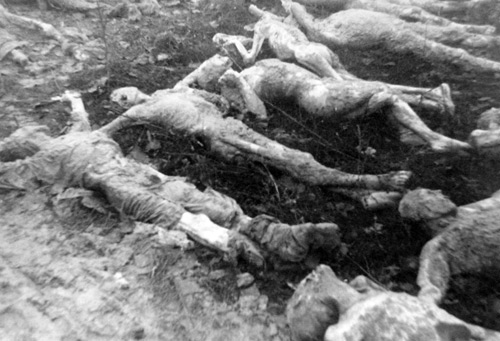
Section of bodies photographed at the mass grave in Babi Yar, Ukraine, by Soviet researchers, three years later in 1944.
The killing did not end with those two days. During the Nazi occupation, Babi Yar continued to be used as an execution site. Jews who had survived or hidden were later brought there and killed. Soviet prisoners of war, Roma people, resistance members, civilians, and others targeted by the occupiers were also murdered in or near the ravine. What had once been a natural landmark became a mass grave and a symbol of the “Holocaust by bullets,” the campaign of open-air shootings carried out across Nazi-occupied Eastern Europe.
After the war, Babi Yar’s memory was itself subjected to silence. Under Soviet rule, public commemoration often avoided naming the Jewish victims specifically, presenting the dead mainly as Soviet citizens. For survivors, relatives, and historians, this omission deepened the wound. The ravine held not only the bodies of the murdered but also a history that official memory struggled to acknowledge.
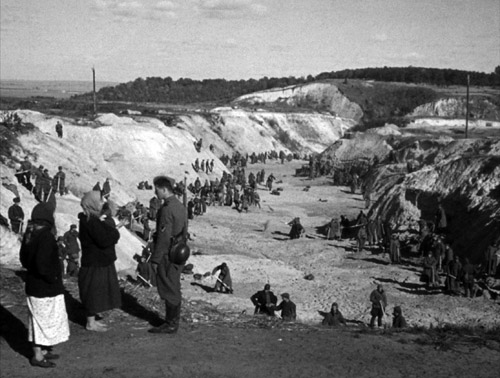
Soviet POWs being used by Germany to cover the mass grave after the massacre, on October 1st 1941. Pic: Johannes Hähle.
Today, Babi Yar stands as a place of mourning and warning. Its story reveals how quickly ordinary streets can become routes to destruction when hatred is organised by the state and human beings are reduced to targets. Behind the number 33,771 were families, neighbours, children, workers, students, grandparents, and entire communities whose lives were ended together at the edge of a ravine. To remember Babi Yar is to restore their humanity against the machinery that tried to erase them.
That silence also speaks to the present. History does not repeat itself exactly, but it often rhymes in the ways hatred is excused, renamed, or redirected. Anti-Semitism rarely begins with violence at the edge of a ravine. It begins with language that turns Jews into a collective blame, with suspicion cast over Jewish identity, with the idea that Jewish fear is exaggerated, or that hostility toward Jews can be justified by events elsewhere. In Ireland today, where public feeling about Israel and Gaza is often intense, there must still be a clear moral line; criticism of any government is legitimate, but blaming Irish Jews for the actions of the Israeli state, intimidating Jewish people, distorting Holocaust memory, or treating Jewish belonging as conditional is antisemitism.
To remember Babi Yar is therefore not only to look back at 1941, but to ask what kind of society we are becoming now. The lesson is not that today is the same as then; it is that dehumanisation must be challenged long before it becomes catastrophe. A country can defend Palestinian lives and rights while also defending Jewish safety, dignity, memory, and belonging.
The measure of moral seriousness is whether we can hold both truths at once, refusing to let grief for one people become hatred of another.
Tipperary filmmaker Anne Williamson has won international recognition in Los Angeles for her short film Bridget, a powerful drama based on the life and death of Bridget Cleary, who was murdered in Co Tipperary in 1895.
Ms Williamson, from Mullinahone, Co Tipperary, directed and co-wrote the film, which revisits one of Ireland’s most haunting historical stories. Bridget tells of the murder of 26-year-old Bridget Cleary, who was killed by her husband, Michael Cleary, after he claimed she had been taken by fairies and replaced by a changeling.
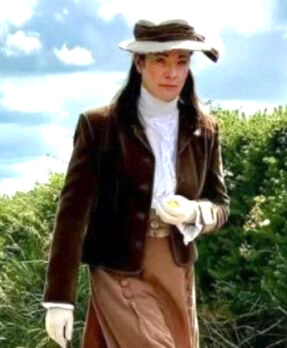
The film was co-written by Williamson and Brian Clancy from Clooneen and was filmed by cinematographer Louis Buggy of Diceman Films. It combines a modern-day introduction, filmed in colour, with a striking black-and-white historical retelling of the events surrounding Bridget’s death.
Speaking at a recent screening of the film at the Abymill Theatre in Fethard, Co. Tipperary, Ms Williamson said the story had stayed with her since childhood. “It was always a story that fascinated me from listening to stories my grandfather told me when I was a child,” she said. “It was always a tale that tore at my heart strings — the fact that Bridget was burned and buried in the middle of the night with no mourners. It always got to me that she was wronged.”
Ms Williamson travelled to Los Angeles with cast members Vicky Maher, who plays Bridget Cleary; John Peter Morris, who plays Michael Cleary; and Deirdre De Búrca, who plays a local gossip. All three were present at the Regal Theatre in Los Angeles when Williamson collected her award.
The production features performances from members of the Fionn MacCumhaill Players from south Tipperary. The cast also includes young actor Cathal Fahey as Danny, Mark Fitzgerald as his father, and Eugene O’Meara as his grandfather, who introduces the story.
The drama includes an original ballad, ‘The Maid of Old Clooneen’, written and performed by Dublin folk singer Chris Kavanagh.
Local support for the film has been strong, with cast and crew members receiving messages of congratulations from across Ireland and abroad following Ms Williamson’s success in Los Angeles.
Fethard undertaker and publican Mr Jasper Murphy, who plays a priest in the film, said the award had brought great pride to everyone involved.
Bridget shines a new light on the Bridget Cleary story, seeking to restore dignity to a young woman whose death shocked Ireland and became known around the world. Through the dedication of local writers, actors, musicians and film makers, the film brings this tragic chapter of Tipperary history to a new international audience.
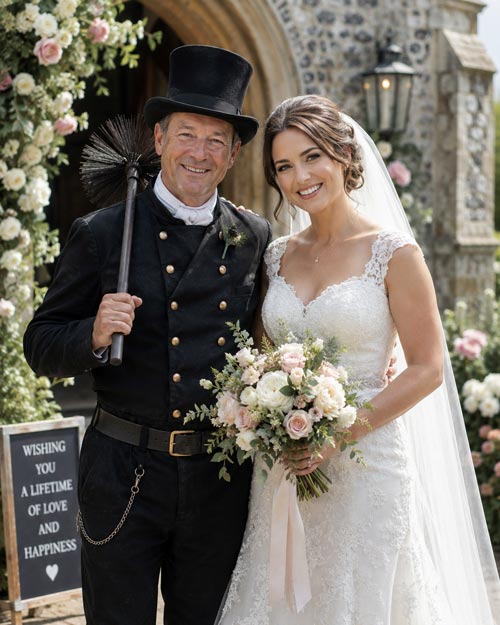
There was once an old wedding tradition that believed it was good luck for a bride and groom to meet a chimney sweep on their wedding day. The story is often linked to a royal legend: a chimney sweep is said to have helped save a king from runaway horses, after which sweeps became known as bringers of good fortune. Whether the tale is fact or folklore, the symbolism is easy to understand. The sweep was connected with the hearth, the fire, and the warmth of the home; all powerful images for a newly married couple beginning life together.
Today, this tradition has become a charming wedding extra. A chimney sweep may appear outside the church, registry office, or wedding venue to greet the couple, shake hands with the groom, kiss the bride on the cheek, pose for photographs, and offer a few words of good luck. It is unusual, memorable, and full of character, exactly the kind of detail many couples now look for when planning a wedding. Wedding venues and professional photographers could also adopt the idea as an added service for couples looking for something traditional, quirky, and memorable.
“Wishing you a lifetime of love, luck, and happiness.”
A venue might offer a “lucky chimney sweep” as part of a heritage or vintage wedding package, while photographers could suggest it as a characterful photo opportunity after the ceremony. Some couples may worry about soot marking the bride’s white dress, but this can be easily avoided. The sweep can arrive in clean ceremonial clothing, use a display brush rather than a working one, avoid close contact with the dress, and pose carefully at the bride’s side. With a little planning, the charm of the tradition can be kept without any risk to the gown.
For modern chimney sweeps, this old custom could also offer a useful additional income stream. The trade is changing. With cleaner heating policies, reduced reliance on fossil fuels, and the gradual move toward low-carbon homes, traditional chimney work is not the same as it once was. Gas, oil, coal, wood, and smokeless-fuel use are all under closer environmental scrutiny, and many households are moving toward heat pumps, better insulation, and electric heating. At the same time, sweeps remain important for homes with working fireplaces, wood burners, and multifuel stoves, where regular sweeping is still essential for safety.
That creates a challenge but also an opportunity. A wedding appearance does not replace the practical work of chimney sweeping, but it can sit alongside it. It makes use of the sweep’s traditional clothing, local reputation, storytelling, and historic image. It can be offered as a weekend or seasonal service, especially during the spring and summer wedding months, when demand for chimney maintenance may be lower.
A Chimney Sweep could offer packages such as: ► A lucky sweep appearance after the ceremony. ► Photographs with the bride and groom. ► A short traditional blessing or good-luck greeting. ► A certificate or keepsake for the couple. ► Optional attendance at the reception for photos with guests.
The idea works especially well for historic venues, country weddings, church weddings, vintage-themed ceremonies, and couples who want something different from the usual wedding entertainment. It also gives younger generations a chance to see a trade that was once central to everyday life but is now becoming less visible. In that sense, the wedding chimney sweep is more than a novelty. It is a way of keeping an old craft in public view, preserving folklore, and helping working sweeps adapt as heating habits change.
For chimney sweeps looking to diversify, the message is simple: the soot may be less common, but the story still has value. A clean chimney keeps a home safe; a lucky sweep at a wedding brings a smile, a photograph, and a tradition that couples will remember for years.
“Come on, lads — let’s bring a little imagination to wedding events.”
This website uses cookies to improve your experience. We'll assume you're ok with this, but you can opt-out if you wish.AcceptRead More
Privacy & Cookies Policy
Privacy Overview
This website uses cookies to improve your experience while you navigate through the website. Out of these, the cookies that are categorized as necessary are stored on your browser as they are essential for the working of basic functionalities of the website. We also use third-party cookies that help us analyze and understand how you use this website. These cookies will be stored in your browser only with your consent. You also have the option to opt-out of these cookies. But opting out of some of these cookies may affect your browsing experience.
Necessary cookies are absolutely essential for the website to function properly. This category only includes cookies that ensures basic functionalities and security features of the website. These cookies do not store any personal information.
Any cookies that may not be particularly necessary for the website to function and is used specifically to collect user personal data via analytics, ads, other embedded contents are termed as non-necessary cookies. It is mandatory to procure user consent prior to running these cookies on your website.





Recent Comments