|
|
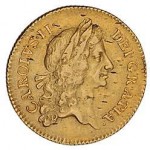 Charles II Gold Coin A hoard of some eighty one gold coins, described as a ‘significant’ discovery by the National Museum, has been found here in Co Tipperary.
The coins, made of pure gold and dating from the early 1600’s through to the early 1700’s, were discovered close to the foundations of a fire damaged pub on the Main Street in Carrick-on-Suir in South Tipperary.
The coins, which were located by workmen digging a support foundation at the licensed premises, following a fire, are described as being in excellent condition and were located without any form of wrapping or container, approximately two feet below the surface of the floor area.
A further search of the area by museum experts has located no other artefacts of significance.
The actual value of the coins found, now in the care of the National Museum in Dublin, have as yet to be estimated.
Local Police were called to the scene by employees who made this find, while working on the site.
Julia Kavanagh (Born this day, 7th January 1824 – Died 28th October 1877) was an Irish Novelist & Biographer, born in Thurles, Co Tipperary, the only child to parents, Dublin born Morgan, Peter (Latter his Confirmation Name) Kavanagh (Irish author, poet, and novelist 1800 – 1874) and Bridget (née Fitzpatrick, latter who died 1888).
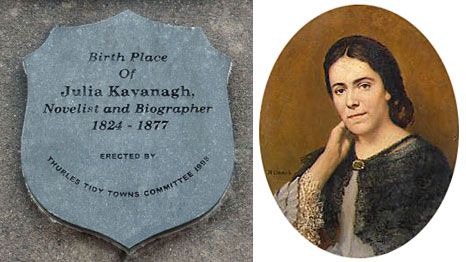 Her once small house sadly no longer exists, but stood at what is today the entrance to the Presentation Convent Secondary School, close to the junction leading from Cathedral Street into Mitchel Street, here in Thurles, Co. Tipperary. Her once small house sadly no longer exists, but stood at what is today the entrance to the Presentation Convent Secondary School, close to the junction leading from Cathedral Street into Mitchel Street, here in Thurles, Co. Tipperary.
An Irish Catholic, life for the young Miss Kavanagh was hard. She was partially crippled from youth (curvature of the spine), nevertheless she, through her own genius and strong connections, would carve out a successful career as a novelist, biographer and travel writer.
Her parents were married in 1823 and moved with Julia from Thurles to London, her father possibly as a teacher of languages. In late 1825 or early 1826 they moved to Paris, before returning to London again in 1837. When they returned to London, over the next year Morgan arranged for Julia to receive special treatment for her spinal problem. They returned to Paris in 1839 and stayed there until the early 1840s. It was during this early life with her parents in Paris, that Julia conquered her initial mastery of the French language and her remarkable insight into French modes of thinking, which was then perfected by her later long residences in Paris, Rouen and Nice.
Morgan was alone when he lived at 28 Dean Street, London in the early 1850s. Julia and her mother had parted from Morgan around 1846 and neither Julia or her mother are listed in the 1851 census for that address.
It was at this same address (28 Dean Street, Soho) that her father would become landlord & sub-lets two rooms to atheist Karl Marx, in Dec. 1850. This same address would also be the location at which Marx would write ‘Das Kapital,’ (1867) with the assistance of fellow revolutionary socialist Friedrich Engels. It was to here also that Friedrich Engels would send postal orders for £1 or £5 notes, each cut in half and sealed in separate envelopes, to avoid postal theft and in order that the impoverished and resident Marx family could pay their rent and continue to survive.
Note: Today, 26-29 Dean Street Soho, London, houses the famous restaurant “Quo Vadis,” (Latin: “Where are you going?”).
Julia now began to support herself and her invalid mother Bridget, with her writing career. Her first book was entitled “The Three Paths (1847), a story for the young, however her first work to attract the attention of her large readership was “Madeleine, a Tale of Auvergne,” (1848), a story of “heroic charity and living faith founded on fact.”
Her other works included; “Woman in France during the 18th Century,” (1850), “Nathalie,” (1851), “Women of Christianity,” (1852), “Daisy Burns,” (1853), “Rachel Gray,” (1855), “Adele,” (1857), “A Summer and Winter in the Two Sicilies,” (1858), “French Women of Letters,” & “English Women of Letters” (1862), “Queen Mab,” (1863), “Beatrice,” (1865) “Dora,” (1868), “Silvia,” (1870), “Bessie,” (1872), “John Dorrien,” (1875) & finally following her death, unmarried, on October 28th, 1877, at Nice, France, “Forget-Me-Nots,” (1878, a posthumous edition with preface by C. W. Wood)
Outside of her life as a novelist, her years appear rather uneventful, with a great part of her time devoted to the care of her invalid & later widowed mother. At the outbreak of the Franco-German War around 1870, Julia with her mother, both of whom were resident in Paris, moved to Rouen and then to Nice, where she died in her fifty-fourth year, following an accident, having fallen from her bed. Julia’s last words are reported to have been spoken in French: “Oh Mama! How silly I am to have fallen….”
Her mother Bridget continued to live in Nice until her death in 1888, but how she managed to cope financially after Julia’s death is not known. However, in 1884 Bridget donated a painting of Julia, by French artist Henri Chanet (dated 1875), to the National Gallery of Ireland.
Julia’s father is known to have entered into a common-law marriage with one Marie Rose in about 1856 and they had three children; Alfred, Matilda and Alexander Morgan. Her father died in 1874 and a Coroner’s Inquest, held at Islington, on February 14th 1874, indicates that, like Julia herself; his death was also caused by a fall.
Lest we forget, today marks the 40th anniversary of the Sackville Street bombing, which took place in Dublin forty years ago, on the 1st December 1972. A Fethard, & Co. Tipperary native was one of two victims who lost their lives in this tragic event.
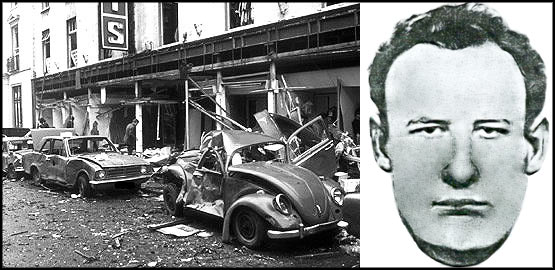 George Bradshaw was just a young man of 29 years, when he was brutally murdered in this Dublin Street, his only crime, being there. George Bradshaw was just a young man of 29 years, when he was brutally murdered in this Dublin Street, his only crime, being there.
George had married his wife Kathleen, a nurse from Belfast and a mother of two young children, Lynn and Rory. He was employed as a bus driver with CIE and the family had only moved to Dublin less than two years previously, when this unforgivable tragedy occurred.
George was working the late shift that December night when at around 8.00pm a bomb exploded on Dublin’s Eden Quay. When the CIE canteen was evacuated, George and a colleague were caught in the blast of a second bomb, containing an estimated 100lbs of high explosives, which had been placed in a rented car parked on Sackville Place.
It was established that this car bomb which exploded in Sackville Place was a silver-grey Fort Escort Registered No. 9551-VZ . The Irish police investigation, carried out in Belfast, revealed that the car had been hired on the 30th November 1972, from Moley’s Car Hire Firm, 49 Victoria Square, Belfast, at 9.00 a.m. on 30/11/72, by a man using a stolen driver’s licence in the name of one Joseph Fleming.
A Photo-fit illustration of the man, described as the hirer of this silver/grey Escort motor car, was issued. (See Picture above.)
A description of the man was also issued, stating he was 40 years old, 6ft tall, weighing 14-15 stone, with round reddish face, fair hair thinning on top and receding. He was wearing a modern style, brown coloured gabardine over coat, was of well dressed appearance, and was perceived as a business man. He spoke with a cultured North of Ireland or English accent.
It is now claimed that Loyalists, aided by British intelligence, carried out this civilian murder, in an attempt to force the Irish government to crack down on paramilitaries. On that day the Dáil was debating the introduction of “The Offences Against the State Act.” As this news filtered through into Leinster House, Fine Gael decided to drop their objections to this Bill, resulting in it being passed with little opposition dissent.
No one has ever been convicted for this brutal murder and a wreath laying ceremony will now take place at Sackville Place on Tuesday next, in the presence of the Lord Mayor of Dublin, the CEO of Dublin Bus, Justice for the Forgotten together with members of the victim’s family.
Go ndéana Dia trócaire ar a anam dílis.
Thurles native, and always a welcome contributor to Thurles.Info, Mr Proinsias Barrett reflects romantically on Thurles, Tipperary, a changing Irish landscape and the life & times of Carlo (Charles) Bianconi (1786 – 1875).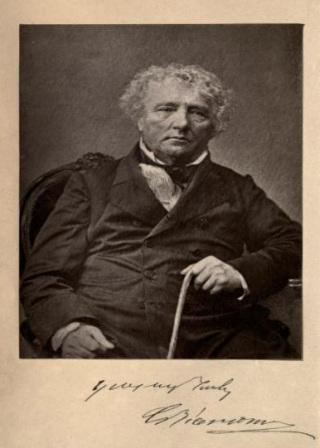
Proinsias writes; “The Thurles connection with Charles Bianconi is interesting because I was aware that a late 19th century ancestor of Brodericks ‘of The Ragg,’ also provided a service similar, albeit on a smaller scale, to Bianconi. We were often told growing up that Martin Broderick, whose father Patrick moved from the Horse & Jockey area of Tipperary circa 1850, had business dealings with Charles Bianconi and went on to develop a respectable hackney service himself. Family business dealings with Bianconi may have been in the form of taking over some routes once used by the Bianconi operation and the development of contacts along these various routes, where teams of horses could be changed and collected on long haul trips. In fact Martin Broderick often went from Thurles as far as Galway with customers.
This tradition of horses and stables continues to this day with Martin’s Grandson Austin Broderick and Austin’s son Gregory and sister Cheryl, both developing horses not for drawing carriages but for prize racing and show-jumping at Ballapatrick Stables.
But Martin Broderick of the Ragg was an exception at the time and I have often wondered why Irish men had not already established hackney services throughout Tipperary before Bianconi. If we look at the times then and the predisposition of the majority of Irish people we might find some answer to that question.
As the story reads Bianconi arrived in Ireland in 1802, hardly four years after the 1798 Rebellion and the terrible counter insurgency measures conducted throughout Tipperary by the then ‘High Sherrif,’ one Thomas Judkin Fitzgerald (Fitzgerald being a surname he took in order to lay claim to a will, his real name was Tomas Judkin Unicke.). Known as ‘The Flogger Fitzgerald,’ he conducted his free-hand ‘interrogations,’ without bias towards sex or age, assisted by local Landlords and Yeomanry commanders like the Carden’s or Otway’s or Armstrong’s.
Robert Emmet the Dublin Barrister had also attempted rebellion in 1801. Penal Law, which had largely been relaxed during the 1760’s was once again enforced. Catholics, or native Irish for example, could not own land, own a horse worth more than £5, or have any formal education in Ireland. Without these how could one access credit or show collateral. Bianconi in 1801 had entered a country where 90% of the population had few or no rights. Some Catholics did succeed in business, being fortunate enough to have received an education in France, but the general atmosphere of business and politics in Ireland at that time favoured those of the ascendancy class.
I wonder if the same laws would have applied to Carlo Bianconi, being Italian we must presume that he was a Roman Catholic.
Religion and politics aside, I recently came across some interesting descriptions of conditions in Ireland for the weary traveller during the 18th & 19th century, pertaining in particular to the weather and the roads.
A German called Henrich Boll who travelled Ireland during the early 19th century noted that ‘the rain here is absolute, magnificent and frightening, to call this rain bad weather is as inappropriate as to call scorching sunshine fine weather.‘ Two centuries earlier an English Soldier called Fynes Moryson wrote after a night watch before the battle of Kinsale: ‘It groweth now about 4 o’clock in the morning as colde as stone and as darke as pitche, and I pray, sir, whether this is a life that I much delight in.’
Another called Thomas Stafford wrote of the wind coming off the snow covered mountains of Munster which ‘tested the strong bodies, whereby many turned sick, and some unable to endure the extremity, died standing sentinel.’
The English traveller Twiss wrote in 1755 ‘the climate of Ireland is more moist than that of any other part of Europe, it generally rains for four or five days in the week for a few hours at a time; one can see a marvellous rainbow almost daily.’
From ancient times a system of roadways around Ireland later used by Normans and Elizabethans contained many important landmarks and areas of archaeological antiquity, most nowadays are forgotten or replaced or by-passed. The late 18th early 19th century Scottish traveller, Lithgow, described the discomfort of travelling in Ireland using these ‘toghers,’ or causeways, particularly during winter when every day his horse constantly sank to its girths in the boggy road, complaining that his saddle bags were destroyed. He often had to cross streams by swimming his horses; during a period of five months six of them died or were drowned. In the end he felt as worn out as any of his steeds.
Finally Peter Sommervill-Large who in 1973 took the walk from Bantry Bay in Cork to Leitrim in wintertime retracing the lamentable steps of Donal Cam O’Sullivan Beare, Lord of Beare and Bantry, who in December 1602 marched the 300 or so miles to the territory of the O’Rourke’s in Leitrim with a thousand followers, arriving 15 days later with just 35 followers remaining.
Sommervill-Large describes the countryside he passes through on the walk in 1973 with admirable endearment and his subsequent book was very well researched. After crossing the Shannon at Portumna, through Eyrecourt, Aughrim and Ballygar in the direction of Glinsk, he mentions something I found interesting; ‘[The landscape] soon changed into numerous little hills and hollows with farms tucked into their sides, linked by a system of un-tarred country lanes.’
When I took one at random, I found that walking through the mud and the long narrow puddles in the deep ruts was an unexpected pleasure. The old dirt road has an intimacy, an ageless sense of belonging to the scene, and nothing changes the whole tenor of rural life more quickly than a coating of tarmac.
All the wild places are coveted now and are becoming trimmed and neatened, and the smell of petrol and diesel drifts over the country; there are few roads left like those Synge used to walk along. It seems unnecessary to tie down every remote section of the countryside with these bands of iron. I suppose one day when about five or six un-tarred roads are left, they will be preserved as national monuments.”
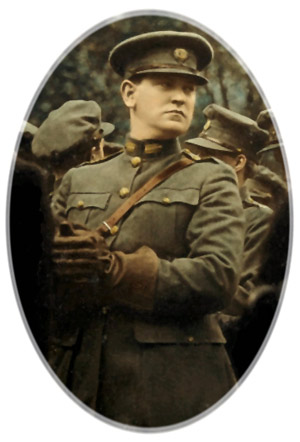 Portrait of Micheál Ó Coileáin (Michael Collins) It was in October of 1922 that the Irish Army Council decided to organise a census of National Forces, to be undertaken at midnight spanning the 12th & 13th November of that year. Its purpose was “To ascertain the exact strength of the National Forces by location, for administrative, logistical and operational purposes.”
Today, a full list of personnel in the Free State Army originally led by General Michael Collins is being currently launched on-line, on the website of the Defence Forces’ Military Archives.
When the site is complete the full contents of Ireland’s first, and indeed only military census, which was compiled just months after General Collins was killed in 1922, will list the names of all those who served in the Irish National Army, during the Civil War.
The then National Army consisted of units of the IRA who had fought for independence from Britain. Their Commander in Chief was General Collins, who was also the Chairman of the new Provisional Government of the Irish Free State, which was scheduled to materialise in December 1922. However this expected transition to Irish independence was to be disrupted by the Irish Civil War, which began in June 1922. This new army would now split between those who supported the Treaty and the “Irregulars,” latter, those who opposed it.
Following his death in an ambush by ‘Irregulars,’ at Béal na mBláth, Cork in August 1922, General Michael Collins was replaced as head of the provisional government, between August to December 1922, by William Thomas Cosgrave. (Though it had the option to appoint General Richard Mulcahy, the pro-Treaty leadership decided on W. T. Cosgrave to succeed, in part due to his democratic credentials as a long-time serving politician.)
A sample on-line page listing named individuals in the barracks at Borrisoleigh, Thurles, Co Tipperary, can now be viewed by clicking Here or visiting the ‘Links Category,’ shown on the right hand side of our sister site Hidden Tipperary under ‘Irish Army Census 1922.’
|
Support Us Help keep Thurles.info online by donating below. Thank you.
Total Donated 2026: €290.00
Thank You!
Daily Thurles Mass Livestream
|





Recent Comments