|
|
“Glory looking day, glory day, glory looking day,
And all its glory, told a simple way, behold it if you may.”
Lyrics Neil Diamond (Album: Jonathan Livingston Seagull.)
Rural Ireland and in particular Co Tipperary continues to be seen as the ‘Poor Relation,’ or ‘The Lower Order,’ and unworthy of Dublin’s well healed bourgeoisie when it comes to Fáilte Ireland and the fair distribution of taxpayer public funding.
We learn in recent weeks that well over half a million Euro (€620,000 to be precise) is to be spent on developing a number of tourist attractions in our capital city, latter aimed at our discerning International visitors who are only encouraged to stand at the gateway to Ireland. These funded projects are to be part of “Dubline,” a proposed heritage trail which will run across Dublin from East to West along a route roughly selected from College Green to Kilmainham. Proposed tourism projects here in Thurles will once again go unrewarded, not for the first time, with not one single cent of our nations central funding being spent for future tourism promotion.
Amongst these five funded Dublin restoration projects is the repair of a bell, at a cost of almost €18,000, supposedly the first Catholic bell to ring in Dublin in nearly 300 years, breaching the then existing penal laws of the 16th and 17th centuries (same laws were largely ignored in the 18th century) while also providing secure exhibition space for a few miserable artefacts found on the Smock Alley site, latter which will now move from where they are currently housed in the National Museum.
(Note: Despite a meeting in January last, to present date and some nine weeks later, Thurles cannot yet get clarification on the possibility of returning the Derrynaflan Hoard back to its native county, same being required on loan for just two months, to celebrate the 35th anniversary of its finding.)
Here in Thurles, during the years 1804-1862, Archbishop Thomas Bray and later Archbishop Patrick Leahy had no problem ringing the bell at the Big Chapel here in Thurles. The cracked bell at the Smock Alley Theatre, latter which only reopened in 2012, was built originally as a Theatre Royal and now in 2014 lends itself to the myth that Daniel O’Connell rang it to celebrate Catholic Emancipation in 1829. Natives here in Co Tipperary are being now asked to augment this ‘Freedom Bell’ myth, which will be acclaimed as the Dublin equivalent of America’s also cracked ‘Liberty Bell,’ latter that iconic symbol of American Independence, and in the case of the former, therefore worthy of €18,000 of Irish public funding just to remove a few splatters of pigeon poop with a power washer.
Continue reading Thurles History Decays In Favour of ‘Dubline’
Carden’s Wild Domain.
“And the turtle dove sits cooing there, upon the tall oak trees.
The thrush and blackbird warbles loud, their notes come through the breeze.
The cuckoo’s notes are heard to sound along those flowery vales
And echo all the woodland around Carden’s Wild Domain.”
Extract from Lyrics by Rev. Timothy Corcoran (1857-1928)
Very recent public discussions on the “Stalking” of a named RTE1 newsreader; the subsequent arrest of a suspect and the later treatment of the female victim herself by at least one gutter press photographer, leads me to pen this particular article.
John Rutter Carden
John Rutter Carden was born on February 5th 1811 in Oxford, the eldest son of parents John Carden and his wife Ann Rutter. His parents took up residence in Barnane Castle outside Templemore, Co Tipperary in or about the year 1815. In 1822, when John was just 11 years old, his father died. John’s mother Ann then continued to run the large Estate at Barnane until John himself came of age some ten years later.
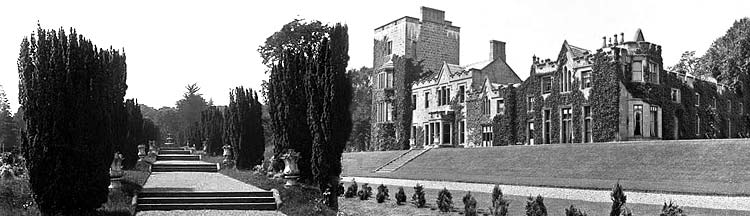 The once grand Yew Tree Terrace Walk and Barnane Castle, Templemore, Tipperary – Circa 1865. On inheriting a somewhat run-down Estate, John Rutter Carden set about demanding that tenants on his lands should now pay rent. Under his mother’s management these Irish tenants had paid little or no rent in the past and would now greatly resent being requested to do so under their new landlord, into the future. The inevitable result of this action was that John Carden then began proceedings to evict up to 100 families from their homes on his estate. Because of these evictions Carden’s tenants tried repeatedly to kill him. However all attempts failed, earning him the nickname ‘The Woodcock Carden’ (Scolopax rusticola), because as any lover of gun sports will confirm, Woodcock, when startled, fly with great speed in an erratic and twisting movement, making them difficult to kill while airborne.
Ireland around this period was beginning to be seen as a hostile place (e.g. The Doneraile Conspiracy) in which to live and as a consequence absentee landlords were very common, with some visiting their property only once or twice in a lifetime, and often never at all. These rents acquired in Ireland were then mostly only spent in England, with an estimated £6,000,000 being remitted and spent outside of Ireland in 1842. John, contrary to still locally held beliefs, possibly was not the worst of the Landlord classes then operating in Ireland; he would go on to invest in his locality and even build a local non denominational school for his tenants, offering them free education. He improved the then existing housing stock on his estate and eventually his employee’s and tenants would learn to look on him with a certain respect and admiration, despite he having participated in a couple of them being hanged for an attempt on his life.
Miss Eleanor Louisa Arbuthnot
Miss Eleanor Arbuthnot (1833 – 1894) was the youngest daughter of thirteen children born to George Arbuthnot (1772 – 1843) of Elderslie, Surrey, England and his wife formally Eliza Fraser (1791 – 1834). Her mother died when she was just one year old and by the age of ten her father was also deceased. In 1852, Eleanor and her sister Laura (born 1830), latter three years her senior, were residing with their sister Jane, (Born 1816) who had married (1846) the Hon. Viscount George Gough, latter who lived at Rathronan House, two miles from Clonmel, near to Fethard Co.Tipperary.
Continue reading John Carden Tipperary – Stalker Or A Victim Of Love?
The Lár na Páirce GAA Museum, located in Thurles town, latter the birthplace of the GAA, is home to Ireland’s first and oldest collection of Gaelic Games sporting heritage and to be brutally honest if you have not visited this venue at least once since it opened in 1994, regardless of which Irish county you support, you are not really a true dedicated and passionate GAA fan.
Our video hereunder shows just a sample of some of the delights that this venue, at Slievenamon Road, Thurles, has to offer.
(Video courtesy Ursuline Convent, Thurles, Transition Year Students 2013/14 – Photographic Project.)
Recently refurbished, Lár na Páirce GAA Museum houses an impressive collection of memorabilia by any standards – including hurleys, footballs, jerseys, trophies, medals, programmes, publications and banners – which brings to life the development of Gaelic Games from ancient times to the present day as well as showing its unique role in Irish history.
Same is part of what we are, a valuable and treasured expression of our heritage – a storehouse of the culture and traditions of our most popular national pastimes. The venue now features a state of the art audio-visual system to enhance the visitor’s experience at key points throughout the tour.
Lár na Páirce is now a multi-faceted, sophisticated, fully automated experience with the centre-piece of the museum remaining the rare Sam Melbourne collection and is, as our video shows, visited daily by schools at all levels, together with Retirement Groups and visitors from every country under the sun.
The Sam Melbourne Collection
The late Mr Sam Melbourne, a native of Horse & Jockey, Thurles, started collecting GAA material in the 1930s. In 1989, Tipperary GAA Board purchased this unique collection and gave it a permanent home at Lár na Páirce. Over the years the collection had grown in importance and size and remains a unique experience for the visitor.
Museum Site: Lár na Páirce GAA Museum is located at Slievenamon Road, close to the junction with Liberty Square, in the Thurles town centre and for more information on this “state of the art” visitor attraction visit Treasures In Lár Na Páirce Museum.
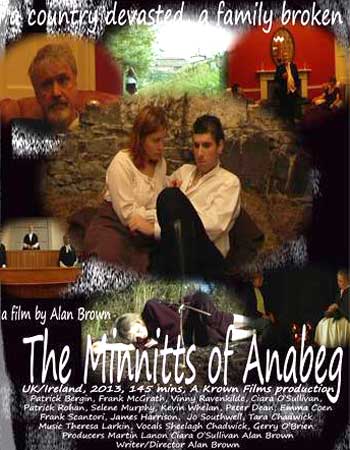 The new Tipperary film “The Minnitts of Anabeg,” will receive a screening at the Source Arts Centre, Thurles, this day week, on Thursday, March 13th beginning at 8.00pm sharp. The new Tipperary film “The Minnitts of Anabeg,” will receive a screening at the Source Arts Centre, Thurles, this day week, on Thursday, March 13th beginning at 8.00pm sharp.
(Click on image left for larger image of poster.)
This excellent film production (Writer/Director Alan Brown, UK/Ireland, 2013, 105 mins) was made on a micro budget and filmed around Nenagh and Thurles, here in Co Tipperary, using localised and very talented actors from amateur drama groups representing Nenagh Players and our own much enjoyed award winning Thurles Drama Group.
The film “The Minnitts of Anabeg,” tells the true and factual story of the Minnitt family and the generations who lived in Anabeg house near Nenagh, from the 1600’s to the early 1900’s. The Film focuses in particular on one Joshua Minnitt, latter a prominent landowner living around the period of the Great Famine era (1845 -1849) and his assistance in helping the local impoverished community through that tragic, black period in our Irish history.
While managing to greatly assist and save a community, Joshua Minnitt failed however to save his own family. His only son against his wishes married a local Catholic girl resulting in the former being disinherited.
The film’s factual storyline however is not just a tale dominated by religious bigotry, but is also an account of a family torn apart by politics and power.
The soundtrack for this film was written by Roscrea music composer Thersa Larkin, while the original Anabeg House building was used as the film’s main location. Other scenes were filmed at locations here in Thurles, at St Mary’s Famine Museum and at Nenagh Convent, latter which still has a laundry room from the days of the old workhouse regime.
Tickets: Tickets for this Thurles screening of a Tipperary based production cost just €10/€8 conc. available from The Source – Tel: (0504) 90204.
This is a must see event for lovers of real romance, drama, history and in particular Tipperary history, not to mention real local Tipperary talent performing on screen.
DVD: A limited edition DVD will also be available to purchase on the night.
The Cormackstown Heritage Centre, Holycross, Thurles, Co Tipperary is without doubt one of the largest single private collections of rural memorabilia to be found anywhere in today’s Ireland. Spanning some three centuries, these rare and now almost forgotten “tools of our once rural trade,” used to develop rural Ireland down the years, will go on display officially from Wednesday next, just a five minute drive on the outskirts of Thurles town.
“A Passage Through Time.”
So if you are out and about this coming weekend, why not spend an hour or two at the Cormackstown Heritage Centre and see for yourself this extensive array of historical artefacts, just a few of which are depicted in our video hereunder.
In the Cormackstown Heritage Centre expect to find:-
- A unique large dairy collection including an old style Creamery Laboratory.
- Experience at first hand the history of the Traveller and the tools of the Tinsmith.
- Experience the old retail shop and meet Margaret the Shop Keeper.
- Visit the old Pub complete with Barmaid.
- Take a trip back in time to view the tools of the Carpenter, the Cobbler, the Wheelwright and of course the Blacksmith’s Forge.
- Call into the Old School Room complete with its Teacher and her School Text Books from the past.
- Enter that old style, warm and welcoming Farmhouse Kitchen of the last century.
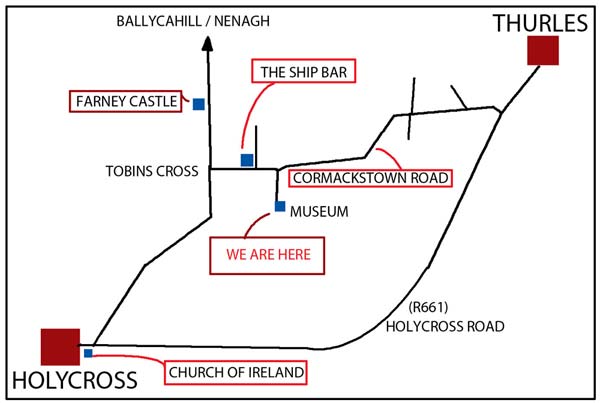 All of this and much, much more will make your visit to the Cormackstown Heritage Centre both enjoyable and educational and to the elderly visitor, will bring back fond and emotional memories of the good and bad experiences of times past. All of this and much, much more will make your visit to the Cormackstown Heritage Centre both enjoyable and educational and to the elderly visitor, will bring back fond and emotional memories of the good and bad experiences of times past.
(Click on directional Map Image left to enlarge picture.)
Note: The centre is available to all individuals / groups; including Educational, Pensioner and Retired persons and all are welcome.
This welcoming Venue will remain open, both for Daytime and Evening visits, with a Guide on hand to talk visitors through the myriad of artefacts currently on display.
Group Tours are advised to contact the Cormackstown Heritage Centre, Tel: 085 7131584 to book their visit in advance.
You can follow ‘Cormackstown Heritage Centre’ on Facebook simply by clicking HERE.
The Exhibition is highly recommended by the Tipperary tourism group Hidden Tipperary, latter who will visit the centre on Tuesday next March 4th, for their monthly meeting, beginning at 11.00am sharp.
|
Support Us Help keep Thurles.info online by donating below. Thank you.
Total Donated 2026: €300.00
Thank You!
Daily Thurles Mass Livestream
|



Recent Comments