Non Productive Tipperary TD’s & Councillors Commanding Large Salaries For No Work
In keeping with our decision stated yesterday, September 7th 2020; we have forwarded an email to Mr Ger Walsh (Ethics Registrar /Senior Executive Officer, Corporate Service, Tipperary Co. Council.) as advised by the Standards In Public Office Commission (SIPO). The email contained details of the refusal by Co. Councillors and officials within the Templemore / Thurles Municipal District to answer pertinent questions.
This refusal demonstrates a pattern of attitudes and behaviour from those concerned, that leaves the local electorate feeling that they are worthless or wanting of any real consideration. Such behaviour from those responsible can no longer be tolerated.
Note: The video shown above was first uploaded on October 28th 2019. Since that date this area has suffered further deterioration becoming progressively worse in its neglect. This is despite being visited by Ms Roisin O’Grady (Tipperary Heritage Officer & Creative Ireland Coordinator) in November 2019.
In the interests of full transparency, the full content of my communication with Mr Walsh is published hereunder for our readers to peruse.
To: Mr Ger Walsh: (Senior Executive Officer, Corporate Service, Tipperary Co. Council).
I now respectfully request that each of the offending elected councillors, reply to my 3 questions, apologising for their failure, nay refusal, to previously do so.
You will be aware from my post, that this issue was correctly attended to and dealt with by Cllr. S. Hanafin and Cllr. S. Ryan, with whom I have no difficulty.
In the interests of fairness, truth and full transparency, all replies received in writing or by email will be published on Thurles.Info [Note: Both my home address and my email address were included in the communication.]
I understand that the failure by Teachtaí Dála (TD’s) is a matter for the Houses of the Oireachtas (Committee on Members Interests not yet set up)
I thank you, in anticipation, for your attention to this matter. Should you have any difficulty regarding this issue; please instruct me further.
Yours faithfully, George Willoughby.
We learned from legal counsel, sought last week, that Under the Roads Act 1993, it is the responsibility of Tipperary County Council not only to protect but also to maintain the public’s right to access Public Rights-of-Way, in each local authority area.
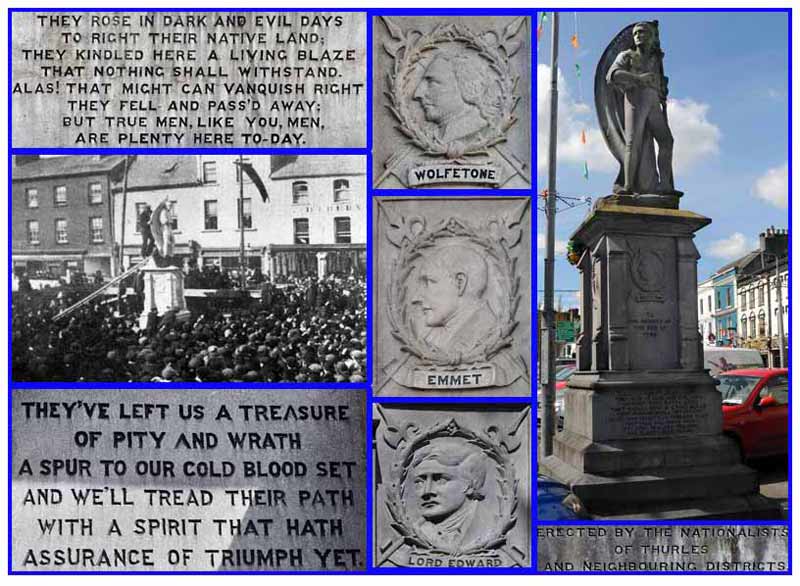
Councillors, Mr Seamus Hanifin and Mr Sean Ryan (Elected Members Thurles Municipal District Council) have both moved quickly to confirmed that the 1798 Memorial statue, better known locally as the ‘Stone Man’, will not be moved or indeed removed from its current position overlooking Liberty Square, in Thurles town, Co. Tipperary.
1798 Memorial erected on Liberty Square, Thurles in 1901
In an email addressing a number of key questions sent from Thurles.Info, Cllr. Mr Seamus Hanafin stated; “There are no plans to move the monument on Liberty Square, either during or after the works”.
Answering this same question, Cllr. Mr Sean Ryan further confirmed this welcome news, stating; “I am informed by the council’s engineering staff that the statues in Liberty square will not be moved during the upgrade of the square”.
Fears expressed to Thurles.Info some weeks ago, were based, understandably, on an early drawing of the ‘new look’ sanctioned Liberty square, (Image shown above) which appears to indicate that the statue of Archbishop Thomas William Croke, (First G.A.A. Patron) would be moved to replace the ‘Stone Man’, latter which would be then be moved elsewhere, out of its current streetscape position.
To read more on the history of the 1798 Memorial please view HERE. To read more on the history of Archbishop Thomas William Croke, First G.A.A. Patron, please view HERE.
Portrait by Irish painter Sir John Lavery, R.A., R.S.A., R.H.A. of Lady Evelyn Farquhar.
Billionaire and former K-Club owner, Dr. Michael Smurfit, who currently resides in Monaco, aged 83, is offering for sale certain Irish art works, the collection estimated at making up to €2 million at auction.
One of the paintings being offered for auction by Sotherby’s, is a portrait by Irish artist Sir John Lavery, R.A., R.S.A., R.H.A. of ‘Lady Evelyn Farquhar‘; in impressionism style, which has an estimated price tag of some €800,000.
The oil on canvas features one of the daughters of the fifth Earl of Donoughmore; latter an old Irish family that originally hailed from Knocklofty House, Clonmel, here in Co. Tipperary.
Lady Evelyn the lady in the portrait, married Lieutenant Colonel Francis Douglas Farquhar in April 1905. Lieutenant Colonel Farquhar, alas, was killed in action early during WWI, in 1915 and was awarded the Distinguished Service Order (DSO), latter a military decoration of the United Kingdom. After eight years as a widow, Lady Evelyn then remarried in 1923, one Sir Dougal Orme Malcolm KCMG (Knight Commander of St. Michael and St. George) of Poltalloch, in mid Argyll, Scotland; latter who died aged 78 years in 1955. Lady Evelyn herself died in 1966.
The painting has been described by the auction house as one of Lavery’s most successful and striking portraits.
“Those who do not remember the past are condemned to repeat it” – Quote George Santayana (Spanish Philosopher, essayist, poet, and novelist.)
The historic flagstones upon which Padraig Pearse read the 1916 Proclamation outside of Dublin’s General Post Office (GPO) have gone missing, possibly lost for ever to future generations.
The responsible body, namely Dublin City Council, admit that they do not know where these historic paving stones presently exist or whether they were ever reused elsewhere in its city streets.
Dublin City Council has since confirmed that following the refurbishment of O’Connell Street, sometime between the years 2004 and 2007, these historic stones were removed by the Road Maintenance Services and sent to a storage depot in Railway Street, Mountjoy in Dublin. It was planned that they should be re-used by Road Maintenance Services crews in Dublin city centre locations, where similar paving required complementing. Regrettably, the records held in Road Maintenance Services do not show where exactly this historic paving from O’Connell street was ever re-used.
Is similar destruction about to be foisted on the residents and business people of Thurles, courtesy Tipperary Co. Council?
Similar destruction may also be about to happen, courtesy Tipperary Co. Council, under the leadership of Mr Joe MacGrath(Chief Executive Tipp. Co. Co.) and Mr Marcus O’Connor(Director of Services for Roads, Transportation and InfrastructureTipp. Co. Co.).
Yes, we are referring to the possible destruction of the “Double Ditch”. We ask our readers to refresh their memories HERE.
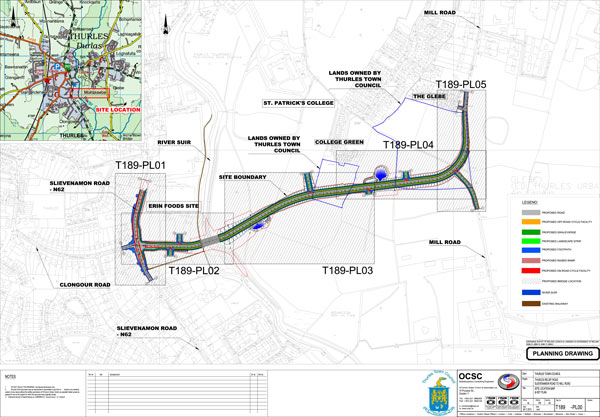
Please see Thurles inner relief road map hereunder, drawn up by Tipperary Co. Council, which appears to indicate that the “Double Ditch”, linking College Lane with the Mill Road is about to be partially at least eradicated.
We had hoped to get reassurance regarding the preservation of the “Double Ditch” and a commitment to its upgrade as a tourist attraction, when we wrote to all elected public representatives and senior Council officials, some 5 weeks ago. However, the silence emanating from all local elected politicians, including Fianna Fáil TD Mr Jackie Cahill; Independent TD Mr Michael Lowry and all County Councillors, within the Templemore / Thurles Municipal District, leave us now fearing the worst possible scenario.
We now cannot be sure what exactly Tipperary County Council is planning. We are aware Mr Joe MacGrath CE instructed his Secretary, Ms Evelyn Harty, to request that Mr Marcus O’Connor contact us over 5 weeks ago. Alas, Mr O’Connor has failed to do so.
A subsequent 4 week reminder, sent by us, to Mr MacGrath’s office received the following reply from Mr Joe MacGrath’s Secretary, “I acknowledge receipt of your email below on behalf of Joe MacGrath, Chief Executive and confirm that the matter is receiving attention”.
Prior to the formation of the present coalition government, we corresponded with Ms Josepha Madigan TD last May, who was then acting Minister for Culture, Heritage and the Gaeltacht.
In correspondence received from her, Ms Madigan stated, and I quote, “So far as we understand, there is no direct impact on the “Double Ditch” from any current development. The Department is a statutory consultee in the planning and development process, but our role in this regard is to respond to particular development proposals as referred to us by the planning authority. If there is a particular proposed development which you believe to be of concern, and you can send us details, we can review further.”
A further query was sent to Ms Madigan via Ms Helen Francis(Private Secretary to Minister Ms Madigan), which went totally unanswered.
Since then, Irish Green Party politician Mr Malcolm Noonan TD, has taken on the role of Minister of State for Heritage and Electoral Reform. While our correspondence to him was eventually acknowledged, to date no further information has been forthcoming from his office. Mr Noonan’s Private Secretary, Ms Danielle McDonnell stated: “On behalf of Mr. Malcolm Noonan TD, Minister of State for Heritage and Electoral Reform, I wish to acknowledge receipt of your recent emails in relation to Thurles / Famine Double Ditch. A further reply will issue as soon as possible”.
There comes a time when silence is betrayal.
The spread of misinformation is not achieved by words only; but also on numerous occasions by people remaining completely silent. We have contacted all elected personnel representing Thurles; requesting the answers to 3 simple questions within the last 3 months; result has been silence. This cannot be allowed to continue.
I might point out to Mr Joe MacGrath CE, Mr Marcus O’Connor and all County Councillors the Code of Conduct for Councillors, prescribed under the Local Government Act of 2001.
Need I quote directly from this document: “The public is entitled to expect conduct of the highest standards from all those involved in the local government service, be they councillors, county/city managers, other local authority staff or non-councillor members (“external members”) of local authority committees. The Local Government Act 2001 (“the Act”) sets out a new ethical framework and imposes a statutory duty on all in the local government service to maintain proper standards of integrity, conduct and concern for the public interest.“
The 3 questions which now need to be answered by Tipperary Co. Council officials; Templemore / Thurles Municipal District Councillors; Michael Lowry TD and Jackie Cahill TD, are as follows and require simple answers:-
(1). Will the planned Thurles inner relief road impinge, in a negative way, on the 1846 Thurles “Double Ditch”, which has been a right of way and a Mass Path for almost 175 years and which is the property of the people of Thurles?
(2). What are the future plans for the 1798 memorial statue [The Stone Man], first erected in Liberty Square, Thurles in 1900, and still standing there, awaiting removal prior to the new upgrade?
(3). Which Municipal District Councillor is responsible for delaying the Thurles Recycling Civic Amenity, which this town so badly needs?
Please answer these 3 questions in writing please, as failure to do so has already placed you in breach of Tipp. County Council Policy,i.e.“Tipperary County Council is committed to providing an efficient and courteous service to all our customers”.
Note Please: All answers to the 3 questions above, by August 27th, must be sent in written format by email, which you already have. All answers will be published.
We find Tipperary County Councils staff and their officials actions; in their failure to answer questions, similar to the errors made recently by Mr Michael Cawley (Fáilte Ireland – holidaying abroad); Mr Dara Calleary and Mr Jerry Buttimer’s behaviour of last Wednesday night; latter who believed there was one law for them and another law for the great unwashed – their electorate. Those who participate in decision making, same likely to impact local people, must maintain a duty to follow the regulations laid down by government.
I took a walk along the “Double Ditch” this afternoon, no effort by Tipperary County Council to resolve fly-tipping has been undertaken whatsoever, despite our request of October 2019. Dumping however, has increased and trees have been cut down, removed possible for firewood.
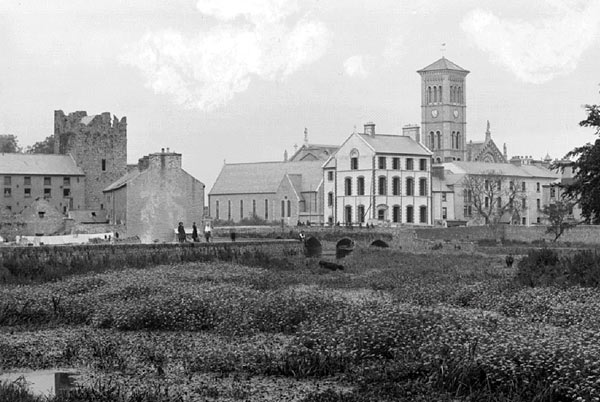
Perhaps one of the most valuable vintage picture postcards of Thurles, Co. Tipperary, currently owned or sought by collectors, is the picture featured here below. Same is usually entitled/labelled “Ursuline Convent, Castle and Cathedral Thurles, Tipperary, Ireland”.
So why is this vintage postcard so highly prized by collectors, I hear you ask? Take a look at it again, and see if you can guess.
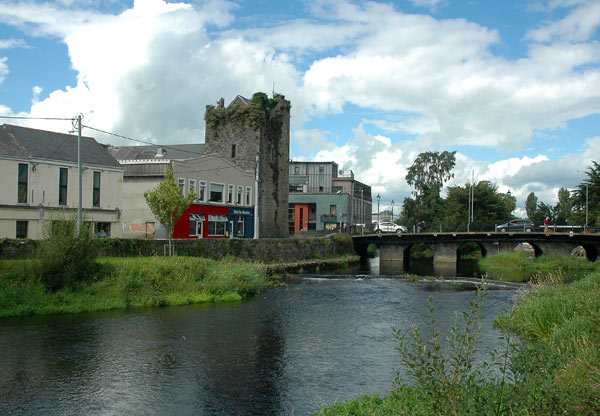
Yes, in reality this image of course does not actually exist. See existing picture hereunder, taken just yesterday 19th August, 2020.
Picture courtesy G. Willoughby
This monochrome vintage picture postcard, photographed around possibly the beginning of the 20th century is indeed a photomontage made up of a series of 2 or perhaps 3 photographs, unless of course our wonderful picturesque Cathedral of the Assumption of the Blessed Virgin Mary building, is slowly slipping eastward, sitting as it does on the edge of the townsland known as “Monacocka”, [Irish – ‘The Shitty Bog’.]
The pictures are indeed the work of a skilled photographer and with the dexterity of an even more experienced photographic printer, sometime later.
From close examination the picture is probably made up of 3 pictures using 3 separate negative of; (1) The River Bed, (2) The Castle, and (3) The Ursuline Convent and Thurles Cathedral, latter one of the few now remaining tourist attractions in Thurles town.
Assuming that the image was printed at the beginning of the 20th century, the printer would have exposed in full, each of the images first, before cutting out masks to cover off and montage each separate image into just one picture. In the days before the computer editing programme ‘Adobe Photoshop’, same would not have been an easy task to undertake, as each of the 3 images montaged together, would have required different exposure times and precise masking.
Gelatin-coated silver bromide printing paper was coming on stream from 1886, therefore it is most likely that one of the modern upright type photo enlargers, which came into production around 1921, (before ceasing in 2005), was used.
Whatever the time and date of the photographs manufacture, the Cathedral of the Assumption clock informs us that the photographs were taken close to 3:00pm in the afternoon.
Associated Historic Nonsence The finished historic picture which shows buildings stretched / existing between the 15th century castle and the river however, does make a total nonsense of the claim that “Chieftains would drop fishing lines into the river Suir below. Whoever caught the biggest fish would lay claim to the favourite Wench of the castle.”
This nonsense information exists, suggested to visitors, on a misleading stone plaque erected in 2002, attached to the castle wall. The plaque is long regarded as being totally disrespectful of women, suggesting that rape and / or indeed prostitution was accepted as the ‘order of the day’, during the 15th, 16th and 17th century, or even that women were present in the castle building, itself designed to collect tolls and if necessary defend the river crossing against attack.
This plaque should now be removed, while Liberty Square is being upgraded. Other information on this plaque is also totally misleading to the very few tourists left grinning, that actually do find their way into the Premier County and into Thurles.
This website uses cookies to improve your experience. We'll assume you're ok with this, but you can opt-out if you wish.AcceptRead More
Privacy & Cookies Policy
Privacy Overview
This website uses cookies to improve your experience while you navigate through the website. Out of these, the cookies that are categorized as necessary are stored on your browser as they are essential for the working of basic functionalities of the website. We also use third-party cookies that help us analyze and understand how you use this website. These cookies will be stored in your browser only with your consent. You also have the option to opt-out of these cookies. But opting out of some of these cookies may affect your browsing experience.
Necessary cookies are absolutely essential for the website to function properly. This category only includes cookies that ensures basic functionalities and security features of the website. These cookies do not store any personal information.
Any cookies that may not be particularly necessary for the website to function and is used specifically to collect user personal data via analytics, ads, other embedded contents are termed as non-necessary cookies. It is mandatory to procure user consent prior to running these cookies on your website.





Recent Comments