If women are equal before God, why are they still excluded from the Roman Catholic priesthood?
Yesterday, October 17th, a historic gathering of Roman Catholics in Gormanston, Co Meath, brought one of the oldest and most controversial questions in Christianity, back into the spotlight; Why does the Roman Catholic Church continue to exclude women from ordained ministry?
At Ireland’s first National Synodal Assembly of its kind, delegates voted on proposals concerning the future of the Church, including the position of women.
On the proposal for continued exploration of women’s ministry, including ordination to the diaconate, 54% voted in favour, 42% highly recommending it and another 12% recommending it.
However, 27% opposed the recommendation and 19% wanted further consideration.
Interestingly, a separate proposal to establish a national office for women was rejected, with 56% voting against it.
These mixed results demonstrate that the Church is far from united on how women should participate in its future. But surely the deeper question is not simply whether women should be permitted to become deacons. It is whether there is any convincing justification for continuing to exclude them from the priesthood altogether.
Why Does The Church Exclude Women?
The Vatican’s traditional argument rests primarily on three claims.
First, Jesus chose twelve male apostles. Second, the Church has maintained a male priesthood through centuries of tradition. Third, Catholic theology teaches that a priest represents Christ in a particular sacramental capacity.
In 1994, Pope John Paul II declared that the Church had no authority to ordain women as priests and insisted that this teaching was definitive.
But should the customs of a male-dominated society two thousand years ago determine the opportunities available to women today?
Jesus treated women with remarkable dignity, often challenging the conventions of his time. Women supported his ministry, remained faithful at the Crucifixion and were among the first witnesses to the Resurrection.
Mary Magdalene, in particular, occupies an extraordinary place in Christian history.
Surely, if women could proclaim the Resurrection, surely we are entitled to ask why they cannot proclaim the Gospel from the altar as ordained priests.
And what about Pope Joan?
There is an extraordinary story from medieval Church history that deserves mentioning. For centuries, accounts circulated of a woman known as Pope Joan, who supposedly disguised herself as a man, entered the priesthood and eventually became Pope during the ninth century. According to the legend, her identity was exposed when she unexpectedly gave birth during a religious procession through Rome.
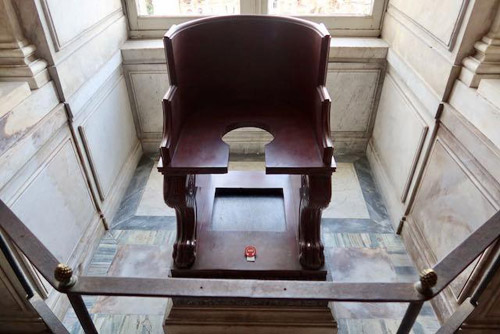
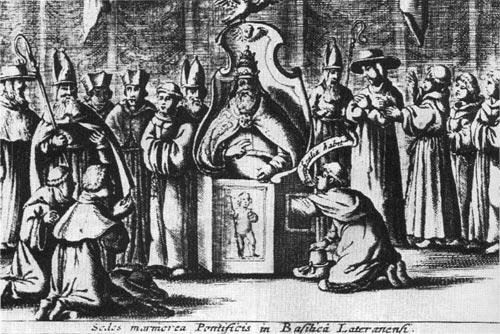
Most modern historians regard the story as a legend rather than established historical fact. Nevertheless, an equally remarkable tradition developed around the story. Special chairs (marble perforated chairs “Sedia Stercoraria” meaning the Dung Chair“), with holes in their seats, associated with papal ceremonies, were supposedly used to establish that a newly elected pope was biologically male. The alleged inspection was even accompanied, according to later accounts, by a declaration confirming the pope’s masculinity.
According to the legend, after the scandal involving Pope Joan, every newly elected pope was required to sit on a special chair while a cleric physically checked beneath the seat to establish that he possessed male genitalia.
The cleric supposedly announced: “Duos habet et bene pendentes”, (Meaning; “He has two, and they hang well.”)
The assembled clergy supposedly would reply, “Deo gratias”, (Meaning; “Thanks be to God.”)
Perforated chairs associated with papal ceremonies really did exist. However, there is no reliable evidence that they were used for such examinations.
The Pope Joan story therefore cannot be presented as proof that a woman once occupied the papacy. Yet the persistence of the legend is a fascinating reminder of how deeply gender and religious authority have been intertwined throughout Church history.
A church sustained by women but governed by men.
Across Ireland, generations of women have sustained Catholic life. They have educated children, staffed hospitals, cared for the sick, maintained parish communities, organised charitable activities, supported religious vocations and passed the faith from one generation to the next.
Without women, much of the Church’s daily work would simply be impossible. Yet when it comes to the authority to celebrate Mass, administer certain sacraments or become a bishop or pope, women remain excluded.
The Church insists that men and women possess equal dignity. But can an institution convincingly claim equality while permanently reserving its most important ordained offices for men? Supporters of the existing doctrine sincerely argue that this is a matter of faithfulness to Christ rather than discrimination.
Others believe that the Church has confused historical tradition with divine instruction and that centuries of exclusively male leadership have helped preserve that interpretation.
Another long-overdue question is whether Roman Catholic priests should be permitted to marry. Celibacy is a Church discipline, not an unchangeable doctrine of the Christian faith. Indeed, married men already serve as priests in some Eastern Catholic Churches in full communion with Rome, and exceptions also exist in the Western Church. If marriage is regarded by the Church as a sacred institution, why should it ordinarily prevent a man from entering the priesthood? Surely a married priest, with the experience of family life, raising children and sharing everyday responsibilities, could bring valuable understanding and compassion to his ministry. Celibacy should remain a respected personal vocation, but why must it be compulsory? At a time when Ireland faces a serious shortage of priests, surely allowing married men to enter the priesthood deserves serious consideration alongside the question of women’s ordination.
The Irish Bishops now have a choice.
The recommendations from the Gormanston assembly will go to the Irish Catholic bishops for consideration.
The delegates did not vote to introduce women priests, and the recommendation concerning the diaconate does not alter Vatican teaching. Nevertheless, the meeting has reopened an important conversation.
At a time when religious practice is declining, congregations are ageing and many parishes face difficulties maintaining sufficient clergy, surely the Catholic Church must seriously consider whether excluding women from ordained ministry serves its spiritual mission.
The Church has changed its practices and developed its understanding of many questions over the centuries. Why, then, must the possibility of women becoming priests remain permanently closed?
This should not be about attacking religion or dismissing sincere religious belief. It should be about justice, participation and whether the Church is prepared to listen to the women who have contributed so much to its survival.
The final question is a simple one:
If a woman is sufficiently worthy to teach the faith, nurture a Christian community, care for the vulnerable and proclaim the message of Jesus Christ, why is she considered ineligible to stand at the altar as a priest?
Perhaps the greatest challenge facing the Catholic hierarchy is no longer simply persuading people to return to the Church. It is persuading people that the Church itself is prepared to listen, reflect and change.





Leave a Reply