|
|
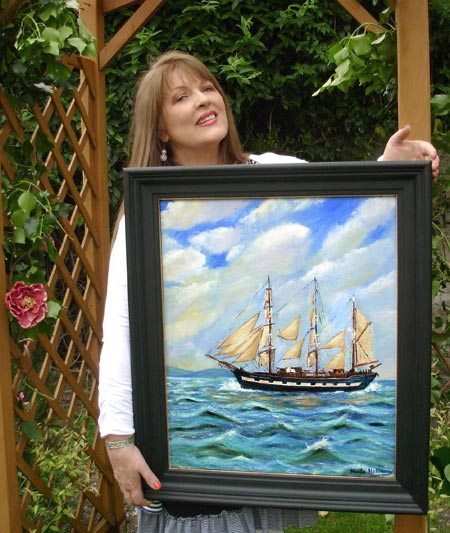 Artist Nuala Holloway with her painting of the 'Jeanie Johnston.' US President Barack Obama and his wife Michelle will to be showered with specially commissioned gifts, when they both arrive at the President’s ancestral home in Moneygall, on the Tipperary/Offaly border, by Marine One helicopter tomorrow.
The US President and America’s first lady, who will first arrive on the tarmac of Dublin Airport tomorrow morning on Air Force One, will travel by helicopter to Offaly, for a short 30 minute visit, before returning to Dublin, for a major public address at College Green later in the evening.
One of the gifts specially commissioned for the US President’s visit, made by calligrapher and historian Tim O’Neill, is an ancient styled calligraphic monastic vellum scroll, scribed in both Irish and English, and including the County Offaly Coat of Arms.
For First Lady Michelle Obama, there will be a gift of a flower pendant depicting an Offaly flower, the Andromeda, more commonly known as Bog Rosemary, latter designed by Rachel McKenna and made by jeweller Cathal Barber. The Obamas will also receive a traditional music CD, together with a book on the history of the thatched house in rural Ireland.
One of the more unique gifts to the US President in Dublin, however will be a painting of the famine ship ‘Jeanie Johnston,’ (Oil on Canvas) by noted Irish artist, former Miss Ireland, actress, and academic, Nuala Holloway. (Click on image above to view larger picture.) Nuala, whose third public exhibition of paintings entitled “Moments,” is due to take place in the Sol Art Gallery, Dawson St. Dublin, from December 2nd to 9th, 2011, presently resides in Dublin, while retaining strong connections with Thurles in Co Tipperary and Moate in Co. Westmeath. It is hoped that the painting will be an everyday reminder to the President, of the difficulties experienced by his early relatives who left Ireland around the time of the ‘Great Famine,’ 1845-1849 on board similar ships, the ‘Caroline Read,’ and ‘Marmion,’ eventually arriving in New York City on the 25th of April 1849 and March 20th 1850, respectively.
Interesting also to note that Falmouth Kearney (c.1830-1878) married Charlotte Holloway (c.1834-1877) – any connection between modern Irish artist and ancestor, I wonder?
The original, three masted ‘Jeanie Johnston ‘ built in Quebec, Canada in 1847, was bought by Tralee, Co. Kerry-based merchants John Donovan & Sons. It was a cargo vessel trading successfully between Tralee and North America for a number of years. The trading pattern then was to bring emigrants from Ireland to North America, and then to bring back timber into Europe. The most passengers she ever carried was 254, from Tralee to Quebec on April 17, 1852, the journey taking 49 days.
With Irish weather forecasters promising high winds and stormy conditions over Tipperary and Offaly, locals in the Moneygall village will be saying prayers to Saint Medard, Patron Saint of bad weather. Legend states that the saint was once sheltered from the rain himself, by a hovering eagle. The Bald Eagle, as we all know was chosen in June 20, 1782 as the emblem of the United States of American, because of its long life, great strength and majestic looks, and also because it was then believed to exist only on the continent of America.
In the words of an old Irish blessing Mr President “Go n-éirí an bóthar leat agus go gcoinní Dia i mbos A láimhe thú.” (Translated:- May the road rise to meet you and may God hold you in the hollow of His hand.)
Her Majesty, Queen Elizabeth II and Prince Philip the Duke of Edinburgh arrived at the Rock of Cashel this morning by royal helicopter, hovering over the site which was the former ecclesiastical capital of Ireland.
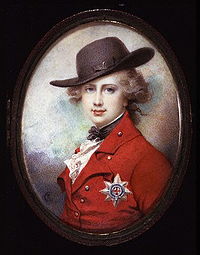 George IV as Prince Regent Her visit to the Rock, the traditional seat of the kings of Munster for several hundred years prior to the Norman invasion in 1169, marked yet another milestone in the history of Irish /English relations. As Queen of England, she became the first reigning British monarch to visit this imposing site, since her forebear King Henry II visited in 1171, although King George IV is believed to have visited the site, while a guest of the Mathew family in Thurles, while then Prince Regent, and prior to ascending the British Throne in 1820.
On landing she was driven from the helicopter by the state Bently to the summit of the rocks outcrop. To loud applause from a group of invited guests and local dignitaries, the Queen went on to visit the 15th century building known as the Hall of the Vicars Choral. She examined a 13th century bronze enamelled Crozier, said to have belonged to Bishop King, Cormac McCarthy, together with the ancient Cashel bell, dating from early 9th century.
Many residents in Cashel felt that security was too tight and regretted not getting a closer view and a chance to properly show their appreciation to the Queen, on her acceptance of their invitation to visit.
A new website described as an invaluable tool for historical researchers, academics and the general public, has been officially launched today hosted by the Moore Institute for Research in the Humanities and Social Sciences at the National University of Ireland, Galway.
 Landed Estates in Connacht and Munster To find this website containing the Landed Estates Database, Click Here.
Cataloging the landed estates of Munster from the 18th to the 20th centuries, this new website brings together a distillation and collation of data from a broad range of historical sources, and the concise codification of this data on an Estate, Name and House basis.
The ‘Connacht and Munster Landed Estates’ project, was funded by the Irish Council for Research in the Humanities and Social Sciences and the Programme for Research in Third Level Institutions respectively. This project undertook the research and now the publication of a comprehensive and integrated resource guide to the landed estates and historic houses, both in Connacht and Munster. It is now published and presented on line in an easy to follow and friendly to use, format.
While the aim of the guide is to assist and support researchers working in the field of social, economic, political and cultural history, c.1700 to 1914, it will also greatly assist ordinary persons actively involved in tracing genealogy, not to mention those who enjoy reading basic historical fact.
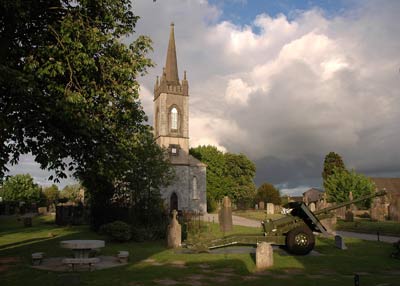 St. Mary's Famine Museum, Thurles. Tipperary. Thurles Famine Museum, housed in St Mary’s Church, Thurles, Co. Tipperary, has re-opened.
The one year closure followed, when over €70,000 worth of malicious damage was inflicted on valuable stained glass windows by local vandals in November 2009. This led to some of Ireland’s most historic artifacts, relating to Ireland’s “Great Famine 1845-1849,” which were on show to the public and stored in the building, having to be removed in the interest of their preservation.
The closure of the museum is calculated to have cost Thurles businesses, particularly the food and accommodation sectors, an estimated .5 million euros in lost revenues, last year.
The Museum, which has never received one cent of financial support from government since opening some 10 years ago, is now about to receive a major face lift, having installed 24 hour state of the art concealed video surveillance equipment to protect the graveyard, the museum and it’s contents.
St Mary’s Church, Thurles, which houses the Museum, and the graveyard attached has huge historical importance not just for Thurles Town, but for the island of Ireland. The graveyard was used extensively for burials during the Great Famine 1845-1849 and was closed as a place of burial in 1942 at the request of Dr J.D. Hourihane, then Local Government Inspector, (With some licenced exceptions,) because of gross over crowding.
Although burials were taking place here in the early 13th century, the first recorded grave in the cemetery is 1520, the Norman ‘Archer Tomb,’ possibly better known for it’s supposed healing properties. A Church has existed on this site since early Norman times in 1179.
Other notable persons buried here include:-
Lady Elizabeth Butler, Viscountess of Thurles and mother of James Butler, Duke of Ormond, ancestress direct of Queen Elizabeth II, Charles, Prince of Wales and the late Diana Spencer, who was interred in the little Chapel of St Mary, Thurles, in 1673.
William Bradshaw, a doctor in charge of the Fever Hospital in Thurles, and who also ran a paupers clinic in The Quarry, Thurles, during the famine years. “The grave of Dr William Bradshaw (Victoria Cross) late Assistant Surgeon 32nd Light Infantry who departed his life 9th March 1861.”
Maurice Leyne, one of the founders of the Young Irelander Movement and joint proprietor / editor of the “Nation” and “Tipperary Leader” newspapers during the famine years. He took part in the Ballingarry uprising of 1848 (Battle of the widow McCormack’s cabbage patch,) and was a grand nephew of Daniel O’Connell (Catholic Emancipation). Leyne died of typhus in 1854. “In this grave are deposited the remains of Maurice Richard Leyne Esq. who died 29th June 1854.”
Continue reading Thurles Famine Museum In Tipperary Re-Opens
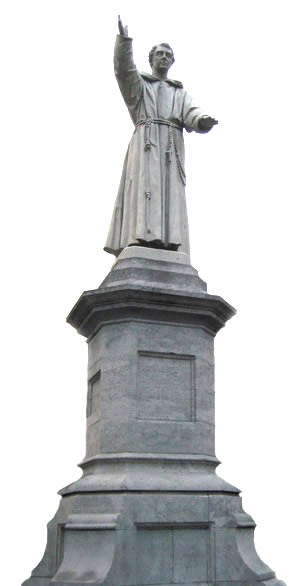 Fr Theobald Mathew (1790-1856) When Her Majesty Queen Elizabeth II is being whisked down O’Connell Street, Dublin, this week, she should keep an eye out for one of her relations from Co.Tipperary, who has been standing there, waiting for her visit since 1893, and is now unlikely to be there if she ever visits again.
Her Majesty, according to today’s Independent newspaper will be attending The British Embassy’s ‘little bash’ in the €380m National Conference Centre on Dublin’s Spencer Dock. She will be meeting leading Irish peace campaigners, like Amanda Brunker, former presenter of “The Podge and Rodge Show,” and chef Rachel Allen, who appears to be getting the day off from O’Briens Sandwich Bars, where she autographs the plastic wrappers on sandwiches for customers.
But enough about that, lets discuss Her Majesty’s Tipperary relation waiting patiently in Sackville Place, Fr. Theobald Mathew, (1790 -1856) Capuchin Friar and Apostle of Temperance, whose life sized limestone monument is shortly to be dumped, according to the same newspaper, from Dublin’s O’Connell Street, to make way for the latest plans by Dublin’s Luas Light Rail System, to flutter away more of taxpayers money in the Pale.
The statue of Fr. Theobald was erected there in 1893, three years after it’s foundation stone was laid on 18th October 1890, latter the centenary of Fr. Mathew’s birthday and 36 years after John Henry Foley’s sculpture in Cork was unveiled.
The statue of the friar in O’Connell Street, Dublin, his back turned on the adulterous Charles Stewart Parnell, (The separated Mrs Katharine O’Shea Affair) is wearing the costume of a late nineteenth-century priest, attired in a ‘Surtout ‘ or man’s frock coat, belted with a rope and hung with rosary beads, his arms raised in a blessing.
Fr. Theobald’s anti-drink campaign is considered to have been a great social revolution, that saw the establishment of Temperance Societies in just about every parish in the country. At its very peak, his campaign, between 1838-1845, it was estimated that there were almost 4 million people abstaining from drink here in Ireland. His success was aided by the fact that Fr. Mathew appealed to every class, creed and rank in Irish society. In 1843, Fr. Mathew went to England and Scotland, where he had even further success, and later spent over two years in the US, where he handed out the Pledge in over 300 towns.
Today, intoxicated Dubliners can often be seen loitering, under the Tipperary man’s statue, ignoring his past warnings regarding the evils of drink, and I regret to report that as religion continues to decline, he commands less and less respect from those that pass underneath his outstretched arms.
Continue reading Queen Elizabeth’s Relative To Be Dumped By DCC
|
Support Us Help keep Thurles.info online by donating below. Thank you.
Total Donated 2026: €300.00
Thank You!
Daily Thurles Mass Livestream
|



Recent Comments