|
|
 Faddan More Psalter Yet another piece of Tipperary treasure went on show yesterday, to the benefit of Dublin City’s local economy.
I refer of course to the historical Faddan More Psalter, a book of psalms possibly as old as the Book of Kells, dated around 800AD and found by turf cutters in 2006 in a Tipperary bog.
Conservationists have spent the past five years painstakingly preserving this vellum paged, leather covered psalter, which now sits centre stage at a new exhibition in the National Museum, not in Tipperary, but in Dublin.
The new Dublin exhibition, which includes previously exhibited major pieces of church heritage, such as the St Patrick’s Bell and its Shrine, the Cross of Cong, the Broighter gold boat, the Corleck Head, and the unique ivory crozier from Aghaboe, Co. Kerry now on loan from the Statens Historiska Museum in Stockholm, certainly demonstrates an ecclesiastical feel, housed in towering glass boxes, beautifully illuminated and set out in a style resembling a monastic cloister.
This latest piece of Tipperary’s heritage now on display, joins five other liturgical vessels found in 1980 as part of the Derrynaflan Hoard, near Killenaule, Thurles, Co.Tipperary. Note all these pieces of priceless Tipperary treasure are greatly benefiting Dublin’s economy, at the expense of Co.Tipperary.
Speaking of Tourism, when will Fáilte Ireland, trading as Discover Ireland.ie, update Thurles on their website ? Click HERE to see that of which I speak. Next click on – Show all Festivals & Events in Thurles. Stay on the page and check what is happening in Co. Tipperary. Of the 38 attractions featured can you see any mention of the Thurles GAA Museum, St.Mary’s Famine Museum, HQ Nightclub, The Source Theatre, Traditional Music at the Monk Gorman’s, Thurles Golf Club etc, etc, etc ? Answer “NO Sir,” but plenty of adverts for Racing and Comhaltas Summer Seisiún’s.
On the same page hit the down arrow beside Towns and Cities and click on Thurles. Go to Whats on Tab and click on the down arrow alongside. Next click on Historical Houses and Castles – see my point, click on Music and Theatre, – see my point, click on Nightclubs, – see my point.
Without boring my readers much further, see Museums and Attractions – Thurles Famine Museum. Click on ‘More details,’and note: no website address shown, no complete postal address and see Map Pin on the accompanying map location showing the museum’s position, at Hillview drive, Thurles, Co. North Tipperary.
In January 2011, Dublin Tourism launched a new three year regional tourism plan, which sets a target to increase overseas visitor numbers by one million a year. Nearly two thirds of visitors to Ireland already visit Dublin. The city is currently lying at number seven on the list of the most visited cities in Europe. Now you now see why taxpayers money is needed to tunnel underground to keep transport moving.
It appears rural midland Ireland must continue to support the manufacturing of wealth for Dublin business, while those responsible for marketing county Tipperary continue to fund projects west of the Shannon river. I think it is time to drag those, given tourism responsibility, around a table for a serious chat.
Note the visitor figures given for fee paying attractions in Dublin last year, confirmed by Bord Failte, click HERE e.g. 469,674 people went to see the Book of Kells. Based on these latter figures, the Faddan More Psalter, at a charge €1 per visitor would be worth €500,000 to the Tipperary economy, plus spin offs in food, accommodation and other sales.
Whatever happened to the idea of a ‘Decentralisation Programme,’ anyway, or was that just another Fianna Fail vote catching idea. It seems Dublin has now become rural Ireland’s modern day plundering “Viking Raider,” and Tipperary has not one Brian Boru to protect us.
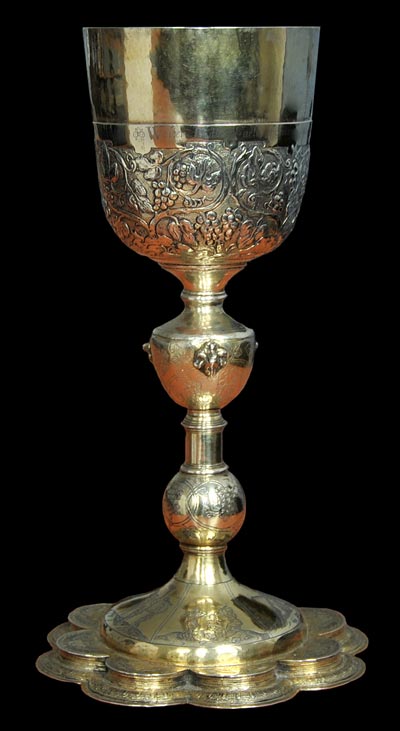 "Walter of the Rosaries (Beads) " Chalice. No disrespect to the beautiful town of Cashel here in Co. Tipperary or indeed to our recent special guest, Her Majesty Queen Elizabeth II. However, a word to those whom we elected to promote Irish tourism and our historic town of Thurles in Co. Tipperary, – be ashamed, be red faced, consider resignations.
Yes I am of course referring to those over paid individuals who hold public office at local, county and national level, the unseen faces behind Shannon Development, Discover Ireland, North Tipperary County Council, Thurles Town Council and in particular Shannon Region Tourism group.
By stating “in particular Shannon Region Tourism group,” I am of course referring to the fact that in 2011, yet again, Thurles has been treated as the ‘Poor Relation.’ Click Here, and note, just for starters, Thurles and Roscrea are not even worthy of a mention on their Shannon Region map included on their web-page, or in their rail travel listings and barely gets a mention in their recently launched School Tours promotion.
But enough on that, as I will be discussing Shannon Region Tourism’s transgressions, in depth at a later date, in an effort to raise discussion on what share of the Irish Government’s allocation of more than €155 million for tourism last year, actually materialised in ‘dear old North Tipperary,’ compared with what was spent west of the river Shannon.
Instead I am going to introduce, for the first time to many of our readers, the historically important “Walter of the Rosaries Chalice,“made by Walter Butler, 11th Earl of Ormonde. Such a shame latter was not shown to Queen Elizabeth II on her recent visit to Tipperary.
(Do click the picture on right, to see full resolution photograph of this priceless piece of our local heritage.) Photo: Courtesy George Willoughby.
As I have explained in previous posts on this site, Her Majesty Queen Elizabeth II, is a native of Thurles, with direct ancestors going back to the early/mid 17th century and to Thomas Butler’s marriage to Elizabeth Poyntz. So to put this Chalice in context Walter Butler was father of the latter Thomas Butler, known as Viscount Thurles, latter who died in 1619.
Walter Butler, 11th Earl of Ormonde and 4th Earl of Ossory (1569 – 1633), was an Irish peer, the son of John Butler of Kilcash and of Lady Katherine MacCarthy, latter the daughter of Cormac na Haoine MacCarthy Reagh, 10th Prince of Carbery. He inherited the title of this Earldom because his uncle Thomas (Black Tom or Thomas Dubh) had died without producing a legitimate male heir.
Walter served as a Member of Parliament for Tipperary and being a very devout Roman Catholic, he was known as “Walter of the Rosaries ” or Beads. His claim to the family estates was thwarted by James I of England. The Ormond Butlers had owned most of counties Kilkenny and Tipperary, including Thurles. King James had sought to engineer the marriage of Black Tom’s daughter and heiress, Elizabeth Butler, with one of his own Scottish favourites, Richard Preston. He made Richard Preston Earl of Desmond and awarded Elizabeth, instead of Walter, most of the Ormond estates in Tipperary.
Following much litigation by Walter Butler in fighting this decision, King James made an award to which Earl Walter refused to accept and in in 1617, King James had him committed to the Fleet Prison, where he remained for six years in poverty.
The Butler chalice was made in 1620 for Walter Butler, the rightful 11th Earl of Ormond and his wife Ellane, while still in prison. In 1620 the family was in deep trouble. The previous year their son, Thomas Butler, Viscount Thurles, who lived in the Castle at the top of Liberty Square, had been drowned off Skerries while going to England to answer charges of treason, regarding the garrisoning of Kilkenny City.
Walter got out of jail in 1625 when he got the title and part of the estates back from the next English king, Charles I. The rest of the estates were only returned in 1629 and 1630 when Walter’s grandson, James Butler (later the Duke of Ormond) effectively purchased the 14-year-old Preston heiress from her guardians and married her.
Walter Butler died in Carrick-on-Suir, Co.Tipperary and was buried in St. Canice’s Cathedral, Kilkenny on 18th of June 1633.
Such a pity Her Majesty Queen Elizabeth II did not get an invitation to her native town, if only to view this wonderful piece of her historical past.
My thanks to Monsignor Dr Maurice Dooley, Loughmore for his assistance in compiling the above historical facts.
The Thurles and District Vintage Club was formed following the enormous success of their millennium celebrations in 2001. Over the past ten years the event has grown considerably and has now become one of the top annual attractions in Tipperary, drawing visitors and vintage machinery exhibitors /collectors from far outside its local natural environment.
In 2001 the club started with three members and today membership has grown to over eighty three, not just from all over North Tipperary, but from surrounding counties such as Co. Limerick and Co. Laois.
The clubs main aim is to promote the collection and restoration of all types of vehicles and memorabilia, thus preserving past heritage and providing valuable primary sources for lovers of rural Irish history.
Our world, over the past ten years, has observed more change and experienced more rapid progress than in the previous one thousand years of man’s existence, so it is extremely important that we display not just our old rural artifacts and labour saving devices, but that also we demonstrate the skills required to operate these devices.
Between annual events the club organise different charity fun events, raising large sums for various designated local and national charities.
The highlight of their year, however, is the clubs Annual Vintage Rally which normally takes place in Corbally, Thurles, Co. Tipperary and already the club have begun planning for this event, and of course are always on the lookout for willing volunteers and helpers, whose assistance is very much appreciated.
We learn from club chairman Mr Jim Fogarty that two, up and coming, events for are already well into the planning stages and worthy of note for those who love to travel back in time and reminisce.
Note : Thurles Vintage Rally is planned for 12th June 2011, while their Thurles and District Road Run will take place on the 17th July 2011.
The club is affiliated to the Irish Vintage Engine and Tractor Association and last year they had the honour of hosting the I.V.E.T.A. National Rally.
For further information on this clubs activities contact Paddy Kelly, Thurles, Tel 087 9678114 or Jim, Tel 087 9678114 or 086 2743442.
For all of their great work and effort, this organisation is truly worthy of Tipperary’s full support.
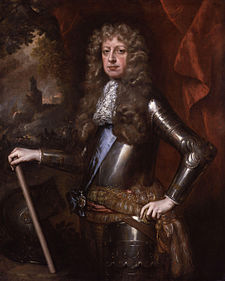 James Butler,Vicount Thurles, a 1680 portrait by Dutch artist Willem Wissing Women, in particular, just love a good romance tale and in keeping with my promise to inform you more about what Her Majesty Queen Elizabeth II missed by not visiting Thurles, her native home, during her recent visit to Tipperary, how better to start than with a factual love story.
James Butler, (1610-1688) the first Duke of Ormonde, was born son of Thomas and Elizabeth Butler (Elizabeth Poyntz – Lady Thurles) at Clerkenwell, London on October 19th, 1610, in the house of his grandfather, Sir John Poyntz. Following the shipwreck, off the coast of Skerries in Dublin resulting in the death of his father in 1619, the boy inherited the title Viscount Thurles.
The year following this family disaster and when he was just nine years of age, because of the influence of his grandfather, his mother brought James back to England, and placed him at school with a Catholic gentleman at Finchley. However it was not long before King James I, anxious that the heir of the Butlers should be brought up Protestant, placed him at Lambeth, under the care of the then Archbishop of Canterbury George Abbot, to be brought up in London under the immediate influence of the court. The boy known as Viscount Thurles, was extremely popular, handsome, and in his early teens quickly became recognised as “the man about town.”
The story regarding his future marriage however is most certainly a romantic one. The young 19 year old Viscount Thurles first cast his eyes on his 14 year old orphaned cousin Elizabeth Preston in church. Elizabeth, only daughter and heiress of the Earl of Desmond, was very wealthy as well as being very beautiful. The Title, ‘Earl of Desmond,’ had been first created for Maurice FitzGerald, 4th Baron Desmond in approximately 1329.
The affection between the couple was immediately noted as being reciprocal. Her father, like his, had also been drowned near Skerries on a passage to England. However, the now orphaned Elizabeth was the King’s ward, she was under the care of Henry, Earl of Holland and George Villiers, then the Duke of Buckingham, had intended her as an excellent ‘catch,’ for his young nephew. However, from all that history has left us, this was a case of love at first sight and Viscount Thurles had resolved he was going to wed her.
Elizabeth Preston, being reserved for someone else, was now guarded under the watchful and jealous eye of Lord Holland, and deliberately kept segregated from Viscount Thurles. Realizing from previous meetings, that his attentions would not be regarded as displeasing by the lovely Elizabeth Preston, Viscount Thurles decided that he would continue to pursue her, regardless of the consequences, so he set upon a devious and clever plan.
He disguised himself as a peddler, and carried his wares to the back-door of Lord Holland’s Kensington residence. During this period and often happily for the course of true love, young ladies were delighted to open their doors to travelling peddlers, and Lord Holland’s own daughters performed this service unknowingly for this love struck disguised Viscount. They made a few purchases from his wares, and then hastened to call Elizabeth, telling her that a handsome English peddler was at the back-door, and begged her to come and view his stock.
The girl recognized Viscount Thurles, and when he urged her to purchase a pair of gloves, she requested him to wait while she went to get some money. Her companions offered to lend her the necessary purchase price, but Elizabeth declined, guessing that one of the gloves could possibly contain a love-note.
Now in the safety of her own room, she read Viscount Thurles’ impassioned letter, and having penned him a favourable reply, came down to the door again and angrily returned the gloves, declaring that they smelt abominably, and could not be worn by any lady of her standing. The disguised peddler accepted the cancellation of this sale and hurridly left, the message in the gloves now settling his doubts and fears, regarding Elizabeth’s true feelings for him.
Women were expensive commodities to maintain even then, and Lord Holland’s consent to the future marriage by James Butler to Elizabeth Preston had to be purchased at a cost of £15,000, which when paid allowed for the smoothing away of the many difficulties opposing this suit. In September 1629, King Charles issued letters patent consenting to this match, on the grounds that it would put a “final end to all controversies between Walter, Earl of Ormond, and Elizabeth, daughter of Richard, Earl of Desmond.”
The groom, James, then but nineteen years and his bride Elizabeth but fourteen years, would now wed in London, during Christmas 1629. The following year, they passed together at her home in Acton, where he devoted his time to study, making up somewhat for past deficiencies in his education, and at the end of 1630 they came over to Ireland, first to rented accommodation in Carrick-on-Suir and later to Thurles and Kilkenny.
The coming of James, Earl of Ormonde to the country and county of his ancestors, was hailed as a welcome sign by most of the then leading Irish families. He was a Protestant, the result of his education in England, but the question of religion was ignored by the Irish, and the handsome and chivalrous Earl was called upon to take his stand in the forefront of the then Irish army.
It seems, Love will always find a way.
The latest volcanic eruption in Iceland forced a reluctant US President Barack Obama to leave Ireland on board Air Force One last night, for his state visit to England. However, this was not before the President had embraced his Irish roots in Moneygall, and the Irish nation had thoroughly embraced him and his very beautiful wife Michelle.
Yesterday despite concerns about the Irish weather, the Obama’s flew by Marine One helicopter to the village of Moneygall, on the Tipperary / Offaly border. As the world and I watched events unfold a few lines from the Irish writer Oliver Goldsmith‘s ‘The Deserted Village ‘ sprang to mind:-
“And, as a hare, whom hounds and horns pursue, Pants to the place from whence at first she flew,
I still had hopes, my long vexations passed, Here to return-and die at home at last.“
This giant of a man who spoke with such eloquence, displaying both Irish empathy and Irish humour, had now finally arrived to embrace his Irish roots and this visit wasn’t for just for votes, this was personal.
 Sláinte ("Health") President Obama with First Lady Michelle and Mayor J.Kennedy in Moneygall. - Picture: AP Source: AP Later while downing a pint of Guinness in Moneygall, latter a small central Irish village, where his great-great-great-grandfather once lived and worked as a shoemaker, we knew he had arrived not just to reaffirm the bonds of affection between the United States and Ireland, but genuinely to visit his past. “My name is Barack Obama, of the Moneygall Obamas and I’ve come home to find the apostrophe we lost somewhere along the way,” he humorously informed over 40,000, mainly young people, who waited for hours to welcome a man whom they truly respected and a man for whom they felt was slowly changing, for the better, the way this world does business.
Local Church of Ireland minister, Canon Stephen Neill confirms: “They were very much at ease here and he was very excited about the official records. The President grabbed his cameraman and said, You got to take a picture of this.”
In paying tribute to the extremely efficient manner that members of An Garda Siochana and the Security Forces oversaw this Presidential event, along with Queen Elizabeth’s visit and Dr. Garret Fitzgerald’s funeral, North Tipperary’s Deputy Noel Coonan stated: “The time that President Obama and first lady Michelle Obama made available to the public was on a scale that was unprecedented and totally unexpected. It was great to observe the huge congregation of brilliant smiles on the faces of the thousands who were present in Moneygall.”
Thurles born North Tipperary Mayor, John Kennedy, one of the US Presidents welcoming committee in Moneygall, later stated “The economy needs a lift, the people need a lift, and this brings a huge lift to the borders of Tipperary. There are millions of Americans who trace their ancestry back to this beautiful island not just through politics, but also through the arts, culture, ancestry and of course commerce. This visit is that lift.”
Ireland has just lowered the Union Jacks that greeted Queen Elizabeth during her landmark visit to Ireland last week. Obama now cited that this was the vital evidence of the willingness and search for progress that Ireland and Britain were making, putting the violence known as “The Troubles,” clearly behind us both, moving forward.
The optimistic phrase “Is féidir linn,” the Irish language version of “yes we can,” was as much about America’s future challenges in re-energising America, as it was telling, we, the Irish that we could overcome our own present economic problems if we undertook the necessary sacrifices needed over the next few years.
The Moneygall visit was without doubt the emotional highlight of the Presidents 12-hour visit to Ireland and as he kicks off a six-day tour of Europe that will also take him to Britain, France, and Poland, immersing him in the thorny issues of military campaigns in Libya and other upheaval daily emerging elsewhere in the Arab world, the Ireland nation wish him every success.
Note the simple emotional words of Irish born actor Brendan Gleeson: “I don’t know about you, I’m fed up looking at the ground. Its time to stand up, breath the air, look around, – What a people.” We must now hope that all the words of wisdom expressed and all the proud feelings we experienced, have somehow been embroidered unto the hearts of each present day Irish inhabitant, for I confidently prophesy, our very future will now depend on each person, each worker’s union and each politician’s personal expression of “real patriotism.” over the next few years.
|
Support Us Help keep Thurles.info online by donating below. Thank you.
Total Donated 2026: €300.00
Thank You!
Daily Thurles Mass Livestream
|



Recent Comments