|
|
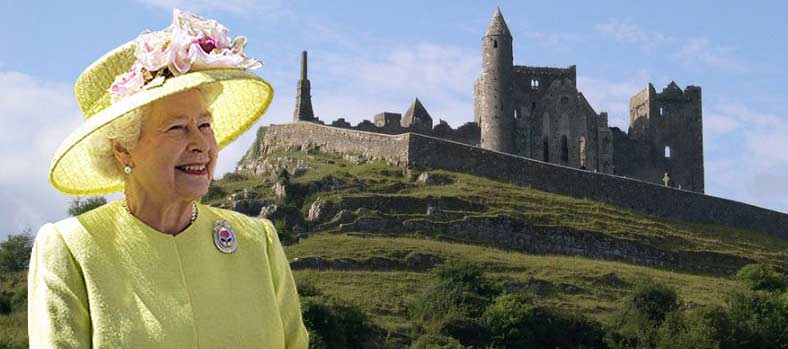 Queen Elizabeth - Welcome To Your Home County Her Majesty Queen Elizabeth II is due to visit Cashel and Fethard in Co.Tipperary on Friday morning next, with a large force of Gardaí and security personnel to be drafted in.
In Cashel, where the Queen will visit the historical “Rock,” (In Irish: Carraig Phádraig) traffic flow restrictions on the M8 are being put in place, beginning from next Monday until next Friday inc, with both carriageways reduced to just one lane. Vehicles will be required, in specified areas, to reduce their speed below 100kmph. Some restrictions in Cashel town will also commence in advance of this visits, fully agreed following local consultation with business and residents in key areas.
With effect from next Thursday evening, access to Cashel will be from Junction 9 of the M8 only, with all other exits effectively closed. Vehicle Information Signs will be put in place on the northbound lane at Junction 10, (Cahir south of Cashel) and at the 2km Junction for Cashel, with motorists warned to make careful note.
A cordon will be placed around Cashel, sealing off the town, between 6.00pm next Thursday and 12.00noon the following day, and only those with valid passes, e.g. local residents and business owners, allowed through a 7km outer cordon around the town.
Police cordons will also be placed around Fethard and Killenaule, as and from Thursday evening, continuing until noon on Friday, although gardai state that business will be permitted to continue as normal, for the most part.
Gardaí have warned the public to allow ample extra time for necessary journeys and to use public transport if at all possible, but point out that some bus timetables may be subject to disruption for short periods of time.
On Friday afternoon the Queen will continue on her visit to Co.Cork, and will not be visiting Thurles, her Ancestral Home, mainly due to the inability of Bord Failte, Politicians, County and Local Councillors and other marketing groups, charged with the Development of Thurles as a Tourist attraction, and who failed to forward an invitation within a proper and appropriate time frame.
Over the coming days we here in Thurles will be showing you, what the Queen missed by not including Thurles in her itinerary.
Meanwhile Your Majesty, “Fáilte roimh do chontae dúchais do Co.Thiobraid Árann.” (Translated “Welcome to your home county, Co.Tipperary.”)
The “Ryan’s Daughter” restaurant, managed by Garry and Geraldine Roche, is a well known and popular haunt of Cashel and Tipperary locals. The restaurant is also particularly well known to long distance travellers, who take a well deserved break, away from the busy, fast M8 motorway, on their journeys between Dublin and Cork.
Situated under the shadow of the Rock of Cashel, on the entrance to the historic Town of Cashel, (Well, that is if you are travelling from the Thurles side.) the chatter from patrons at this delightful little oasis today, was totally focused on the visit by Her Majesty Queen Elizabeth II, on Friday week.
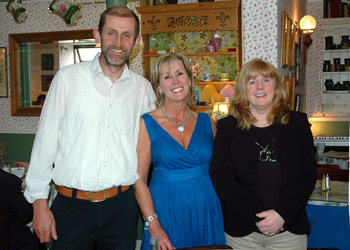 N.Dennehy (Camera), G.Roche (Ryan's Daughter) and H.McInerney (Producer 'Nationwide.') This morning, as I sat amongst the patrons at “Ryan’s Daughter,” enjoying a coffee and a hot scone, the excited chatter was pleasantly interrupted by an unexpected visit from RTÉ Television. Well known producer and reporter Helen McInerney and camera man Neilus Dennehy, were first to appear, much to the obvious delight of those present. They were soon joined by other much loved RTÉ personnel, who arrived in the forms of Mary Kennedy and Michael Ryan, all filming for RTÉ’s popular ‘Nationwide‘ programme.
Locals and visiting tourists, regardless, were pictured or interviewed, between mouthfuls of bacon and cabbage, salad sandwiches and tempting cream cakes.
Note, those wishing to view captured footage of this mornings visit to Cashel by RTÉ, should tune into the “Nationwide” programme, which will go out on air on Monday next at 7.00pm.
Meanwhile, in Cashel town, blossoming flowerbeds are already in place, road repairs are nearing completion and traffic signpost maintenance is fully complete. Everywhere men in yellow reflective jackets are to be observed with yard brushes, rakes and shovels, all totally focused on insuring that all things in the “Cashel of the Kings” will be “Ship Shape and Bristol Fashion,” well ahead of the eagerly awaited ‘Royal Visit.’
For those representing left wing republican politics, and who plan to protest at Her Majesty’s visit to Cashel, be warned, your presence will not be observed with any welcome by Cashel locals and will be damaging to the cause, well that’s if the conversations I overheard this morning are anything to go by.
The ears of Ireland’s Gaelic Athletic Association (GAA) leaders must have burned. Praise was being heaped on them, for recognising that the queen’s visit to Croke Park, in Dublin, is intended as a moment of reconciliation with the GAA over Bloody Sunday, which saw 13 spectators and one player, latter Tipperary footballer Michael Hogan, shot dead. Praise was also being heaped on the GAA, for spearheading the building of a bridge between the British establishment and an organisation that was founded to roll back English influence in Ireland. Some remarked that the queen’s visit will be as significant as the GAA’s 2001 decision to remove the ban on members of the British military and the Northern Ireland security forces from playing Gaelic games.
Locals I spoke to on the streets, later in the day, were 100% unanimous, Queen Elizabeth is welcome to visit Cashel or any other part of Co Tipperary, at anytime. As one commentator put it, “What’s all the fuss, sure Queen Elizabeth is a native of Thurles, Co Tipperary anyway, if anyone cared to check.”
Tipperary is often referred to as the“Premier County,” a description once attributed by Young Irelander Thomas Davis, editor of The Nation newspaper in the 1840’s, and it was he who also stated that “Where Tipperary leads, Ireland follows.”
We welcome contributor Proinsias Barrett, who writes objectively here, in reference to a previous post on thurles.info entitled “How To Cast Your Vote In A Dysfunctional Ireland.”
To introduce Proinsias to our readers, he is a Thurles town native, who now lives in Galway City. He has worked in Sound Engineering and Event Production for some fifteen years, until encouraged by friends and family to further develop his keen interests in history, human geography, sociology and political science. He now attends NUI Galway studying for a Bachelor of Arts honours degree. Proinsias still retains his love of music, particularly alternative non-mainstream progressive styles from the 1960’s to present. He is also interested in Irish Folklore, Celtic Christianity, Heraldry, Irish Surnames and Place Names, Environmental Issues, Travel, Vintage Motor-Scooters and Classic Cars, and offers regular comment through National Press and on this site.
‘The history of all hitherto existing society is the history of class struggles.’
You may recognise these words as the opening lines of Karl Marx and Friedrich Engles ‘ Communist Manifesto, (Written incidentally at the same time as the Chartists movement were calling for change.)
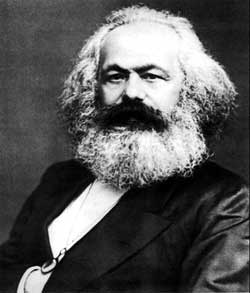 Karl Marx It is interesting that since the ‘fall ‘ of Communism in the former Soviet Union, circa 1989-1991, and the ‘softening‘ of China’s interpretation of Communism in the last ten to fifteen years (Although, a Communist state run by Capitalists, which is what China has evolved into, is far more frightening than modern Russia’s interpretation of democracy.) has re-kindled, especially here in the west, an interest in the political philosophers of old. It has become socially acceptable to discuss Marx’s vision of society, own a copy of the manifesto, and theoretically apply his reason in a contemporary contexts.
When Barack Obama was accused by U.S. Republicans of been a ‘Socialist‘ over his health care reform bill proposals, millions of Americans, with an interest in politics asked ‘What is a Socialist ?,’ ‘Is that Communism ?,’ and so with the disintegration of the former USSR, and Communism no longer a threat to the USA, censorship on certain publications had been lifted (Seemingly there were no more ‘Commies under the bed‘). Information and literature on leftist political philosophy were for the first time since 1946 available in America, which led surprisingly to many Americans researching Socialism and then saying ‘Well, you know, old Marx has some good points here.‘
But I was led to believe as a boy growing up in Thurles in the 1980’s that Class distinctions had been abolished, and people or society were no longer to be categorised in relation to class. The trains removed first-class carriages and airline companies simply re-named first-class to executive class thus side-stepping the issue.
Continue reading Irish Society A History Of Class Struggle
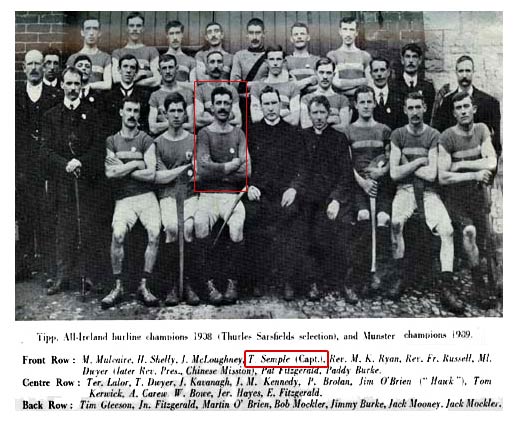 Thurles Sarsfields 1908 with Capt Tom Semple. A competition, whose aim is to promote hurling on an international basis and also promote Thurles Town and its environs as a tourist attraction, is being organised by Thurles Sarsfields, latter one of the oldest, most traditional and most successful clubs in Tipperary.
The hope is that all participants, supporters and visitors will enjoy the first ever international competition for a coveted prize, the Tom Semple Cup. The Tom Semple Cup has been donated by the Semple family, in memory of the great Tom Semple, whose name graces Munster’s finest stadium.
Tom Semple
(Click on Image for larger resolution)
Tom Semple (1879-1943), in hurling lore, is one of Irelands most famous sports persons. Born in The Glebe, Drombane, County Tipperary in 1879 Tom received a limited education at his local national school, and at the age of 16 he left his native Drombane, moving to Thurles where he worked as a guardsman with the Great Southern and Western Railway.
He played hurling with his local club Thurles “Blues” (Now Thurles Sarsfields) and with the Tipperary senior inter-county team from 1900 until 1912. He captained Tipperary to two All-Ireland titles in 1906 and 1908. He rose through the club serving as captain of the team for almost a decade. Semple captained the club to their first senior county title in 1904. Two years later in 1906, while still captain he captured a second county victory. These victories were to lead to the famous four-in-a-row for Thurles. Semple won an unprecedented eight county championship, with just two defeats for Thurles during his reign.
In 1910 Tom Semple and others organised a committee which purchased the showgrounds in Thurles, as part of their vision to develop a local hurling playing field. This field later became known as Thurles Sports-field and is regarded as one of the best surfaces for hurling in Ireland. In 1971 it was aptly renamed Semple Stadium in Tom’s honour, and is still referred to lovingly in some quarters as ‘Tom Semple’s field.’
Tom Semple also held the post of chairman of the Tipperary County Board and represented Tipperary, amongst other positions as treasurer, on the Munster Council and Central Council. Tom Semple’s grave can be visited here in St Mary’s Churchyard, beside St Mary’s Famine Museum here in Thurles.
Munster Final Day in Thurles holds a special place in the hearts of all devout hurling followers and organisers hope that all who visit here, will experience all that is spectacular about this great Irish cultural game, during this planned event. This competition is expected to takes place over this coming Munster Final weekend, and will be an annual event here in Thurles in the future, regardless of where Munster Finals are played. Indeed as organisers correctly state, with our modern road transport network in place and with a regular, fast public transport facilities servicing Thurles, followers of the sport are ever only 1.5 hours away from any likely future Munster Final venue.
The Teams Already Eagerly Signed Up
The teams already signing up to compete this year are Brussels, under Willie Cashin of Moycarkey-Borris. Kilburn Gaels will be managed by Moyne man Tom Bergin. One of the big names are Robert Emmets led ny Mick O’Dea of Liscarroll, Co Cork. The exclusive hurling club of Na Magha in Derry is taking part in its first international competition, led by Damian Doherty. The traditional Gaelic club of Keady from Armagh is under the watchful eye of Jim McCormack and have on occasion been coached by the Thurles Sarsfields’ senior coach, Paddy McCormack. Ger Collins, a former centre-forward with Thurles Sarsfields was involved in the setting up of a hurling club in Dundalk, Naomh Moninne. Co Kildare’s Naas are managed and coached by Pat English from Carlow and their secretary, former Watergrasshill hurler Brian O’Riordan. The Wild Geese from Lakenheath managed by Major Tim Neylon are representing the USA, and by competing will be the first US army team to take part in an official international competition.
This competition has all the promise of becoming the first fully international competition since the Tailteann Games of the twenties, latter a form of “Celtic Olympics” that originated in the 6th century BC, supposedly by Lugh, (Latter an Irish deity represented in mythological texts as a hero and High King of the distant past) and which were held continuously up until the 12th century AD, before being revived in the 1880’s and lapsing in the early 1920s. The first games were to be held in 1922, but the outbreak of our Civil War saw American athletes pull out, resulting in the games being abandoned. When revived two years later, the games were a runaway success, with over 5,000 competitors in disciplines as diverse as hurling and Gaelic football, a full athletics programme, swimming, motor-cycle and airplane racing, art and music competitions, attracted hundreds of thousands of people.
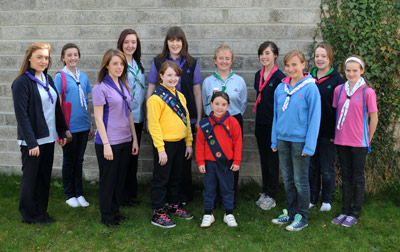 Irish Girl Guides Report by Catherine O’Connor, (Communications Officer – Irish Girl Guides.)
On Saturday next May 7th 2011, the Irish Girl Guides (IGG) will hold the largest celebration fun day in it’s history, to celebrate 100 years of changing lives here in Ireland.
Over 6,000 girls and Leaders will descend on Thurles, Co. Tipperary to join together for a day of great fun activities including a Guinness Book of Records attempt.
The Irish Girl Guides are a voluntary organisation for 11,000 girls and volunteer leaders countrywide. The Irish Girl IGG’s mission is to enable girls and young women to develop to their fullest potential as responsible citizens of the world. IGG was founded in 1911. It provides an environment where girls from all backgrounds can grow in self-confidence and develop a variety of skills in an unpressurised atmosphere.
All the branches will be joining in the celebrations – the Ladybirds who are aged between 5 – 7 years, the Brownies from 6½ – 11 years; the Guides 10½– 15 years and Senior Branch 14½ – 26 years.
The day will begin with a parade which will be led by 85 teenage girls, who are Guiding Stars, as each will be receiving the prestigious Gold Award, the highest achievement that a Guide can achieve. Then IGG will take on the challenge of breaking the Guinness Book of Records for the longest string of reef knots ever.
After this the girls will break into their different age groups to try activities such as Drumming, Circus skills, Dance, Animal Roadshow, Science workshops, Reptile village, Gospel Singing along with time to enjoy the free flow area, which will include Large Scale Inflatables, Helter Skelter, Carousel, Giant Paint by Numbers and Street Entertainers.
As the day comes to a close there will be a presentation of 30 year service pins to many dedicated leaders, by special guest Mary McPhail, CEO of the World Association of Girl Guides and Girl Scouts. This is especially significant as 2011 has been designated the European Year of volunteering.
Emer O’Sullivan, Chief Commissioner of the Irish Girl Guides, said, “This is a great opportunity to thank all our volunteer Leaders but an extremely special
chance to thank the leaders with 30+ years of service. Today we will remember with pride and gratitude, the work and efforts of those who have gone before and those who strive today to make Guiding the wonderful organisation that it is.”
To end the day on a high, the girls and leaders will party to an ABBA tribute band concert as IGG continues to celebrate their centenary for the rest of 2011.
In essence the day is all about celebrating 100 years of an association that has grown from strength to strength, and continues to meet the needs of girls and women in Ireland, through a programme of fun and friendship that enables them to develop their full potential as responsible citizens of the world.
Well known former members of the Irish Girl Guides include Sonia O’Sullivan, Olympic Medallist; Catherine McGuinness, former President of the Law Reform Commission, judge of the Circuit Court (the first woman to serve on the Court), justice of the High Court and Supreme Court of Ireland, Róisín Ingle, Irish Times Journalist and Una Healy of the band The Saturdays to name but a few.
Girl Guides – Welcome to Thurles.
|
Support Us Help keep Thurles.info online by donating below. Thank you.
Total Donated 2026: €300.00
Thank You!
Daily Thurles Mass Livestream
|



Recent Comments