|
|
Leading gaming experts including Head of EA to participate in LIT/Microsoft Ireland event in Thurles.
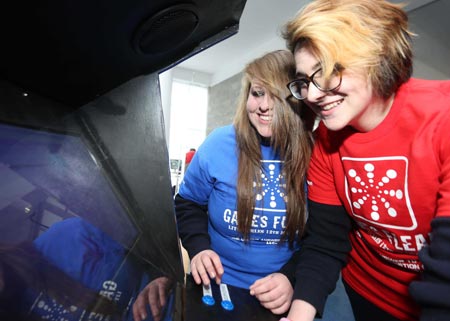 Shannon Mostert and Ciara Bull from Nenagh, Co Tipperary Some of the biggest names in the gaming industry will gather at the Limerick Institute of Technology (LIT) campus here in Thurles later this month to participate in Games Fleadh 2015, an all-island games design and development competition for third-level students.
LIT Tipperary, whose alumni have worked on some of gaming’s biggest titles including ‘Call of Duty’, ‘StarCraft’ and ‘Guitar Hero’, has announced it will host Ireland’s largest gaming event on Wednesday March 11th.
Supported by Microsoft Ireland, EA Games and the Irish Computer Society, the 12th annual Games Fleadh will feature the ‘Direct X’ Endless Runner challenge, Robocode and the Game Studio ‘Endless Runner’ competition, the winners and runners up of which will present their games to Brenda and John Romero and the University of California, Santa Cruz (UCSC) Greenlight Committee.
Games Fleadh 2015 – Open to the public for free
Brenda and John Romero have each more than 30 years experience working in the gaming industry, over 150 game titles such as DOOM and Quake to their credit, dozens of awards and have collectively founded nine game companies.
Games Fleadh will also feature games development and research talks by industry veterans such as Bryan Neider who will assist in the judging process for the various under graduate competitions. Neider is Senior Vice President and Chief Operating Officer of the Electronic Arts (EA) labels, which collectively are responsible for producing some of the bestselling video game titles of all time including The Sims, FIFA, Battlefield and Madden NFL.
“This is a fantastic opportunity for students to create a prototype game, meet people from industry and make a name for themselves within the Irish game sector,” said Dr. Liam Noonan, Lecturer at LIT’s Game Design and Development degree in Thurles at the launch of Games Fleadh 2015.
“In terms of career development, participating in this competition is invaluable as students are adding to their portfolio of creative content and networking with students from other colleges and people from the games industry. It is these up and coming game developers and their innovative ideas that will act as the catalyst for job creation in the Irish game development sector,” added Dr. Noonan.
According to Dr. Noonan: “We were delighted and privileged to work with the Fulbright U.S. Specialist Award scholar Brenda Romero and her husband John back in September in our Thurles campus and they were very supportive of our Games Fleadh initiative. They suggested that the 2015 theme should be Endless Runner as this would allow students flexibility in designing either a 2D or 3D game.”
Commenting about Games Fleadh 2015, Brenda and John Romero said: “We are really excited to be involved in Games Fleadh this year. Having travelled all over Ireland and met hundreds of students and game developers, we know how much talent the country has and are looking forward to seeing this year’s results.”
Speaking ahead of his visit to Ireland, Mr. Bryan Neider stated: “I am looking forward to meeting the games design and development students at LIT Games Fleadh 2015, discussing their “Endless Runner” games and sharing our experiences at EA Games in the design and development of future titles.”
Stephen Howell, Academic Engagement Manager, Microsoft Ireland commented: “Microsoft is delighted to be on board sponsoring the Games Fleadh once again in 2015. We have demonstrated our commitment to the competition over the long term as it represents a fantastic opportunity to shine a spotlight on the immense third level games design talent in this country. It also plays a unique role in promoting knowledge-sharing, with international experts taking part and the latest research in the field up for discussion.”
Games Fleadh 2015 is open to the public for free. Online registration is available at www.gamesfleadh.ie.
For more visit www.twitter.com/gamesfleadh or search Twitter #gamesfleadh.
Thurles Credit Union held their local round of the Credit Union Quiz 2015 in the Premier Hall, Thurles on Friday 30th January 2015 last.
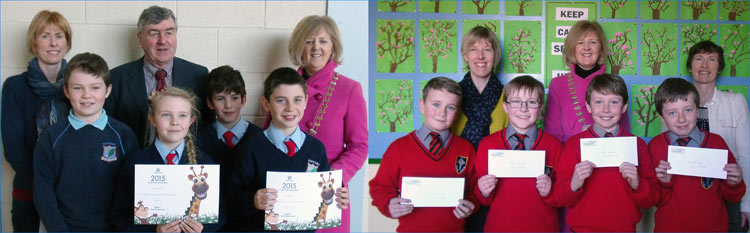
Gael Scoil Bhríde (Left above) were victorious in the U13 quiz, while Scoil Ailbhe (Right above) progressed victoriously in the U11 quiz.
Scoil Iosagain, Upperchurch, came second in the U11 and 3rd in the U13, while Scoil Chroí Naofa, Urlingford took 3rd place in the U11 quiz. Scoil Ailbhe also achieved 2nd place at the U13, in addition to their already U11 success.
Thurles Credit Union would like to thank the parents and teachers of all the participating schools and wish both Gael Scoil Bhríde and Scoil Ailbhe every success in the upcoming Chapter level quiz, where they will do battle with school quiz teams from other Credit Unions throughout North Tipperary.
Winners of the forthcoming Chapter level quiz will then progress to the All Ireland Credit Union competition to be held in Dublin at a date yet to be decided, during April of this year.
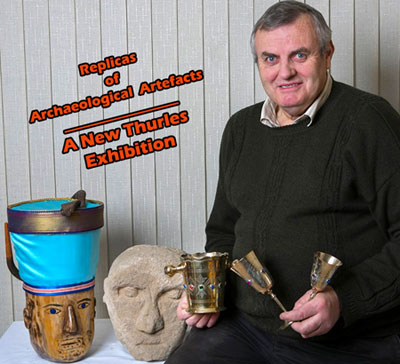 Executive Librarian M/s Ann Marie Brophy Reports; Executive Librarian M/s Ann Marie Brophy Reports;
Thurles Library, The Source Complex, Cathedral Street Thurles is proud to present an exhibition of ‘Replicas of Archaeological Artefacts’.
The exhibition will open on Tuesday 10th February at 7.00 p.m. and will be launched by Mattie McGrath TD. All are welcome to attend.
This exhibition will run until Tuesday 10th March, during normal Thurles Library opening hours. [e.g. Monday: 10.00 a.m. – 1.00 p.m. / 2.00 p.m. – 5.30 p.m. Tuesday & Thursday: 10.00 a.m. – 8.30 p.m. Friday: 10.00 a.m. – 5.00 p.m. Saturday: 10.00 a.m. – 1.00 p.m. / 2.00 p.m. – 5.00 p.m.]
Created by Mr Edward Moten-Letsome, the exhibition features objects in stone, wood, leather, copper and silver; from Early Man through to Egyptian, Greek, Inca, Aztec, Olmec and Viking periods. Edward has also crafted agricultural items from our own Irish heritage.
Edward was originally born at Tullaskeagh, Roscrea but moved to the picturesque Gaeltacht village of Newcastle in 2006. He is a self-taught sculptor and artist. Edward says, “It was during one of my many walks on Bothar na nGall, latter situated in the South Tipperary mountains, that I was inspired to create these artefacts.”
Edward uses the artefacts on display to illustrate his 40 minute talk, which covers the evolution of Early Man and his progress up to the Viking period. Edward hopes that the people who visit this free exhibition will derive as much pleasure from it as he has from sculpting the objects.
If you are interested in bringing a group to this exhibition please contact Thurles Library on Tel: (0504) 29720.
This exhibition should be of particular interest to schools and other educational groups and offers all visiting students and their teachers an ideal opportunity to also visit other interesting primary resource centres, which are within easy distance of this immediate area, e.g. St Mary’s Famine & War Museum Tel: (0504) 21133; Lár na Páirce GAA Museum Tel: (0504) 22702; Cormackstown Heritage Centre Tel: 085-7131584 and the Cabragh Wetlands Trust Tel: Tel: (0504) 43879.
Note: In the case of all of the above named venues, booking in advance is essential to ensure a qualified tour guide is present during your visit.
Deadline for Waste Management Plan public consultation draws near.
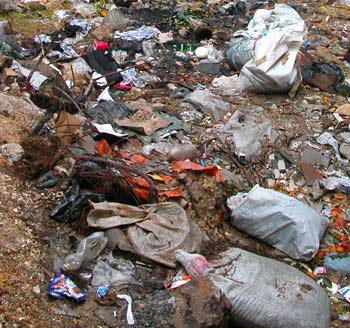 Householders and businesses across County Tipperary are being asked to “Do One More Thing” in 2015 to reduce the amount of waste sent to landfill, to boost recycling rates and to prevent food waste. Householders and businesses across County Tipperary are being asked to “Do One More Thing” in 2015 to reduce the amount of waste sent to landfill, to boost recycling rates and to prevent food waste.
The call has been made as part of a public consultation on a new plan that sets out a framework for waste management in 10 counties across the south of Ireland, including Tipperary, during the next six years.
The Southern Region Waste Management Plan, which is one of three being developed in Ireland, seeks to assist and support the community and local business sector to develop resource efficiency and waste prevention initiatives.
Key targets outlined in the Plan include a 1% reduction per annum in the quantity of household waste generated per capita over the period of the plan, a recycling/preparing for reuse rate of 50% by 2020, and the elimination of the direct disposal of unprocessed residual waste to landfill from 2016.
As well as encouraging the public to engage in the public consultation process, the Southern Waste Regional Office is also urging the wider public to “Do One More Thing” to help reduce the amount of household waste that is generated and to promote waste prevention initiatives in the workplace.
“What we do with our waste will become increasingly important in years to come. As natural resources deplete we will have to reuse, repair and recycle more,” explained Pauline McDonogh, Regional Waste Prevention Co-ordinator, Southern Waste Region.
“The draft waste management plan for the Southern Region aims to move our management of waste from a traditional disposal model to a circular economy model so that waste becomes a future resource or raw material. Householders, businesses and even schools can kick-start this process by visiting our website at wwww.southernwasteregion.ie and learning how they can directly play a role in boosting household and commercial recycling rates and reducing the level of waste sent to landfill. Among the ‘Do One More Thing’ measures being promoted is the repairing and bringing back into use of broken household items, improving the quality of recycling so less recyclable waste is contaminated, and reducing household food waste through smarter shopping, improved food storage and more efficient use of foodstuffs,” stated Ms. McDonogh.
The preparation of new regional waste management plans for the regions has been underway since late 2013 following an evaluation of the previous plans which covered ten regions nationally.
Ms. McDonogh noted that “significant progress” has already been made in relation to waste prevention throughout the southern region.
Since the last waste management plans were published between 2004 and 2006, a southern region network of 770 Bottle bank sites and 50 Civic Amenity Sites accepting more than 25 categories of waste have been maintained, while a household recovery/recycling rate of 63% and a commercial recovery / recycling rate of 61% have been achieved. Nationally, a packaging recovery rate of 87% was achieved while an average of 7.3 kg of WEEE was collected per person from private households.
“We want to hear the public’s views on these achievements and about what more needs to be done,” stated Ms. McDonogh, who added: “We would ask people to have their say on the future of waste management by telling us their views before the deadline of January 30th 2015. The more feedback we receive the greater the potential for improving Ireland’s environment into the future. Feedback forms and the full plan are available on www.southernwasteregion.ie.”
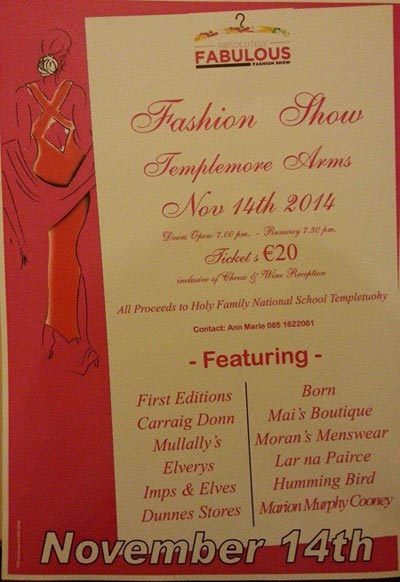 All roads will lead to Templemore, Co Tipperary at the start of this coming weekend as the spectacular ‘Absolutely Fabulous’ Fashion Show takes place in aid of the Holy Family National School, in Templetuohy. All roads will lead to Templemore, Co Tipperary at the start of this coming weekend as the spectacular ‘Absolutely Fabulous’ Fashion Show takes place in aid of the Holy Family National School, in Templetuohy.
This spectacular event will be held in the Templemore Arms Hotel on Friday next, November 14th, [MAP REF] beginning at 7.00pm.
The event, organised by the Parents Association of the school, promises those attending a unique blend of high fashion, local entertainment and a true party atmosphere.
(Click on picture left for larger image quality.)
Committee member M/s Leona Doyle reports:-
“On arrival there will be a cheese and wine reception and also stalls exhibiting local crafts and produce to browse through. You might even pick up a bargain or two ahead of Christmas!
The Fashion Show will feature style from Mai’s Boutique and Mullally’s (Templemore), First Editions, Born, Carraig Donn, Lár na Páirce, Elverys, Hummingbird, Imps and Elfs, Moran’s Menswear and Dunnes Stores (Thurles). Nenagh town will be represented by well known designer Marion Murphy Cooney.
There will be something for all ages, tastes and sizes on show; Men’s wear, Women’s wear, Sports-wear, Casual, Dressy, Teenager and Children’s wear.
During the interval there will be local entertainment while people will also have a chance to chin-wag and browse around the numerous stalls. Your admission ticket will also includes your raffle entry to a great draw with lots of vouchers and great prizes to be won!
The organising Parents Association are encouraging those attending to steal the limelight themselves with a smashing prize on offer for the “Best Dressed” on the night, so here is a great excuse to get dressed up!
Everyone in attendance will also get a great idea of what is “trending” for the Christmas party season while enjoying watching the models strut their stuff on the catwalk. The show will feature lots of well known locals and even some of our recent County Champions are ready to walk the ramp!
A great night is assured for all so do come along, support the local school and have a unique night out! Doors will open at 7.00pm and the runway is at 7.30pm.
Tickets: Tickets are just €20 for a whole evening’s entertainment. They can be obtained from any committee member or by texting /phoning Ann Marie on 085-1622061. You can also find us and keep up to date on our “Absolutely Fabulous Fashion Show” Facebook page. See you there! “Note to you men folk out there – why not surprise / treat the woman in your life with the surprise gift of a ticket to this truly spectacular and worthy event.
|
Support Us Help keep Thurles.info online by donating below. Thank you.
Total Donated 2026: €300.00
Thank You!
Daily Thurles Mass Livestream
|



Recent Comments