|
|
 This day the 21st January, 100 years ago, in 1919 Sinn Féin candidates who had been elected in the Westminster elections of 1918 refused to recognise the Parliament of the United Kingdom and instead assembled as a revolutionary parliament called “Dáil Éireann”. This first meeting of Dáil Éireann on 21st January 1919 was held in the Round Room of the Mansion House. Unlike the normal picture which depicts the first Dáil this photo shows the true first assembly. Éamon de Valera and Arthur Griffith were both in jail on January 21st and Michael Collins, much sought by British Forces together with Harry Boland were busy preparing plans for the successful escape of Éamon de Valera from Lincoln Gaol.
Prior to 1919, Sinn Féin’s popularity had increased dramatically, following the execution by Englands Major General Sir John Maxwell, of most of some 90 leaders of the 1916 rebellion. Sinn Féin had won 73 out of the 105 Irish seats in the Westminster parliament and the party’s founder, Arthur Griffith, believed that Irish nationalists should emulate the means by which Hungarian nationalists, led by Ferenc Deák, had achieved partial independence from Austria.
However, on precisely the same day as the Dáil’s first meeting took place, two members of the Royal Irish Constabulary were ambushed and killed at Soloheadbeg, in Co. Tipperary, by members of the Irish Volunteers, later to be known as the 3rd. Tipperary Brigade of the IRA. This incident had not been ordered by the Dáil but the course of events soon drove the Dáil to recognise the Volunteers as the army of the Irish Republic and the ambush to be seen as an act of war against Great Britain.
The Tipperary Connection.
In relating this historical blog we will again unveil yet another secret of the true hidden Ireland that is Tipperary.
Soloheadbeg is a small townsland near Limerick Junction railway station. The place is steeped in Irish history, for it was here that King Mahon of Thomond together with his brother Brian Ború defeated the vikings at the Battle of Solohead in 968. It was here also that Dónal Cam O’Sullivan Bere stopped on his epic march from Dunboy Castle in west Cork to O’Rourke’s Castle in Leitrim in 1603.
 On 21st January 1919, two Irish born catholic RIC constables, James Alec McDonnell and Patrick O’Connell, were escorting a horse drawn cart containing a load of gelignite taken from the Tipperary town Military Barracks. This gelignite, was destined for use for blasting purposes, at the local Soloheadbeg Quarry. The driver of the cart was James Godfrey, accompanied by Patrick Flynn, the latter a County Council employee.
Constable McDonnell, was a native of Belmullet, Co. Mayo and a widower with seven children. His comrade Constable O’Connell, was a native of Coachford, County Cork, and unmarried. Both men, according to local reports, were reasonably popular as policemen in the area.
Possibly up to eight armed and masked men, members of the then Irish Volunteers from the South Tipperary Brigade, which included their leader Séamus Robbinson, OC; Sean  Tracy, Vice OC; Dan Breen, QM; Sean Hogan, Tadgh Crowe, Patrick Dwyer, Michael Ryan, and Patrick McCormack fired on the Constables, killing both men. Volunteer GHQ had not sanctioned this ambush. The driver and County Council worker were left unharmed. In the pocket of Constable McDonnell’s uniform were 30 electric detonators which remained undiscovered by their assailants. Hogan with Treacy and Breen drove the cart, together with the explosives, away from the scene, while the others involved scattered in the opposite direction. Eye witnesses later saw the cart been driven at high speed in the direction of Dundrum village, in Co. Tipperary, and indeed the horse and cart, minus its contents, were later found abandoned at Allen Creamery, near Dundrum, by District Inspector Poer O’Shee of Clonmel.
Condemnation for the killings was swift and from every quarter, even from some well known local republicans and local priests. Dan Breen claimed the constables attacked first, but a body of opinion says that this was unlikely given the odds against them. Dan Breen claims in his book “My fight for Irish Freedom” that the constables raised their rifles in preparation for a fight and that they were forced to kill the two constables.
However Breen also later recalled:”…we took the action deliberately, having thought over the matter and talked it over between us. Treacy had stated to me that the only way of starting a war was to kill someone, and we wanted to start a war, so we intended to kill some of the police whom we looked upon as the foremost and most important branch of the enemy forces … The only regret that we had following the ambush was that there were only two policemen in it, instead of the six we had expected.
The real facts of this incident are possibly forever lost in history.
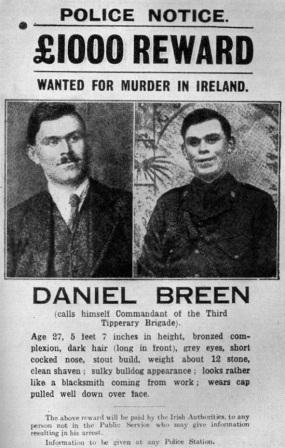
The following day Martial Law was imposed in Co.Tipperary. A reward of £1,000 was offered for information, shown on wanted posters displaying photographs of Dan Breen, which were immediately posted outside every police barracks in the country.
The Soloheadbeg incident is still regarded as the first opening act of the Irish War of Independence, though the Dáil did not formally declare war on Britain until 1921.
Sean Treacy was later killed by British forces and was buried at Kilfeacle in October, 1920. Breen went on to serve as a politician and member of Dáil Éireann (anti-Treaty) from 1923-1927 and 1932-1965. He died in Dublin in 1969 and was buried in Donohill.
 The recent announcement, by the management of the computer multi-national Dell Corporation, to terminate the jobs of 1,900 workers at its Raheen Industrial estate plant in Limerick will seriously effect businesses in Tipperary County. This is because many of the employee’s commute daily from many Tipperary towns including Roscrea, Nenagh, Thurles, and Templemore.
Dell grew during the 1980s and 1990s to become the largest seller of PCs and servers. However from 2008 it held the second spot in computer-sales within the computer industry falling behind the Hewlett-Packard Company.
European officials are now to investigate a reported €52.7million aid package used by the Polish Government to charm this computer giant away from Limerick. This almost €53 million sweetener was agreed with senior Dell executives, at the same time as the company seeks to get rid of 1,900 jobs and seriously affect an estimated other 10,000 jobs in sub-supply companies reliant on Dells business. The new plant, with a cheaper workforce, will be in Łódź (means Boat) which is approximately 135 kilometres (84 mi) south-west of Warsaw.
The European Commission now state that an in-depth investigation into how this deal was struck, will be completed within the next six months. Competition Commissioner, Neelie Kroes, has stated that there are doubts whether this lucrative deal will pass strict rules on State aid.
“We need to investigate all the effects of this aid to verify that it contributes to regional development and to ensure that it will not reinforce Dell’s position or create significant capacity in a market on the decline in the European Economic Area (EEA),” Mrs Kroes stated.
European Union Competition Policy is basically applying rules to make sure that companies compete with each other in order to sell their products, through innovation and good pricing to consumers. The risk if there’s no competition policy is that companies will do deals with each other to split up the market between them, or will act in a way which does not allow competitors into the marketplace. In either case the result can be that consumers are denied access to innovative products and /or pay extremely high prices.
Concerned EU parties, including the Irish Government, will be able to offer their views when full details of this reported sweetner package is investigated and let us now hope that this new factory is not solely dependant on gas.
Now please someone explain the following?
On the 19th December 2006, we are told, that, at an event hosted by the President of Lodz, Jerzy Kropiwnicki, together with Polish Prime Minister Jaroslaw Kaczynski in the Poznanski Palace in Lodz, Poland, the Dell Corporate Vice President Sean Corkery and Polish Minister of the Economy Piotr Wozniak, signed an agreement to inaugurate the establishment of a new factory to produce computers in Lodz, Poland. According to Dell Vice President Corkery, excavation at the site have already begun and they expect to start hiring labour in December 2006 and producing their first product in October 2007. This new factory, we are told, is potentially a €200 million investment with job creation for up to 3,000 employees. The new factory will sell to the Polish market and export to countries in Central and Eastern Europe, thus becoming a regional production and distribution center.
On Thursday, 25 January 2007, Dell again announce that it is building its most state-of-the-art factory in Łódź, Poland in the centre of the country. Its opening is planned again for autumn 2007. From this factory this technical giant aims to increase its production capabilities and meet the growing demand in central and eastern Europe. The new factory will manufacture new generation servers and laptops.
Explain how those we place in charge of our countries affairs were so oblivious to the obvious?
Perhaps it is now time to make the novel by George Orwell, entitled Animal Farm, compulsory reading, as part of our countries educational system.
 Dáil Deputy Michael Lowry, T.D., speaking to Thurles.Info this morning, underlined the importance of patient safety following the publication of the Teamwork report which outlines proposed health service reform for the Mid West.
Deputy Lowry said:
“While we are obliged to listen and take notice of professional medical advice on the structures and procedures that are now considered to give the best possible patient care, the overall safety of patients in Co.Tipperary still remains of paramount importance.”
The Independent Deputy insisted that any reform moves that would possibly improve health services, to the people of Tipperary, would have to be predicated on the basis of fully operational and functioning alternative structures being ready and in place.
He also stated that significant amounts of capital funding will have to be spent on Nenagh hospital to enable it to become a crucial component of the Mid Western Health System and allow it deliver the best possible service to the people of North Tipperary and also meet the needs of those in Limerick and other parts of the Mid West Region that require access to specialist services at Nenagh.
Lowry continued:
“The report raises several key questions that need to be addressed in advance, in terms of the practical implementation of these findings. It is not possible to implement such a report without first putting in place:-
· Alternative Structures
· Alternative Facilities
· Increased Bed Compliment
· Sufficient Paramedic Units
· The proper level of Medical, Nursing and Attendant Staff
· And most importantly a greatly enhanced Ambulance Service
As part of my agreement with this government, I secured a commitment to invest upwards of €25 million in upgrading facilities. That investment is to include 3 new operating theatres, an endoscopy unit, new lifts and other significant improvements which are crucial to the future of the hospital. Without this spend to upgrade outdated facilities, Nenagh Hospital has no future in any capacity. While I have a commitment to the funding in place, I will now, in the context of the current economic environment, be asking for an outline of the precise timing of this funding. These improvements must be in place before any new administrative system of healthcare for the people of North Tipperary is implemented.” concluded Deputy Lowry.
World wide campaigners, who helped secure the recent global ban on “Cluster Bombs” are this years recipients of the Tipperary International Peace Prize.

Last month, 94 countries, including Ireland, signed the Convention on Cluster Munitions, a treaty soon to outlaw the use, manufacture and stockpiling of cluster bombs, following its endorsement on May 30th. 2008, in Dublin and the later signing in Oslo on December 3rd. and 4th. December 2008 last.
The Cluster Munition Coalition movement or CMC, which was formed in 2003, is made up of over 250 groups including civil society organizations,NGOs, faith-based groups and professional organizations working in at least 70 different countries, all who strive to terminate the senseless loss of life and loss of limbs directly caused by the use of these munitions.
Cluster munitions are larger weapons which are deployed either from the air or from the ground and release hundreds of smaller sub-munitions. Sub-munitions released by air-dropped cluster bombs are most often called “bomblets “. Those delivered from the ground by artillery or rockets launching are usually referred to as “grenades.” The use of these cluster munitions kill and injure many more civilians than soldiers. The use of these weapons caused more civilian casualties in Iraq in 2003 and Kosovo in 1999 than any other weapon system then in use.
At least 15 countries have used cluster munitions in the past and these include United Kingdom, Russia (USSR), United States of America, France,Eritrea, Ethiopia, Georgia, Israel, Morocco, the Netherlands, Nigeria, Saudi Arabia, Sudan, Tajikistan, and FR Yugoslavia.
Some 27 countries who are known to have produced cluster munitions are United Kingdom, France, China, Japan, Brazil, Egypt, Germany, Greece, India, Iran, Iraq, Israel, Italy, North Korea, South Korea, Pakistan, Poland, Romania, Russia, Serbia, Singapore, Slovakia, South Africa, Spain, Sweden, Turkey and United States.
A ceremony to celebrate the first year Anniversary of the Adoption of this Convention on Cluster Munitions will be held in Dublin on the 30th. May 2009.
The Tipperary Peace Award was founded in 1984. It’s principal aim is to give recognition to those who promote the ideals of peace and peaceful co-operation both in Ireland and abroad. Over the past years, the Prize has been awarded to a range of peacemakers. Some have taken centre stage; others have worked behind the scenes, in brokering peace accords under the most difficult of circumstances. They are recognised for their courage in the face of adversity, for their perseverance through the most despairing of situations and for their vision and foresight at times when all around was disillusion and despair.
Some previous winners of the Tipperary International Peace Prize include:
South African President Nelson Mandela.
Former Soviet President Mikhail Gorbachev.
The late Senator Gordon Wilson.
Live-Aid organiser Bob Geldof.
US Senator George Mitchell.
Retired Archbishop of Armagh, Lord Robin Eames.
Former Pakistan Prime Minister, Shaheed Mohtarma Benazir Bhutto,
 Traditional festive treats were not the only delights served up at this year’s Thurles Chamber of Commerce Annual Christmas Dinner.
Some 250 business men and women were in attendance and this year’s special guest speaker was business tycoon and former supermarket supremo, now turned gym boss, Mr. Ben Dunne.
Ben Dunne was born on the 3rd March 1949 in Cork. He was a director of the fully Irish owned company Dunnes Stores for many years, having made his start in the retail industry at the age of sixteen. He did every job possible at Dunnes stores, including stacking shelves and worked his way through the ranks. He took over the family business in Dunne’s when his father Ben Dunne Senior died. He finished working with the Dunnes Empire some 10 years ago and after spending time investing in property and retail ventures, he eventually settled into his present gym business. He has built his gym empire with three gyms to date and more planned for 2009. He has successful gyms presently operating at Westpoint in Blanchardstown, Northwood in Santry and Carlisle in Kimmage.
In his address to the Thurles Chamber dinner guests, Mr. Dunne discussed a number of topical issues, most notably the current economic recession. At a time when economic reports, correspondents and predictions cultivate an ambience of impending doom, Mr. Dunne urged attendees to “Hold on to their personal values“, emphasising that “It is your character that will see you through the rough times, just as much as it is your character that will bring to the top in good times“. Whilst he conceded that “We are all in for tough times in the foreseeable future” Mr. Dunne highlighted that “There is one sure thing about recession, it always passes“. Indeed, Mr. Dunne’s address reflected a positive and proactive atmosphere on the night.
Austin Broderick, President of the Thurles Chamber of Commerce, highlighted an abundance of successful Thurles Chamber events and activities, including the 2008 fashion show, golf classic, collaborative meetings with the Thurles Town Council and the production of a new local Chamber magazine. In addition, Mr. Broderick emphasised that the Chamber had and will continue to take all action needed to secure future employment opportunities for the citizens of Thurles. He highlighted the contributions made by Shannon Development to the town, the Chambers recent application to the North Tipperary Enterprise Board and the commitment to ensure that the government delivers on its Decentralisation promises.
On the night, local enterprise was honoured and amongst those highlighted were Moran’s Drapery of Friar Street, Ryan’s Daughter of Rossa Street and Imps and Elves of Croke Street. Mr Broderick praised the contributions of business to the town and gave special mention to Jack Blake of Dew Valley Meats and the Carney Brothers. The excellent work of the Thurles Town Council was also celebrated and Mr. Broderick thanked the Town Council for their consistent efforts over the past year.
|
Support Us Help keep Thurles.info online by donating below. Thank you.
Total Donated 2026: €300.00
Thank You!
Daily Thurles Mass Livestream
|



Recent Comments