The Hammer, the Printing Press, and the Monk who changed Europe.
Yesterday, 509 years ago, on October 31st 1517, a German monk and university professor took a step that would change the course of European history. His name was Martin Luther. He was 33 years old and taught theology at the University of Wittenberg, in what is today Germany. He had become deeply troubled by certain practices within the Roman Catholic Church, particularly the sale of indulgences.
Indulgences were intended to reduce the temporal punishment associated with sins already forgiven. However, some preachers encouraged people to believe that by purchasing these certificates, same could bring spiritual benefits to themselves or even release deceased relatives from suffering in purgatory.
Same belief was aided by a supposedly famous statement▲ associated with Johann Tetzel, the Dominican preacher, whose promotion of indulgences helped provoke Martin Luther’s protest in 1517.
▲ This quotation supposedly stated “Sobald der Gülden im Becken klingt,im huy die Seel im Himmel springt”. [Translated – “As soon as the money in the chest rings, the soul from purgatory heavenward springs.”]
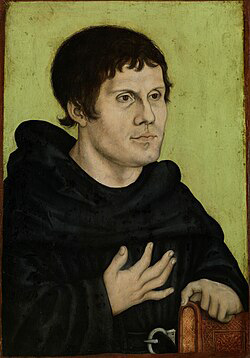
The latter named prominent preacher, Johann Tetzel, was raising money through indulgence sales associated with the rebuilding of St Peter’s Basilica in Rome and the financial obligations of Archbishop Albrecht of Mainz.
Martin Luther believed that people were being misled. God’s forgiveness, he argued, could not be bought, and genuine repentance and faith were more important than any purchased certificate. He therefore prepared 95 propositions, or Theses, written in Latin, questioning the theology and the then practice surrounding indulgences.
On October 31st 1517, Luther sent his arguments to Archbishop Albrecht, hoping to begin a serious theological discussion. He could scarcely have imagined what would follow.
A famous image of the Reformation shows Luther standing outside Wittenberg’s Castle Church, hammer in hand, nailing his 95 Theses to the wooden door, but did Luther really nail his Theses to a Church door? Historians remain divided.
The best-known early account came from Luther’s colleague Philipp Melanchthon, writing after Luther’s death in 1546. Melanchthon had not been in Wittenberg in October 1517 and therefore could not have witnessed the event. Luther himself never mentioned hammering his theses to the church door. Nevertheless, the story is plausible. Church doors served as public noticeboards, and posting invitations to academic debates was customary university practice. Other early evidence suggests that the Theses may indeed have been displayed.
Today Luther’s Theses are engraved into the door of All Saints’ Church, in Wittenberg (Reformation Memorial Church); the Latin inscription informs the reader that the original door was destroyed by a fire, and that in 1857, King Frederick William IV of Prussia ordered that a replacement be made.
Whether Luther personally nailed them to the door, arranged for someone else to post them, or simply circulated them through letters, must be treated with uncertainty. What is certain is that his challenge was real, and its consequences extraordinary.
The Printing Press Spreads the Message
Here another remarkable historical development became crucial: the printing press. Around 1450, Johannes Gutenberg had developed a practical system of movable-type printing in Europe, making the reproduction of books and documents much faster and cheaper to produce.
By Luther’s time, printing workshops were operating throughout Germany and beyond. Copies of his 95 Theses began circulating and were soon printed in cities including Leipzig, Nuremberg and Basel. German translations brought his arguments to readers who could not understand Latin. Accounts suggest that the theses spread across Germany within weeks, while Luther’s subsequent writings reached audiences throughout Europe. A discussion intended primarily for scholars had now become a public controversy.
The printing press transformed Luther from a relatively obscure professor into one of Europe’s most widely discussed religious figures.
From Religious Debate to Reformation
Initially, Luther did not intend to establish a separate Church. He wanted to challenge abuses and encourage reform within Catholic Christianity. But the dispute escalated.
Luther increasingly questioned the authority of the pope and argued that Scripture should be the supreme authority in matters of Christian faith. In 1521, Pope Leo X excommunicated him. That same year, Luther appeared before the Diet of Worms, an imperial assembly, where he refused to retract his teachings unless persuaded by Scripture and sound reasoning. He was subsequently declared an outlaw. The movement inspired by his challenge became known as the Protestant Reformation.
Across northern Europe, new Protestant churches emerged, papal authority was rejected in many territories, and religious beliefs became closely entangled with political loyalties.
Luther also transformed access to the Bible.
In 1522, he published his German translation of the New Testament, followed by a complete German Bible in 1534, produced with scholarly assistance.
Although German Bibles existed before his, Luther’s accessible and influential translation encouraged Bible reading, supported literacy and education, and helped shape the development of modern written German.
The Thirty Years’ War: A Devastating Consequence of Religious Division
The Reformation’s consequences would extend far beyond Luther’s lifetime. Just over a century after the 95 Theses, Europe descended into one of its most destructive conflicts; the Thirty Years’ War (1618-1648). This conflict began in Bohemia, within the Holy Roman Empire, when Protestant nobles rebelled against Catholic Habsburg authority.
Religious tensions had been building for decades. The Peace of Augsburg in 1555 had provided a limited settlement between Catholic and Lutheran territories, but important disagreements remained unresolved. As fighting spread, political ambition became increasingly important.
Protestant Sweden intervened, while Catholic France fought against the Catholic Habsburg powers for strategic reasons. The conflict evolved from a religious struggle into a wider European war involving rival dynasties, territories and political interests. The suffering was immense. Armies devastated towns and villages, destroyed crops and disrupted trade. Famine and disease accompanied the fighting. Millions died, and some German regions lost a substantial proportion of their population.
The war finally ended with the Peace of Westphalia in 1648, which established new political and religious arrangements within the Holy Roman Empire and helped reshape European diplomacy.
Luther had died in 1546, seventy-two years before the war began. He neither planned nor directly caused it. Nevertheless, the religious divisions associated with the Reformation formed an important part of the circumstances from which the conflict emerged. The Thirty Years’ War demonstrated, as Ireland truly understands, how disputes over faith, when combined with political ambition and struggles for power, can have devastating consequences.
The Lasting Legacy of 95 Theses
Luther’s propositions helped initiate changes that reached into almost every aspect of European life. They contributed to the emergence of Protestant churches, challenges to Papal authority, wider circulation of the Bible, growing emphasis on education and literacy, and the development of written German. The Reformation also prompted substantial reforms within the Catholic Church.
Yet the movement brought division as well as renewal, persecution as well as greater religious choice, and conflicts whose continued effects continues to endured for generation after generation.
On October 31st 1517, Martin Luther sought to begin a simple theological debate. Instead, he helped set in motion a religious and political transformation that continues to reshape Europe.





Leave a Reply