Ireland’s latest greenhouse gas figures bring a welcome headline: emissions fell again in 2025. But behind that progress lies a much harder truth. The country is still nowhere near the pace of change required to meet its legally binding climate targets, and the next few years are likely to be far more difficult than the last few.
The Environmental Protection Agency’s provisional figures show that Ireland’s greenhouse gas emissions decreased by 2.2% in 2025, equivalent to 1.2 million tonnes of carbon dioxide equivalent. It was the fourth year in a row that emissions fell. Reductions were recorded across all main sectors, with the biggest falls in energy industries, buildings, industry and transport.
That is encouraging. It shows that emissions can fall while Ireland’s economy and population continue to grow. It also suggests that policy, investment and cleaner technology are beginning to have an effect.
But the scale of the challenge remains stark. Ireland’s national climate law requires a 51% reduction in greenhouse gas emissions by 2030 compared with 2018 levels. By 2025, emissions had fallen by only 14.5% when land use, land-use change and forestry are included. The EPA has warned that emissions must now fall by more than 10% every year to 2030 if Ireland is to meet its national climate target.
That is the central difficulty. A 2.2% annual fall is progress, but it is not enough. Ireland is moving in the right direction, yet not nearly fast enough. The easier gains may also be running out. The energy sector has delivered major reductions, helped by renewable electricity, less fossil-fuel generation and changes in the power system. Emissions from power generation and large industrial companies fell by 5.5% in 2025, according to the EPA. But future reductions will increasingly depend on harder-to-change parts of daily life: how people travel, how homes are heated, how farms produce food, how industry uses energy, and how quickly infrastructure can be built.
Transport is one of the biggest warning signs. Emissions fell in 2025, helped by more biofuel use and rising electricity consumption in road transport. But transport still exceeded its sectoral ceiling. This points to a deeper problem: Ireland is making improvements, but car dependency, slow public transport delivery, rising travel demand and freight emissions continue to make transport one of the most difficult sectors to decarbonise.
Industry faces similar pressure. Industrial emissions fell in 2025, but the sector still overshot its ceiling. Some reductions can come from fuel switching or lower fossil-fuel use, but long-term progress will require deeper changes in manufacturing, cement production, industrial heat and investment in cleaner processes. That will not be simple, cheap or quick.
Agriculture remains perhaps the most politically sensitive challenge. The 2025 fall in agricultural emissions was very small. Lower cattle numbers helped, but this was offset by increased fertiliser use and higher milk production. Agriculture is central to rural Ireland and the national economy, but it is also a major source of methane and nitrous oxide. Reducing these emissions at the speed required will involve difficult choices about land use, herd size, fertiliser, food production and farm incomes.
Buildings offer another mixed picture. Emissions fell in 2025, helped by a warmer winter and reduced fossil-fuel use. Residential emissions are now much lower than in previous decades. But warmer weather is not a climate policy. Lasting reductions will require faster retrofitting, more heat pumps, improved energy efficiency, skilled workers and financial supports that make upgrades realistic for households and businesses.
Ireland also faces a serious EU compliance challenge. Under the EU Effort Sharing Regulation, Ireland must reduce emissions in sectors such as agriculture, transport, buildings, waste and smaller industry by 42% by 2030compared with 2005. The EPA says Ireland is projected to miss that target, with a maximum projected reduction of 23% by 2030 even under a scenario with additional measures.
The cost of missing targets could be significant. Reuters reported that Ireland’s fiscal and climate watchdogs warned the State could face EU compliance costs ranging from €8 billion to €26 billion by 2030, if emissions-reduction plans are not delivered. That means failure would not simply be environmental. It could become a major financial burden on the public purse. There is a risk that one positive year creates a false sense of security. Falling emissions are welcome, but climate targets are not judged by headlines. They are judged by cumulative reductions, carbon budgets and legally binding limits. Ireland may be provisionally under its first carbon budget, but future budgets will be tighter and harder to meet.
The real test now is delivery. Targets have been set. Carbon budgets have been agreed. Sectoral ceilings have been created. The legal framework is in place. What Ireland needs next is faster implementation; more renewable power, stronger grids, cleaner transport, warmer homes, lower-emission farming, industrial investment and public policies that make low-carbon choices affordable and practical.
Ireland’s emissions are falling. That matters. But the road to 2030 is getting steeper, not easier.The 2025 figures should be welcomed, but they should not be mistaken for success. They are a reminder that progress has begun, and that the hardest work is still ahead.
According to the latest INMO figures, 91 admitted patients are waiting for a bed at University Hospital Limerick, the hospital serving communities across the Mid-West, including North Tipperary.
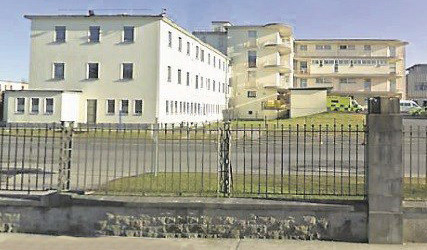
University Hospital Limerick.
Again, patients who are sick enough to be admitted are being left on trolleys, chairs, and in overcrowded hospital spaces, while waiting for basic dignity and proper care.
University Hospital Galway is the second most overcrowded hospital, with 51 patients waiting for a bed. In Tipperary University Hospital in Clonmel, 21 admitted patients are being cared for on chairs or trolleys while they wait for a bed.
Nationally, 516 patients are without a bed today. These are not just numbers. They are people; older people, vulnerable patients, families waiting anxiously, and frontline staff trying to deliver care in conditions that are simply not acceptable.
Again, we are seeing the same pattern. Again, warnings from nurses, doctors, patients, and communities are being ignored. Again, hospitals are being pushed beyond capacity while Government statements fail to match the reality on the ground. The Government cannot continue to treat this as a seasonal pressure or a temporary spike. This is a long-running failure of planning, capacity, staffing, and accountability. Communities in the Mid-West and across Tipperary deserve safe access to emergency care, timely admissions, and a hospital system that works when people need it most.
Frontline staff are doing everything they can, but they cannot fix a broken system on goodwill alone.
How many times must University Hospital Limerick top these overcrowding lists before real action is taken?
Again, patients are waiting. Again, staff are under pressure. Again, Government and Tipperary politicians must be held responsible.
An Coimisiún Pleanála’s decision to push back its ruling on Uisce Éireann’s massive Shannon water abstraction project is not just a planning delay. From a Tipperary perspective, it is a crucial breathing space.
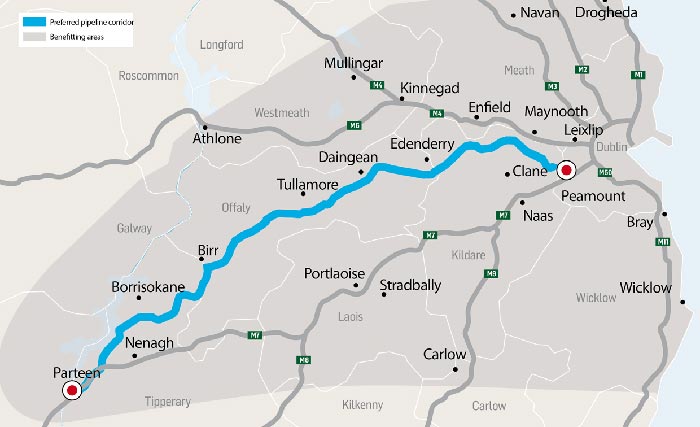
The proposed Water Supply Project for the Eastern and Midlands Region would see more than 300 million litres of water a day abstracted from the River Shannon at Parteen Basin, below Lough Derg, before being treated and piped across the country to serve the Midlands, the east and the Greater Dublin Area. It has been described as the largest water infrastructure project in the history of the State, with estimated costs in the region of €4.6 billion to €5.9 billion.
For communities in north Tipperary, this is not an abstract national infrastructure debate. The intake point is at Parteen Basin, and the project includes a major treatment plant close to the extraction point in Co Tipperary. That means local people are being asked to host the front end of a project whose main benefits will be felt far away, particularly in Dublin and the wider eastern region.
Uisce Éireann argues that the project is critical to providing a safe, secure and resilient water supply for up to 50% of the State’s population. It says planning permission has been lodged with An Coimisiún Pleanála and that the project is central to future housing, population growth and economic development. Those are serious national objectives, and nobody in Tipperary should dismiss the need for proper water planning.
But a project of this scale cannot be waved through simply because Dublin needs water. The Shannon is not just a line on an engineering map. It is an ecological, recreational, economic and cultural resource for Tipperary, Clare, Limerick, Galway, Offaly and many other communities along its course. Any long-term abstraction must be judged not only by what it delivers to the east, but by what it risks taking from the west and midlands.
The fact that 114 submissions have been made to An Coimisiún Pleanála shows the level of public concern. Environmental groups have warned about climate, ecological and sustainability risks, while business groups have urged approval on the basis of security of supply. That divide is exactly why the Commission is right to take more time.
The new decision deadline, now expected before July 2nd 2027, should be used properly. It should not become a procedural pause while the same assumptions remain in place. It must allow for deeper scrutiny of the project’s environmental impact, climate resilience, cost, alternatives, local consequences and long-term governance.
Tipperary needs clear answers. How will Lough Derg and the lower Shannon be protected during drought conditions? What guarantees will there be that abstraction levels will not damage habitats, fisheries, tourism or water quality? What permanent benefits will host communities receive? How will local voices be represented after construction begins? And what happens if the project costs rise beyond current estimates?
There must also be a fairer national conversation about water conservation. Before rural and regional communities are asked to carry the burden of supplying the east, the State must show that leakage reduction, demand management, rainwater harvesting, wastewater reuse and sustainable urban planning have been pursued with real urgency.
This delay is therefore welcome, not because Ireland does not need infrastructure, but because infrastructure must be done right. Tipperary should not be treated as the convenient source for a Dublin solution. The county has a legitimate stake in the future of the Shannon and deserves more than reassurances.
An Coimisiún Pleanála now has time to examine the evidence fully. Uisce Éireann has time to answer local concerns openly. Government has time to prove that this is part of a balanced national water strategy, not simply another example of regional resources being redirected towards the capital.
The Shannon belongs to the communities who live with it every day as much as it belongs to the State. If this project is to proceed, Tipperary must be heard, protected and respected from the very start.
Thurles has great history, strong community spirit and huge potential, but like many towns, it can sometimes look tired because of small things left unattended.
Grass and weeds growing out of pavements. Untidy frontage outside homes and businesses. Litter caught along kerbs. Faded and decaying walls, neglected planters, shabby entrances and streets waiting for overstretched council workers to get to every corner.
Maybe the answer is not to wait. Maybe the answer is for each of us to look after the few metres outside our own front door. That is the idea that comes to mind behind the notion of a Thurles Front Door Challenge. For one day, or better still one full week, householders, businesses, schools, clubs, residents’ groups and volunteers could be encouraged to clean, weed, sweep, wash, paint, plant and tidy the visible area outside their own homes, shops, estates and community buildings.
The idea is simple: If every person improves the small patch in front of them, the whole town improves. This should not be about blame. Some people are elderly, unwell, busy, struggling or unable to manage outdoor work. In those cases, neighbours, clubs and volunteers could step in and help. It should be a positive community effort, practical, friendly and visible.
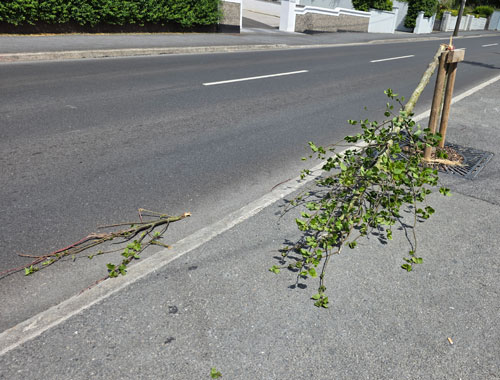
A newly planted broken tree on Dublin Road out of Thurles, left for the past number of weeks unattended.
Tipperary already has a strong base to build from. Tipperary County Council has supported Tidy Towns and community groups through grant schemes, including support for local enhancement works, and the Thurles Municipal District Tidy Towns grant scheme is aimed at recognised community and Tidy Towns groups visibly working to improve their local area. The National Spring Clean campaign also provides free clean-up kits to registered groups, including items such as bags, gloves, high-vis vests and posters. A Thurles Front Door Challenge could work alongside those existing supports, but with a sharper local focus: the front of every house, shop, street, estate and approach road.
There should also be rewards. Local businesses, event organisers and community sponsors could offer incentives such as free or reduced entry to music events, youth discos, local concerts, cinema nights or family activities for those who actively take part. A volunteer wristband or certificate could give participants a discount in participating cafés, shops or takeaways for the chosen week.
There could also be prizes for: Best Improved Street. Best Improved Estate. Best Shopfront. Best Youth Team. Best School Effort. Best Before-and-After Transformation. Best Pollinator-Friendly Frontage. Best Community Volunteer Group. Best Overall Thurles Front Door Challenge Area
Cash prizes, paint vouchers, garden-centre vouchers, planters, tools, event tickets or small street-improvement grants could all make a real difference.
A special part of the challenge should also involve Thurles Municipal District Council officials organising a review of public signs around the town; especially the enormous amount of signs that remain turned the wrong way, left facing inwards, are damaged, are hidden, or are no longer clearly visible due to overgrown hedging etc. A town can look neglected when signage is crooked, confusing or pointing nowhere. Correcting these small details would immediately improve the appearance, safety and welcome of Thurles.
The council workforce cannot be expected to be outside every door every day. But every door has someone who can care about the space just in front of them.
This is not a grand or complicated idea. It is a simple one. Sweep the path. Pull the weeds. Wash the gate. Paint the wall. Clean the window. Tidy the planter. Fix the sign. Help the neighbour.
Improve your street. That is how pride spreads. One front door at a time. The Thurles Front Door Challenge — your patch, your pride, your town.
Thurles, Co. Tipperary did not decline overnight. It has been weakened over decades by the loss of major employers, the failure to replace them at scale, and town-centre decisions that have made Liberty Square less convenient for the very businesses it is supposed to support.
Over the past 50 years, Thurles, has lost some of the employers that once gave the town real economic strength. The Sugar Factory closure remains one of the deepest blows in local memory. Later came further losses: GMX, BSN Medical, Erin Foods and others. In the Seanad in 2007, the pattern was described clearly; since the loss of the Sugar Factory, Thurles had suffered repeated job losses in Barlow, BSN Medical, GMX and Erin Foods.
These were not minor losses. BSN Medical announced in 2006 that it would cease manufacturing in Thurles, with 80 jobs to go. Erin Foods, which had operated in Thurles for 46 years, was then marked for closure with the loss of 95 jobs. The closure of GMX / Moulinex had already removed around 230 jobs from the town. When these losses are added to the Sugar Factory and smaller vanished industries, the picture is obvious: Thurles lost a serious employment base and never got it back.
Yes, there have been minor replacements announced and some investment. Dew Valley Foods, Lidl, smaller enterprise supports, the university presence and the ThurlesShopping Centre have all brought activity. But they have not replaced the scale or quality of what was lost. A town cannot lose major factories and long-standing employers and then be told that scattered retail jobs, short-term construction work and small-scale schemes are the same thing. They are not.
[Song hereunder ,“Rust & Rain”, is AI-generated entirely by Dallas Ray Little(operating under the label Crusty Records)]
Even An Taoiseach Mr Micheál Martin appeared to acknowledge this failure in Dáil Éireann on June 10th 2026, when he said he had “often thought Thurles would have done better because of its location” and noted that not everywhere near the motorway had received the same degree of foreign direct investment. That single comment says a great deal. For decades, Thurles was told that its central location, rail access and proximity to major routes should be an advantage. Yet the town watched major employers disappear, while replacement investment went elsewhere. If even the Taoiseach is surprised that Thurles has not benefited properly from its location, then local people are entitled to ask why successive governments, state agencies and elected representatives allowed that failure to continue for so long.
Tipperary County Council’s own Thurles Local Area Plan confirms the weakness of the employment base. It states that Thurles has a relatively low jobs ratio of 1.01 compared with Clonmel at 1.39 and Nenagh at 1.22. It also records that just under half of resident workers are employed in Thurles, while many others work elsewhere in Tipperary or outside the county. That is not the profile of a town that has been properly protected or rebuilt after decades of industrial loss.
The same plan says Thurles is a “Key Town” and speaks of supporting employment, prosperity, regeneration and revitalisation. But people in Thurles have heard plans, strategies and promises for years. What they can see with their own eyes is different; empty premises, weakened footfall, businesses struggling, and employment lands that have not delivered the kind of jobs once provided by the town’s former industrial base.
Liberty Square is the clearest example of the problem. Tipperary County Council’s Phase 2 public realm proposal includes wider footpaths, raised crossings, road-layout changes, a one-way system on Cuchulain Road, and the relocation of 12 parking bays from the central island car park. The Council presents this as enhancement. Many traders see it differently. For a rural market town, convenient short-stay parking is not a luxury; it is part of how the town trades.
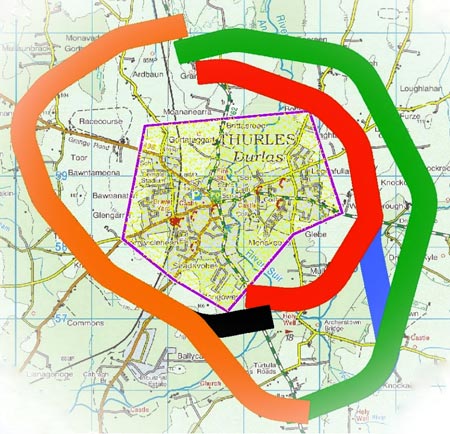
The long-awaited Thurles bypass is another example of how the town has been pushed down the road for decades. The need is obvious; heavy traffic and HGVs continue to pass through the heart of Thurles, including Liberty Square, while the town centre is simultaneously expected to become a more attractive public realm. Those two aims are in conflict. Press reported in November 2025 that the “long awaited and badly needed” bypass was back on the Government agenda, noting that it would ease congestion in the heart of the town where heavy goods vehicles regularly clog Liberty Square. Yet Tipperary County Council’s own 2026 budget material stated that while a route had been selected and a reserved corridor was in place, the Council would continue lobbying for the project to be included in the National Development Plan. By March 2026, the project had only received a €50,000 allocation to progress early design work with TII. After so many years, that is not delivery; it is another promise pushed into the future.
Long awaited Thurles bypass selected route/reserved corridor still only receives early-stage funding/progression in 2026
A town centre like Thurles depends on easy access. People call in to collect prescriptions, go to the post office, visit the butcher, chemist, café, solicitor, barber, newsagent or bank, and then move on. If parking is removed, made awkward, pushed away, or controlled in a way that does not suit shoppers, people change habits. They go where parking is free, plentiful and easy. In Thurles, that increasingly means the shopping centre or edge-of-town retail or indeed another nearby town.
The pull of the shopping centre is not imaginary. Thurles Shopping Centre is marketed as having more than 55,000 visitors per week and 550 free multi-storey parking spaces. That is a huge advantage over Liberty Square with its parking charges. When the Council reduces or reconfigures central parking while the shopping centre offers hundreds of free spaces, it should surprise nobody that trade drifts away from the historic core.
Parking charges resulted in the relocation of the post office, seen as yet another major blow. In 2019, An Post moved from Liberty Square to Thurles Shopping Centre. Local concern at the time was that the move would reduce footfall in the town centre. An Post said the old building was not viable and that the new location would provide improved services, but the result for Liberty Square was still the loss of a key daily footfall generator.
This is the core issue; decisions may be justified one by one, but their combined effect has damaged the heart of Thurles. One decision removes jobs, while another fails to replace them. Another moves a key service while another reduces convenient parking and then another produces a plan promising regeneration at some later date. Over time, the town centre is weakened not by one single act, but by a long chain of decisions that fail to protect how a real town works.
It would be unfair to claim that every closure was caused by councillors, the Council or TII. Companies close for many reasons: restructuring, costs, competition, building condition, online shopping and changing consumer behaviour. But it is entirely fair to say that successive politicians, councillors, agencies and planners have failed to secure a proper replacement employment base for Thurles and have failed to protect Liberty Square as a practical commercial centre.
The people of Thurles do not need more glossy language about regeneration. They need jobs, occupied buildings, realistic parking, fair access, active streets and a town centre that serves local traders as well as public-realm theory. A square can look tidier on a drawing and still fail commercially. A plan can sound modern and still damage small businesses. A town can be called a “Key Town” in official documents and still be treated like an afterthought in practice.
Thurles deserves better than managed decline. It deserves leadership that understands the town’s history, its losses, its trading patterns and its people. After 50 years of industrial closures, weak replacement employment and the hollowing-out of Liberty Square, the question is not whether Thurles has been let down. The question is who is finally going to take responsibility for reversing the damage.
This website uses cookies to improve your experience. We'll assume you're ok with this, but you can opt-out if you wish.AcceptRead More
Privacy & Cookies Policy
Privacy Overview
This website uses cookies to improve your experience while you navigate through the website. Out of these, the cookies that are categorized as necessary are stored on your browser as they are essential for the working of basic functionalities of the website. We also use third-party cookies that help us analyze and understand how you use this website. These cookies will be stored in your browser only with your consent. You also have the option to opt-out of these cookies. But opting out of some of these cookies may affect your browsing experience.
Necessary cookies are absolutely essential for the website to function properly. This category only includes cookies that ensures basic functionalities and security features of the website. These cookies do not store any personal information.
Any cookies that may not be particularly necessary for the website to function and is used specifically to collect user personal data via analytics, ads, other embedded contents are termed as non-necessary cookies. It is mandatory to procure user consent prior to running these cookies on your website.




Recent Comments