For years, the people of Thurles have heard announcements, assurances and political claims about the Inner Relief Road and the long-promised Outer Ring Road. Yet despite all the publicity and political celebration, Thurles still has no completed Inner relief road, no Outer Ring Road and no binding construction timetable that the public can honestly rely upon.
Mr Michael Lowry TD and Mr Ryan O’Meara TD, who both support the present government, must now accept political responsibility for the continuing lack of measurable progress. Meetings, press releases and statements welcoming developments are not substitutes for an approved budget, completed design, signed construction contract and machinery working on site.
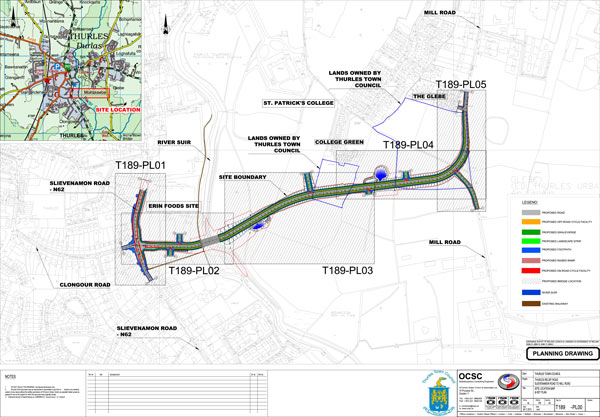
Tipperary County Council describes the Inner Relief Road as approximately 1.1 kilometres of new road linking the N62 at Slievenamon Road with Mill Road. The scheme includes a new bridge over the River Suir, several junctions and associated flood-relief works. However, the council’s May 2026 management report still stated that Department of Transport approval was required before the project could proceed to detailed design and construction.
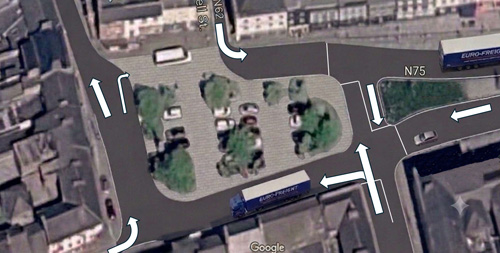
One of our many readers has submitted the suggestion shown above, which they believe could help ease the daily traffic bottleneck in Liberty Square, Thurles. This problem is likely to become even more severe when schools reopen in late August and early September. Any suggestions from other readers?
Inner Relief Road: The public was informed that the Inner Relief Road may be “ready for construction” in 2027. That wording does not provide a guaranteed completion date. If approvals, design work, procurement and funding continue to slip, there is a genuine danger that construction will not commence before 2030.
Outer Ring Road/Thurles Bypass: The situation surrounding the Outer Ring Road is even more concerning. Mr Michael Lowry has said that the Thurles bypass will advance through design and planning and that he will insist it is “ready for construction in 2030.” That is not a promise that the road will be built or opened by 2030. The scheme remains at a very early development stage, despite the need for a bypass having been recognised as necessary, some 40 years ago or more.
If the shorter and more advanced Inner Relief Road cannot be brought promptly to construction, how can the public have confidence that the much larger and longer Outer Ring Road will be construction-ready by 2030?The Thurles electorate are not fools.
There must also be accountability for the loss of the historic Great Famine “Double Ditch” at Mill Road. Local heritage campaigners described and proved it to be a famine-era pathway dating from approximately 1846, constructed as relief work for impoverished and starving people and later used as a right of way and Mass path. Concerns were raised publicly from 2020 onward, that the proposed Inner Relief Road would seriously damage or destroy this locally significant landscape feature. The tragedy now is that part of Thurles’s tangible Famine heritage appears to have been sacrificed for a road that, years later, has still not been delivered. Whatever disagreement may exist about its formal archaeological status, the failure to preserve, commemorate or meaningfully incorporate the “Double Ditch” into the project represents a serious loss to Thurles town’s historical memory.
Meanwhile, HGVs will continue entering Thurles every day. Even after a bypass is eventually constructed, some heavy vehicles will still need to enter the town to supply supermarkets, shops, hotels, restaurants, construction sites and other local businesses. These essential deliveries cannot simply be prohibited.
However, there is an important difference between HGVs that must enter Thurles to supply local businesses and heavy through-traffic that has no business being in the town centre. In the absence of proper alternative routes, both types of traffic continue to use the same narrow medieval streets and junctions.
The council’s own transport planning identifies the effect of through-traffic on Thurles and recognises the need for relief and bypass infrastructure. The Local Transport Plan presents the Inner Relief Road and a town bypass as important elements of the future transport network.
Regrettably, local elected representatives and county councillors have failed to grasp—or act upon—the urgency of this critical issue.
No redesign of Liberty Square can really solve the underlying problem. Wider footpaths, altered parking arrangements, crossings and junction changes may improve the visual appearance and pedestrian environment, but they cannot create a proper alternative route for strategic traffic.
Without the Inner Relief Road and Outer Ring Road, attempts to improve traffic movement in Liberty Square, risk becoming little more than a rearrangement of the same congestion.
Mr Michael Lowry TD and Mr Ryan O’Meara TD must now jointly secure and publish:
►Final Department approval for the Inner Relief Road; ► A fully funded programme for detailed design and construction; ► Firm construction commencement and estimated completion dates; ► Immediate progression of the Outer Ring Road through its formal planning and approval stages; ► An interim HGV-management plan separating essential local deliveries from avoidable through-traffic; ► A permanent memorial or heritage interpretation scheme acknowledging the Great Famine “Double Ditch” and the people whose suffering and labour it represented.
Thurles has already lost an irreplaceable piece of its Famine-era heritage. It must not now be left with neither the historic “Double Ditch” nor the road whose development was used to justify its loss. A plaque of some description must now be constructed recognising its once construction and recent destruction.
Thurles does not need more political celebration of mere preliminary steps, which is all our local politicians have had to offer their electorate over the past 40 years. It needs approvals, funding, contracts, construction and most of all accountability.
Ireland may be about to create an entirely new residential construction market, but the opportunity is being misunderstood.
In April, the Irish Government announced proposed planning exemptions that would allow a detached auxiliary dwelling of between 32 m² and 45 m² to be built behind an existing home and connected to the main house’s services. The detailed conditions have not yet been finalised, and the regulations still require environmental assessment and Oireachtas approval.
That distinction matters. This is not simply permission to place a larger garden room beside the patio. It is a proposal to create a new home without the conventional planning process.
Homenot a shed!
And a home is not a shed with better finishes. The Government has explicitly stated that all relevant Building Regulations, Building Control requirements and fire-safety rules will continue to apply. Removing planning permission does not remove the obligation to design, construct and certify a safe, energy-efficient dwelling.
That is where the real market disruption begins. Ireland already has a capable garden-room sector supplying offices, gyms, studios and leisure spaces. Many of those companies deliver attractive buildings quickly and efficiently. But a structure intended for occasional use is fundamentally different from a dwelling occupied every day and night. A compliant home must address structure, insulation, ventilation, airtightness, energy performance, drainage, fire safety, radon protection, access and long-term durability. Depending on the final regulatory route, it may also require professional design input, a commencement notice, inspection documentation, energy assessment and completion certification. These obligations are not administrative extras. They are the product.
The commercial risk is obvious. Homeowners may compare two buildings that appear almost identical online: one offered as an inexpensive “garden pod” and another priced as a fully designed and certified dwelling. The cheaper option may win at the kitchen table because the most important differences are hidden inside the floor, walls, roof, ventilation system and compliance file. Those differences may only become visible years later — during a sale, an insurance claim, a mortgage application or an investigation following a fire or structural failure.
That creates four urgent challenges for the industry. ► First, design must become repeatable. The strongest providers will develop standardised systems that can be engineered, energy-modelled and documented once, then adapted responsibly for each site. ► Second, buyers need meaningful protection. A marketing promise or company guarantee is not the same as independent certification, professional indemnity cover and a credible structural warranty. ► Third, contractors need a clear delivery process. Responsibility for design, assigned roles, inspections, testing and handover documentation must be established before work begins — not assembled retrospectively when a customer asks for proof. ► Fourth, the public needs better information. “Planning exempt” must never be allowed to become shorthand for “unregulated.”
There is also confusion around tax. Revenue currently allows up to €14,000 of qualifying Rent-a-Room income to be exempt from Income Tax, PRSI and USC. However, current guidance says a detached self-contained unit does not qualify. The Government has only committed to considering how auxiliary dwellings might interact with the relief. The opportunity remains substantial. Families need flexible accommodation. Adult children need routes to independence. Older homeowners need options. Ireland needs additional housing capacity.
But the winners will not be the businesses that manufacture the cheapest box. They will be the contractors and partners that can deliver a genuine home: designed correctly, built safely, tested properly, certified transparently and supported long after handover. That is the standard serious builders should establish before the first advertising campaign begins.
In this market, compliance will not slow the sale. Compliance will be the sale.
Thurles Inner Relief Road: New Tender Documents Raise Serious Questions Over Timelines, Political Claims and the Destruction of the Great Famine Double Ditch.
The publication of new tender documents for the Thurles Inner Relief Road has been presented as a significant milestone for a long-delayed project. In one sense, it is. After years of promises, updates and political announcements, Tipperary County Council has now gone to the market seeking engineering technical consultancy services to progress the scheme. But the detail contained in the newly published tender raises serious questions about the true timeline for delivery, the accuracy of previous political claims, and the destruction of the historic Great Famine “Double Ditch”, to facilitate a road that still appears to be years away from completion.
The official eTenders notice, published in July 2026, confirms that Tipperary County Council is seeking a multi-disciplinary technical consultancy team for the Thurles Inner Relief Road. The tender describes the work as including a review of existing documents, completion of outstanding deliverables for Stages 3 and 4, and preparation of deliverables through Stages 5 to 7. Crucially, the official notice gives the contract duration as 50 months.
That single figure changes the entire public understanding of this project. The proposed road is not simply waiting for diggers to arrive. Tipperary County Council’s own January 2026 management report described the scheme as an approximately 1.1km local link between the N62 and Mill Road, including a signalised junction at Slievenamon Road, a new priority junction with Mill Road, five intermediate access junctions, public lighting, flood alleviation works and a 50-metre tied bowstring arch crossing of the River Suir.
This is a substantial piece of infrastructure, and the new tender shows that major consultancy, design, approval, procurement, construction supervision, handover and defects processes still remain. The public therefore deserves honesty about the timeline. That honesty is especially important because previous political messaging now appears highly questionable. In November 2025, press reported that Deputy Mr Ryan O’Meara said Minister for Transport Mr Darragh O’Brien expected construction to commence on the Thurles Inner Relief Road the following year;2026. The same report quoted Deputy O’Meara as saying that Department of Transport officials had advised him the project should be completed and opened in approximately 24 months from then.
How does that claim stand beside a 50-month consultancy contract published in July 2026? If the tender process for the consultancy team is only now underway, and if that consultancy contract itself is expected to run for approximately 50 months, then completion by late 2027 is no longer credible. It is not enough to simply welcome “progress” while ignoring the contradiction. Deputy O’Meara should clarify exactly what he was told, by whom, and on what basis the public was led to believe that the road could be completed and opened in roughly two years.
This matters because Thurles people have heard promises about this project for far too long. Planning permission for the road was granted as far back as 2014, according to earlier press and local radio reporting. More than a decade later, the project is still moving through consultancy and design stages. Local frustration is understandable. But frustration should not be used as a cover for spin. Nor should the traffic needs of Thurles be used to brush aside the heritage loss already caused by this scheme.
The planned route has been linked for years by local campaigners and heritage advocates to the Great Famine “Double Ditch” at Mill Road. In 2020, Thurles.info publicly asked whether the planned Inner Relief Road would negatively affect what it described as the 1846 Thurles Double Ditch, a right of way and Mass Path associated locally with famine-era history. The warnings did not stop there. In February 2021, Thurles.info published commentary on an Archaeological Impact Statement, arguing that the proposed road would most likely impinge on the Great Famine Double Ditch in two locations. In March 2021, the same local outlet reported that Cllr Jim Ryan had confirmed the Double Ditch was to be destroyed to construct the Inner Relief Road. This was despite phone denials by Councillor Mr Micheál Lowry of the “Lowry Team”, who readers will remember inquired as to my standing in the community. {☺☺☺}
These are not minor matters. A famine-era pathway, Mass Path or heritage landscape is not just an inconvenience on a drawing. It is part of the physical memory of a town and its people. If warnings were made before destruction occurred, then the question must be asked clearly: why was the Double Ditch not protected, preserved, recorded more fully, or incorporated into the design?
Was every alternative route examined? Was the public given a full explanation? Was the heritage value properly weighed against the road design? Who decided that destruction was acceptable? And why is Thurles now being asked to accept the loss of a historic feature while the road itself may not be complete until around 2030 or later?
Nobody disputes that Thurles needs traffic solutions. The town has long suffered from congestion, poor circulation and pressure on its historic centre. A second river crossing and an improved link between Slievenamon Road and Mill Road may well bring benefits. But infrastructure should not be delivered through vague timelines, political overstatement and irreversible heritage loss. The publication of the new tender documents should therefore be treated as more than a procedural step. It should be treated as a moment of accountability.
Tipperary County Council should publish a clear and realistic delivery programme for the Thurles Inner Relief Road. Deputy Ryan O’Meara should explain the gap between his previously reported 24-month completion claim and the newly published 50-month consultancy timeline. The Council should also account for the treatment of the Great Famine Double Ditch, including what warnings were received, what assessments were carried out, and why destruction was permitted.
Thurles deserves roads. But it also deserves truth. It deserves progress, but not spin. And it deserves development that respects the town’s history rather than erasing it first and explaining later.
The European Commission has taken a significant step in enforcing the European Union’s cybersecurity framework by referring Ireland, Spain, France and the Netherlands to the Court of Justice of the European Union over delays in implementing the NIS2 Directive.
The case centres on the four countries’ failure to fully notify the Commission of national measures transposing the Directive into domestic law. NIS2 is one of the EU’s key cybersecurity laws and is designed to strengthen the resilience of essential and important services across the bloc. It applies to organisations operating in 18 critical sectors, including healthcare, energy, transport, public administration, digital infrastructure and other services vital to the functioning of society and the economy.
The Commission’s action follows earlier stages in the infringement process. Letters of formal notice were sent on 28 November 2024, followed by reasoned opinions on 7 May 2025. Since the Commission considers that complete transposition has still not been notified, it has now escalated the matter to the EU’s highest court.
This move comes at a time when cyberattacks against governments, public bodies and private companies are becoming more frequent, more sophisticated and more disruptive. Across Europe, ransomware incidents, attacks on public services and threats to critical infrastructure have underlined the need for consistent cybersecurity standards across all Member States.
The NIS2 Directive is intended to reduce fragmentation by setting common rules on cybersecurity risk management, incident reporting, supervision and enforcement. Its full implementation is important not only for individual countries, but for the EU as a whole, because cyber threats rarely stop at national borders. Weaknesses in one jurisdiction can create vulnerabilities across wider supply chains, public networks and cross-border services.
By asking the Court to impose financial sanctions, including a lump sum and daily penalties until full notification is made, the Commission is signalling that cybersecurity implementation is not optional. The referral also sends a wider message to Member States that delays in transposing critical digital and security legislation will attract consequences.
For organisations operating in affected sectors, the development is another reminder that NIS2 compliance remains a priority. Even where national laws are still being finalised, businesses and public bodies should be preparing their cybersecurity governance, risk management processes and incident response capabilities now.
The Commission’s decision marks an important enforcement moment for EU cyber policy. As cyber threats continue to grow, the EU is pushing to ensure that its legal framework is not only adopted on paper, but implemented in practice.
Irish Rail and Córas Iompair Éireann have brought High Court proceedings against Tipperary County Council in a dispute over a train signalling mast near the old Cahir railway station.
Irish Rail
The case centres on whether the mast, located about 130 metres from the old Cahir Rail Station, should be treated as exempted development or whether it affects the setting of a protected structure. The station, described in reports as a Gothic revival railway building dating from the 1850s, is at the heart of the planning disagreement.
Tipperary County Council served an enforcement notice in June 2026 under the Planning and Development Act 2000. That notice requires Irish Rail to cease using and remove the signalling mast by September 2026. Irish Rail is now asking the High Court to quash the council’s decision.
Irish Rail argues that the local authority made errors “in law and in fact” when deciding the mast was not exempted development. It also disputes the council’s view of the “curtilage”; the land or setting attached to a protected structure and says the mast is too far from the station building to fall within that protected area.
The rail operator further says it has installed more than 700 similar masts around Ireland without complaint from other planning authorities. It claims the protected status at the Cahir location now applies only to the station building, rather than other nearby railway structures previously listed in older development plans.
The council’s position is that the mast impacts the character and setting of the historic station. The matter is expected to return before the High Court on July 20th 2026.
This website uses cookies to improve your experience. We'll assume you're ok with this, but you can opt-out if you wish.AcceptRead More
Privacy & Cookies Policy
Privacy Overview
This website uses cookies to improve your experience while you navigate through the website. Out of these, the cookies that are categorized as necessary are stored on your browser as they are essential for the working of basic functionalities of the website. We also use third-party cookies that help us analyze and understand how you use this website. These cookies will be stored in your browser only with your consent. You also have the option to opt-out of these cookies. But opting out of some of these cookies may affect your browsing experience.
Necessary cookies are absolutely essential for the website to function properly. This category only includes cookies that ensures basic functionalities and security features of the website. These cookies do not store any personal information.
Any cookies that may not be particularly necessary for the website to function and is used specifically to collect user personal data via analytics, ads, other embedded contents are termed as non-necessary cookies. It is mandatory to procure user consent prior to running these cookies on your website.





Recent Comments