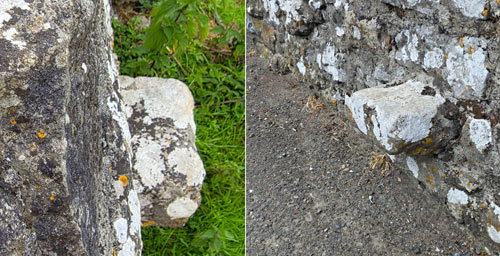
These photographs were taken on the R659, close to and north of Mid Tipperary Co Operative Livestock Mart at Ballycurrane, Thurles, Co. Tipperary. Mid Tipp Mart describes itself as a farmer co-operative, “run by farmers for farmers,” and a major cattle-trading centre serving Tipperary and surrounding counties.
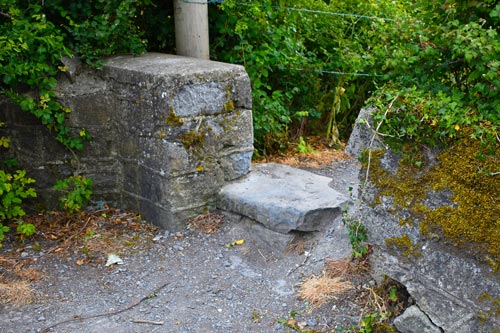
Built into this possibly early 19th-century roadside wall is what appears to be a stone stile; a simple arrangement of projecting stones that allowed a person to climb over a boundary without opening a gate. Such features were practical, durable and stock-proof. They belonged to a world of footpaths, fields, fairs, churchyards, wells and farm boundaries, where people moved on foot through a working rural landscape.
A stone stile near Mid Tipperary Co Operative Livestock Mart at Ballycurrane, Thurles, Co. Tipperary.
The wall itself cannot be dated from the above photographs alone, but its rough stone construction, weathering, lichens and traces of whitewash suggest considerable age. The projecting step stones are the key detail. They were not decorative, but functional, forming a small built-in ladder through the boundary.
Stone stiles are recorded elsewhere in Tipperary’s architectural heritage. The National Inventory of Architectural Heritage records a double stile in the boundary wall at Ballingarry Church, dated 1855–1860, and also records a random stone boundary wall “with stile” at Castletown near Coolbaun. These examples show that such modest access points were once a recognised part of the county’s built landscape.
A sadly related loss should also be remembered. On Mill Road, Thurles, a stile confirmed locally to have been built in 1846, at the beginning of the Great Famine period of 1845–1849, once stood as part of the historic landscape associated with the Great Famine now eradicated “Double Ditch.” Local reports on Thurles.info recorded warnings about the need to retain this heritage feature and later reported the destruction of the Great Famine Double Ditch area by Tipperary County Council officials and and Thurles Municipal District elected Councillors. Its loss underlines why surviving small structures like this R659 stile deserve notice before they too are dismissed as ordinary roadside stonework.
No longer in existence, the once rare stone stile; despite numerous warnings, eradicated by Tipperary Co. Council, at the entrance to the now also demolished historic Great Famine Double Ditch.
These stiles also belong to the wider Irish tradition of stone walling. Teagasc notes that Ireland has an estimated 400,000 km of dry stone walls and 210,000 km of stone-earthen banks, while in 2024 Ireland’s dry stone construction tradition was officially inscribed by UNESCO on the Representative List of the Intangible Cultural Heritage of Humanity.
This little stile on the R659 is easy to pass without noticing. But it may mark an older line of movement: a field path, a local crossing point, or an access route used before cars, marts and modern road traffic changed the rhythm of the countryside. It is a modest feature, but a valuable one; a reminder that heritage is not only found in castles, churches and big houses, but also in the small, practical details built into ordinary walls.
Ireland is set to introduce tougher penalties for littering, with on-the-spot fines increasing by €100 from September 1st 2026. The current fine of €150 will rise to €250 as part of a renewed effort to protect towns, villages, beaches, parks, green-ways and other shared public spaces.
Minister of State for the Circular Economy Mr Alan Dillon said the increase is intended to send a clear message that littering and dog fouling will not be tolerated. The move comes alongside the publication of the 2025 National Litter Pollution Monitoring System results, which show that litter levels across the country have improved.
New Support for Cleaner Communities. A new €250,000 fund is also being introduced to help local authorities keep public areas clean. Councils will be able to apply for funding to support practical measures such as extra dog waste bins and bag dispensers in places where they are most needed. Here in Thurles, a few extra bins at the lower end of the public park and river walk might encourage people from dumping directly into the river Suir.
The aim is to make it easier for responsible dog owners to clean up after their pets and to reduce the amount of dog fouling in public spaces. Local authorities will receive a circular outlining how they can apply for the funding.
Dog Fouling Enforcement Under Review. Dog fouling remains a major challenge, despite only 48 fines being issued nationwide last year. Minister Dillon said officials are examining whether DNA testing of dog droppings could help identify owners who fail to clean up after their pets.
One idea being considered is linking dog DNA samples with dog licences, so enforcement officers could trace fouling back to registered animals. However, the minister said the cost and practicalities must be reviewed before any such system could be introduced. He added that Ireland should look at examples from other European countries before deciding whether DNA-based enforcement is workable here.
Sinn Féin, like Father Murphy, will attempt to “Spur up the rocks with a warning cry”, here in Thurles.
There is no doubt that households in Thurles, across Tipperary, and throughout Ireland are under real pressure. Electricity bills, grocery prices, rents, mortgage repayments, insurance, childcare and transport costs have all eaten into family budgets. Nobody in Government should dismiss that. But equally, nobody in Opposition should pretend that reliefs, credits, freezes and subsidies come without a cost.
That is the part of the cost-of-living debate that too often gets lost. The crisis Ireland has faced was not invented in Leinster House, Dublin. It came from a series of international shocks; the aftermath of Covid-19, supply-chain disruption, the surge in gas and oil prices, Russia’s invasion of Ukraine, higher food and fertiliser costs, and interest-rate rises across the eurozone. Ireland, as a small open economy, cannot simply opt out of global energy markets or European monetary policy. The Government can cushion the blow, and it has done so, but it cannot abolish reality.
Budget 2026 shows the Government trying to do that difficult balancing act. It increased most weekly social welfare payments by €10, increased Fuel Allowance by €5 per week, extended the 9% VAT rate on electricity and gas to the end of 2030, extended the Rent Tax Credit, and adjusted the USC band so minimum-wage workers would not be pulled into the higher rate because of the minimum-wage increase. These are not slogans; they are practical measures aimed at helping people, while keeping the public finances under control.
That is the difference between responsible government and permanent protest. Government has to decide not only what people would like to receive, but how it is paid for, who pays for it, and what is sacrificed elsewhere.
Sinn Féin’s alternative budget proposed a €2.5 billion cost-of-living package, including €450 energy credits, a double child benefit payment, higher welfare and pension increases, rent measures and the abolition of USC on the first €40,000 of income. Those proposals may sound attractive when listed at a public meeting. Who would not like lower bills, higher payments, lower taxes and cheaper rent? But politics is not a wishing well. A €2.5 billion package must be funded by someone.
And that “someone” is usually the worker, the taxpayer, the business owner, or the next generation.
If the State pays for broad energy credits, the money comes from taxation, borrowing, or less spending elsewhere. If taxes are raised on “someone else,” they rarely stay neatly confined there. Business taxes can affect investment and jobs. Higher taxes on workers reduce take-home pay. Borrowing passes today’s relief bill to tomorrow’s taxpayers. Cutting or delaying spending elsewhere means less money for housing, schools, hospitals, roads, disability services, Garda resources, water infrastructure and energy investment.
This is why the Government is right to be cautious about turning every pressure into a permanent spending commitment. Ireland’s public finances look strong on paper, but independent watchdogs have repeatedly warned that the headline figures hide real risks. The Irish Fiscal Advisory Council warned in June 2026 that Ireland remains heavily reliant on corporation tax from a small number of foreign-owned multinationals. It also said that, excluding excess corporation tax, the State is forecast to have an underlying deficit of €11 billion this year. That means we are not as flush with money as some political speeches expected from Sinn Féin suggest.
The same watchdog warned that most corporation tax receipts are being spent rather than saved, with only €1 in every €6 being set aside under the Government’s plan. It also warned that spending growth is running faster than the sustainable growth rate of the economy. These are not Fine Gael or Fianna Fáil talking points. They are warnings from Ireland’s independent fiscal watchdog.
The Central Bank has also warned that Ireland faces downside risks to exports and corporation tax receipts if US tax or industrial policy changes, with possible effects on investment and incomes. In plain English, the tax money we are relying on today may not be guaranteed tomorrow.
That is why the Government cannot responsibly govern as though every surplus is permanent and every demand can be met by writing another cheque.
Of course, Opposition parties will always say more should be done. That is their job. But there is a danger in turning every genuine hardship into a rallying cry against the State. Public meetings can easily become exercises in stirring-up anger, rather than solving problems. The old cry of “Arm, arm” may be poetic, but it is not an economic policy. Ireland does not need a politics that spurs up resentment while avoiding the hard question: who pays?
The responsible answer is that support should be targeted, temporary where possible, and affordable. Help should go to those most exposed: pensioners, carers, low-income workers, families with children, people with disabilities, and households facing energy poverty. But permanent giveaways funded by unstable revenues or future borrowing are not compassion. They are deferred taxation.
The Government’s position should be defended because it recognises both sides of the truth: people need help, but the State must remain solvent; households need relief, but workers cannot be taxed into the ground; today’s pressure is real, but tomorrow’s taxpayers also matter.
There is no such thing as free cost-of-living relief. There is only a choice about who pays, when they pay, and whether politicians are honest enough to admit it.
Ireland needs action, yes. But it also needs prudence, honesty and responsibility. Demanding everything immediately may win applause in a public meeting. Governing requires asking whether the applause today becomes the tax bill tomorrow.
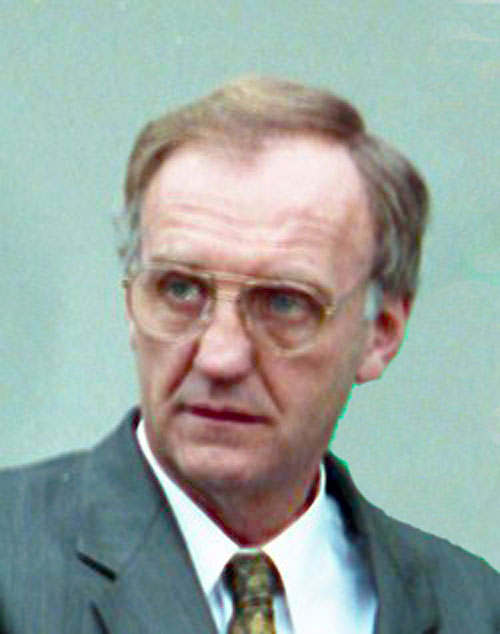
Former government minister Mr David Andrews (1935 – 2026) died on Saturday last at the age of 91, leaving behind a remarkable legacy in Irish public life, diplomacy and human rights advocacy.
A Fianna Fáil TD for almost four decades, Mr Andrews was first elected to Dáil Éireann in 1965, representing Dún Laoghaire-Rathdown and later Dún Laoghaire until his retirement from politics in 2002. Over that long career, he served as Government Chief Whip, Minister for Defence, Minister for the Marine and, on two occasions, Minister for Foreign Affairs.
His time in public office placed him at the centre of some of the most important political moments in modern Irish history. As Minister for Foreign Affairs in the late 1990s, he was closely involved in the negotiations that led to the 1998 Good Friday Agreement, a landmark achievement that helped transform relationships across these islands and bring new hope for peace in Northern Ireland.
Mr Andrews was also known as a politician of conviction. During years on the backbenches, he became an outspoken campaigner for justice and human rights, supporting the Guildford Four, the Birmingham Six and Brian Keenan, the Belfast man taken hostage in Beirut in 1986. His concern for those caught in injustice and conflict remained a defining feature of his public life.
Born into one of Ireland’s best-known political families, he was the son of Todd Andrews, a founding figure in Fianna Fáil. That tradition of public service continued through the generations, including through his son Barry Andrews, now an MEP. He was also the father of comedian David McSavage.
Following his retirement from elected politics, Mr Andrews continued to contribute to civic life, including through his work with the Irish Red Cross.
Tributes have described him as a man of principle, courage, intelligence and good humour. Taoiseach Micheál Martin said Mr Andrews had led an extraordinary life of public service, while former president Michael D Higgins remembered him as a friend and colleague who made a major contribution to Irish politics.
David Andrews will be remembered not only for the offices he held, but for the causes he championed: peace, justice, human dignity and public service. His life reflected a deep commitment to Ireland and to the belief that politics, at its best, can help change lives.
He is survived by his wife Annette and their five children. May he rest in peace.
The Central Statistics Office has released its Recorded Crime figures for Quarter 1 2026, covering incidents recorded in January, February and March.
The figures show a rather mixed picture. In the 12 months to Q1 2026, recorded crime incidents fell in 6 of the 15 main offence groups. The largest decreases were seen in Homicide & Related offences, Sexual offences, Burglary & Related offences, and Robbery, Extortion and Hijacking offences.
However, some offence groups continued to rise. The largest increases were recorded for Dangerous or Negligent Acts and Weapons & Explosives offences. The report also highlights an increase in victims of Assaults & Related offences. Female victims rose by 8% to 2,460 in Q1 2026 compared with Q1 2025, while male victims rose by 1% to 3,334. Overall, victims in this category increased by 4% to 5,794.
The CSO also advises caution when interpreting fraud figures. Current published figures for Fraud, Deception & Related offences include only incidents directly reported to An Garda Síochána by members of the public and recorded on the PULSE system. Certain referrals from financial institutions are still excluded while work continues on reporting and recording systems.
These statistics are important because they show recorded crime incidents, not necessarily the full level of crime in society. Some offences may be under-reported, particularly crimes such as fraud, sexual offences, and assault.
This website uses cookies to improve your experience. We'll assume you're ok with this, but you can opt-out if you wish.AcceptRead More
Privacy & Cookies Policy
Privacy Overview
This website uses cookies to improve your experience while you navigate through the website. Out of these, the cookies that are categorized as necessary are stored on your browser as they are essential for the working of basic functionalities of the website. We also use third-party cookies that help us analyze and understand how you use this website. These cookies will be stored in your browser only with your consent. You also have the option to opt-out of these cookies. But opting out of some of these cookies may affect your browsing experience.
Necessary cookies are absolutely essential for the website to function properly. This category only includes cookies that ensures basic functionalities and security features of the website. These cookies do not store any personal information.
Any cookies that may not be particularly necessary for the website to function and is used specifically to collect user personal data via analytics, ads, other embedded contents are termed as non-necessary cookies. It is mandatory to procure user consent prior to running these cookies on your website.





Recent Comments