Motorists now face significantly higher charges when reclaiming vehicles seized by An Garda Síochána, including scrambler bikes.
Under the revised fees, introduced on 14 August, the charge for the first day of storage has doubled from €125 to €250. Each additional day will cost €70, up from €35.
For vehicles weighing more than 3,500kg, typically heavy goods vehicles, the initial charge has risen from €250 to €500. The daily fee thereafter has increased from €50 to €100.
E-scooters are not covered by these revised charges.
Minister of State at the Department of Transport Mr Seán Canney said vehicle owners should bear the expense associated with removing and storing seized vehicles. He added that the higher fees more accurately reflect those costs while providing a stronger deterrent against road traffic offences.
Ms Susan Gray of road-safety campaign group PARC welcomed the increases, noting that the charges had remained unchanged since 2011.
Ms Gray said the previous €125 fee had failed to discourage some offenders, particularly inexperienced learner drivers travelling without an accompanying qualified driver, who were often able to reclaim their cars and return to the road the next day.
“People who live in glass houses shouldn’t throw stones”
Geoffrey Chaucer 1385, in his epic poem Troilus and Criseyde (Book II) wrote: “Who that hath an hed of verre, Fro cast of stones war hym in the werre!”, (Translated: “He who has a head of glass should beware of hostile stones.”) The phrase warns against hypocrisy.
Sinn Féin justice spokesperson Mr Matt Carthy says violent offenders should “serve the custodial sentence that they were given.”
He raised questions after Ms Alison Chawke was released under supervision, after serving only four weeks of an effective 12-month sentence for a serious assault. Ms Chawke had received an effective 12-month custodial sentence. She had served approximately four weeks, before entering the Community Return Scheme. She remains strictly supervised by the Probation Service and must perform unpaid work; the scheme is formally restricted to prisoners assessed as posing no threat to the community.
But where was this absolute principle when Sinn Féin supported the accelerated release of republican prisoners under the Good Friday Agreement?
A total of 428 republican and Loyalist paramilitary prisoners received early release, including 143 serving life sentences. Among the first 248 released, official figures show that 78 had been convicted of murder. Sinn Féin strongly supported the Agreement and its prisoner-release provisions.
The Good Friday Agreement was an exceptional peace settlement, endorsed by voters, and its releases cannot simply be equated with an ordinary criminal-justice decision. Nevertheless, Mr Carthy cannot credibly declare that all violent offenders must serve their full custodial sentences without acknowledging the major exception his very own political party supported.
He is entitled to question Ms Chawke’s release, the risk assessment and the effect of prison overcrowding.
But consistency matters. If early release can be justified for people convicted of murder to advance peace, Sinn Féin should explain why supervised release can never be justified for rehabilitation or prison management today.
Otherwise, its position looks less like a consistent principle and more like political hypocrisy.
Approximately 150 fish, mostly brown trout, have died in a stretch of the River Suir in the Templemore area.
The incident is understood to have been discovered around August 10th, 2026 during the week ending August 12th, 2026, reportedly by a staff member of the River Basin Management Service, latter the organisation formerly known as the Local Authority Waters Programme, or LAWPRO. The change of name is confirmed HERE.
At the time of writing, no official report establishing the cause of the deaths has been published. However, an initial examination reportedly suggested that the fish may have died from oxygen depletion, same associated with extensive aquatic vegetation and restricted flow. Dense reed growth is clearly visible along sections of the upper Suir, including from Barry’s Bridge in the heart of Thurles town centre. Nevertheless, visible vegetation does not prove what killed the fish.
The public requires evidence; dissolved-oxygen records, water and fish sample results, the extent of the affected stretch and an assessment of any pollution, temperature, flow or habitat factors.
Could dense vegetation deplete oxygen? It is scientifically plausible that excessive aquatic growth could contribute to dangerously low dissolved-oxygen levels. Plants, algae and microorganisms respire continuously, consuming oxygen. During daylight, photosynthesis can replace or exceed that consumption. At night, photosynthesis stops while respiration continues, causing dissolved oxygen to fall. Surveys undertaken confirms that plant, microbial and algal respiration reduces dissolved oxygen at night, while daylight photosynthesis increases it.
The risk is greatest where vegetation is abundant and the water is warm, shallow, slow-moving or stagnant. Dense growth can restrict mixing, while bacteria and fungi decomposing dead plant material consume additional oxygen, as observed when Thurles Municipal District undertook the strimming of rushes last year, leaving same in the water to rot. Warm water also holds less dissolved oxygen.
We can confirm that the above public meeting will take place, as stated above. Perhaps Minister of StateMr Kevin Moran, Independent TD Mr Michael Lowry, together withCouncillor Mr Micheál Lowry should receive invitations.
The US Environmental Protection Agency identifies excessive plant growth, nighttime respiration, decomposition, high temperatures and reduced flow as possible contributors to oxygen depletion. Emergent reeds can transport atmospheric oxygen through their stems, so their direct withdrawal of oxygen from the water may be less significant than that of submerged vegetation or algae. A dense reed bed may still create locally oxygen-poor conditions by slowing the flow and trapping decomposing organic material.
A healthy, fast-flowing river is continually re-aerated by turbulence. If oxygen depletion caused this fish kill, the investigation must determine what combination of vegetation, nutrient enrichment, low flow, temperature and decomposition produced it.
Testing must occur at the correct timeand a single daytime oxygen reading would be inadequate. Dissolved oxygen generally reaches its lowest level shortly before sunrise, following a night of respiration without photosynthesis. Monitoring should therefore be continuous or conducted immediately before dawn. Measurements should be taken inside dense vegetation, in nearby open water and both upstream and downstream. Temperature, flow, pH, weather conditions and readings close to the sediment should also be recorded.
Salmonids, including brown trout, are particularly sensitive to low oxygen. The investigation must establish whether oxygen depletion caused this incident rather than merely presenting it as a possibility.
Thirteen years of warnings As stated in a recent post on Thurles.Info, the deterioration of the River Suir cannot credibly be described as sudden or unforeseeable. For more than a decade, residents, anglers and environmental campaigners have raised concerns about pollution, excessive vegetation, restricted flow, sediment, litter and neglect. These concerns were documented in “River Suir Crisis—Thirteen Years of Warnings, But Still No Coordinated Action”.
Section ofUpper River Suir, viewed from Thurles Park in the heart of Thurles town centre, last week. Picture: G. Willoughby
13 years to late; the Minister of State Mr Kevin “Boxer” Moran recently visited sections of the Suir in Thurles and Holycross following representations from Independent TD Michael Lowry. It was stated that the Office of Public Works would support an application by Tipperary County Council under the enhanced Minor Flood Mitigation Works Scheme. Support for an application is welcome, but it is not a restoration programme. The public has not been shown the precise work proposed, the scientific evidence supporting it, the environmental assessments required, the anticipated cost and timetable or the body responsible for delivery and monitoring.
Political videos, visits and announcements cannot substitute for accountable work. Councillor Micheál Lowry, Deputy Michael Lowry and every other representative addressing the issue must be judged by measurable results. The same standard must apply to Tipperary County Council.
Reeds may be a symptom-not the underlying cause. The problem cannot be reduced to reeds, bulrushes or appearance. Previous catchment assessments have identified excess phosphorus from sources including wastewater, animal waste and fertilisers as a significant pressure. Nutrient enrichment can encourage excessive plant growth, while respiration and decomposition may subsequently reduce oxygen.
Low summer flows, high temperatures, pollution, sediment, obstructions and vegetation may interact. Removing reeds without identifying why they proliferated risks treating a symptom, while leaving the underlying causes untouched. Clearance without ecological assessment could also damage habitat or transfer problems downstream.
Any intervention must therefore be based on catchment science and agreed with the relevant environmental and fisheries authorities.
Too many agencies and too little accountability
Responsibility is divided among Tipperary County Council, the River Basin Management Service, Inland Fisheries Ireland, the EPA, the OPW, Uisce Éireann, the National Parks and Wildlife Service, Landowners and Angling organisations. That complexity cannot provide cover for delay or buck-passing.
The public should now be told:
which organisation is leading the investigation;
when and where the fish were discovered;
how many fish and species were affected;
when oxygen, temperature and flow were measured;
what samples were collected;
whether pollution sources were investigated;
when laboratory results will be available;
and which agency will publish the findings.
Community initiatives, including proposals to remove bulrushes or establish a River Suir trust, may make a valuable contribution. However, volunteers and anglers cannot be expected to replace statutory responsibility.
Publish the findings This fish kill must mark a turning point. The responsible agencies should provide a published scientific assessment, laboratory and monitoring results, continuous oxygen and temperature monitoring at vulnerable locations, investigation of pollution and nutrient sources, an environmentally assessed vegetation-management programme and a costed river restoration plan.
Responsibilities, deadlines and progress reports must be made public. The cause of this fish kill should not be prejudged; but uncertainty cannot become an excuse for inaction. After thirteen years of warnings, the questions are who will take responsibility, what the evidence shows and how quickly a credible recovery programme will begin.
Payments to Tipperary’s 40 county councillors climbed to almost €1.83 million during 2025, with Thurles representative Mr Sean Ryan, (Fianna Fáil), finishing among the five highest-paid elected members in the county.
Figures published through Tipperary County Council’s public payments register show that councillors across the county’s five municipal districts received a combined €1,828,735.43 during the year. That represents an increase of €86,658 compared with the corresponding total for 2024.
Fianna Fáil Cllr Mr Sean Ryan
The published amount covers more than expenses in the everyday sense. The council’s register includes councillors’ basic remuneration, annual allowances, vouched local-representation expenses, additional payments for holding senior council positions, training and conference costs, and payments from external bodies.
Fianna Fáil councillor Mr Sean Ryan was the highest-placed Thurles representative in the countywide rankings. He received €54,226.22 in total during 2025, making him Tipperary’s fourth-highest-paid councillor. His overall payment included the standard councillor’s salary of €30,932, together with the various allowances and expenses available to elected representatives. Cllr Mr Ryan also received an additional €6,000 for serving as Chair of one of Tipperary County Council’s strategic policy committees. Strategic policy committees (SPC), help develop and review council policy in areas such as housing, roads, planning, economic development and community services. Their Chairs take on responsibilities beyond the ordinary workload of a councillor and consequently qualify for an additional allowance. The prominent position of Thurles councillor Mr Sean Ryan in the rankings, reflects the additional payment attached to his SPC chairmanship, as well as the security allowance recorded during the year. His total was almost €3,000 higher than that of the councillor immediately below him in the top five.
Cllr Mr Ryan was also one of only two Tipperary councillors recorded as receiving a security-related allowance during the year, claiming €2,750 in the third quarter of 2025.
Note:“Security allowances”are intended to help local representatives pay for measures designed to improve their personal safety. Eligible measures can include CCTV systems, intruder alarms and panic buttons installed at a councillor’s home.
The other recipient was Clonmel Fine Gael councillor Mr John Fitzgerald, who received a security payment of €2,777.75 during the final quarter. Cllr Fitzgerald ranked fifth overall, with total payments of €51,971.83.
Tipperary’s highest-paid councillor in 2025 was Fianna Fáil’s Mr John Carroll, who received €60,644.22. Cllr Carroll became Cathaoirleach of Tipperary County Council in June and received €6,923.10 in connection with that office during the year. His total also included the basic annual remuneration of €30,932, annual allowances of €6,958 and €1,577.23 through the Local Representation Allowance, (LRA). The LRA is a vouched scheme through which councillors can recover qualifying costs incurred while carrying out their work as public representatives.
Fine Gael councillor Mr Declan Burgess was narrowly behind Cllr Mr Carroll, receiving €60,580.61. Cllr Burgess, who had been the county’s highest-paid councillor in 2024, received €13,846.20 in Cathaoirleach allowances relating to his period in the Chair before Cllr Mr Carroll’s election. His 2025 payments also included almost €31,000 in basic remuneration, annual expenses of €5,834 and €3,248 under the LRA scheme. His total increased from €59,114.09 in 2024.
Ms Mary Hanna Hourigan occupied third place, with payments totalling €55,201.47. Alongside her €30,932 basic remuneration, she received €6,253 under the LRA, annual expenses of €6,549 and a €6,000 allowance for Chairing a strategic policy committee.
At the opposite end of the table, Carrick-on-Suir Fianna Fáil councillor Ms Amy Goldsboro received the lowest total, at €34,388.39.
Independent councillor Mr Micheál Lowry was the second-lowest recipient, with €37,743.48. Ms Pamela Quirke O’Meara received €38,635, Ms Louise Morgan Walsh was paid €39,019, and Mr Joe Hannigan received €39,205.
Fine Gael’s Ms Peggy Ryan, representing the Thurles Municipal District, received €42,076.44 in total payments during 2025. The council’s quarterly registers show the total included her basic remuneration, annual and local-representation allowances, payments connected with chairing the Thurles Municipal District from June, and payments from the Southern Regional Assembly. For example, she received €1,384.62 as an MD chair allowance in Q3 and €1,615.39 in Q4. She also recorded external-body payments of €474.58 in Q3 and €794.15 in Q4. Note:“External-body payments” are payments councillors receive from organisations outside Tipperary County Council on which they serve as council representatives. They generally relate to attendance, travel or subsistence, rather than additional council salary.
That places her outside the five highest-paid councillors but above several representatives at the lower end of the countywide table.
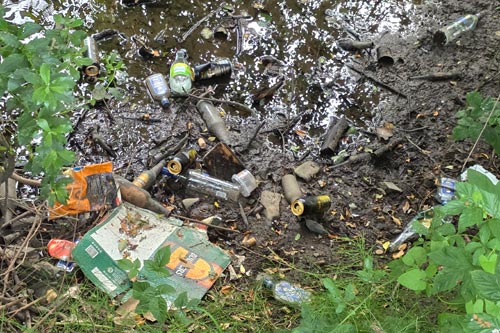
On August 2nd, 2026, Thurles.Info highlighted the growing litter problem caused by drinks containers being discarded on streets, roadsides and in public spaces around Thurles and other Irish towns.
Among the containers increasingly being found are round aluminium BuzzBallz cocktail cans and miniature plastic bottles used for spirits and cocktail mixes. Many of these containers cannot be returned through Ireland’s Deposit Return Scheme.
The scheme generally covers PET plastic drinks bottles and aluminium or steel drinks cans with a capacity of between 150ml and three litres. However, containers must also display the Re-turn logo and carry a barcode registered with the Irish scheme. To be accepted, they must be empty, undamaged and retain their original shape. Consequently, an imported or unregistered container may be rejected by a Reverse Vending Machine, even when it is made from aluminium or PET plastic and falls within the specified volume range. Miniature glass bottles and containers made from plastics other than PET remain outside the scheme.
Government Minister’s office contacted Following publication of that report, we contacted Minister of State Mr Alan Dillon, who has responsibility for the Circular Economy at the Department of Climate, Energy and the Environment.
We received the following standard automated acknowledgement: “Thank you for your email to Minister of State Alan Dillon’s Office. Your correspondence will be brought to the attention of the Minister and relevant officials in the Department of Climate, Energy and the Environment. Please be advised that if the issue raised in your correspondence is more appropriate to another Government Department or Agency, your correspondence will be forwarded to that organisation for direct response, in accordance with the provisions of the Department’s Data Protection Policy.”
This acknowledgement merely confirms receipt of our correspondence. It provides no substantive response to the litter problem raised and offers no indication as to what action, if any, may be taken.
“100% recyclable” is not the same as being eligible for a deposit refund. Result littering.
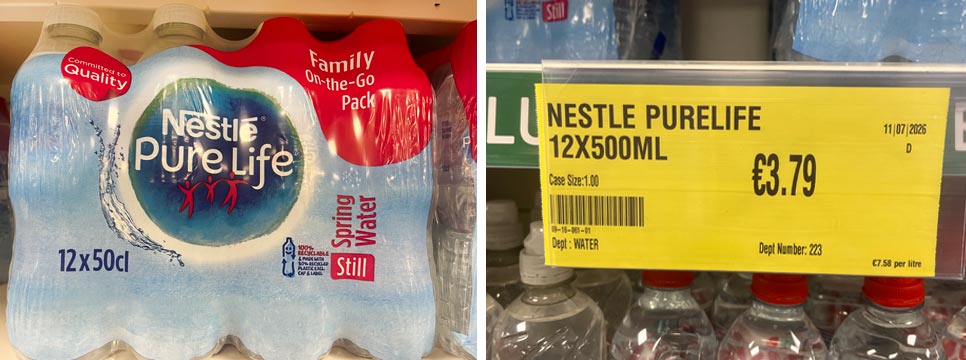
Bottled water without the Re-turn logo We have again contacted Minister Dillon’s office after observing Irish retailers selling multipacks of bottled water whose packaging states that the bottles are “100% recyclable”, but which do not appear to display the official Re-turn logo.
“100% recyclable” is not the same as being eligible for a deposit refund Under the published scheme rules, in-scope containers must display the Re-turn logo and carry a barcode registered with the scheme. Re-turn states that all in-scope drinks containers placed on the Irish market must meet these labelling requirements.
The water shown in our accompanying photograph above is sold in 500ml plastic bottles; a size that would normally fall within the scope of the Deposit Return Scheme if the bottles are made from PET plastic and properly registered. Their apparent lack of a Re-turn logo therefore raises questions as to why such products are being offered for sale and whether Irish consumers can return them for a deposit refund.
Without a financial incentive to return these bottles, more of them are ending up discarded along roadsides, on streets and in other public places, adding to an already serious litter nuisance.
Consumers who see a recycling symbol may understandably believe that a bottle can be placed in a Reverse Vending Machine. If the machine then rejects it because its barcode is not registered or because it lacks the required Re-turn marking, the system becomes confusing and public confidence is weakened.
We now respectfully ask Minister Dillon and his Department to clarify:
Why drinks containers that appear to fall within the scheme’s material and volume requirements are still being offered for sale without the Re-turn logo? Whether retailers are permitted to sell such products in Ireland? Which authority is responsible for inspecting retailers and enforcing compliance/ What measures will be taken to include, or otherwise address, aluminium cocktail containers, miniature bottles and other drinks packaging currently falling outside the scheme? Whether the Deposit Return Scheme will be reviewed to prevent avoidable gaps that contribute to litter?
Ireland’s Deposit Return Scheme can reduce litter only when the containers most likely to be discarded are included and when consumers can easily identify what is returnable.
A recyclable container that cannot be returned is still a container that can become litter.
This website uses cookies to improve your experience. We'll assume you're ok with this, but you can opt-out if you wish.AcceptRead More
Privacy & Cookies Policy
Privacy Overview
This website uses cookies to improve your experience while you navigate through the website. Out of these, the cookies that are categorized as necessary are stored on your browser as they are essential for the working of basic functionalities of the website. We also use third-party cookies that help us analyze and understand how you use this website. These cookies will be stored in your browser only with your consent. You also have the option to opt-out of these cookies. But opting out of some of these cookies may affect your browsing experience.
Necessary cookies are absolutely essential for the website to function properly. This category only includes cookies that ensures basic functionalities and security features of the website. These cookies do not store any personal information.
Any cookies that may not be particularly necessary for the website to function and is used specifically to collect user personal data via analytics, ads, other embedded contents are termed as non-necessary cookies. It is mandatory to procure user consent prior to running these cookies on your website.






Recent Comments