The death of Edward “Ted” Howell in January 2025 brought renewed attention to one of the most influential yet least publicly known figures in modern Irish republicanism. While names such as Mr Gerry Adams and more recently, Ms Mary Lou McDonald have become synonymous with Sinn Féin’s political rise; Mr Howell operated largely behind the scenes. Yet those who knew the movement best often described him as its most significant strategists.
His life also highlights one of the enduring tensions at the heart of Sinn Féin’s history: the complex relationship between the party’s political leadership and the legacy of the Provisional IRA.
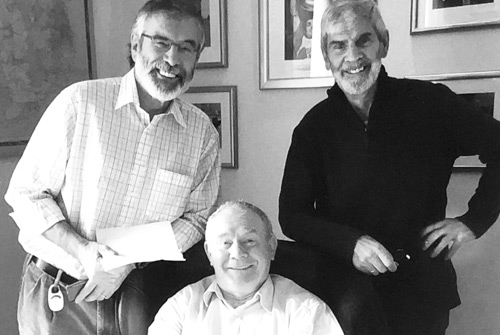
Born in Belfast in 1947, Mr Howell became involved in republican activism during the early years of “The Troubles”. Public records and contemporary reporting show that he was associated with the Provisional IRA and was interned during the 1970s. Like many republicans of his generation, his political development occurred during a period of intense conflict, marked by violence, imprisonment, and political upheaval.
In February 1982, Mr Edward Howell and fellow republican Mr Desmond Ellis were both arrested by U.S. immigration authorities while attempting to cross illegally from Canada into the United States at the Whirlpool Bridge near Niagara Falls. Contemporary accounts state that the pair, accompanied by three Canadians, were carrying false documentation and what authorities described as a “shopping list” for weapons, including detonators and other materials associated with then IRA operations. U.S. officials refused them entry, placed them in immigration detention, and began deportation proceedings.
Reports from the period indicate that Mr Howell, oddly, was accused of only attempting to enter the United States using false documents, rather than being criminally charged with weapons trafficking. During deportation arrangements via Canada and France, Howell reportedly escaped from escort at Paris airport before later being found located in Ireland.
This incident however, then formed part of a now wider U.S. investigation into IRA fundraising and arms-procurement networks operating through Canada and North America during the early 1980s.
A lesser-known aspect of Mr Ted Howell’s political activity was his involvement in Sinn Féin’s international engagement. According to public statements by Mr Gerry Adams, Mr Howell accompanied senior Sinn Féin representatives on visits to the Middle East and took part in meetings with Hamas representatives. Sinn Féin stated that these discussions focused on sharing lessons from the Irish peace process and encouraging political dialogue as an alternative to conflict. The contacts attracted controversy because Hamas is designated as a terrorist organisation by the European Union, the United States and several other countries. Howell’s involvement reflected Sinn Féin’s long-standing support for the Palestinian cause, a position that continues to influence the party’s strong criticism of Israeli government policies today and its advocacy for Palestinian statehood.
For critics of republicanism, the 1982 incident reinforced concerns about Howell’s involvement in the IRA’s international activities. For supporters, it became part of a broader narrative of a republican activist engaged in a struggle that they believed was political as well as military.
What is beyond dispute is that Howell emerged from the turbulent years of the conflict as one of Sinn Féin’s most trusted strategic thinkers. His relationship with Mr Gerry Adams was particularly significant. Adams was the public face of republicanism’s political transformation, but numerous accounts from journalists, former negotiators, and party insiders suggest that Howell was among the key advisers helping shape the movement’s long-term direction. He was involved in developing major policy documents during the 1980s and 1990s, including proposals that laid the groundwork for Sinn Féin’s engagement with the peace process.
Unlike Mr Adams; Mr Howell rarely sought publicity. He preferred to operate away from television cameras and political rallies. Yet those involved in negotiations frequently noted his influence. He was regarded as an intellectual force within republican circles, someone whose opinions carried considerable weight despite his low public profile.
The transition from armed conflict to political engagement remains one of the defining developments in modern Irish history. Supporters of Sinn Féin argue that figures, such as Mr Howell, played a crucial role in guiding that transition. They point to his involvement in discussions that eventually contributed to the Good Friday Agreement and later political settlements.
Critics, however, take a different view. They argue that individuals with IRA backgrounds continued to exercise influence within Sinn Féin long after the peace process had begun. For them, Mr Howell’s career raises important questions about accountability, transparency, and the extent to which former republican activists continued to shape decision-making behind the scenes.
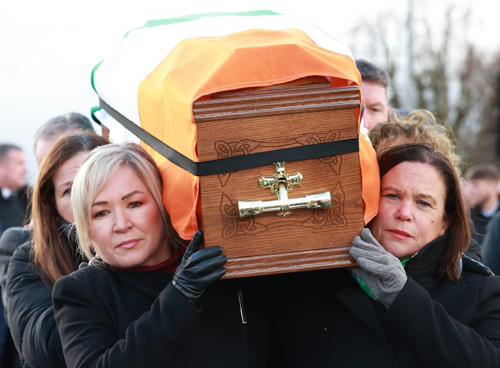
Above Photograph: Courtesy Liam McBurney.
These debates resurfaced after his death. The attendance of senior Sinn Féin figures at his funeral, including party president Ms Mary Lou McDonald, attracted considerable attention. Ms McDonald paid tribute to Howell’s contribution to the republican cause, reflecting the high regard in which he was held within the party. Alongside Ms Michelle O’Neill and Mr Gerry Adams, she helped honour a man whom many republicans regarded as a pivotal figure in the movement’s evolution.
For Sinn Féin supporters, these tributes were entirely appropriate. They viewed Mr Howell as a dedicated activist who helped steer republicanism towards democratic politics and constitutional engagement. They emphasised his role in peace negotiations and his commitment to Irish unity through political means.
But for others, particularly victims’ groups and critics of the IRA, the public recognition of Mr Howell revived painful memories of the conflict. Some questioned whether individuals associated with paramilitary organisations should be celebrated by contemporary political leaders. The sight of prominent Sinn Féin representatives honouring a former IRA member prompted renewed debate about how Ireland and Northern Ireland should remember “The Troubles”.
The relationship between Mr Gerry Adams, Ms Mary Lou McDonald, and Mr Ted Howell also symbolises a broader transition within Sinn Féin itself. Mr Adams represented the generation that led republicanism through conflict and into negotiations. Mr Howell was one of the key strategists working behind that transformation. Ms McDonald, by contrast, represents a newer generation of leadership seeking to position Sinn Féin as a mainstream political force across the island of Ireland.
Yet the party’s history cannot be separated from the individuals who shaped it. Mr Howell’s life serves as a reminder that many of the architects of modern Sinn Féin came from a movement deeply intertwined with the IRA. Whether viewed as a peacemaker, strategist, activist, or controversial figure, his influence on republican politics is difficult to deny.
Ultimately, Mr Ted Howell’s legacy depends largely on the perspective from which it is viewed. To supporters, he was a committed republican thinker. To critics, he remained a figure whose association with the IRA raises unresolved questions about responsibility and remembrance.
What is certain is that, despite spending much of his life out of the spotlight, Mr Edward “Ted” Howell left a significant imprint on Sinn Féin, on the republican movement, and sadly on the political history of Ireland.





Leave a Reply