Mr John Downey was not merely someone whom Sinn Féin defended from a distance. He was publicly described by the party’s own newspaper as a “popular Donegal Sinn Féin member,” while senior party figures repeatedly campaigned on his behalf.
In December 2019, the High Court found, on the civil standard of proof, that Mr Downey was an “active participant” in the IRA’s 1982 Hyde Park bombing. The attack killed four Household Cavalry soldiers: Lieutenant Anthony Daly, Squadron Quartermaster Corporal Roy Bright, Lance Corporal Jeffrey Young and Trooper Simon Tipper. Thirty-one other people were injured and seven horses were killed. Downey denied involvement.
Also linked to this atrocity was the late Tipperary-born Fr Patrick “Paddy” Ryan, who admitted to BBC investigative journalist Jennifer O’Leary that he “had a hand in the Hyde Park bomb.” Ryan, who assisted the Provisional IRA by sourcing funds, weapons and bomb components, was not accused of planting or detonating the device and was never convicted in connection with the attack; nevertheless, his own admission and the evidence concerning the electronic component he procured establish his involvement in supporting the operation.
Mr Downey’s earlier criminal prosecution collapsed in 2014; not because he was acquitted on the evidence, but because the British government had mistakenly assured him that he was no longer wanted. The judge ruled that proceeding with the prosecution would therefore be an abuse of process. Sinn Féin had played a direct role in securing consideration of Downey’s status. An official parliamentary investigation records that his name was submitted to the Northern Ireland Office on January 10th 2002 as part of what became known as “Sinn Féin list two.” Sinn Féin representatives, including Mr Gerry Kelly, were subsequently kept informed about his case.
The party’s association with Downey continued publicly:
Sinn Féin’s newspaper described him as a party member and long-time supporter of the peace process.
Senior figures visited him in prison and spoke in solidarity with him.
Sinn Féin President Mary Lou McDonald said in 2019 that the party would continue supporting Downey and his family.
Pearse Doherty condemned Downey’s arrest and extradition as “vindictive.”
Sinn Féin speakers paid tribute to him at the party’s 2019 conference.
There are also serious questions concerning Downey’s property. Irish Land Registry documents reportedly showed that in June 2017; while victims’ relatives were pursuing civil proceedings, he removed his name from the ownership of the family home in County Donegal. Other land was reportedly transferred to his wife. The timing prompted allegations that assets were being placed beyond the claimants’ reach.
However, an important distinction must be maintained: no reliable evidence located so far proves that Sinn Féin owned, received or helped transfer these properties. The documented connection is political, personal and organisational; not a proven link to the movement of Downey’s assets.
The established facts are nevertheless significant; a court found Mr Downey civilly responsible as an active participant in an IRA bombing that killed four soldiers. Sinn Féin submitted his name to the “on-the-runs” process; the party identified him as a member; and successive senior Sinn Féin figures publicly supported him.
The Minister for Agriculture Mr Martin Heydon has agreed to reconvene the National Fodder and Food Security Committee amid mounting concern about the impact of prolonged dry weather on fodder supplies.
The decision followed a meeting in Celbridge, Co Kildare, with Teagasc and representatives from leading farm organisations, including the Irish Farmers’ Association, the Irish Creamery Milk Suppliers Association and Macra.
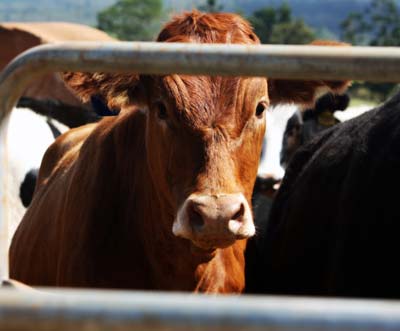
Farm representatives warned that drought conditions have severely affected grass growth, forcing some farmers to use fodder originally reserved for winter. Farms in parts of Carlow, Laois and Kilkenny are understood to be among those experiencing significant pressure. The committee will assess the national and regional fodder situation and consider what measures may be needed. A Teagasc fodder survey is also expected to provide a clearer picture of stocks across the country.
Minister Heydon acknowledged that the conditions are increasing costs and causing stress for affected farmers. He encouraged anyone experiencing cash-flow difficulties to engage with their banks, merchants and co-operatives.
“The Government is committed to supporting the sector in what has been a difficult year,” he said. “The call from farm organisations for additional supports will be considered when the full picture is available and in the context of Budget 2027.” Requests from farm organisations for greater flexibility across a range of agricultural measures will also remain under review.
IFA president Mr Francie Gorman welcomed the reconvening of the committee, but said farmers now need firm proposals and practical action to address the worsening situation.
The prolonged dry spell has also affected parts of continental Europe, potentially limiting Ireland’s ability to source additional fodder from other EU countries if domestic shortages deepen.
‘Not simply an equality issue’ – Network Ireland seeks Budget 2027 investment in women-led businesses.
Women-led businesses should be given greater priority in Budget 2027, with targeted measures needed to help female entrepreneurs overcome barriers to growth and support Ireland’s wider economic performance, according to Network Ireland.
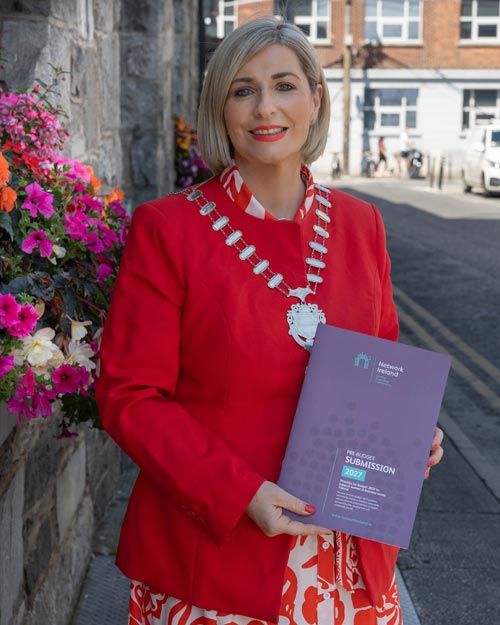
Ms Karen Ronan(Network Ireland National President)
The organisation, which represents more than 1,400 members through 17 branches nationwide, has called on Government to recognise women-led enterprise as a key driver of productivity, resilience and sustainable economic growth.
In its first national pre-Budget submission, Ireland’s longest-established women-only business network has identified seven priority areas for Budget 2027, including reducing the cost of doing business, improving access to finance for female entrepreneurs, expanding childcare supports, investing in skills and artificial intelligence, strengthening innovation, and addressing housing and infrastructure challenges.
The submission is based on a survey of members which found inflation and rising operating costs remain among the biggest challenges facing businesses. It also highlighted the growing use of artificial intelligence, with almost seven in ten members already using the technology and many expecting to increase their use of the technology in 2027.
Network Ireland National President Ms Karen Ronan said women-led businesses were making a significant contribution to the Irish economy but continued to face barriers that limited their ability to grow.
“Women-led businesses are creating jobs, driving innovation and making a significant contribution to Ireland’s economy. Budget 2027 is an opportunity to remove barriers that continue to limit business growth while unlocking the full potential of female entrepreneurship,” she said. “Investing in women in business is not simply an equality issue; it is an economic one. The right supports will strengthen businesses, increase workforce participation and enhance Ireland’s competitiveness.”
Among its recommendations, Network Ireland is calling for targeted tax measures for SMEs, improved access to finance, increased investment in childcare, and stronger supports for innovation and skills development.
Ms Ronan, who is also CEO of Galway Chamber, said the measures would help create the conditions for more women to start, grow and scale successful businesses.
“Our recommendations are practical and achievable and focused on helping businesses thrive. By investing in female entrepreneurship, childcare, innovation and workforce participation, Government can deliver lasting benefits for businesses, communities and the wider economy,” she said.
Founded in 1983, Network Ireland supports entrepreneurs, SME owners, professionals and business leaders through 17 regional branches and a virtual branch. See www.networkireland.ie.
An Garda Síochána is inviting the public to have its say on proposed rules governing Garda access to live CCTV feeds operated by businesses, organisations and private individuals.
Third-party live CCTV feeds allow Garda personnel to view footage from camera systems that are not owned or operated by An Garda Síochána. Such systems are already widely used across Ireland, and demand for Garda access has increased in response to drug-related crime, vehicle and property offences, and public-order incidents.
The Garda Síochána (Recording Devices) Act 2023 provides the legal framework for processing third-party CCTV through a live feed. It also requires the introduction of a Code of Practice containing more detailed rules and safeguards for its operation. The proposed Code is intended to clarify when live access may be used, how it should be authorised and managed, and what protections should apply to members of the public. As part of this consultation, the Garda Commissioner must also seek the views of several public bodies, including the Data Protection Commission, the Irish Human Rights and Equality Commission, the Policing and Community Safety Authority and Fiosrú, the Office of the Police Ombudsman.
According to the official Garda consultation page, a Human Rights Impact Assessment has already been conducted. A Data Protection Impact Assessment will also be completed before the Code can be considered by the Minister for Justice, Home Affairs and Migration.
Potential benefits Live CCTV access could help Gardaí respond more quickly to crimes and public-safety incidents. Officers may be able to follow a developing situation, identify suspects or vehicles and direct resources to the right location without waiting for recorded footage to be retrieved. It could also support the investigation and prosecution of offences by helping Gardaí establish timelines, identify witnesses and preserve relevant evidence. In busy public areas, live feeds may assist with crowd safety, missing-person searches and serious public-order incidents. A clear national Code of Practice could also produce greater consistency. Garda personnel, CCTV operators and members of the public would have a clearer understanding of when access is permitted and what safeguards must be followed.
Potential concerns The main concern is privacy. People captured on CCTV may not be suspected of any offence, yet their movements and behaviour could still be observed by Garda personnel. Live access is potentially more intrusive than requesting recorded footage after a specific incident. There is also a risk of “function creep”, where a system introduced for serious or clearly defined policing purposes gradually becomes used more routinely or for broader forms of monitoring. Security and accountability must therefore be central to the final Code. It should clearly address who may access a feed, the circumstances in which access is allowed, how decisions are recorded and reviewed, and what happens if the system is misused. Other important questions include how long information may be retained, whether individuals will be informed that a system can be accessed by Gardaí, and how private operators will be required to protect footage from unauthorised access or cyberattack.
Conclusion Third-party live CCTV feeds could provide Gardaí with a valuable tool for preventing crime, responding to emergencies and gathering evidence. However, their usefulness does not remove the need to protect privacy, human rights and personal data.
The final Code of Practice should permit targeted and proportionate access for legitimate policing purposes while imposing firm limits, detailed audit requirements, strong data-security measures and meaningful independent oversight. Public confidence will depend on people knowing not only that CCTV can help keep communities safe, but also that access will be justified, controlled and accountable.
Members of the public can review the draft Code and submit their observations through the Garda consultation page. The consultation closes on 14 September 2026.
Employment in IDA Ireland client companies across the Mid-West has increased by 18% over the past five years, according to figures provided to Clare TD Mr Joe Cooney.
Mr Joe Cooney TD.
There are now 28,125 people directly employed by 158 IDA client companies across Tipperary, Limerick and Clare, A further 22,500 jobs are estimated to be supported indirectly in the region. Co, Clare accounts for 67 of the companies, employing 6,136 people directly and supporting an estimated 4,909 indirect jobs.
The Department of Enterprise, Tourism and Employment said IDA Ireland recorded 55 facilitated site visits across the three Mid-West counties during 2025. Co.Tipperary recorded only three visits; while Limerick recorded the highest number with 33 visits, followed by Co. Clare with 19 visits. A further 17 visits were recorded across the region in the first quarter of 2026, including two in Tipperary, nine in Limerick and six in Clare.
Deputy Cooney said the increase in employment demonstrated the continued strength of the Mid-West in attracting foreign investment. “An 18% increase in employment among IDA client companies across the Mid-West over the past five years is very positive news for the region, he said. “It shows that the Mid-West is continuing to attract and retain major international employers and that the region has the skills, infrastructure and business environment needed to support high-value jobs.”
He said Co. Clare was playing a significant role in that growth, with more than 6,000 people now directly employed by IDA client companies in the county.
The Department said the Mid-West had attracted significant investment across technology, life sciences, international financial services, and engineering and industrial technologies. It said the availability of suitable property and strategic sites remained critical to attracting new investment.
The Department also cautioned that IDA site visits were only one measure of investor interest and did not necessarily translate into an investment. Potential investors may visit more than one county or return to a location more than once, while final decisions on where to locate an investment are made by individual companies. The Department said IDA Ireland’s regional strategy aims to secure 550 foreign direct investment projects outside Dublin between 2025 and 2029. Deputy Cooney said continued investment in infrastructure, skills and enterprise supports would be important if the Mid-West is to build on the growth of recent years.
This website uses cookies to improve your experience. We'll assume you're ok with this, but you can opt-out if you wish.AcceptRead More
Privacy & Cookies Policy
Privacy Overview
This website uses cookies to improve your experience while you navigate through the website. Out of these, the cookies that are categorized as necessary are stored on your browser as they are essential for the working of basic functionalities of the website. We also use third-party cookies that help us analyze and understand how you use this website. These cookies will be stored in your browser only with your consent. You also have the option to opt-out of these cookies. But opting out of some of these cookies may affect your browsing experience.
Necessary cookies are absolutely essential for the website to function properly. This category only includes cookies that ensures basic functionalities and security features of the website. These cookies do not store any personal information.
Any cookies that may not be particularly necessary for the website to function and is used specifically to collect user personal data via analytics, ads, other embedded contents are termed as non-necessary cookies. It is mandatory to procure user consent prior to running these cookies on your website.




Recent Comments