A proposal to deliver 42 new homes near the centre of Thurles has encountered an early planning setback after Tipperary County Council ruled the application invalid.
Coolross Homes Ltd submitted plans for the residential development on land at Innisfail, Kickham Street, Thurles, Co. Tipperary. The proposed scheme would provide a range of housing options, including two, three and four-bedroom houses alongside one and two-bedroom apartments.
The development site forms part of the grounds of Inisfail House, a protected structure understood to date from 1898. While the historic property is located within the application site, it would not be redeveloped as part of the current proposal.
Documents accompanying the application indicate that the company intends to lodge a separate planning submission concerning the future restoration and reuse of the house. In the meantime, some temporary work may be required to keep the building secure and protected from water damage. An architectural heritage assessment prepared for the project said the proposed housing had been designed to retain the historic buildings and the established entrance from Kickham Street. It also concluded that the scheme would not adversely affect the setting or character of the protected structure.
Nine of the proposed homes were earmarked for transfer to Tipperary County Council. These properties would have been made available as social housing, to applicants on the local authority’s waiting list. Accessibility was another feature highlighted in the plans. The proposed houses were designed so that residents could be provided with ground-floor living accommodation if their needs required it. However, the council has not progressed to a full assessment of the development because of problems with the submitted documentation.
One issue concerned the public site notice, which did not state that the proposed work would take place within the curtilage or surrounding grounds of a protected structure. Council planners also found inconsistencies between the floor plans and roof plans supplied for one section of the development.
An invalid application is not the same as a refusal of planning permission. Instead, it means the submission has failed to meet certain administrative or documentation requirements and therefore cannot currently be considered on its planning merits. Coolross Homes must now correct the identified errors and submit a new application if it wishes to advance the project. Once a valid application is lodged, the council can begin its formal assessment and the public consultation process can proceed.
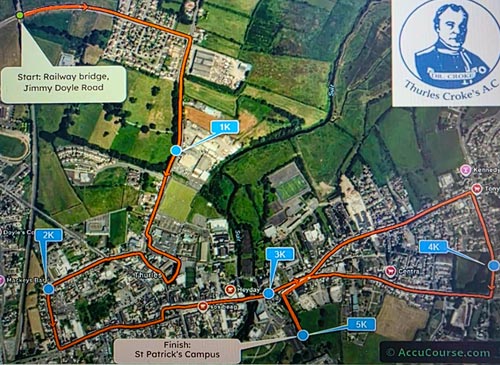
The Thurles Crokes A.C. Streets of Thurles 5K Road Race will take place on Sunday, 16th August 2026, from 10:00am to 11:30am.
Traffic Notice and Route: Streets of Thurles 5K Road Race.
Traffic restrictions and diversions will be in place throughout Thurles town for the duration of this popular event. Motorists should expect delays and are advised to allow extra time for their journeys or use alternative routes where possible.
McDonald’s Restaurants of Ireland Ltd. has submitted a new planning application for a prominent illuminated sign at its drive-thru development currently under construction in Thurles.
Planning application reference 2660699 seeks permission for a 6.5-metre-high totem sign on the western side of the site at Slievenamon Road and the Thurles Relief Road. The proposed structure would feature the familiar yellow acrylic, internally illuminated McDonald’s “Golden Arches”, together with all associated works required for its installation.
The drive-thru restaurant itself was previously permitted under Tipperary County Council planning reference 2460829, subsequently considered under An Coimisiún Pleanála reference 322465-25. The planning authority granted permission in April 2025, subject to conditions, and the development is now under construction. An Coimisiún Pleanála’s inspector examined issues including traffic, lighting, visual amenity, nearby homes and the site’s relationship with the town centre before recommending approval.
However, one wonders why the applicants now require a separate application for a 6.5-metre Golden Arches totem, perhaps the signage details simply got lost somewhere between ordering the fries and securing permission for the drive-thru.
No doubt residents overlooking the site will be absolutely thrilled to discover that this substantial, internally illuminated Golden Arches sign, has arrived through a fresh planning application; after permission for the restaurant itself had already been secured and construction had begun. How extremely thoughtful of McDonald’s Restaurants of Ireland Ltd to deal with such a visually prominent feature separately.
Local Retailers Note: There could be a major run, in the near future, on Blackout Roller Blinds and Sleep Masks sought by the families overlooking this restaurant site; so stock up.
Whatever one’s view of the restaurant, signage of this height and brightness deserves proper scrutiny, particularly regarding its visibility from nearby homes, its effect on residential amenity and its overall impact on the surrounding streetscape after dark.
More than 600 patients were being treated without a regular hospital bed today Tuesday, according to the Irish Nurses and Midwives Organisation, as the union warned of a “summer trolley crisis”.
The INMO recorded 617 admitted patients on trolleys, chairs or in other inappropriate bed spaces across the country. As usual University Hospital Limerick (UHL) serving North Tipperary, has the highest total, at 130.
This national figure was 189 higher than the 428 patients recorded by the union on August 5th last year 2025; an increase of approximately 44%. INMO general secretary, Ms Phil Ní Sheaghdha, described this situation as “outrageous”, saying patients and staff were bearing the consequences of an avoidable crisis, during one of the hottest summers on record.
At UHL, INMO assistant director Ms Mary Fogarty described the persistent overcrowding as “like Groundhog Day”. She said the hospital’s recently added 96-bed unit had not produced a meaningful improvement and called for an independent examination of unusually high attendances and admission decisions. HSE Mid West has rejected the suggestion that operational performance was the principal problem. It said analysis by HIQA and the ESRI had identified a long-standing mismatch between demand and acute-bed capacity in the region. RTÉ’s report carries the statements from both sides.
Why the HSE recorded only 408 patients The HSE’s official 8:00am report recorded 408 patients on trolleys: 272 in emergency departments and 136 on wards. It separately reported 551 surge-capacity beds in use at 2:00pm. These figures are confirmed in the HSE’s daily urgent and emergency-care report.
The 209-patient difference between the INMO and HSE trolley totals is mainly a question of classification and collection, not evidence that one side made a simple arithmetic error.
Explanation: ► The INMO count is compiled from reports by nurses in participating hospitals. It covers admitted patients who have no ordinary inpatient bed and are being treated on trolleys, chairs, extra beds or in other spaces the union considers inappropriate.
The HSE uses hospitals’ administrative reporting under defined TrolleyGAR categories. It now includes qualifying patients in both emergency departments and wards.
Crucially, the HSE excludes patients placed in designated surge-capacity beds from its headline trolley total and reports that capacity separately. An official parliamentary answer describing the methodology explicitly states that designated surge beds are not included in TrolleyGAR.
The two systems can also classify particular spaces differently. A temporary bed in a day ward or assessment unit may be treated as operational surge capacity by the HSE, but still regarded by the INMO as an inappropriate or inadequately staffed bed setting.
Differences in reporting processes, participating locations and validation can create further hospital-level discrepancies.
The HSE’s 551 surge figure should not simply be added to its trolley total or subtracted from the INMO figure. It was recorded at a different time, covers all occupied surge beds and is a separate measure of temporary capacity rather than a reconciliation table.
The safest presentation is therefore: the INMO counted 617 admitted patients without a regular bed, while the HSE classified 408 as trolley patients and separately reported 551 surge beds in use.
Both datasets indicate severe pressure, but they measure that pressure using different boundaries.
Application Ref: 2660723 Applicant: Coolross Homes Ltd. Development Address: Innisfail , Kickham Street , Thurles Development Description: Description: the following works: a) the construction of 42 no. residential dwelling units comprising of the following types; 1no. Block A (2-storey semi-detached block of 1 no. 2-bed & 1 no. 3-bed); 1no. Block A1 (2-storey semi-detached block of 1 no. 2-bed & 1 no. 3-bed); 1 no. Block B (2-storey semi-detached block of 1 no. 2-bed & 1 no. 3-bed); 1 no. Block C (2-storey semi-detached block of 2 no. 3-bed); 1 no. Block C1 (2-storey semi-detached block of 2 no. 3-bed); 1 no. Block D (2-storey terrace block of 3 no. 3-bed); 10 no. Block E (3-storey semi-detached block of 2 no. 4-bed); 1 no. Block F (2-storey terrace block of 2 no. 2-bed & 2 no. 3-bed); 1 no. Block G (2-storey terrace block of 1 no. 2-bed & 4 no. 1-bed apartments); b) proposed new site entrance, access roads and footpaths; c) new site boundary treatments; d) new waste, water and utility service connections and all associated site works. The above works are proposed to be carried out in the grounds of a protected structure, schedule of Protected Structures reference: TRPS2460 Status: N/A Application Received: 24/07/2026 Decision Date: N/A Further Details:http://www.eplanning.ie/TipperaryCC/AppFileRefDetails/2660723/0
Application Ref: 2660718 Applicant: MQ Transport Ltd Development Address: Cabragh Business Park, Cabra, Thurles, Co. Tipperary Development Description: an extension to the front (Northern side) of our existing warehouse premises for storage use incorporating 3 no dock levellers with all associated sitework and ancillary works Status: N/A Application Received: 23/07/2026 Decision Date: N/A Further Details:http://www.eplanning.ie/TipperaryCC/AppFileRefDetails/2660718/0
Application Ref: 2660499 Applicant: Mary Mockler Development Address: Grange Brittas , Thurles , Co. Tipperary Development Description: the replacement of septic tank and percolation area including all associate site works Status: Conditional Application Received: 24/05/2026 Decision Date: 16/07/2026 Further Details:http://www.eplanning.ie/TipperaryCC/AppFileRefDetails/2660499/0
This website uses cookies to improve your experience. We'll assume you're ok with this, but you can opt-out if you wish.AcceptRead More
Privacy & Cookies Policy
Privacy Overview
This website uses cookies to improve your experience while you navigate through the website. Out of these, the cookies that are categorized as necessary are stored on your browser as they are essential for the working of basic functionalities of the website. We also use third-party cookies that help us analyze and understand how you use this website. These cookies will be stored in your browser only with your consent. You also have the option to opt-out of these cookies. But opting out of some of these cookies may affect your browsing experience.
Necessary cookies are absolutely essential for the website to function properly. This category only includes cookies that ensures basic functionalities and security features of the website. These cookies do not store any personal information.
Any cookies that may not be particularly necessary for the website to function and is used specifically to collect user personal data via analytics, ads, other embedded contents are termed as non-necessary cookies. It is mandatory to procure user consent prior to running these cookies on your website.




Recent Comments