The erection of a 6.5-metre illuminated Golden Arches sign, at the new McDonald’s Drive-Thru in Thurles has reportedly been granted permission, according to local press reports.
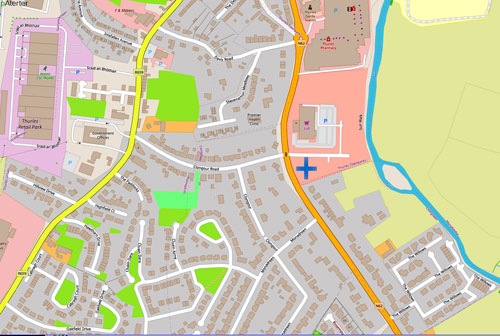
Site of McDonald’s Drive-Thru Restaurant, Slievenamon Road, Thurles, Co. Tipperary.
Three local residents had lodged objections, citing concerns about light pollution, road safety, wildlife and the impact on nearby homes.
One objector highlighted an existing planning condition banning totem and banner signs at the development. They questioned the justification for changing that restriction, arguing that the application offered insufficient new evidence.
Another resident had raised concerns about how the illuminated sign could affect neighbouring private homes.
The press reports states that permission was granted despite those objections.
We learned last week that the Data Protection Commission (DPC) has fined the HSE €645,000, following serious failures in the care of confidential medical records.
The investigation began after two data breaches were reported in 2023. People had gained unauthorised access to paper medical records stored in the disused St Loman’s psychiatric hospital in Mullingar and St Conal’s Hospital in Letterkenny. Videos of the records were subsequently posted on social media.
When inspectors examined 12 HSE storage sites, they found records in appalling conditions. Documents were stored in disused bathrooms, cubicles, a shipping container inside a turf shed and derelict buildings. Some records were damaged by mould, water, rubble and animal droppings. The DPC also found that records had been retained longer than necessary and that some breaches had not been reported promptly to either the regulator or the people/patients affected.
The DPC imposed four fines totalling €645,000 and ordered the HSE to audit its storage facilities, remove records from unsuitable locations and introduce a proper system for tracking and managing paper records. The HSE’s previous similar data-protection failures were treated as an aggravating factor.
But who will really pay this fine? The HSE is funded mainly with public money. Therefore, the €645,000 will not come from the pockets of the officials responsible. It will come from resources that could otherwise have been used for patients, staff and health services. Once the fine has been confirmed by a court and collected, the DPC must transfer the money to the Government’s Central Fund, namely the Irish Exchequer. It does not go to the patients whose records were mishandled, and it does not remain with the DPC. The result is that one taxpayer-funded public body pays another part of the State. The money leaves the HSE’s budget and returns to the general Exchequer.
The HSE will then find itself €645,000 short in its future dealings with patients and support services, unless it can absorb the loss elsewhere. If it seeks additional funding, that money will again have to come from the taxpayer. The HSE cannot simply demand the fine back, but future governments may provide it with increased funding through the normal budget process.
Is this not ridiculous? The HSE must certainly be held accountable for the disgraceful treatment of sensitive medical records. Strong corrective action, public accountability and consequences for those responsible are entirely justified. However, taking money from the health service, placing it in the Exchequer and potentially providing more taxpayers’ money to the HSE later looks like public money being moved in a circle.
Meanwhile, patients may face the real cost through reduced resources or delayed services, although they did nothing wrong. The people directly responsible may suffer no personal financial consequence, while taxpayers effectively pay the penalty.
The fine sends a public message, but it raises a serious question; is moving €645,000 of taxpayers’ money from one State account to another really the best way to hold a public body accountable?
Meaningful accountability should correct the failures without making patients and ordinary taxpayers pay for the same institutional mistakes again.
Application Ref: 2561271 Applicant: J. O’Connor. Development Address: Old Baker Street , Thurles , Co. Tipperary Development Description: The change of use from domestic garage (that was associated with apartment no. 2) and part of adjoining shop unit 2 at ground floor to a 1 bed apartment with all associated sitework and ancillary works Status: Conditional Application Received: 09/12/2025 Decision Date: 27/08/2026 Further Details:http://www.eplanning.ie/TipperaryCC/AppFileRefDetails/2561271/0
Ireland’s First-Home Divide: A Six-Figure Salary Is Now Required in Three Irish Counties.
A single first-time buyer now needs to earn more than €100,000 a year to buy a typical home in Dublin, Wicklow or Kildare, according to new research from Chill Insurance. Last year, Dublin was the only county where a six-figure salary was needed.
The estimated salary required is €108,000 in Dublin, €101,250 in Wicklow and €100,238 in Kildare. Yet the current national median salary is only €44,816. Even in Longford, the country’s most affordable county, a single buyer would need to earn €48,375.
The figures assume that buyers have a 10% deposit and can borrow four times their annual income; the usual Central Bank limit. They are estimates and do not include personal debts, household bills or other circumstances.
There is no easy answer to this problem. State schemes can help some people with their deposit or the gap between their mortgage and the purchase price. However, Ireland also needs many more affordable homes, including smaller homes and apartments for people buying alone.
Simply allowing people to borrow more could push prices even higher. Research from the OECD’s Economic Survey suggested in 2025, that the lasting solution is to build more homes by speeding up planning, making serviced land available, lowering construction costs and building more suitable housing near/close to places of employment and public transport.
The real warning is clear: an average single worker can no longer today afford a typical first home in any Irish county. Home ownership is increasingly limited to couples, high earners or people who can get financial help from their families or the Irish State.
Most of Cabragh Road in Thurles was resurfaced over the past week, following the deterioration and collapse of sections of the road surface after water-service works were carried out some years ago.
Much of the new surface appears to have been finished to a good standard. However, several sections near homes and businesses; including the area entrance to O’Meara Oil, now appear to be incomplete and potentially hazardous.
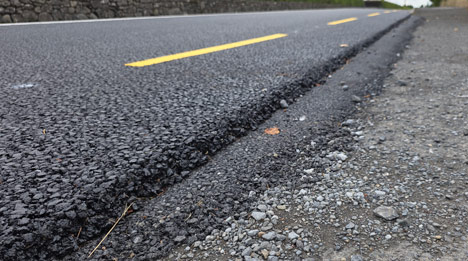
As our photographs show, the newly laid asphalt ends in a rough, abrupt and raised edge beside an uneven pedestrian margin. Anyone walking out from town may suddenly encounter a section where the resurfacing covers only part of the available roadside space.
Pic: G. Willoughby.
This presents particular difficulties for:
► wheelchair and mobility-scooter users; ► parents pushing children in buggies; ► people using walking aids; ► older pedestrians and those with impaired balance; ► cyclists moving close to the road edge; and ► residents entering or leaving adjoining properties.
Small wheelchair castors or buggy wheels could catch against the raised lip or loose stone. A pedestrian attempting to avoid the uneven surface could also be forced closer to moving traffic.
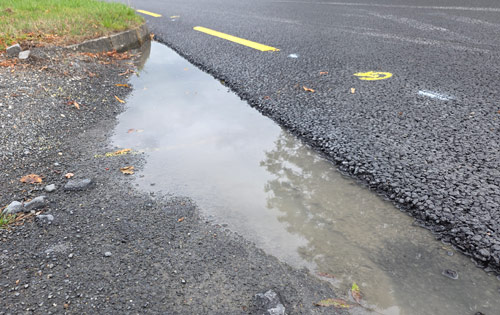
Pic: G. Willoughby.
The unfinished edge may create further problems if it is not corrected promptly. Water could collect along the change in level instead of draining freely, increasing the risk of puddles, splashing and deterioration. Water entering an unsealed pavement edge can weaken it, while passing traffic may loosen the exposed aggregate and cause the asphalt to ravel or break away progressively.
The resulting loose stones could become an additional slipping or skidding hazard. Repeated vehicle loading may also widen the damaged edge, leaving potholes, crumbling margins and an even greater difference in level.
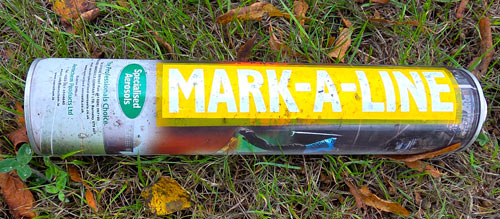
Pic: G. Willoughby.
Serious questions therefore arise: Why were these sections left at a different level? Was pedestrian and wheelchair access assessed before the work was accepted? Were drainage and connections to entrances properly examined? Has the resurfacing received a final inspection? Is the contractor expected to return and complete the margins?
Fresh road markings and a new running surface do not make a project complete if unsafe edges remain beside homes, businesses and pedestrian routes.
These locations should now be inspected urgently by Tipperary County Council, made safe without delay and brought to a properly finished, accessible and well-drained standard. The council provides an official service for reporting damaged roads and footpaths, including an online “Fix-it”facility, [which today same consultation portal, despite every attempt, refused access].
Which begs another question; Where have “Refresh Thurles” members vanished to? Note: Refresh Thurles members have failed to note that those working on this re-surfacing project, forgot to take their litter with them.
The public should not have to wait until somebody falls, a wheelchair becomes trapped or the newly laid surface begins to disintegrate before action is taken.
This website uses cookies to improve your experience. We'll assume you're ok with this, but you can opt-out if you wish.AcceptRead More
Privacy & Cookies Policy
Privacy Overview
This website uses cookies to improve your experience while you navigate through the website. Out of these, the cookies that are categorized as necessary are stored on your browser as they are essential for the working of basic functionalities of the website. We also use third-party cookies that help us analyze and understand how you use this website. These cookies will be stored in your browser only with your consent. You also have the option to opt-out of these cookies. But opting out of some of these cookies may affect your browsing experience.
Necessary cookies are absolutely essential for the website to function properly. This category only includes cookies that ensures basic functionalities and security features of the website. These cookies do not store any personal information.
Any cookies that may not be particularly necessary for the website to function and is used specifically to collect user personal data via analytics, ads, other embedded contents are termed as non-necessary cookies. It is mandatory to procure user consent prior to running these cookies on your website.







Recent Comments