Application Ref: 2660179. Applicant: John & Lorraine McLoughlin. Development Address: 3 The Glebe , Thurles , Co. Tipperary. Development Description: The following works: a) demolition of the existing single storey rear extension; b) proposed new 2-storey extension to the rear of the existing dwelling; c) associated alterations to existing dwelling external elevations to accommodate proposed new extension & internal layout; d) all associated site works. RETENTION PERMISSION is also sought for e) the existing shed structure; f) retention of the existing widened vehicular entrance & all associated site works. Status: Conditional. Application Received: 01/03/2026. Decision Date: 18/08/2026. Further Details:http://www.eplanning.ie/TipperaryCC/AppFileRefDetails/2660179/0.
A multi-million-euro investment has been sanctioned for Coláiste Mhuire Co-Ed in Thurles, delivering a significant improvement in facilities for its growing school community.
The project was advanced by the school and its patron and managing authority, Tipperary Education and Training Board. Funding has been sanctioned by the Department of Education, while Tipperary County Council is responsible for the relevant local planning decisions.
This development will provide 11 classrooms, including three additional general classrooms and new specialist facilities for Home Economics, Design and Communication Graphics, and Science.
Five prefabricated classrooms that have been in place for more than 35 years will now be replaced. A purpose-built ASD classroom with a dedicated sensory space will also be provided, supporting a more modern and inclusive learning environment.
In addition to the new accommodation, the existing school building will undergo a comprehensive roof retrofit.
This substantial public investment represents an important milestone for Coláiste Mhuire Co-Ed and will provide improved facilities for students, staff and the wider Thurles community for many years to come.
A housing initiative intended to help older homeowners move into smaller and more manageable accommodation has been put on hold while its effectiveness is examined.
Local authorities have reportedly been directed to stop operating the Older Persons Housing Financial Contribution Scheme pending a review by the Housing Agency. Although the decision has been described as the scheme being “shelved,” current information indicates that it has been paused rather than formally abolished.
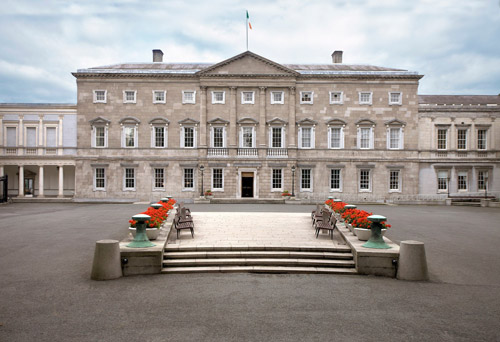
Leinster House.
The initiative offered a potential route for older people whose homes had become too large, expensive or difficult to maintain. Participants could sell their property to a local authority—or sell it privately—and provide the council with an agreed financial contribution from the proceeds. In return, they could receive a tenancy in smaller social housing designed to suit their changing needs.
However, the financial arrangement appears to have discouraged many potential applicants. Age Action explains that participating homeowners could be required to give a substantial proportion of their property equity to the council. After surrendering that equity, they would become social housing tenants and continue paying rent.
According to Age Action, those conditions made the scheme relatively unattractive. An older person could move from owning a valuable asset outright to holding a rental tenancy, while retaining considerably less of the money generated by the sale. For homeowners hoping to preserve savings for future care, living costs or their families, that trade-off may have been difficult to justify.
The scheme’s limited appeal also highlights a wider obstacle facing older people who want to “rightsize”. Ireland does not have enough smaller, accessible and age-friendly homes in suitable locations. Even a more financially attractive programme would struggle if councils could not offer appropriate properties close to participants’ families, healthcare services and established communities.
“Rightsizing” can nevertheless deliver important benefits when it is voluntary and properly supported. A suitable home may be easier to heat and maintain, safer for someone with reduced mobility and better equipped for independent living. Larger properties released through such moves could also become available to families needing additional space.
The Housing Agency’s review now presents an opportunity to reconsider contribution levels, rental conditions, housing availability and the protection of homeowners’ remaining equity. Any replacement or revised programme will need to offer older people genuine choice, financial fairness and a secure home, not simply a smaller property.
‘Not simply an equality issue’ – Network Ireland seeks Budget 2027 investment in women-led businesses.
Women-led businesses should be given greater priority in Budget 2027, with targeted measures needed to help female entrepreneurs overcome barriers to growth and support Ireland’s wider economic performance, according to Network Ireland.
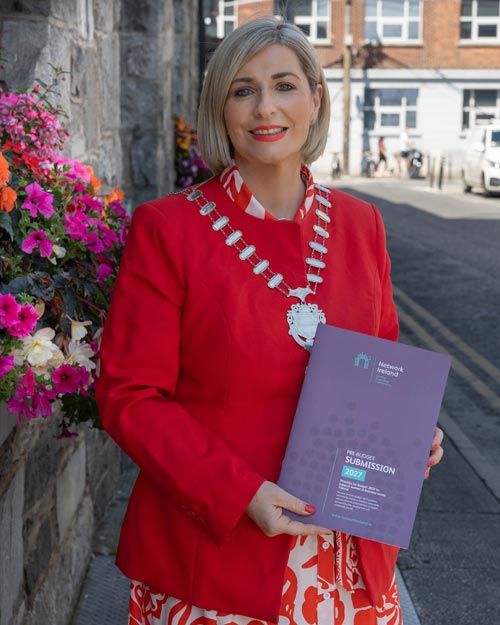
Ms Karen Ronan(Network Ireland National President)
The organisation, which represents more than 1,400 members through 17 branches nationwide, has called on Government to recognise women-led enterprise as a key driver of productivity, resilience and sustainable economic growth.
In its first national pre-Budget submission, Ireland’s longest-established women-only business network has identified seven priority areas for Budget 2027, including reducing the cost of doing business, improving access to finance for female entrepreneurs, expanding childcare supports, investing in skills and artificial intelligence, strengthening innovation, and addressing housing and infrastructure challenges.
The submission is based on a survey of members which found inflation and rising operating costs remain among the biggest challenges facing businesses. It also highlighted the growing use of artificial intelligence, with almost seven in ten members already using the technology and many expecting to increase their use of the technology in 2027.
Network Ireland National President Ms Karen Ronan said women-led businesses were making a significant contribution to the Irish economy but continued to face barriers that limited their ability to grow.
“Women-led businesses are creating jobs, driving innovation and making a significant contribution to Ireland’s economy. Budget 2027 is an opportunity to remove barriers that continue to limit business growth while unlocking the full potential of female entrepreneurship,” she said. “Investing in women in business is not simply an equality issue; it is an economic one. The right supports will strengthen businesses, increase workforce participation and enhance Ireland’s competitiveness.”
Among its recommendations, Network Ireland is calling for targeted tax measures for SMEs, improved access to finance, increased investment in childcare, and stronger supports for innovation and skills development.
Ms Ronan, who is also CEO of Galway Chamber, said the measures would help create the conditions for more women to start, grow and scale successful businesses.
“Our recommendations are practical and achievable and focused on helping businesses thrive. By investing in female entrepreneurship, childcare, innovation and workforce participation, Government can deliver lasting benefits for businesses, communities and the wider economy,” she said.
Founded in 1983, Network Ireland supports entrepreneurs, SME owners, professionals and business leaders through 17 regional branches and a virtual branch. See www.networkireland.ie.
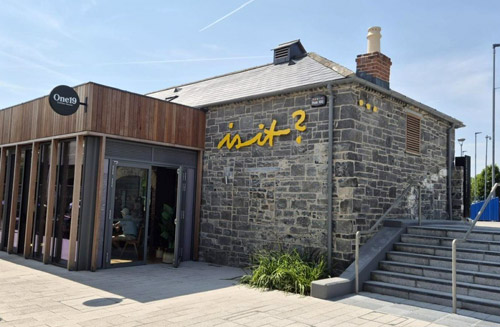
A striking ribbon of yellow now sweeps around the new café at Thurles Market Quarter, carrying with it the voices of the past, the questions of the present and the possibilities of tomorrow.
Thurles.Info has already highlighted the work of talented artist Ms Anja Buchheister, despite previously being unable to identify the artist by name. Our sincere thanks, therefore, to Ms Esther Griffin, (Research Assistant with the Tipperary Arts Office), for bringing the artists name and her magnificent new public artwork, once again, to our attention.
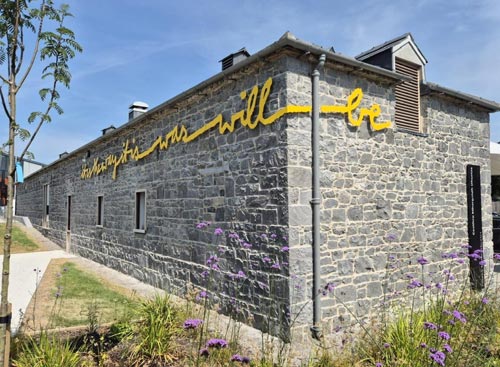
Thurles Market Quarter. Pic: Anja Buchheister.
Created by artist Ms Anja Buchheister, “Flowing Places” is far more than an architectural embellishment. It is a compelling meditation on memory, change and our relationship with place. Wrapped around a building once belonging to the farmyard of nearby St Patrick’s College, the artwork transforms a historic structure into a living conversation between generations.
Cut from powder-coated metal, its words unfold in an endless, thought-provoking sequence: “it is the way it is … was … will be … is it? …”
With this playful reversal of a familiar expression, Ms Buchheister challenges passive acceptance. Is a place simply what it is – or is it also what it was, what it may become and what its community chooses to make of it?
Thurles Market Quarter. Pic: Anja Buchheister.
The artist’s research reached deep into Thurles itself. Old maps and conversations with local residents revealed layers of memory embedded in the former old early 19th century agricultural machinery sheds. These recollections helped shape an artwork that honours the people who came before, while recognising that every landscape remains in motion. Like the nearby River Suir, the words flow continuously around the building. There is no fixed beginning and no final conclusion; only an invitation to pause, remember and imagine.
Originally from Wolfenbüttel, Germany, Ms Buchheister now works from her studio in Templetuohy, Thurles. Drawing on her training in sculpture and graphic design, she has created a poetic intervention that is simultaneously bold and delicate, deeply local and universally resonant.
“Flowing Places” is a magnificent addition to Thurles Market Quarter; an artwork that does not merely occupy public space, but awakens it. It celebrates heritage without trapping it in the past and turns an evolving corner of Thurles into a landmark of curiosity, creativity and civic pride.
Commissioned by Tipperary County Council under the Per Cent for Art Scheme and developed with Thurles Municipal District, the work stands as a powerful reminder that public art can do more than decorate a place, it can give that place a voice.
This website uses cookies to improve your experience. We'll assume you're ok with this, but you can opt-out if you wish.AcceptRead More
Privacy & Cookies Policy
Privacy Overview
This website uses cookies to improve your experience while you navigate through the website. Out of these, the cookies that are categorized as necessary are stored on your browser as they are essential for the working of basic functionalities of the website. We also use third-party cookies that help us analyze and understand how you use this website. These cookies will be stored in your browser only with your consent. You also have the option to opt-out of these cookies. But opting out of some of these cookies may affect your browsing experience.
Necessary cookies are absolutely essential for the website to function properly. This category only includes cookies that ensures basic functionalities and security features of the website. These cookies do not store any personal information.
Any cookies that may not be particularly necessary for the website to function and is used specifically to collect user personal data via analytics, ads, other embedded contents are termed as non-necessary cookies. It is mandatory to procure user consent prior to running these cookies on your website.





Recent Comments