McDonald’s has confirmed that its new drive-thru restaurant in Thurles, Co. Tipperary, is scheduled to open on Wednesday, August 19th, 2026.
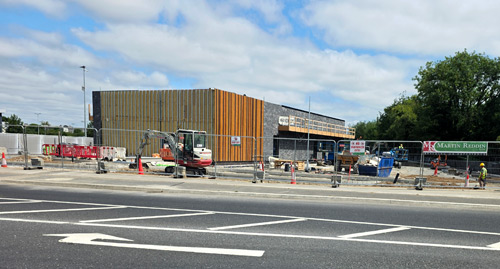
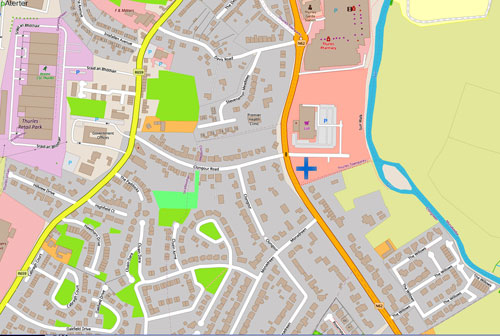
The opening will come almost one year after An Coimisiún Pleanála issued its final approval for the controversial development, bringing a lengthy planning process and months of local debate to an end. The new restaurant is being constructed on a former industrial site at the junction of Slievenamon Road and the now once again delayed “Thurles Relief Road“, close to the Lidl supermarket and approximately 700 metres from Thurles town centre.
Plans provide for a single-storey restaurant measuring almost 479 square metres, together with a drive-thru lane, customer-ordering points, digital menu boards, car parking, accessible spaces, electric-vehicle charging bays and bicycle parking. The development will also include outdoor seating, landscaping, lighting, signage, an electricity substation and changes to the existing vehicle entrance from the relief road.
Recruitment Begins Ahead of August Launch. McDonald’s has begun recruiting full-time and part-time staff members for the new Thurles restaurant. The recruitment advertisement confirms the August 19th opening date and states that successful applicants will receive paid training at other nearby McDonald’s restaurants during the weeks leading up to the launch. Advertised hourly pay for some adult employees is up to €14.25, depending on age and the terms of the new positions. The recruitment drive is expected to create a significant number of new low paid hospitality jobs in the Thurles area, although the company has not publicly confirmed the restaurant’s total anticipated workforce.
Plans Attracted More Than 20 Objections. McDonald’s Restaurants of Ireland submitted its planning application for the Thurles development in September 2024. The proposal proved controversial from the beginning, attracting more than 20 objections from residents and other interested parties. Concerns raised during the initial planning process included the location of the outlet, traffic levels, road safety, litter, noise, opening hours and the proximity of the proposed restaurant to residential properties and childcare facilities. Some objectors also raised public-health concerns relating to fast food and childhood obesity. The development was originally intended to operate around the clock. However, permission ultimately restricted its opening hours to between 6am and 10pm, meaning the Thurles restaurant will not be permitted to trade on a 24-hour basis.
Tipperary County Council initially sought additional information from the applicant, including further details concerning traffic and the proposed operation of the development. Documents submitted during that stage included an analysis indicating that the site would have space for a queue of approximately 32 vehicles, before waiting traffic would potentially reach the adjoining public road.
Council Permission Was Appealed Tipperary County Council granted permission for the restaurant, subject to conditions, on April 9th, 2025. That decision was subsequently appealed to the national planning authority by a third party, while a number of additional observations were submitted for consideration. An Coimisiún Pleanála examined issues including traffic and pedestrian safety, flood risk, residential amenity, visual impact, town-centre development and the site’s proximity to the River Suir and the Lower River Suir Special Area of Conservation. The Commission issued its decision on August 26th, 2025, upholding the council’s decision and granting permission with revised conditions. In its formal order, the planning body determined that the development would not seriously damage the amenities of nearby properties or create unacceptable risks in relation to public health, flooding, traffic, pedestrian safety or visual amenity. It also considered the mixed-use zoning of the former industrial land, Thurles’s status as a key regional town and the planning policies applying to the area.
Construction Work Underway Site-clearance activity began in early 2026, allowing construction of the restaurant and associated infrastructure to proceed. Information published locally indicated that the principal works were expected to take place between February and July, leaving several weeks for completion, staff training and final preparations before the planned August opening. The development represents the latest chapter in efforts to bring a McDonald’s outlet to the former Erin Foods lands. A previous application connected to a proposed drive-thru restaurant at the wider site was submitted as far back as 2020 but was deemed incomplete shortly afterwards.
While the current project has continued to divide opinion locally, the August opening will introduce one of the world’s largest fast-food brands to Thurles and hopefully provide new employment opportunities for the town For supporters, the development represents investment, additional consumer choice and the productive reuse of former industrial land. For critics, concerns about traffic, litter, public health, late-evening activity and the effect of drive-thru development on the character of the area remain.
Barring any construction or operational delays, the first customers are expected to be welcomed through the doors of the new Thurles McDonald’s on August 19th.
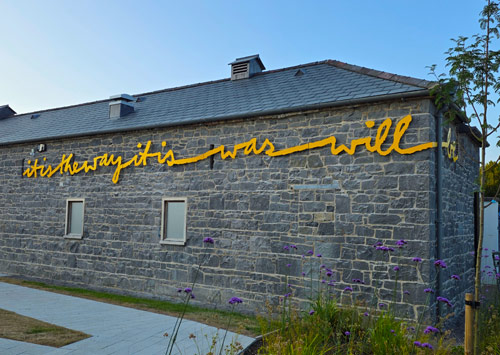
The above words are placed so beautifully and appropriately that it would be difficult to imagine a better setting.
Written in glowing golden script across the weathered limestone, the inscription seems almost to float upon the old walls; not merely as a sign, but as a quiet conversation between what has been, what is now and what is still to come. This striking artwork adorns the carefully restored 1849 stone old farm building in what is now Thurles Market Quarter. Once a modest agricultural shed, shaped by work, weather and generations of local life, it has now been lovingly reborn as ONE19 Coffee House & Restaurant.
West side of “One19 Restaurant”, Cathedral Street,Thurles, Co. Tipperary.
Its transformation has thankfully not erased its past. Instead, the old stone, the traditional form of the building and the marks of age have been allowed to remain, lending great warmth and authenticity to its new life. What was once a place of labour has become a place of welcome; a setting for coffee, food, conversation, friendship and new memories.
Its location gives the inscription an even deeper resonance. The building stands between two other landmarks, both woven into the spiritual and educational heritage of Thurles: the Cathedral of the Assumption and the former St Patrick’s College, now part of Mary Immaculate College. In such surroundings, the words/phrase naturally carry an almost sacred rhythm. They are not a direct quotation from Scripture, yet they gently recall the ancient Christian doxology:-“As it was in the beginning, is now, and ever shall be, world without end.” They also echo the language of the Book of Revelation, which describes God as the one “who is and who was and who is to come.”
Yet the sentiment has travelled beyond religious tradition and into popular culture. A closely related line, “That’s the way it is, was and will be”, introduces the established order of Sneetch society in the 2017 musical adaptation of Dr. Seuss’s “The Sneetches”. Dr. Seuss’s original 1961 story, later adapted for television in 1973, ultimately challenges the belief that society must always remain as it has been. The ‘Sneetches’ learn that inherited divisions are neither natural nor permanent and that even “the way it was”, can be changed.
The wording also appears with a more playful and satirical flavour in the 1974 comedy film “The Groove Tube”, where a fictional television newscaster signs off: “And that’s the way it is, was, and will be.” There, the phrase humorously imitates the certainty and authority of traditional television news.
Placed upon this restored building, however, the words take on a gentler and more romantic meaning. The stone remembers farm carts, tools, harvests and working hands. Today, those same walls shelter laughter, conversation and the aroma of freshly brewed coffee and hastily produced food. Tomorrow, they will hold stories belonging to generations not yet born.
The way it was: A humble building serving the life of the land. The way it is: A beautifully renewed gathering place in the heart of Thurles. The way it will be: A cherished part of Thurles town’s story for many years to come.
At dusk, when the golden lettering shines against the cool grey stone, it feels as though the building itself is speaking. Not mourning what has passed. Not resisting what has changed. Simply acknowledging that the past, present and future can inhabit the same place beautifully. An old building saved rather than forgotten. A historic quarter renewed rather than replaced unlike the towns Great Famine “Double Ditch“. A little philosophy, faith and humour written in golden light.
Application Ref: 2660461. Applicant: Air Impact Ltd. Development Address: Racecourse Retail Park, Thurles, Co. Tipperary. Development Description: The temporary storage containers on site and PERMISSION for change of design of previously granted store shed, which consists of increase footprint/area and alterations to elevations of previously granted store shed, including all ancillary site works. This store shed was previously granted permission under planning permission Ref. no. 2560292. Status: Conditional. Application Received: 18/05/2026. Decision Date: 01/07/2026. Further Details:http://www.eplanning.ie/TipperaryCC/AppFileRefDetails/2660461/0.
Sinn Féin’s Housing Record: Opposition, Alternatives and the Charge of NIMBYism, (“Not In My Backyard”).
Ireland’s housing crisis has produced no shortage of political outrage. Sinn Féin has been among the loudest voices condemning missed targets, unaffordable rents and the chronic shortage of homes. But a party that presents itself as the answer to the housing emergency must be judged not only by what it promises nationally, but by what its representatives do when actual developments are proposed locally. That is why Mrs Mary Lou McDonald’s latest planning appeal matters.
The Sinn Féin president and Dublin Central TD has joined local party councillor Seamus McGratten in appealing permission for a 249-bed student-accommodation development on the former Matt’s of Cabra pub site, at Fassaugh Avenue in Dublin 7. An Coimisiún Pleanála’s official record confirms the appeal, which was lodged in June 2026. A decision is due by October 6.
Mrs McDonald argues that the land should instead be used for social and affordable housing. She has raised concerns about height, overlooking, traffic, parking, drainage, road safety and pressure on local services. Any one of those concerns may sound reasonable when considered in isolation. Almost every substantial urban development creates some local inconvenience or planning trade-off. The problem is that Ireland can no longer pretend those trade-offs do not exist. We cannot demand tens of thousands of additional homes and student beds while insisting that every development must create no traffic, cast no shadow, inconvenience no neighbour, alter no streetscape and place no pressure on existing services. That is not a housing policy. It is a formula for building almost nothing.
The Cabra scheme is particularly revealing because this is not the first time Mrs McDonald has opposed a major residential proposal on the same site. An earlier application sought permission for 117 build-to-rent apartments. That proposal also faced opposition from the Sinn Féin leader. The political message is difficult to ignore: apartments were unsuitable, and now student accommodation is unsuitable too. Social and affordable housing is presented as the preferred alternative, but no equivalent 249-unit public-housing project is currently being delivered on the site.
It is always easier to endorse the ideal development that does not yet exist than to accept the imperfect one that is ready to proceed. Mrs McDonald’s suggestion that student accommodation should instead be built at Grangegorman, illustrates the familiar politics of displacement: housing is necessary, but “somewhere else.” would be better. Every constituency has a “somewhere else.” Taken together, those arguments are one reason Ireland finds itself trapped in endless cycles of objections, appeals, redesigns and delays.
Dedicated student accommodation is also not unrelated to the wider housing crisis. Students who cannot secure purpose-built rooms compete for houses and apartments in the private rental market. Blocking student beds does not eliminate demand; it pushes that demand back into neighbourhoods already struggling with high rents and limited supply.
The Cabra controversy would be less damaging for Sinn Féin if it were an isolated case. It is not. Sinn Féin representatives have opposed, appealed, challenged or voted against numerous housing-related developments. Fine Gael has claimed that the party objected to, voted against or attempted to hinder 11,687 homes in Dublin between 2018 and 2023, later increasing its claimed total to more than 12,000. Those figures come from a political opponent and should not be accepted uncritically. The totals combine formal objections with council votes, rezoning disputes, legal actions and opposition to particular development or land-transfer models.
A detailed Journal FactCheck found that an earlier claim that Sinn Féin had objected to approximately 6,000 homes was misleading because many of the cases concerned affordability, public-land disposal or tenure rather than straightforward opposition to construction. That qualification is important,but it is not a complete defence. Sinn Féin frequently says it supports building on a site but opposes the proposed mix of private, affordable and social homes. It says public land should remain public and that developments should contain more genuinely affordable housing. Those are legitimate ideological positions. However, rejecting developments because they do not conform to Sinn Féin’s preferred model still has consequences. A home delayed by a dispute over tenure remains a home unavailable to a family. A project voted down because it includes private housing does not shelter anyone while politicians debate the perfect ownership structure.
Some cases involved more direct opposition. At Kilbride Lodge in Bray, two Sinn Féin councillors voted against 18 social-housing apartments. In Knocklyon, two party councillors opposed 27 social homes proposed on football pitches, although three other Sinn Féin councillors supported the development. At Fosterstown North in Swords, Sinn Féin councillors backed legal action concerning a 278-home scheme, citing density, height and school-capacity concerns.
Oscar Traynor Road, O’Devaney Gardens, Ballymastone, Killinarden and Kilcarbery, here Sinn Féin also opposed development arrangements involving hundreds of homes. The party’s position was generally that the public land involved should deliver more social and affordable housing rather than being developed under private or mixed-tenure models.
Yet this exposes the central contradiction in Sinn Féin’s approach. The party wants to be judged on the housing system it imagines, while dismissing criticism of the developments its representatives actually oppose. It promises dramatic increases in supply, but too often treats individual projects as optional whenever the location, height, tenure or design becomes politically uncomfortable. In the 2024 general-election campaign, Sinn Féin promised 300,000 homes over five years, including 125,000 social, affordable-purchase and affordable-rental homes. Such ambition requires difficult choices. It requires accepting apartments, density, construction disruption, mixed-tenure developments and buildings taller than many existing neighbours would prefer. It requires political leaders to tell communities that additional housing cannot always be built without changing their surroundings.
The real test of a housing party is not whether it supports housing in theory. Every party supports housing in theory. The test is whether it supports enough real developments, in real communities, to match its promises. Sinn Féin is entitled to challenge poor planning and demand better affordability. But when its representatives repeatedly oppose concrete proposals, while insisting that a different development, would be preferable, scepticism is justified.
Ireland does not need another party that promises abundance nationally and practises obstruction locally. Until Sinn Féin reconciles those two positions, its housing rhetoric will continue to look less like a credible delivery plan and more like political opportunism; blame the Government for every shortage, promise a perfect alternative, and object when construction reaches your own doorstep.
Ireland may be about to create an entirely new residential construction market, but the opportunity is being misunderstood.
In April, the Irish Government announced proposed planning exemptions that would allow a detached auxiliary dwelling of between 32 m² and 45 m² to be built behind an existing home and connected to the main house’s services. The detailed conditions have not yet been finalised, and the regulations still require environmental assessment and Oireachtas approval.
That distinction matters. This is not simply permission to place a larger garden room beside the patio. It is a proposal to create a new home without the conventional planning process.
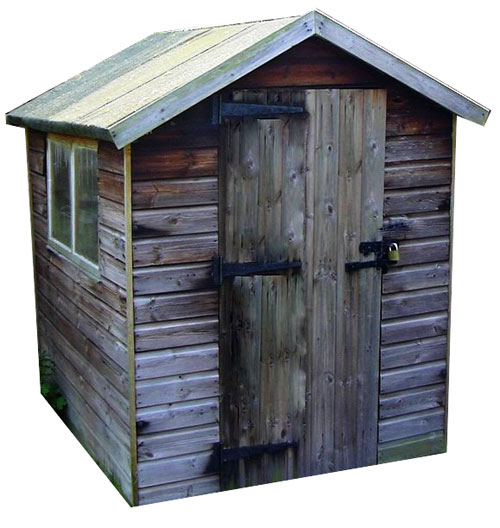
Homenot a shed!
And a home is not a shed with better finishes. The Government has explicitly stated that all relevant Building Regulations, Building Control requirements and fire-safety rules will continue to apply. Removing planning permission does not remove the obligation to design, construct and certify a safe, energy-efficient dwelling.
That is where the real market disruption begins. Ireland already has a capable garden-room sector supplying offices, gyms, studios and leisure spaces. Many of those companies deliver attractive buildings quickly and efficiently. But a structure intended for occasional use is fundamentally different from a dwelling occupied every day and night. A compliant home must address structure, insulation, ventilation, airtightness, energy performance, drainage, fire safety, radon protection, access and long-term durability. Depending on the final regulatory route, it may also require professional design input, a commencement notice, inspection documentation, energy assessment and completion certification. These obligations are not administrative extras. They are the product.
The commercial risk is obvious. Homeowners may compare two buildings that appear almost identical online: one offered as an inexpensive “garden pod” and another priced as a fully designed and certified dwelling. The cheaper option may win at the kitchen table because the most important differences are hidden inside the floor, walls, roof, ventilation system and compliance file. Those differences may only become visible years later — during a sale, an insurance claim, a mortgage application or an investigation following a fire or structural failure.
That creates four urgent challenges for the industry. ► First, design must become repeatable. The strongest providers will develop standardised systems that can be engineered, energy-modelled and documented once, then adapted responsibly for each site. ► Second, buyers need meaningful protection. A marketing promise or company guarantee is not the same as independent certification, professional indemnity cover and a credible structural warranty. ► Third, contractors need a clear delivery process. Responsibility for design, assigned roles, inspections, testing and handover documentation must be established before work begins — not assembled retrospectively when a customer asks for proof. ► Fourth, the public needs better information. “Planning exempt” must never be allowed to become shorthand for “unregulated.”
There is also confusion around tax. Revenue currently allows up to €14,000 of qualifying Rent-a-Room income to be exempt from Income Tax, PRSI and USC. However, current guidance says a detached self-contained unit does not qualify. The Government has only committed to considering how auxiliary dwellings might interact with the relief. The opportunity remains substantial. Families need flexible accommodation. Adult children need routes to independence. Older homeowners need options. Ireland needs additional housing capacity.
But the winners will not be the businesses that manufacture the cheapest box. They will be the contractors and partners that can deliver a genuine home: designed correctly, built safely, tested properly, certified transparently and supported long after handover. That is the standard serious builders should establish before the first advertising campaign begins.
In this market, compliance will not slow the sale. Compliance will be the sale.
This website uses cookies to improve your experience. We'll assume you're ok with this, but you can opt-out if you wish.AcceptRead More
Privacy & Cookies Policy
Privacy Overview
This website uses cookies to improve your experience while you navigate through the website. Out of these, the cookies that are categorized as necessary are stored on your browser as they are essential for the working of basic functionalities of the website. We also use third-party cookies that help us analyze and understand how you use this website. These cookies will be stored in your browser only with your consent. You also have the option to opt-out of these cookies. But opting out of some of these cookies may affect your browsing experience.
Necessary cookies are absolutely essential for the website to function properly. This category only includes cookies that ensures basic functionalities and security features of the website. These cookies do not store any personal information.
Any cookies that may not be particularly necessary for the website to function and is used specifically to collect user personal data via analytics, ads, other embedded contents are termed as non-necessary cookies. It is mandatory to procure user consent prior to running these cookies on your website.





Recent Comments