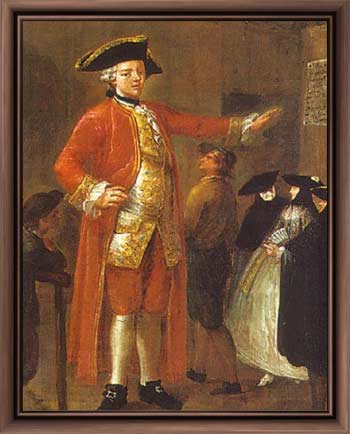
Cornelius Magrath the Silvermines Co. Tipperary giant.
Trinity College Dublin claim that they have no immediate plans to release the skeleton of a giant, born in March 1736, near the Silvermines, Nenagh, Co Tipperary to assist in his burial.
Cornelius Magrath who suffered from gigantism was 7ft 3in tall when he died in 1760. Legend recalls that Trinity students stole his body the day he died and it has been kept at the University ever since.
Of course body snatching was a lucrative business back in the 18th century and those who were involved were often called “resurrectionists” or “resurrection-men”, who often benefited on the double, stealing personal effects from the corpses sold on for dissection or anatomy lectures in medical schools. Because the only bodies legally available for medical dissection back then were the remains of executed criminals, demand soon outpacing supply.
Such body snatching activity possibly lends itself to the use of the phrase “The Graveyard Shift”. Graveyards started running out of places to bury people. So coffins were often dug up and bones sent to a “bone-house” allowing for the reuse of grave space. When opening such coffins, it was discovered that a considerable number were found to have scratch marks on the inside lid, confirming that individuals were being burying alive. Based on this evidence it was agreed that a piece of string be tied to the wrist of certain corpses; to be lead through the coffin and up through the ground before being tied to a bell. An individual would sit out in the graveyard all night (the “graveyard shift”) to listen for bell; sounds, hence someone could be “saved by the bell” or was considered to be a “dead ringer.”
The Magrath skeleton today is viewed only by those doing research and continues to inspire scholarship through teaching a great many students, scientists, professors and experts studying his disease.
While it is claimed that Tipperary locals are calling on Cornelius’s skeleton to be released for burial; certainly Thurles.Info has heard nothing about it and Trinity College have released a statement also confirming it also had not been approached by any Tipperary individuals who are requesting his burial. The University in the past admits putting Cornelius’s skeleton on public display, but there are no plans for such similar displays into the future; leaving Cornelius to be only visited by medical students or associated groups involved in research or other educational activities.
Looks like our Dublin Media were stuck for front page sensationalism and national debate again.
You can read all about the Tipperary Giant Cornelius Magrath simply by clicking HERE
Initial design drawing of the ‘Stannix Homes’ produced before building in 1889.(Photo colour toning G. Willoughby.)
The Stannix family appear to have spent comparatively little time here in Co. Tipperary. We are aware they were of the Protestant faith and left us a legacy which involved the setting up of the charitable almshouses known today here in Thurles as ‘The Stannix Homes’.
In the mid 1870’s the representatives of Jeremiah Stannix held 2,054 acres in county Tipperary. What we can reliably ascertain is that Emma Stannix held townlands in the parish of Moycarkey, Thurles in barony of Eliogarty, Co. Tipperary. There is a reference to the provisions of the will of Miss Emma Stannix in a letter in the papers of Archbishop Thomas William Croke of Thurles, dated 1st December 1886. There are references to the representatives of Emma Stannix holding untenanted lands at Ashhill and Knocknanuss, in the parish of Moycarkey, in 1906.
We believe that Emma herself showed some talent as an artist and spent much of her time overseas in Versailles in the Île-de-France region of France. Tipperary press reports appear to constantly conflict with the spelling of her name; e.g. Stannix and Stanwix.
Stannix Homes September 2016
However Ema’s philanthropic soul passed away in 1857; and her will makes provision for the Stanwix Almshouses to be financed and subsidised by her deceased estate. She is also understood to have made generous provision for the remaining tenants on her various Moycarkey agricultural properties.
Here in Thurles the Emma Stannix Charity left a sum of money to build alms-houses for what were referred to as “reduced female widows aged over sixty years”. The site was provided on ground (Thurles Townparks) to the south east of Thurles with frontages overlooking and facing west towards the town.
The terrace of two-bay single and two-storey former almshouses, were built 1889, and featured open gable-fronted porches. The central house is a higher two-bay gabled erection, while the two storey director’s house attached to the north side of the terrace features a small spire with roundels on a turret.
The pitched slate roofs have rendered chimney stacks while the buildings themselves are constructed of red brick, with half-timbered gables and verandas. Each resident was then provided with two rooms, a yard and sanitary accommodation. Gate piers with alternating bands of brick and stone, together with wrought-iron gates and cast-iron railings are features of the boundary surrounding the site.
The building work was initially carried out by Mr. J. Kiernan, of Talbot-street, at a cost of about £2,500, using the designs and under the superintendence of Mr. Albert E. Murray[1], F.R.I.B.A., architect, Dawson-street.
Albert Edward Murray (1849-1924)[1]. Interesting to note that when Queen Victoria (1819-1901) visited Dublin in 1900, Mr. Albert E. Murray was responsible for the decorations in Sackville Street, now O’Connell Street, Dublin and also for those in Clyde Road, Ballsbridge where he then resided.
Ceremonial gateways had been erected on Queen Victoria’s route into Dublin from Kingstown (Dun Laoghaire). It was on the occasion of this same trip by Queen Victoria that it was reported that the Irish Times supposedly printed a typo stating, “a large crowd cheered as Queen Victoria pissed over Carlisle Bridge.” (Now O’Connell Bridge). Even though they had only gotten one letter wrong the entire type room staff were supposedly sacked.
Albert Murray would also decorate Sackville Street (O’Connell Street) for the visit by Queen Victoria’s eldest son Edward VII (1841-1910), during his visit to Dublin in 1907.
This 2017 planned refurbishment of this area has been muted since as far back as the late 1980’s and is now ready to commence, with the development of some 125 car parking spaces to be located on the south side behind Liberty Square; exiting unto Slieve-na-Mon Road.
On the Square itself, duel street lighting, wide footpaths, semi-mature trees and 3 x 1 courtesy crossing zones all will greatly add, not just to a more secure safety, but also to that sense of beauty which has for generation provided an aesthetic emotion amongst tourists and local & visiting shoppers. No more can world tourism brochures label us as “Liberty Square, Thurles, just one giant car park.”
From a history point of view of course Liberty Square, could have looked totally different in 2017, had planned proposed upgrading taken place back in 1896.
(View the architectural drawings hereunder, set to replace the then existing ruined Market House, which was itself eventually removed in 1901 following the erection of the 1798 memorial (Stone Man), and later replaced by a single storey tin roofed weigh house.)
Architects drawings dated August 1st 1896 showing the winning tender for a once proposed new Thurles Town Hall & Market House on Liberty Square. [Photo colour toning G. Willoughby]
When tenders were invited in November 1895 to provide drawings for a proposed new Thurles Town Hall & Market House for Liberty Square, Thurles, the winning proposal was won by one Mr Joseph F. Freeman and submitted by Mr. Walter G. Doolin, M.A., architect, Dublin.
Walter Glynn Doolin was born in Dublin circa 1850, the son of William Doolin and his wife Anne Eliza, née Glynn. He attended school at Tullabeg and Castleknock Colleges, before entering Trinity College, Dublin, where he obtained a BA degree and later a Licentiate in Engineering. He received his architectural training initially from his father before going to London where he worked first in the Architects’ Department of the School Board and then as an assistant in the office of William Burges. He returned to Dublin in early 1872, to his father’s house at 204 Great Brunswick Street.
Doolin, a keen athlete, oarsman and rifle shot, and described as being both ‘jovial’ and ‘genial’, had won many commissions here in the Catholic Diocese of Cashel, possibly because of his strong friendship with Dr. Thomas H. Kinane, Dean of Cashel. As a parish priest of Killusty, Fethard, Co. Tipperary, in 1881, Dr. Kinane had given Mr Doolin work designing a new church in the area.
Planned Exterior Arrangement:
On examining the drawings provided we discover that the exterior of the Town Hall & Market House building was to be executed in local limestone to the level only of the first floor. Above that level it was proposed to use red brick with cut stone dressings also of local limestone. In addition to the perspective view, two plans of the building were published showing the suggested interior arrangement.
Planned Interior Arrangement:
On the ground floor the drawings show a covered market area for Butter Dealers etc., with office spaces for Market Officials. In addition a second covered market area was allocated for smaller dealers, possibly Fresh Meat Sellers. The building was intended to open and trade 6 days each week.
On the upper floor was to be located an assembly-room, 72 ft. x 80 ft., together with a concert-stage, combining separate dressing-rooms for ladies and gentlemen. On this floor also is planned accommodation for the Town Commissioners office, together with a public reading-room, and lavatory accommodation.
Here also was to be provided a room for the Young Men’s Society. This latter popular social and spiritual Society, had been first founded by Father Richard Baptist O’Brien in Limerick in 1849; towards the end of the Great Famine period. Today this Society’s history confirms that Father O’Brien first met with some 24 labouring men on the 19th May of that year, in the upper room of a small two-storey cottage. The purpose of the meeting was to establish and launch the ‘Young Men’s Society of the Immaculate Heart of Mary’. Its purpose initially, to use their own words, was to foster “by mutual union and co-operation, and by priestly guidance, the spiritual, intellectual, social and physical welfare of its membership”.
Liberty Square, Thurles.(Top of picture facing in an easterly direction).
Plans and particulars of this proposed development will be made available from the offices of the Templemore / Thurles Municipal District Offices, (Castle Avenue, Thurles, Co. Tipperary) and from Thurles Library, (Source Arts Centre, Cathedral Street, Thurles, Co. Tipperary) for inspection and indeed purchase, (latter can be copied at a fee not exceeding the reasonable cost of making such a copy) during normal office hours from 9.30am to 4.30pmMonday through to Friday, for the period from Thursday next(16th.February, 2017) to Friday (31st. March, 2017), excluding Public Holidays.
Private submissions or Observations with respect to these same new proposed developments, dealing with the proper planning and sustainable development of this area in which the proposed development would be situated, may be made in writing to M/s Deirdre O’Shea (Acting District Administrator), C/O Tipperary County Council, Templemore / Thurles Municipal District, Castle Avenue, Thurles, Co. Tipperary; to be received no later than 4.30pm on the 14th.April, 2017.
We didn’t want to upset everyone before Christmas, but Santa Claus we can confirm is well and truly dead for some 800 years. But not to worry children thankfully his spirit still lives on and be assured, providing you are of the very best behaviour, come Christmas Eve night next he will be doing his rounds as usual, unless of course our government or the European Union (EU) (Who presently run this country) raise difficulties surrounding Santa Claus’s permit to travel in Irish airspace.
Saint Nicholas is buried in the ruined Church of St Nicholas, Jerpoint, across the Tipperary border in Co. Kilkenny, just 67.4 km (42mls) from Thurles.
Today the church itself is all that remains of the medieval village of Newtown Jerpoint, (Name Jerpoint means ‘Nore Bridge). The village had been surrounded by the Cistercian Jerpoint Abbey, founded in 1183 before slowly falling into ruins in the 17th century.
The original Abbey had been originally located on some 1,880 acres; boasting its own gardens, watermills, a cemetery, granary, and kitchens and had served as a launching point in the past for Irish-Norman Crusaders from Kilkenny, before being dissolved in 1540.
A now ruined church can be found on privately held farm land, located to the west of the abbey. This ruin contains an unusual grave slab with a carved image of a cleric and two other carved heads. These images are understood to be that of St Nicholas and the two crusaders who brought the remains of Santa Claus (St. Nicholas) back to Ireland. Though the church dates from 1170, the grave slab itself appears to be dated back to the early 1300’s.
According to legend a band of Irish-Norman knights from Jerpoint, travelled to the Holy Land to take part in the Crusades. However on heading back to Ireland, they seized the remains St. Nicholas, and brought him back to Kilkenny, and to where his bones are now buried. What lends some credence to this legend is the fact that firstly Norman knights from Kilkenny did participate in the Holy Land Crusades and secondly, Normans knights were keen collectors of religious relics. Relics placed on public show encouraged annual pilgrimages, in turn creating revenues, which in turn paid the logistical costs associated with Crusade participation.
Of course human memory is short lived and often recounted recollections in history vary somewhat. Thus another version of this story tells of the de Frainet family, who removed Santa’s remains from Myra to Bari, Italy, in 1169, while Bari remained under the Norman control. The de Frainet family were crusaders to the Holy Land and when the Normans lost power in France, Nicholas de Frainet finally settled in Thomastown, Co. Kilkenny; taking with him the relic; buring Santa Claus in Jerpoint around the year 1200.
Whatever the real truth; a poem, ‘The Bones of Santa Claus’ commemorates this legend today.
‘The Bones of Santa Claus’(Author Bill Watkins)
Where lie the bones of Santa Claus, to what holy spot each pilgrim draws Which crypt conceals his pious remains, safe from the wild wind, snows and rains.
It’s not in Rome his body lies, or under Egypt’s azure skies Constantinople or Madrid, his reliquary and bones are hid.
That saint protector of the child, whose relics pure lie undefiled His casket safe within its shrine, where the shamrocks grow and rose entwine.
Devout wayfarer, cease your search, for in Kilkenny’s ancient church Saint Nicholas’ sepulchre is found, enshrined in Ireland’s holy ground.
So traveller rest and pray a while, to the patron saint of orphaned child Whose bones were brought to Ireland’s shore, safe from the Vandal, Hun and Moor.
Here lie the bones of Santa Claus, secure beneath these marble floors So gentle pilgrim, hear the call, and may Saint Nicholas bless you all!
This website uses cookies to improve your experience. We'll assume you're ok with this, but you can opt-out if you wish.AcceptRead More
Privacy & Cookies Policy
Privacy Overview
This website uses cookies to improve your experience while you navigate through the website. Out of these, the cookies that are categorized as necessary are stored on your browser as they are essential for the working of basic functionalities of the website. We also use third-party cookies that help us analyze and understand how you use this website. These cookies will be stored in your browser only with your consent. You also have the option to opt-out of these cookies. But opting out of some of these cookies may affect your browsing experience.
Necessary cookies are absolutely essential for the website to function properly. This category only includes cookies that ensures basic functionalities and security features of the website. These cookies do not store any personal information.
Any cookies that may not be particularly necessary for the website to function and is used specifically to collect user personal data via analytics, ads, other embedded contents are termed as non-necessary cookies. It is mandatory to procure user consent prior to running these cookies on your website.


 Plans for the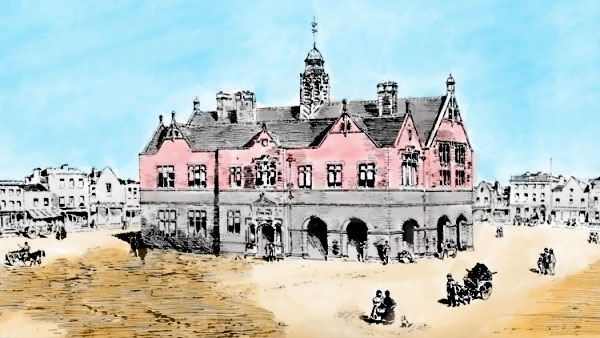
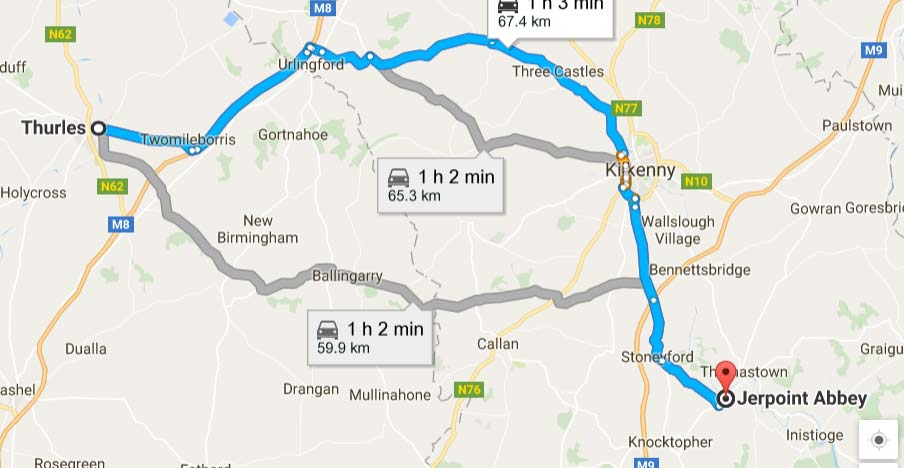 Saint Nicholas is buried in the ruined Church of St Nicholas, Jerpoint, across the Tipperary border in Co. Kilkenny, just 67.4 km (42mls) from Thurles.
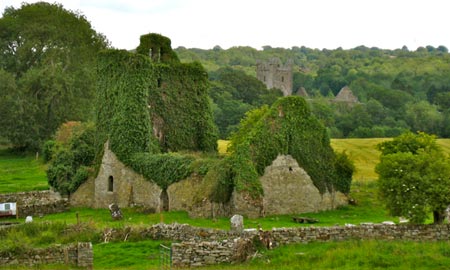 According to legend a band of Irish-Norman knights from Jerpoint, travelled to the Holy Land to take part in the Crusades. However on heading back to Ireland, they seized the remains St. Nicholas, and brought him back to Kilkenny, and to where his bones are now buried. What lends some credence to this legend is the fact that firstly Norman knights from Kilkenny did participate in the Holy Land Crusades and secondly, Normans knights were keen collectors of religious relics. Relics placed on public show encouraged annual pilgrimages, in turn creating revenues, which in turn paid the logistical costs associated with Crusade participation.




Recent Comments