|
|
The Chairman of the Oireachtas Committee on Health, Dr. Michael Harty; latter an Independent TD for the County of Clare, has stated he will support a vote of ‘No Confidence’ in respect of Fine Gael Wicklow politician and Minister for Health, Mr Simon Harris.
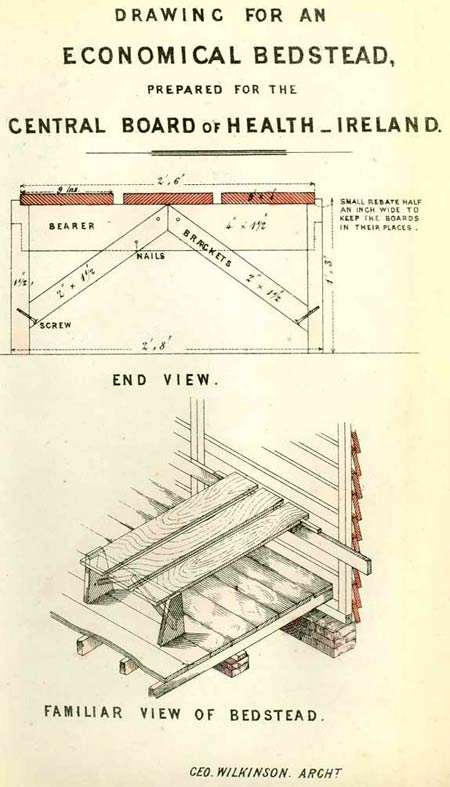 Infirmary bedstead designed by architect George Wilkinson in 1847, for the Thurles Workhouse. The ‘No Confidence’, motion in Mr Harris has been proposed by Sinn Fein, following a number of failures in the department, under the governance of Mr Harris, which came fully to a head in recent weeks; most notably the Cervical Cancer scandal and the apparent significant cost overruns cover-up with regards to the construction of the National Children’s Hospital; latter funding for which has now caused delays in promised funding for Limerick University Hospital; same the most overcrowded medical facility in Ireland, servicing North Tipperary.
An angry and disappointed Dr. Harty, summed up his overall feelings describing the decision as; “Shocking news”; “An abysmal failure by government”; A dysfunctional health system spiralling out of control; further stated; “It is an indictment of both the Government, the Minister for Health and in particular Fine Gael TD’s in Clare and Limerick, who have failed to ensure that University Hospital Limerick is a properly functioning 21st century health care facility.”
New would-be Tipperary Fine Gael hopefuls, who sit with their tongues hanging out, in the hope of collecting large salaries and pensions into the future; e.g. Mrs Mary Newman Julian (MaryforTipperary who has set up a promotional stall in Liberty Square, Thurles) and Mr Garret Ahern, would do well to take note.
Dr Harty had previously indicated that he would abstain on the vote of ‘No Confidence’ in Minister Harris, to ensure the government did not fall in the run up to ‘Brexit’. However, the TD now says he has “lost trust in this Minister and this government”.
Interest Note: The now demolished old Thurles Workhouse was erected in 1841-2 on a 6.5-acre site, on the east side of New Street (now Racecourse Road). [For younger readers, same in later years became known as the Hospital of the Assumption].
Erected by architect Mr George Wilkinson, at the request of the then Poor Law Commission, the completed building, designed to accommodate 700 inmates, was based on one of his standard declared building plans for such building, and deemed fit for the reception of all local paupers on 25th April 1842.
Mr Wilkinson’s design for beds in the Thurles Workhouse infirmary and fever hospital in 1847, declared that they should be a minimum of 18 inches (45.72 centimetres), distant between each bed, (Remember the year was 1847).
In 2019, 172 years later, the distance between trolleys on corridors at Limerick University Hospital, are often less than 4 inches (10.16 centimetres) apart, as busy medical staff attempt to treat all attending patients, to the very best of their ability, leaving very little space for themselves to distribute their great and necessary skills.
Apart from our present government doing their very utmost to eradicate people living in rural Ireland, it is also obvious that when it comes to health, the people of North Tipperary are destined to remain in the dark and distant past.
Historians of the future will most surely ponder as to why a supposedly well educated people, residents of North Tipperary, failed to rebel, thus allowing this present calamitous and catastrophic health scenario to transpire.
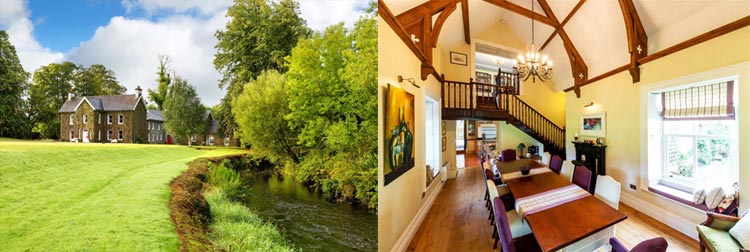
Certainly one of the top five sought-after private estates in Ireland presently; positioned on the banks of the River Clodagh, close to Thurles, Co. Tipperary, is currently being offered for sale.
The fully restored Moyaliffe House Estate, at Ballycahill, Thurles; situated on 4.85 hectares (some 12 acres) comes on the market with an initial price tag of €850,000.
Moyaliffe Castle was to became the home of the Armstrong family circa 1695, when Thomas Armstrong (1671-1741) purchased the townland and the ruins of a tower-house which had been built here, by the Butler family in the early fourteenth century. Thomas was the younger son of Captain William Armstrong of nearby Farney Castle who had come to Ireland to fight for the royalist cause in the Irish Confederate Wars.
The Armstrong family were originally of Scottish origin and are said to have derived their name during the Battle of the Standard (22nd August 1138), when a warrior of the Armstrong clan lifted a fallen King David I (Dauíd mac Maíl Choluim) back onto his horse by using just one arm. The family motto, “Vi et armis invictus maneo” (Translation – ‘By force and arms I remain unvanquished’), truly reflects the warlike nature of this then famous clan.
The Armstrongs held on to the Moyaliffe Estate more than three hundred years, from 1695, until 1999, during which time, despite the property remaining vacant for many years, they kept the house in reasonable repair. The property was then purchased by Mr John & Mrs Breda Stakelum and their daughters Laura & Ashling, [Stakelum’s Hardware Retail Park, Nenagh Road, Thurles]. Their timely purchase now ensured a full, extremely sensitive restoration of this estate, ensuring the retention of Georgian symmetry; Victorian charm; down to the two-person, hidden, secret compartment for females, complete with water supply, being retained within the main house structure.
The Armstrong family were extremely sensitive and considerate landlords down through the years, offering considerable employment and feeding the local poor during the Great Famine, 1845-1849. One of the family, John Armstrong died from a fever contracted while working to support the poor during this period. During the period immediately prior to Ireland gaining its Independence; while many of the estate houses of Protestant landlords were burnt to the ground; Moyaliffe House was actually guarded by Irish Republican Army (IRA) members, who operated locally.
Moyaliffe House Grounds
The 4.85 hectaress (12 acres) grounds at Moyaliffe include landscaped gardens with mature trees; the site ruins of the original Butler tower-house; a walled garden; and a rare long Gallipoli beech tree walk, running close to the banks of the trout filled River Clodagh, latter which runs through the property; and all of which offers truly exceptional peace and privacy to the occupier.
A sheltered, sunny inner patio leads off the now modernised Victorian kitchen, while another extends from the drawing room / library, French windows, giving a marvellous view from both the inside looking out and outside looking in house.
Situated in the heart of some of Tipperary’s picturesque countryside; these private grounds offer leisure amenities, including pleasant walkways, and a hard-court tennis court. There are also Victorian outhouses in a separate coach yard, an arrangement which could suit either dedicated equestrians, or others, with an eye for renovation and redevelopment.
You can get further information regarding this most historic of properties and the Armstrong family, who once owned it HERE.
The Environment unit of the Irish conservation charity, An Taisce, has recently updated and published their directory of Ireland’s most at-risk buildings. One such structure added to their list, is located here in our own County of Tipperary.
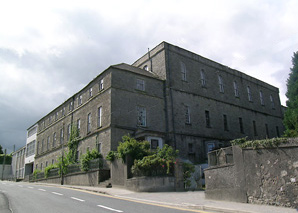 Sacred Heart Secondary School, Roscrea, Tipperary. The latest Tipperary building listed is the once Sacred Heart Secondary School, situated at Parkmore, Roscrea, Co. Tipperary, which currently sports unsightly, boarded-up windows on its road side, displaying all the future promise of total dereliction.
Originally constructed about 1865, this still solid stone, large-scale structure is one of a number of interesting buildings within a former school complex.
According to the National Inventory of Architectural Heritage same, until more recent years, once added variety of form and texture to the local street scape. Its imposing façade is further enlivened by well executed features; e.g. the stone string courses, and the fine porch with steps.
An Taisce warns that the named buildings all of national importance could be lost to future generations if action is not immediately taken, and further point out that some of the named listed structures could be restored to provide affordable housing.
“Given the critical homeless situation in the country, some of these heritage buildings could be restored to provide affordable housing for families and individuals.” An Taisce stated.
An Taisce confirm that a number of buildings on their list are in such disrepair, that they may now be dangerous or unusable.
Definition of ‘Befuddled’ – A verb meaning; unable to think clearly; stupefied; baffled; jumbled; muddled; perplexed or puzzled.
Ireland, once the home of Saints and Scholars, is truly impressive when it comes to dredging up its unsavoury past; same initially caused by insufficient funding by, firstly England and more recently, with the foundation of the State, Irish Governments, resulting in children in residential homes being severely malnourished.
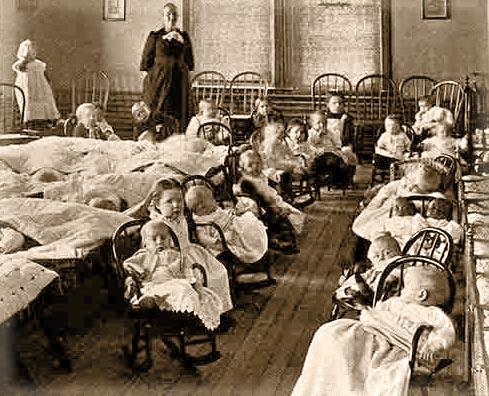 The ‘Mother & Baby Homes Commission of Investigation’ began a geophysical survey on the site of a children’s burial ground at the former Sean Ross Abbey Mother & Baby Home south of Roscrea town in Co. Tipperary this week. The ‘Mother & Baby Homes Commission of Investigation’ began a geophysical survey on the site of a children’s burial ground at the former Sean Ross Abbey Mother & Baby Home south of Roscrea town in Co. Tipperary this week.
According to the Minister for Children and Youth Affairs, Ms Katherine Zappone, this geophysical survey is expected to last for one or possibly more days. Minister Zappone also confirmed that the Cabinet has granted a further one-year extension to this investigating Commission, before it will publish its final report; latter which will now NOT be due until February 2020, five years after this Commission was first established back in February 2015.
Now, here is where residents of Ireland’s ‘green and pleasant land’ become ‘Befuddled’. Allow me to explain.
The Eighth Amendment of the Constitution Act of 1983 clearly amended the Constitution of Ireland by inserting a subsection, same recognising the equal right to life of a pregnant woman and her unborn child. Previously abortion had been subject to a criminal penalty in Ireland since 1861, and now a new Amendment would be signed into law on October 7th 1983.
Some 35 years later; on May 25th 2018 last, a referendum was passed to remove this constitutional ban on abortion, and after an unsuccessful legal challenge; same became signed into law on September 18th 2018. Today residents in this State can be severely prosecuted for animal cruelty, but no current law exists, whatsoever, with regards to the cruelty to which unborn humans in the womb can be subjected.
So, my question is this; why are we in 2019 dredging up and investigating, for over five years, 18 residential homes, to dig up bodies of deceased babies? Ireland has already agreed that abortion is to become the new contraceptive for Irish men and women, to be paid for by the Irish taxpayer, and baby’s, either dead or alive in the womb, are no longer important in a greedy, materialistic and money-oriented society. Same decree was supported by various Irish politicians, including Minister for Children and Youth Affairs, Ms Katherine Zappone.
This dawdled and to my mind, now unnecessary final report, is expected to include details of multiple lines of inquiry relating to different institutions over a period of more than three quarters of a century and will include extensive technical reports prepared in the course of geophysical survey work on the site in Tuam, Co. Galway and burial arrangements at other major institutions. Despite this requested one-year extension, the Commission is still expected to report on the key issue of burial arrangements at all major institutions, by March 15th of this year.
Over one year ago, this same Mother & Baby Homes Commission, stated it could not comprehend how residents of the Bethany Home, had been excluded from the State’s 2002 redress scheme. However, the Irish Government has stated that it could not make a decision on compensating this same, now gradually fading quantity of once Bethany residents, until the commission had delivered its final report on all 18 homes, now under the spotlight.
Bethany Home survivors, (Latter establishment a Protestant religious residential home in Dublin for women who were convicted of petty theft, prostitution, infanticide, as well as for women who were pregnant while outside the bounds of wedlock, and, of course, for those children born to these same unfortunate women). However, Bethany Home survivors understandably allege that they have / are being discriminated against on religious grounds, from the point of view of compensation already handed out to others of the Roman Catholic faith; a charge nevertheless rejected by this present Fine Gael minority government; which have not clearly and adequately explained their justification.
As our government continues to dredge up our unsavoury past, the number of homeless children currently in some parts of the country, in the past year, has more than doubled; continuing to increase with the latest homeless figures indicating some 4,000 children and more than 10,000 persons in all.
Two questions: (1) In 50 to 70 year’s time will an Irish government be reviewing and compensating the present generation of homeless children and surviving family members?
(2) When the cost of the ‘Mother & Baby Homes Commission of Investigation’ is finally totted up, how many houses for the homeless could have been built using this same spend?
A secret ‘briefing note’, now released as part of the 1988 Irish State Archive 30-year rule, (Period for which Irish confidential government documents are restricted from public viewing by taxpayers), sheds new light on the non-extradition to Britain of a Tipperary born Irish Roman Catholic priest, accused by British intelligence of being an IRA volunteer.
This refused extradition to Britain was to spark an angry stand-off between the then Irish government led by An Taoiseach Mr Charles J. (C.J.) Haughey and the British government, then led by the now Late Mrs Margaret (Maggie) Thatcher.
Fr. Patrick (Paddy) Ryan.
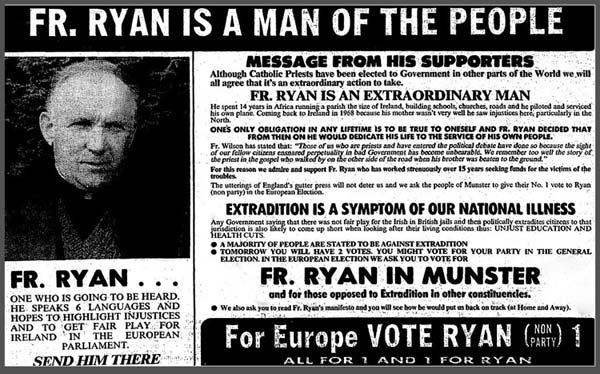 Fr. Ryan contested the European Parliamentary Elections in 1989, as a Sinn Féin supported Independent, however, he failed to be elected, but received over 30,000 votes. The priest in question was Fr. Patrick (Paddy) Ryan, born on June 26th, 1930, in Rossmore, Cashel, Co. Tipperary, and one of six children born to a rural farming family.
Paddy Ryan attended the local Christian Brothers School (CBS) here in Thurles and later the Pallottine College, Thurles, going on to train in the priesthood at St. Patrick’s College, Thurles, before being ordained on June 6th, 1954.
As a member of the Pallottine Order, he went to work on the missions in the diocese of Mbulu, one of the six districts of the Manyara Region of Tanzania and then later in America and later still in the city of London.
Fr. Ryan had shown no great interest in politics beyond a hatred for past and present British rule on the island of Ireland, however the Catholic Church and the Pallottine Order would formally suspend him from priestly duties after he refused a transfer to a parish church in England. Later during a trip to Rome in the summer of that year, he is reported to have informed Italian priests that he hoped that the IRA would bomb the centre of London.
By the Autumn of 1973, he was shuttling back and forth between Dublin and Geneva, opening bank accounts and transferring funding (over £1,000,000) reportedly granted by his newly acquired contacts within Libyan Military Intelligence in Tripoli.
Continue reading Note On Tipperary’s Fr. P. Ryan Released Under State Archive Rule
|
Support Us Help keep Thurles.info online by donating below. Thank you.
Total Donated 2026: €300.00
Thank You!
Daily Thurles Mass Livestream
|



Recent Comments