|
|
Almost twenty years ago this month; on Wednesday 15th August 1998, an act of terrorism known as the ‘Omagh Car Bombing’ took place, in Omagh town, [ Irish Óghmaighan or Ómaigh meaning “The virgin plain” ], in Co. Tyrone, Northern Ireland. The bombing was carried out by a group calling themselves the Real Irish Republican Army, (IRA), latter a Provisional IRA break away splinter group, who totally opposed the IRA’s ceasefire and the Good Friday Agreement or Belfast Agreement. Latter had been agreed on 10th April 1998, and overwhelmingly further approved in two referendums in both the North and South of Ireland, in May 1998.
The Good Friday Agreement gives prominence to the ‘principle of consent’, which affirmed the legitimacy of an aspiration to a United Ireland, while recognising a current wish for the majority of people living in Northern Ireland to remain part of the United Kingdom (UK).
The bombing, on that day, killed 29 people (including a woman pregnant with twins) and injured 220 others. This death toll was higher than any other, one, single incident of terrorism during the period that history records as ‘The Troubles’, (1968-1998).
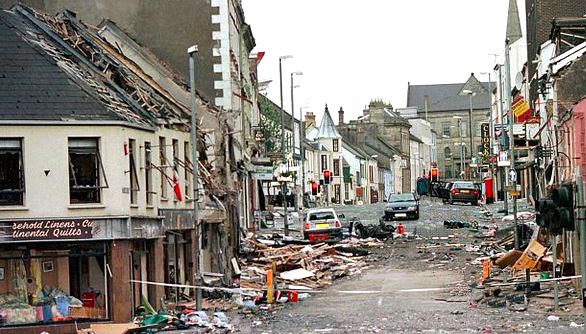
Omagh One August
By Thurles Author & Poet Tom Ryan ©
On the eve of the Sabbath in August, they crucified Jesus again,
Bombing the good and the gentle, the women, the children, the men.
Our people are weeping forever, their blood on the streets of shame,
As history and history makers mock with the old refrain.
Oh, more than our tears for the trouble, oh, more than mere words for the dead.
Oh, heaven and pity embrace us and gentleness rule us instead.
What now for the Gentle Seer? What now for life’s joyful song?
And I long, how I long for the music that is neither right nor wrong.
On the eve of the Sabbath in August, when we the people have died
Innocence bombed to oblivion on the altar of dubious pride.
On the eve of the Sabbath in August, forever in time to be,
The good, the innocent, the gentle will praise humanity.
Will triumph, as triumph they must, when sad, shameful history is done,
When hearts, now fashioned in metal, are loving in unison.
On the eve of the Sabbath in August, whoever, whatever to blame,
Oh, love now where is your grandeur? Oh, history where is your shame?
End
Tom Ryan, “Iona”, Rahealty, Thurles, Co. Tipperary.
Sunday last, July 22nd 2018 marked the 116 anniversary of the death of Archbishop Thomas William Croke (D.Div.) [28 May 1824 – 22 July 1902], the second Catholic Bishop of Auckland, New Zealand (1870–74) and later to become the Irish Archbishop of Cashel and Emly. A former patron of the Gaelic Athletic Association, with the largest GAA stadium situated in Dublin, Croke Park, named in his honour.
 Dr Thomas William Croke (D.Div.) Archbishop of Cashel and Emly – Strong Supporter Of Irish Nationalism. Archbishop Croke was born in Castlecor, Dromin in the parish of Kilbrin, Co. Cork, in 1824. His grandfather was a shopkeeper in the local square. His father, William was Land Agent/Manager for the 4,000 acres Freeman Estate, purchased from the Chinnerys in the early 18th century. (Freemans of Castle Cor, Co. Cork, their home now demolished.).
William his father married a Protestant girl, one Miss Isabella Plummer, daughter of an aristocratic family, latter descendants of the Knight of Glin, a hereditary title held by the FitzGerald families of Co. Limerick, since the early 14th century. Isabella’s parents would disown her following her Roman Catholic marriage to William in 1817.
Archbishop Croke was the third of eight children born of this couple, before his father died in 1834. William’s brother, Reverend Thomas Croke, now took it upon himself to supervise the education and upbringing of the children.
Two of Archbishop Croke’s brothers would enter the priesthood, while two sisters would enter a convent and become nuns. Archbishop Croke himself would go on to be educated in Charleville, Co. Cork and later at the Irish College in Paris and the Irish College in Rome, winning academic distinctions, including a Doctorate of Divinity, with honours.
Ordained a priest of the Cloyne diocese at the height of the ‘Great Famine’ (1845-1849) in May of 1847, he was appointed a Professor in Carlow College. Irish nationalist Member of Parliament (MP) and leader of the Young Ireland movement, William Smith O’Brien claimed that Archbishop Croke fought on the barricades in Paris during the French Revolution in 1848.
In 1858 he became the first president of St. Colman’s College, Fermoy, Co. Cork and then served as both parish priest of Doneraile and Vicar General of Cloyne diocese from 1866 to 1870. Thomas Croke attended the First Vatican Council as theologian to the Bishop of Cloyne in 1870.
In 1870 Croke was appointed Bishop of Auckland in New Zealand, arriving in Auckland on 17th December 1870 on the Steamer “City of Melbourne”. During the next three years as Bishop of Auckland; Croke devoted some of his considerable personal wealth to rebuilding diocesan finances. However, in Auckland there was then little sign of the strongly Irish nationalist line Croke would later adopt following his return here to Ireland; transferred to become a member of the Irish hierarchy as Archbishop of Cashel, (One of the four Catholic Irish archbishoprics, i.e. Cashel & Emly; Dublin; Armagh and Tuam).
Archbishop Croke (His motto – “Mergimur Nunquam”. Literal translation from Latin “We are never sunk”.), would now become a strong supporter of Irish nationalism, aligning himself with the Irish National Land League; an Irish political organisation of the late 19th century which sought to help poor tenant farmers; and with the chairman of the Irish Parliamentary Party, Charles Stewart Parnell, latter a wealthy and powerful Anglo-Irish Protestant landowner. Croke’s support of nationalism caused successive British governments and the Lord Lieutenant of Ireland’s civil service in Dublin to be deeply suspicious of his known associations. He also associated himself with the Temperance Movement of Irish Catholic priest and teetotal reformer, Father Theobald Mathew, [latter born at Thomastown, near Golden, Co. Tipperary, on October 10th, 1790], and the Gaelic League from its foundation in 1893; its aim to restore the Irish language.
Later, somewhat embarrassed by Charles Stewart Parnell’s immorality, Archbishop Croke was forced to distance himself and withdrew from active participation in nationalist politics, following the scandal that erupted over Parnell’s relationship with Mrs Katherine (Kitty) O’Shea, (particularly during the period 1886-1890), latter the separated wife of Parnell’s fellow M.P., Captain William (Willie ) O’Shea. Captain O’Shea would eventually file for divorce from his wife, citing Charles Stewart Parnell as co-respondent. A two-day trial would reveal that Mr Parnell had been the long-term lover of Mrs O’Shea and had indeed fathered three of her children. This scandal back then would force the two dominant forces of Nationalism and Catholicism to split wide apart.
Due to his support and known association with Parnell’s efforts, Archbishop Croke now found himself summoned to Rome by Pope Leo XIII and Cardinal Simeoni. Following his meeting and prior to his return to Ireland, he stayed over at the Irish College in Rome and when questioned regarding the outcome of his meeting with both men, Archbishop Croke stated that he returned to Ireland “Unchanged and unchangeable.”
Archbishop Croke died at the Archbishop’s Palace in Thurles, Co. Tipperary on 22nd July 1902, aged 78 years and he is buried in the Cathedral of the Assumption, Thurles, Co. Tipperary.
Today: From the western side and overlooking Liberty Square, in the centre of Thurles, Co. Tipperary, a very fine life sized statue of Archbishop Thomas William Croke (D.Div.) exists bearing the Irish inscription:-
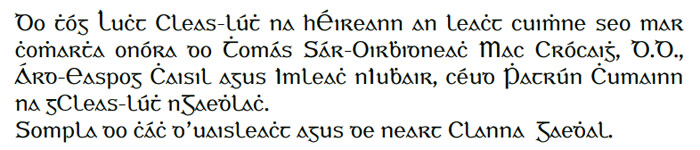
Translation: The Athletic Association of Ireland erected this commemorative plaque as a tribute of honour to the Most Reverend Thomas Croke, D.D., Archbishop of Cashel and Emly, the first Patron of the Gaelic Athletic Association.
An example to everyone of the nobility and strength of the Irish People.
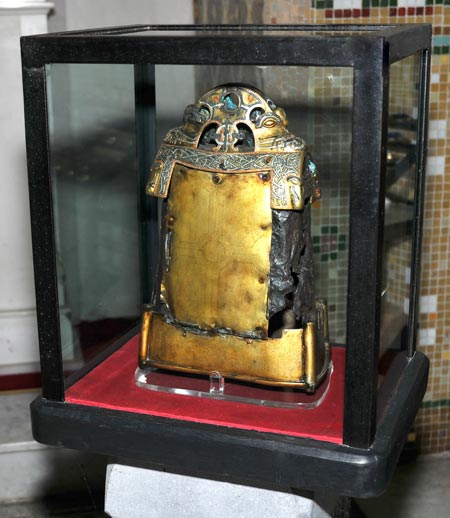 Replica of St. Cualan’s Bell, Sacred Heart Church, Borrisoleigh, Co. Tipperary. The ancient art of Handbell Ringing is largely unheard of here in Southern Ireland; first Handbells having being developed by brothers Robert and William Cor in Aldbourne, Wiltshire, England, between 1696 and 1724.
Now on Friday next two simultaneous Hand Bell Ringing Marathon Recital events will take place in the area of the village of Borrisoleigh, Thurles, Co. Tipperary on Friday next, July 27th, 2018. The bell ringing recitals will be conducted by the London-based guild of St. Cualan, under the direction of Mr Thomas Hinks.
This St. Cualan Guild take their name from the Bearnan Cualan, a 12th century Irish bell shrine, which originally belonged to the monastery of St Cualan at Glenkeen, Borrisoleigh, in Co. Tipperary.
St. Cualan’s Bell, (also known as the Glankeen Bell or An Béarnan Cuileáin) is a late 7th to early 8th century [Anno Domini], iron hand bell, latter encased in a richly ornamented early 12th century brass shrine; its height being about 30 centimetres, inclusive.
It had been located hidden in a tree trunk in the townsland of Kilcuilawn, Borrisoleigh, Co. Tipperary, in the late 18th century and the original now resides in the British Museum in London, (Reference Record No. 1854,0714.6.B.)
The bell shrine is decorated in what is possibly an Irish version of the Viking Ringerike style, (Ringerike style receives its name from the Ringerike district north of Oslo, in Norway who produced similar designs), with an inlaid Silver and Niello strip, (latter manufactured by fusing together copper, silver and lead before mixing the molten alloy with sulfur).
The work is similar to that found on the Clonmacnoise Crozier and the Lough Derg Sword and indeed it is quite likely that all three pieces may have originated from the same metal workshop. It is also possible that all three pieces were made either for use at or in commemoration of the Synod of Ráith Bressail, which met near Borrisoleigh in the year 1111. Latter was the most important of all the synods associated with the twelfth-century Church Reform movement in Ireland, organising for the first time an administrative structure and a territory based system of dioceses under the control of individual bishops.
Interesting: For many years St. Cualan’s Bell was used to detect false oaths; liars swearing by St. Cualan’s Bell, risked having their ‘heads reversed’. [Perhaps same should be moved for regular use in Dáil Éireann. No on second thoughts Dublin has already stolen, Viking style, most of Tipperary’s heritage and tourist attractions.]
The original bell is partially incomplete, missing its internal ‘clapper’ and a handle; however, an accurate replica of the shrine is kept on open display in the Roman Catholic parish Church of The Sacred Heart in the picturesque village of Borrisoleigh, just 14km or 16 mins drive from Thurles, Co. Tipperary, via route R498.
The bell somehow came into the possession of Birr attorney and historian Thomas Lawlor Cooke from Borrisoleigh, Co. Tipperary, who wrote important histories on the town of Birr and district [`Picture of Parsonstown’ (1826)]. Cooke went on to sell the bell shrine, along with other artefacts, to the British Museum, where it has remained as part of religious displays ever since.
When this visiting guild of bell ringers were first formed, they were not fully aware of the ancient story behind the famous Bearnan Cualan and its association with Borrisoleigh village.
Now, at about 1.00pm on Friday next, July 27th the welcome Bearnan Cualan Chapter will divide into two groups. One half will remain in the Church of The Sacred Heart, Borrisoleigh; while the other half will attend near the ivy-covered medieval ruins of Glenkeen church, before both commence a three hour long ‘Marathon Peal’.
Needless to say, everyone is invited to make an appearance to either or both venues and to remain for whatever length of time they can spare.
Over the past number of weeks a building on the south side of Liberty Square, last known as Griffin’s News-agency and previously, during the 1920’s, Hickey’s pub, has now been demolished to make way for a new car-park entrance, in an effort to make Thurles town centre more pedestrianised.
The now demolished building did have some small, yet not insignificant history attached, which can be found when reading a statement from the Bureau of Military History, 1913-21 (Document No. W.S. 1454, File No. S.790), by witness James Leahy, Commandant, No. 2 (Mid) Tipperary Brigade, latter born in 1896 in the townsland of Tubberadora, Boherlahan, Cashel, Co. Tipperary.
James Leahy Writes: [Signed 3rd July 1956]
“I returned to business in Thurles early in 1917, and then went to work for Michael (‘Mixey’) O’Connell, as he was popularly called. O’Connell was a prominent Sinn Feiner and Irish Volunteer and his house in later days became the headquarters of the Mid-Tipperary Brigade.
Five masked and armed policemen raided the house of Larry Hickey, publican, Main St., Thurles, when they found the owner in bed. Re was ordered out in his night attire and when he reached the head of the stairs, he was tripped and thrown downstairs by an R.I.C. man named Jackson.
In the fall, Hickey’s neck was broken and he was in great pain at the foot of the stairs, when Sergeant Enright, who was in charge of the raiders, shot him dead, to put an end to his agony. Hickey was a well known republican in Thurles, and a detailed account of his shooting was given to me during the truce period, by Sergeant Enright himself.
While the raid in Hickey’s was in progress, (Night of March 9th 1921) another party of masked policemen visited the home of the Loughnane family in Mitchell St., Thurles, and shot dead in bed William Loughnane. This man along with his father and three brothers were active members of the local I.R.A. company.
On the same night, the Barry homestead in Turtulla (Today Thurles Golf Club), a short distance from Thurles, was entered by R.I.C. men in disguise. They were looking for Denis Regan, a workman and a prominent I.R.A. man. He had hidden in a ‘couchette’ (Latter a box type bed usually found in a house close to an open fireplace, with a lid which closed during the day to become a useful bench or large seat), in the house and when the police could not find him, they ordered Michael Barry to come with them, as they were going to shoot him, instead of Regan.
Barry had no connection with the republican movement and Regan overheard remarks made by the raiders. Rather than see his employer suffer on his account, Regan left his hiding place and gave himself up. Barry was then released while Regan was led into the yard, where the police fired six or eight shots at him. Though very seriously wounded, he survived and is still hale and hearty. (In later years Denis Regan became the hearse driver for the undertaking firm of W. H. Ryan). He (Regan) was treated by his employer’s brother, Dr. Barry, who was then in practice in Thurles and was always ready to answer a call when needed by the I.R.A.
I got a dispatch from the brigade adjutant (1921) requesting me to meet him that night at Larry Hickey’s (Latter later to become Griffin’s Newsagents), in Thurles, as he had some urgent communications to send to G.H.Q. which he wished me to see and sign.
I went on to Thurles, armed with a revolver. My going off to meet the brigade adjutant very nearly led to my capture and death. I made my way into Larry Hickey’s as arranged and was waiting upstairs for my colleague to put in an appearance, when a scout, who was posted to watch out for enemy raiders, shouted through the letter box of the door that a force of R.I.C. were searching “Mixey” O’Connell’s house next door. I waited for a while, thinking that if they found nobody in O’Connell’s, the police might move off.
Word came after awhile that they had gone. Concluding that O’Connell’s place (next door) might now be safer than Hickey’s, I went out by the back door to get into O’Connell’s back yard. The wall separating the two yards was about 8-feet high and I had my breast just on the top of it when I heard the order “Hands up”. In the light which was shining on me I could see a figure sitting on top of the wall a few yards away from me. He was a guard whom they had left on the place. As I was leaving Hickey’s the scout, again reporting through the letter box, shouted that the main raiding party was returning. Apparently the man by whom I was now confronted was left to keep an eye on developments at the back. On being challenged I dropped back into Hickey’s and crouching as low as I could, I ran down under the shelter of the wall to the lower end of the yard.
The guard was firing after me. From the corner into which I had crouched I had a clear view of my opponent. I drew my revolver and fired four shots at him. He quickly disappeared from view. Without delaying, I seized my chance and from the yard, ran down the garden (Latter soon to become part of the new car park) and out into the Mall. I went on to Barry’s in Turtulla, where I stayed for the night.
On examining my overcoat, I found that it had been penetrated by shots several times during the brief encounter. Next day, I heard that the policeman involved was wounded by my return fire.”
Folks, do remember the prophesy in the lines from Eric Bogle’s song, “The Band Played Waltzing Matilda” :-
“I see the old men all tired, stiff and sore
Those forgotten heroes from a forgotten war
And the young people ask “What are they marching for?”
And I ask myself the same question.
But the band plays Waltzing Matilda,
And the old men still answer the call,
But year after year, the numbers get fewer
Someday, no one will march there at all. “
So perhaps, while this information is now fresh in our memories, our masters from the Templemore / Thurles Municipal District Council might now unveil a small plaque or stone tablet, to commemorate this piece of Thurles History.
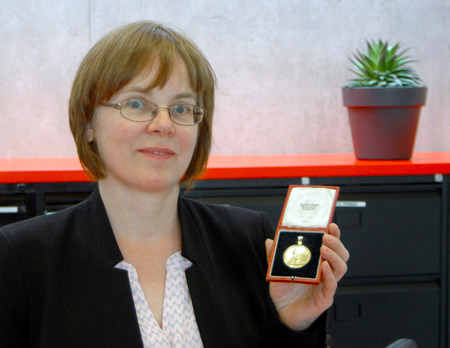 Miss Jane Bulfin, (Research Librarian with the Tipperary Studies Section of Thurles Library), pictured here with the Dermot F. Gleeson gold medal. A gold medal for ‘Oratory’, awarded in 1917-1918, by the Incorporated Law Society of Ireland to historian, author and Co. Clare District Justice for some 20 years, Mr Dermot F. Gleeson, has now been returned on long term loan to his beloved county of Tipperary.
Born in 1896 in Nenagh, Co. Tipperary into the family of Michael Gleeson, Mr Dermot F. Gleeson was a pioneer of Tipperary local history. His publications include “The Last Lords of Ormond” (1938) and “A History of the Diocese of Killaloe” (1962).
Mr Gleeson also contributed dozens of articles to learned journals and indeed the popular press, discussing a wide variety of aspects relating to local history. He was also a hard-working District Justice and was the youngest of a batch of twenty-seven District Justices to be appointed to the new Irish Free State of 1922. Mr Gleeson, would sufferer a heart attack and pass away, while attending a recreated Medieval Banquet as a guest in Bunratty Castle, on September 23rd, 1962, aged 66 years. (R.I.P.)
The one hundred-year-old unique gold medal now takes pride of place in the Tipperary Studies section of Thurles County Library, this week at The Source, Cathedral Street, Thurles, and can be viewed during their normal hours of opening.
This unique piece of Tipperary history was kindly presented to the Tipperary County Council Library Service on long-term loan by Mr Donough Gleeson, latter son of Mr Dermot F. Gleeson. The Gleeson family recently travelled here to Thurles from their home in England, to make the presentation, happy in the knowledge that this Gold Medal, has been returned to Mr Gleeson’s native homeland on this, the centenary of his first receiving this prestigious award.
The Tipperary Studies section of Thurles Library is also the home to many of Mr Dermot F. Gleeson literary and historic publications.
|
Support Us Help keep Thurles.info online by donating below. Thank you.
Total Donated 2026: €300.00
Thank You!
Daily Thurles Mass Livestream
|



Recent Comments