“Let the passer-by inscribe my epitaph upon this stone, ‘FANATIC’, what then? It shall only be a memento that one, in a foreign land, lived and pitied Ireland and did what she could to seek out its condition.”
Introducing Mrs AsenathHatch-Nicholson.
Mrs Asenath[pronounced A-se-nath]Hatch-Nicholson walked through Thurles, Co. Tipperary and indeed the greater Irish countryside, between the years 1844 and 1848, singing hymns, reading the Bible; while distributing Bibles and religious printed tracts, to the few who could read.
She was 52 years old, at the time of her arrival in Ireland, before commencing to walk the highways and byways of nearly every county in Ireland.
She took to the Irish roads wearing Indian rubber boots; a polka coat; underneath which she carried two filled bags of Bibles; same attached to her waist by a stout cord. The Bibles had been supplied by the Hibernian Bible Society, (founded in Dublin, Ireland in 1806; their aim to encourage a wider circulation of the Bible in Ireland). `
She is also recorded as wearing a large bonnet; a black bearskin muff; silver rimmed spectacles and carried an umbrella. A number of doctors had generously offered to remove a large wart from her face, of which she recorded, with some indignation, that same was possibly the reason that people were inclined to stare at her.
The poet W.B. Yeats would later refer to her, stating, “one of its missionaries who travelled Ireland has written her life, has described meeting in peasant cottages where everybody engaged in religious discussion, has said that she was everywhere opposed and slandered by the powerful and wealthy, because she was on the side of the poor”.
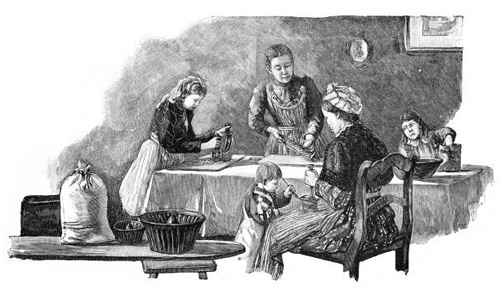
Asenath Hatch Nicholson (1792 – 1855). Above drawing attributed to Anna Maria Howitt.
In a rare book, [edited with an introduction by Alfred Tresidder Sheppard, (London 1871-1947)], entitled “The Bible in Ireland”(Ireland’s welcome to the stranger or excursions through Ireland in 1844 and 1845 for the purpose of personally investigating the conditions of the poor), written by Asenath Nicholson; we learn of her visit to Thurles, Co. Tipperary and other nearby villages, including Gortnahoe, Urlingford and Holycross.
Born the daughter of Michael and Martha Hatch in Chelsea, latter a village in the White River Valley of eastern Vermont, New England, United States; Asenath Hatch(February 24th, 1792 – May 15, 1855), grew up to became a teacher, a reforming journalist, a social observer and philanthropist, and a committed practising vegan.
Regarding the latter, her family had become interested in a diet recommended by Rev. Sylvester Graham, latter an American Presbyterian Minister and a dietary reformer, known for his emphasis on vegetarianism. At the age of 39, Asenath married her husband Norman Nicholson (Merchant c.1790–1841); latter a widower (c.1790–1841), with three children, in 1831, before moving with him, to live in New York. In the 1840s she ran boarding houses at No.118 Williams Street, New York and at No. 21 Beekman Street, Saratoga Springs, New York and at Wall Street, which offered a strict vegetarian menu and she would go on to publish what is regarded as the first Sylvester Graham Recipes, entitled “NATURE’S OWN BOOK: VEGETABLE DIET. FACTS AND EXPERIMENTS OF MANY YEARS PRACTISE.“
Asenath Nicholson’s diet advocated that; “good bread, pure water, ripe fruit and vegetables are my meat and drink exclusively.” Her published book did use some recipes containing dairy products, but for the most part advocated against their use.
Her family belonged to the Protestant Congregational Church (Protestant churches in the Calvinist tradition), where she was Christened with the name ‘Asenath‘, latter the biblical name of an Egyptian , [daughter of Poti-pherah, priest of the ancient Egyptian Town of On], whom the Pharaoh gave to Joseph son of Jacob, to be his wife; as a gift for his interpreting of the Pharaoh’s dream, [ See Genesis 41:45, 50 and Genesis 46:20. ], and after naming him ‘Zaphenath-Paneah’ possibly Egyptian meaning, “the revealer of secrets”.
Asenath’s Arrival In Ireland
It was in the cold attics and underground cellars, portrayed in the 2002 American epic historical drama film, “Gangs of New York“, (Five Points, area of Manhattan), that Asenath Nicholson first became acquainted with the extreme poverty of the Irish peasantry, and it was there that she identified that they were indeed a suffering people.
Following her husband’s possible separation and eventual death; in May 1844, Asenath left New York for Ireland, aboard the passenger packet vessel ‘Brooklyn‘ to begin for the next 15 months, her journey around the country, visiting almost every county. During her travels she rebuked people regarding their hygiene habits and their use and abuse of alcohol, tobacco, tea and coffee, which she argued was capable of giving its users “delirium tremens“, latter a severe mental or nervous system change.
Her parents in America had instilled in Asenath, from an early age, that idleness was both a sin and disgraceful. As she travelled, she noted that many people lacked employment, and relied almost entirely on their crop of ‘Lumper’ variety potatoes, to avoid starvation. In relation to employment Asenath Nicholson saw employment conditions in Ireland different to the then insensitive Sir Charles Edward Trevelyan*, (latter head of the British civil service), who regarded the Irish people as being lazy.
* In a letter to an Irish peer, the same Sir Charles Trevelyan wrote; “the judgement of God sent the calamity (i.e. the Great Famine), to teach the Irish a lesson”.
Asenath Nicholson identified and denounced many of the existing Protestant Irish landlords, for failing to grant employment to their tenants; then necessary in an effort to stave off hunger and extreme poverty being experienced by the latter. She declared that her own did not have a place for her and were it only that the Catholics took her in, she would have been without shelter. As a teacher, she visited Protestanted schools to learn that they are not being thought to read maps, since the children are conceived as being from the “lower orders”. Asking the same question, when visiting a Presentation Sisters Roman Catholic school, she learned that, though they are children of the poor, they are taught everything, as the nuns “do not know what God will expect of their assembled pupils”.
Regarding the Potato; she noted that on visiting the village of Roundstone in Co. Galway, a man described the potatoes to her as being; “The greatest curse that ever was sent on Ireland; and I never sit down, see, use, or eat one, but I wish every divil of ’em was out of the island.The blackguard of a Raleigh, (Refers to Sir Walter Raleigh 1552 – 1618), who brought ’em here, entailed a curse upon the labourer that has broke his heart. Because the landholder sees we can live and work hard on ’em, he grinds us down in our wages, and then despises us because we are ignorant and ragged.” Asenath would record, “This is a pithy truth, one which I had never seen in so vivid a light as now”.
Asenath noted seeing a woman with her daughters carding and knitting, which gave rise to her following comment; “This was an unusual sight for seldom had I seen, in Ireland, a whole family employed among the peasantry. Ages of poverty have taken everything out of their hands, but preparing and eating the potato, and then sit listlessly on a stool, to lie in their straw or saunter upon the street, because no one hires them”. She became loud in praise of the few resident landlords, who provided employment for their tenants and derided those who had abandoned the poverty stricken.
With her strong interest in the need for employment, there is little doubt that Asenath Hatch Nicholson would have left the Thurles area, before first visiting the work sites established by the Thurles/Rahealty Famine food committee, including the Great Famine Double Ditch; same sadly, recently, deliberately and knowingly, destroyed by Tipperary County Council, aided and abetted by self-serving local councillors, Thurles Municipal District officials and the town’s two resident politicians, namely J. Cahill & M. Lowry.
Asenath became enraged that grain was being diverted from food into alcohol. She was furious that grain was being used for distilling, which could feed the Irish pauper. It has often been charged that the government had allowed food to be exported while the inhabitants, remaining in Ireland, were left to starve. Nicholson looked at this issue of diverted food sources from another angle; charging that grain used for distilling alcohol could have fed the Irish poor. In 1847, with grain prices high, the consumption of legal spirits fell only about 25%, from approximately 8,000,000 gallons to about 6,000,000 gallons, and it took 30,000 tons of grain to distil 6,000,000 gallons of eighty proof spirits, which could have provided more than 300,000,000 servings of grain-based cereal. Irish Catholic priest and teetotalist reformer, Rev. Fr. Theobald Mathew, latter born in Thomastown, near Golden, County Tipperary, had earlier complained to the aforenamed Sir Charles Trevelyan, and also to judges in Thurles District Court, latter whom issued liquor licences, that “Pestiferous Erections”(make-shift public houses) were being erected at some relief work sites, including in the area of Upperchurch, Thurles, Co. Tipperary. [Same would account for the large number of pubs that once existed between Thurles and Kilcommon, Co. Tipperary]. In at least one case, a publican who was a member of a local relief committee, had recommended men get work, only on condition that they spent part of their wages on alcohol.
As soon as Asenath Nicholson arrived in Dublin on 7th December 1846, she wrote to the readers of the New York Tribune, [founded and published by Horace Greeley (1811-1872)] and another American Congregationalist minister; abolitionist, emancipator and former lawyer, Rev. Joshua Leavitt (1794-1873), in which she described conditions in Dublin city, and asking for assistance for the Irish poor. Asenath did not have the means to finance relief efforts herself and despaired that she had to witness a famine, without the necessary means to relieve the hungry. A letter duly arrived from Horace Greeley with money from his newspaper’s readers, which she regarded as something of a sign indicating divine intervention. Other friends also sent food, clothing and money to be distributed by her or to be sent by her to other trusted friends for similar distribution.
During July 1847 New Yorkers sent Asenath Nicholson five barrels of Indian corn aboard the United States frigate “Macedonia”. Using the funding she had acquired, she walked through areas of Dublin each morning, often distributing slices of bread from a large basket. She went on to open her own soup kitchen in The Liberties, in Dublin; an area she had selected because of its recognised extreme poverty.
Note: As early as 1789, the Republic of Vermont, the town where Asenath was born, had forbade the sale of slaves. Not herself being of the Quaker faith; it was not surprising that she befriended Quakers, who opposed slavery. In the autumn of 1848, like so many others, believing the Great Famine was over, Asenath Nicholson left Dublin for London. She was seen off to the boat, probably by her great friend the abolitionist Quaker and printer Richard Davis Webb one of the founder members of the Hibernian Antislavery Association. Webb, a friend of the Young Irelander member Thomas Davis and sympathetic to Irish nationalism; was one of the few Irish delegates who attended at the 1840 Anti-Slavery Convention in London, which also included Daniel O’Connell, (The Liberator).
Following the killing of the Cork born Irish revolutionary, Michael Collins in an ambush at an isolated area known as Béal na Bláth, on August 22nd 1922, the Free State provisional government, under the new leadership of MrW. T. Cosgrave, MrRichard Mulcahy and MrKevin O’Higgins, took the stance that the Anti-Treaty IRA were conducting an unlawful rebellion against a legitimate Irish government.
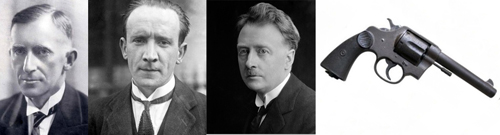
Left-right: Richard Mulcahy, MrKevin O’Higgins, W. T. Cosgrave& a hand gun used during Tipperary civil war period.
Mr Kevin O’Higgins had voiced the opinion that the use of martial law was the only way to bring this civil war to an end. So by imposing capital punishment for anyone found in possession of either firearms or ammunition; without a lawful reason, Republican fighters would now be treated as criminals rather than as army combatants, thus introducing martial law for the duration of the then conflict.
To this end, on September 27th 1922, the Irish Free State’s Provisional Government put before the Dáil the Army Emergency Powers Resolution, proposing legislation to try suspects by military court martial.
It should be noted that on October 3rd, 1922 the legitimate Free State government offered an amnesty to any Anti-Treaty fighter who surrendered their arms and recognised the government. This amnesty offered, sadly saw little response.
A final version, of the motion, first put to the Dáil, by then Minister for Defence, Mr Richard Mulcahy, on September 26th, was passed on October 18th 1922, which stated: “The breach of any general order or regulation made by the Army Council and the infliction by such Military Courts or Committees of the punishment of death or of penal servitude for any period or of imprisonment for any period or of a fine of any amount either with or without imprisonment on any person found guilty by such Court or Committee of any of the offences aforesaid. Provided that no such sentence of death be executed except under the countersignature of two members of the Army Council”.
This new legislation, referred to as the “Public Safety Bill”, which empowered military tribunals with the ability to impose penal servitude of any duration, or the death penalty, for a variety of offences including; aiding/abetting attacks on state forces; persons found in possession of arms, ammunition or explosives, without the proper authority; looting; the destruction of public or private property, and arson.
Excommunication A supportive Catholic Hierarchy issued a pastoral letter condemning Anti-Treaty fighters (known as ‘Irregulars’). The letter stated that: “All who are in contravention of this teaching, and participate in such crimes are guilty of grievous sins and may not be absolved in Confession nor admitted to the Holy Communion if they persist in such evil courses”. Devout Roman Catholics saw this pastoral letter as a powerful social pressure being applied and at an opportune time for the then Provisional Government. Same pastoral letter would serve to understand and indeed excuse the close connection developed in later decades between Church and State.
This Order was later strengthened in the following month of January, 1923, allowing execution for several other categories of offences not previously clearly identified. These included non-combatant Republican supporters carrying messages; assisting in escapes; using army or police uniforms; together with desertion from the existing National Army. It further stipulated that all sentences passed on military prisoners, taken by Provisional Government forces before the passing of the Act, were retrospectively remain valid. January 1923 also saw this policy of executions being further extended throughout 10 Irish counties, namely; Tipperary, Dublin, Louth, Carlow, Kerry, Limerick, Westmeath, Waterford, Offaly and Laois, each county serving as the location for such executions. Kevin O’Higgins had got it right; soon afterwards the anti-Treaty IRA recognised that prolonging their campaign would only further inevitably result in further executions of their imprisoned fighters.
Executions during the Irish Civil War took place during the guerrilla phase of the Irish Civil War (June 1922 – May 1923). By the first two months of the Civil War (July–August 1922), Free State forces had successfully taken all the territory held by Republicans and the war seemed all but over. However, the loosing Anti-Treaty side moved to using guerrilla tactics in August–September, and National Army casualties began to mount.
Many people today, appear to forget that during this phase of the war both sides; the Government forces of the Irish Free State and the Anti-Treaty Irish Republican Army (IRA) insurgents, both used executions and terror in what developed into a cycle of atrocities.
From November 1922, the Free State Government justified embarking on a policy of executing Republican prisoners in order to bring the war to a successful end.
Tipperary Executions
On January 15th 1923 four men were executed by firing squad for the illegal possession of arms and ammunition, at Ross Cottage, Borrisoleigh, Co. Tipperary, on December 23rd 1923. The four men; Mr Frederick Burke, Curnaboola, Ileigh, Borrisoleigh, Co. Tipperary, aged 28; MrPatrick Russell, Summerhill, Borrisoleigh, Co. Tipperary, aged 26; Mr Martin O’Shea, Garrangrena, Borrisoleigh, Co. Tipperary, aged 22, and MrPatrick McNamara, Killarey, Ballina, Killaloe, County Clare, aged 22, were all executed in Roscrea Castle Barracks, Roscrea, Co. Tipperary.
MrFrederick Bourke, a farm labourer had served with the IRA from 1919 onwards. MrMartin O’Shea, who helped out on his family’s small farm and worked as a casual labourer for the local Council, had served with the Irish Volunteers and IRA from 1917 onwards. MrPatrick Russell, was a farmer’s son had also served with the Irish Volunteers and IRA from 1917 onwards.
According to the official report issued after their execution, Frederick Bourke, Martin O’Shea and Patrick Russell were tried and convicted, on January 2nd 1923, for being in possession of arms and ammunition and for the armed hold up of a Mail Car at Ross Cottage, Borrisoleigh, Co. Tipperary.
The bodies of the executed were not handed back to family members until the middle of 1924. Ugly scenes would accompany the handover of the bodily remains of those executed in some areas, as military displays and the discharging of weapons at re-interments were totally banned.
The pro-Treaty government remained unapologetic about their execution policy during the Civil War; as did the Anti-Treaty Irish Republican Army (IRA) insurgents; the former maintaining that they had simply done what was necessary in order to save the new Irish state. Anti-Treaty Irish Republican Army (IRA) insurgents refused to support some of its members, latter who had been executed for basic armed robbery crime, while endorsing as martyrs others that were executed.
In typed and handwritten communications sent to Fianna Fail TD Mr Andrew Fogarty (April 1879 – April 1953) on some 10 years later on November 11th 1933 to his home in Cashel; [latter a farmer, first elected on the 15th count to the 5th Dáil, as a Fianna Fáil Teachta Dála (TD) in 1927], we learn the strong feelings with regards to failure to get compensation for the living, destitute family members of those executed. One such communication came from within the local Borrisoleigh, Fianna Fáil Club.
To Andy Fogarty, (TD) Cashel. Co. Tipperary.
Borrisoleigh Fianna Fáil Club Castlequarter, Borrisoleigh, Thurles November 11th 1933
A Chara, Just a few lines in connection with the claims of the mothers of Russell, Bourke and O’shea, who were executed by the Cosgrave Government on January 15th 1923 at Roscrea Military Barracks. We are sure there’s no need for us to put before you the necessity of having the claims of these three poor women attended to immediately. Perhaps it would be well to give you an outline of the happenings that led up to the execution of those young men. They were under orders from their Commanding Officer to hold up the Mail Car at least twice per week & it was during the progress of one of these searches at a place called Ross Cottage, Borrisoleigh, that they were surrounded by ‘Crown Forces‘. They put up a most desperate fight for about three hours, and it was only when their supply of ammunition became exhausted that they were reluctantly compelled to surrender. Then after a time in prison the government decided to put them against the wall and there and then ended the lives of three gallant young men. In conclusion we would ask you to make a strong appeal to the government on behalf of these three old widowed mothers and to see that they get a reasonable amount of Compensation. We do not propose to suggest to the government the amount they should pay. but we do suggest that they should consider every aspect of their claims. They should consider very carefully the loss of these fine young fellows to their poor widowed mothers and above all they should consider the large pensions they are paying to some of the men that were responsible for their executions, We would ask you to see that those claims are attended to immediately, as the poor old women are very old and feeble.
Thanking you in anticipation. Yours Faithfully, Borrisoleigh Fianna Fáil Club. (Timothy Shanahan. Sec.)
The recipient of the above communication, Tipperary TD Mr Andrew (Andy) Fogarty*, forwarded the letter, shown above, to the Department of Defence, together with his own representations, clearly indicating the strength of local feeling within the Borrisoleigh area, since the three executed men were under orders at the time of their capture. The reference ‘captured by Crown Forces’ in the letter, above, is possibly a deliberate insult aimed at the then operating Pro-Treaty forces.
* In the 1948 General Election, the same long serving Fianna Fail TD for Tipperary, Mr Andrew Fogarty lost his seat. In other correspondence we learn that a presentation was organised and subscriptions collected amounting to donations of £542-4s-0.
The names on the list of contributors includes Sean Lemass (£25); Dan Breen, (Tipperary £10); WJ Magner (£10); together with many more TDs and Senators including a number of clergies. Many of the subscribers included were from Thurles, Co. Tipperary. Amongst them were Mr Bill Dwan, Holycross, Thurles (£10); Mr J, Hogan, Liberty Square, Thurles, (£10); Mr James Maher, Parnell Street, Thurles, (£5-5s-00p); Mr Dan Brady, Archerstown Mills, (£5); Mr J. Hanafin, Corner House, Parnell Street, Thurles (£5); Mr J.P Carrigan, Solicitor, Thurles, (£5); Mr Pierce Moloney, Racecourse, Thurles, (£2-2s-00p); and Mr P.J. OMeara, Solicitor Thurles, (£2-2s-00p).
In respect of the 3 executed Borrisoleigh natives; claims made by their mothers seeking compensation, received a partial dependents’ gratuity of £112.10.00 (one hundred and twelve pounds and ten shillings sterling) in 1934, under the Army Pensions Acts in respect of their sons, possibly helped by a serious threat by the Borrisoleigh, Fianna Fáil Club to resign and distance themselves from the Fianna Fáil political party.
[In the case of the fourth executed man, namely Mr Patrick McNamara; a file relating to a request by a John McNamara, with an address at Killarey, Ballina, Killaloe, County Clare, for an application form to make a claim in respect of his unnamed brother, executed on January 1923, most likely relates to the Patrick McNamara executed in Roscrea Castle Barracks; however, the individual allegedly executed is not named in the documentation]
Anne Feeney (July 1951 – February 2021) was an American folk musician, singer-songwriter, political activist and an attorney. [Her grandfather was William Patrick Feeney of Irish parents that arrived to the United States at the age of fourteen, during the last quarter of the 19th century, and later became State Representative in the Pennsylvania General Assembly, between the years 1910 -1912.]
Granddaughter Anne enrolled in college at the University of Pittsburgh and joined “Thinking Students for Peace”, latter a group that protested the Vietnam War and apartheid in South Africa. In 1972 Anne attended the annual Conference on “Women and the Law” and inspired by the group that founded “Women Organized Against Rape” in Philadelphia, she began a campaign for a rape crisis centre in Pittsburgh and successfully co-founded Pittsburgh’s first rape crisis centre.
It was in that same year, while an undergraduate, she was arrested in Miami at the Republican National Convention, where she was protesting Richard Nixon’s re-nomination for President of the United States. Anne graduated from the University of Pittsburgh in 1974 with a Bachelor of Arts degree, going on to earn a Juris Doctor (JD) degree in 1978, seeking to effect social change through the legal system. She worked as a lawyer for 12 years but ultimately decided to engage her pursuance of activism, through her music, blending Irish music with American folk and bluegrass, as well as her political message, through her regular attendance at protest rallies.
Carrying a business card that read “Performer, Producer, Hellraiser”, regrettably Anne passed away at a hospital in Pittsburgh, on February 3rd 2021, at the age of 69; a victim of Covid-19.
The song hereunder evokes history and celebrates events people can be proud of in the context of the elimination of child labour, slavery and the extending of the vote to women, noting that these changes could not have occurred without changes within the law and the acts of people who were willing to take a stand that involved going to jail for their ideals of natural justice.
Have You Been to Jail for Justice?
Lyrics: Anne Feeney Vocals: Peter, Paul & Mary.
Was it Cesar Chavez? or Rosa Parks that day. Some say Dr King or Gandhi that set them on their way. No matter who your mentors are it’s been plain to see, That, if you’ve been to jail for justice, you’re in good company.
Have you been to jail for justice? I want to shake your hand, Cause sitting in and lyin’ down are ways to take a stand. Have you sung a song for freedom? or marched that picket line? Have you been to jail for justice? Then you’re a friend of mine.
Hey, you law abiding citizens, come listen to this song. Laws were made by people, and people can be wrong, Once unions were against the law, but slavery was fine. Women were denied the vote, while children worked the mine. Yea, the more you study history the less you can deny it, A rotten law stays on the books til folks like us defy it.
Have you been to jail for justice? I want to shake your hand, Cause sitting in and lyin’ down are ways to take a stand. Have you sung a song for freedom? or marched that picket line? Have you been to jail for justice? Then you’re a friend of mine.
Well the law’s supposed to serve us, and so are the police, But when the system fails us, it’s up to us to speak our piece. We must be ever vigilance, for justice to prevail, So get courage from your convictions, let them haul you off to jail!
Have you been to jail for justice? I want to shake your hand, Cause sitting in and lyin’ down are ways to take a stand. Have you sung a song for freedom? or marched that picket line? Have you been to jail for justice? Then you’re a friend of mine.
Have you been to jail for justice? Have you been to jail for justice? Have you been to jail for justice? Then you’re a friend of mine.
Funeral procession of Garda John Morley and Garda Henry Byrne, Knock, Co. Mayo, 1980. Garda Byrne and Garda Morley were the fifth and sixth Gardaí officers to die in the Troubles, and the 21st and 22nd Gardaí to die violently since the foundation of the state in 1922.
The death occurred, on Saturday 31st December 2022, of Mr Peter Pringle, Casla, Connemara, Co. Galway, and formerly of Killybegs, Co. Donegal, and Banba Terrace, Kickham Street, Thurles, Co. Tipperary.
Pre-deceased by his daughter Lulu and his sister Pauline; Mr Pringle passed away peacefully, aged 84, at his place of residence in Co. Galway.
While a resident here in Thurles in the late 1960s, Mr Pringle was one of the organisers of the then well attended “Peoples Debating Society”, whose Public Relations Officer, back then, was Thurles Author & Poet, Mr Tom Ryan “Iona”, Rahealty, Thurles, Co. Tipperary.
Mr Pringle would later be wrongfully convicted of murdering two Gardaí (Garda John Morley and Garda Henry Byrne), in a Roscommon bank raid in Ballaghaderreen in the 1980s. He had served almost 15 years in prison before being released in 1995; following his conviction, later deemed unsafe and unsatisfactory.
It was on July 7th 1980, that three armed and masked men had raided the Bank of Ireland in Ballaghaderreen, Co. Roscommon; holding staff and customers at gunpoint, before leaving with some IR£35,000 in cash.
Unarmed Gardaí had arrived on the scene, but were unable to stop the armed robbers from escaping in a blue Ford Cortina car. However, the perpetrators of the bank raid were intercepted by a Garda patrol car containing four Gardaí, summoned from Castlerea Garda station. The occupants of the Garda car included Detective Garda John Morley, who was armed with an Uzi submachine gun. Both cars collided at Shannon’s Cross, Aghaderry, Loughglinn, Co. Roscommon. One of the raiders jumped out of the blue Ford Cortina and sprayed the patrol car with bullets, killing the aforementioned Garda Henry Byrne. Another man also left the Ford Cortina and ran away, while his two accomplices, both wearing balaclavas, ran in the opposite direction. There was an exchange of shots in which Garda Morley wounded one of the robbers, but he himself was, sadly, fatally wounded. Two men were later apprehended, while a third man Mr Peter Pringle was arrested in the city of Galway, almost two weeks later. The two other Gardaí, namely Sergeant Mick O’Malley and Garda Derek O’Kelly both survived the shootout.
Mr Pringle was sentenced to death for both murders, alongside two others, named as Mr Colm O’Shea and Mr Pat McCann. The three robbery suspects were identified as being associated with the Irish National Liberation Army, (Irish: Arm Saoirse Náisiúnta na hÉireann) [INLA], same an Irish republican socialist paramilitary group formed on December 10th 1974. However, Mr Pringle, Mr O’Shea, and Mr McCann each had their sentences commuted to penal servitude of 40 years, by the then Irish President Mr Patrick Hillery, back in 1981. Mr O’Shea and Mr McCann would later serve 33 years behind bars, before being released from jail 10 years ago, in 2013. Mr Pringle, on the other hand, (whose son Thomas is an Independent Donegal TD), spent 14 years and 10 months in prison, before the Court of Criminal Appeal found his conviction to be unsafe and unsatisfactory.
In 2012, Mr Pringle married Ms Sunny Jacobs, latter named who was similarly placed on death row in Florida in 1976, also for the murder of two police officers. Ms Jacobs served 17 years before she was exoneration. It was following her release, that Ms Jacobs had travelled to Ireland to speak at an Amnesty International event in 1998, where she met Mr Pringle.
The passing of Mr Pringle is most deeply regretted and sadly missed by his wife Sunny (nee Jacobs), daughter Anna, sons Thomas and John, his brother Pat, his in-laws Eric and Christina, twelve grandchildren, nephew Roschard, niece Rosana, extended relatives, neighbours and friends.
The remains of Mr Pringle reposed at Naughtons Funeral Parlour, Knock House, Knock, Inverin, Co. Galway, on Monday evening last, January 2nd, 2023, from 5:00pm-7:00pm, before his remains were cremated on Tuesday, January 3rd, 2023, following a 2:00pm ceremony in Shannon Crematorium, Illaunmanagh, Shannon, Co. Clare.
Christmas, in my short-trousered, tousle-haired, cowboy-strutting, Flash Gordon mimicking days in that street of wild abandon that was virtually our entire world; began a week before the birthday of Jesus Christ in those days through which we of innocence lived.
We had, of course, seen movies about Christmas in the New Cinema which was for some inexplicable reason, called ‘The Wan Below’ and in the Capitol Cinema which was known as ‘The Wan Above’. We had seen Christmas scenes from ‘A Christmas Carol’ and bemoaned the frustrating fact that the ice was not as thick in the glassy, white-frosty, frozen ponds just outside the town as it was in faraway England.
The ice on the road was a slide stretching for maybe one hundred yards on which the bigger boys with great shouts of ‘Wheyeee’ skated on their good leather winter boots to keep the ‘cowld’ out, skated faster than the few motor cars then in town, utterly regardless of whatever calamity a high speed fall might bring. They were the fellas who did not wilt, when the leather straps of the teachers and brothers reddened their wrists and hands.
We didn’t actually write letters to Santy in those days like now, and even today I wonder why bother writing to Santy at all; after all he is omniscient and knows what is good for every little boy of desire and girl of great expectations.
I remember how I always longed for a great huge tractor you could actually pedal like the real thing and how my heart burst with the thrill of Santy bringing me my heart’s desire. I never did get the tractor that for three years figured in all my dreams and boyhood ambitions. But it did not ever matter when the bells of the Cathedral of the Assumption pealed with a clear, airy sound on a Christmas morning.
The shops were great wonderlands stacked, shelf upon magic shelf, with the wonders of the world. It was all enough to make you loiter and be late for school, where the teachers in Irish and English told us to write essays on ‘An Geimhreadh’(Irish -Winter) and ‘Christmas’ and when the Irish word for presents, ‘Feirini,’ had, indeed, a fairytale ring about it.
In those days especially on the nights around Christmas, as on many a Sunday night throughout the year, I marvelled at the Caruso sounding voice of an uncle who sang ‘I’ve Got A Lovely Bunch of Coconuts’. He’d been in the British army during the war and he was so happy I thought it must have been great to have been a soldier. That was until one night I saw ‘All Quiet on the Western Front’ in ‘The Wan Below’.
There in the uncle’s kitchen a cousin played an unusual type of music, whang, whang, on a hair comb, encased in silver paper, while another uncle jumped over a chair and “tut, tut, tut”, said my aunt, “but keep the porter, black and potent, out of his grasp”. I also had an uncle who was “well in with the fairies and the leprechauns”. Often, he would take me aside, when I would visit him after school and urge me with a whispering caution to go out among the cabbages to see if the fairies had left me any gifts. Upon minute examination, I would find Cadbury’s chocolates, bon-bons, gobstoppers, licquorice sticks, bulls-eyes which we could also buy with our Sunday pennies, in a little shop on a corner of Fianna Road close to the Watery Mall in Thurles.
We talked about nothing else but Christmas in the week before the feast day, in our little hobby house underneath a great palm tree where we boys held Councils of War, General Staff meetings of the 7th U.S Cavalry (Which everyone pronounced ‘Calvary’) and debated, in the icy-cold evenings in the mystical darkness, the types of soldiers or cops or indeed, robbers, we would be, depending on what picture we had seen in the cinema the Sunday before. We talked about Santy mostly and some of the lads swore that they had actually seen the great man. Others tried to persuade us that Santy did not exist at all. Which of course, as we all know today was a lie. One of our company was so enraged by this dismissal of the existence of Santa that he tried to bring a boat (well, actually an airplane petrol tank) up the river in an attempt to discover the North Pole.
One of the most important tasks for youngsters was to decide on which ‘Annual’ they wanted from Santy. My butty always insisted on asking Santy for the ‘Lion’ and he would write for the ‘Tiger’ or ‘Film Fun’ and then we could go do swaps. That was another nice thing about Christmas you could get brand new, fresh-from-the- shops, comics and ‘Annuals’ which had not been swapped from one end of the town to the other. Sixty- fours (War comics) and Dell and classics were all in demand and so Santy in his North Pole home was inundated with prayers from boys who’d even settle for a ‘Topper‘ or ‘Beano‘, should Santy be short of war comics or annuals this year. All of us, of course, wanted Roy Rogers or Lone Ranger cowboy outfits with bang-bang silver-plated guns with ‘caps’ and lots of extra ‘ammo’ so we could launch a raid on the ‘Enemy’ at the other end of the town. The girls, with whom we never bothered about, really, were all worked up about dolls and roller-skates and spinning tops, latter you could beat along the road and ‘School Friend’ annuals.
I always, willingly, went to bed early on Christmas Eve, exhausted by the promise of the next day and the hectic shop-to-shop expeditions with my mother, who was always mad curious about what we wanted from Santy. We were only too happy to share our expectations with her as we called in to pick up the chicken or goose for the Christmas dinner or the ham for the St. Stephen’s Day celebration.
The older people always seemed happy on Christmas Eve. I remember a saw-dust-covered floor in a pub, where I used to be treated to bottles of lemonade and orange crush on a Christmas Eve. Men buying me iced buns and biscuits; all the better to put down time until after the day was spent. We cuddled up to Radio Eireann on a ‘Wireless’ hooked up to wet and dry batteries; to hear Christmas songs and stories from faraway Dublin.
We had been to Confession, to be soul-sparkling for the big day and we had made all sorts of promises to God, parents and teachers to be ‘good’ as we wanted to get our heart’s desire from Santy. I slept on Christmas Eve in a bed near a flickering fire of coal and timber and gazed for what seemed hours on end up the soot- covered chimney hoping the fire would quickly go out so that it would be safe for Santy to descend, red-coated, white-bearded, jolly and generous with all my presents. I never did manage to catch Santy in the act of delivery, and neither has any other boy or girl I’ve since discovered.
Of course it always seemed to snow around Christmas in those days. I used to gaze out the window as I lay in bed on a Christmas Eve watching the flaky snow crystals lightly falling from the heavens enshrouding our little street world with a great white blanket, pure and uncomplicated and as mysterious as the heavens from which it fell.
It was always the Cathedral bells chiming that awoke me on a Christmas morning, to the joy and fulfilment of a boyish fantasy that seemed so very real then. Yes, the ‘Annual’ was there and trains and tracks that actually went clickety-clack, like the real thing and sweets and a Christmas stocking with comics and oh! life was heaven on earth and I jumped out of bed, with the smell of bacon and sausages and fried eggs, deliciously wafting up my nostrils. Yet, I was too excited to eat and “couldn’t I go to last Mass instead of ten o’clock” and “I want to show my presents to my butty, and to see what he got” and . . .
All the morning through the snow streets I trudged seeking out best butties and even bad butties and what a great exciting commotion existed. We went to ten o’ clock Mass where priest always had a short sermon to enable us to get back to the presents in double quick time. I thought the high roofed cathedral had a magical quality like a castle of fairyland about it and we wished Baby Jesus a happy birthday in his crib of golden straw. And after the steamy-hot dinner of roast potatoes, sea- green brussels sprouts, succulent ham and a black plum pudding, followed by custard and jelly and cream and tea and a slice of fruit cake, we would go to sleep for a while, with our comics, by the great black-red coloured range, in the holly and ivy covered kitchen, which I’d helped to decorate. Sometime before tea-time, we would go down to flip a penny or threepenny bit into the golden straw in the cardboard crib in the Cathedral and gaze at the lighted candles and light a few candles for those who had known Christmases on earth before us, though I didn’t understand that then. Then it was home to read the comics, play with the toys as the shades of night began to fall fast on the day. And maybe there would be a play or something on the radio to while away the night.
Older people thought and talked about older things and times and in their remembering, there was a certain sadness and oft-heard remark that Christmas was only for the children. It was a type of sadness I was not to understand until many more stars had lit up the skies over the quiet town and it’s quiet streets, in a quiet world, that was the only world we’d known at that time.
Nollaig Shona daoibh go léir. (Translated “Merry Christmas to you all”).
Tom Ryan, “Iona”, Rahealty, Thurles, Co. Tipperary.
This website uses cookies to improve your experience. We'll assume you're ok with this, but you can opt-out if you wish.AcceptRead More
Privacy & Cookies Policy
Privacy Overview
This website uses cookies to improve your experience while you navigate through the website. Out of these, the cookies that are categorized as necessary are stored on your browser as they are essential for the working of basic functionalities of the website. We also use third-party cookies that help us analyze and understand how you use this website. These cookies will be stored in your browser only with your consent. You also have the option to opt-out of these cookies. But opting out of some of these cookies may affect your browsing experience.
Necessary cookies are absolutely essential for the website to function properly. This category only includes cookies that ensures basic functionalities and security features of the website. These cookies do not store any personal information.
Any cookies that may not be particularly necessary for the website to function and is used specifically to collect user personal data via analytics, ads, other embedded contents are termed as non-necessary cookies. It is mandatory to procure user consent prior to running these cookies on your website.





Recent Comments