|
|
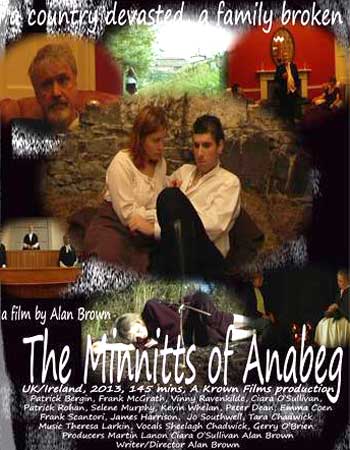 A new Tipperary film “The Minnitts of Anabeg,” will receive its very first screening at the Nenagh Arts Centre, North Tipperary, this coming Wednesday night, December 18th, beginning at 7.30pm sharp. A new Tipperary film “The Minnitts of Anabeg,” will receive its very first screening at the Nenagh Arts Centre, North Tipperary, this coming Wednesday night, December 18th, beginning at 7.30pm sharp.
(Click on image left for larger image of poster.)
This excellent film production was made on a micro budget and filmed around Nenagh and Thurles, here in Co Tipperary, using localised and very talented actors from amateur drama groups representing Nenagh Players and our own much enjoyed award winning Thurles Drama Group.
The film “The Minnitts of Anabeg,” tells the true factual story of the Minnitt family and the generations who lived in Anabeg house near Nenagh, from the 1600’s to the early 1900’s. The Film focuses in particular on one Joshua Minnitt, latter a prominent landowner living around the period of the Great Famine era (1845 -1849) and his assistance in helping the local impoverished community through that tragic, black period in our Irish history.
While managing to greatly assist and save a community, Joshua Minnitt failed however to save his own family. His only son against his wishes married a local Catholic girl resulting in the former being disinherited.
The film’s factual storyline however is not just a tale dominated by religious bigotry, but also an account of a family torn apart by politics and power.
The soundtrack for this low budget film was written by Roscrea music composer Thersa Larkin, while the original Anabeg House building was used as the film’s main location. Other scenes were filmed at locations in Thurles, at St Mary’s Famine Museum and at Nenagh Convent, latter which still has a laundry room from the days of the old workhouse regime.
Tickets: Tickets for this very first screening of a Tipperary based production cost just €8.00 and will give the audience a chance to meet many of the talented actors, musicians, technical people and producers involved, many who will be in attendance.
This is a must see event for lovers of real romance, drama, history and in particular Tipperary history. So if you are tired of looking at the same old Dublin produced rubbish, currently sold and eluded to as ‘celebrity entertainment,’ by our various Irish TV channels presently, get out there and see real Tipperary talent perform on screen.
DVD: A limited edition DVD will also be available to purchase on the night.
A Christmas Card For You
At this season of Christmas, Thurles.Info would like to wish our growing readership, both at home and abroad, a very healthy, happy, prosperous and holy Christmas.
At this time each year the crib always reminds me of the actions of my now long deceased grandmother. Each year she would visit the local crib and having placed a six penny piece in the poor box, she would remove a piece of straw from the crib and place it in her purse, where it would remain until the following Christmas. This action she assured me would guarantee that regardless of prevailing economic conditions, God would supply all her needs. Strangely, I must admit that despite living in lowly impoverished circumstances all of her life, for her it always appeared to work.
Cathedral of The Assumption – (In Irish-Ard Eaglais na Deastógála.)
Our brief slide show features the interior of the very beautiful Italianate Romanesque, Thurles Cathedral of The Assumption, latter which stands on a site with ecclesiastical associations going back to the beginning of the 14th century, when a Carmelite Priory was then first established in Thurles.
Around 1730 a humble thatched chapel (Thatched- a roof covered in dry vegetation such as straw, water reed, or rushes, so as to shed water away from the inner roof) was erected in the vicinity of this former priory, courtesy of the then ruling local Mathew family. For the next eighty years this simple structure alone would serve the needs of an impoverished Thurles Catholic peasant community.
During the years 1804 -1807, Archbishop Thomas Bray replaced this thatched chapel with a more impressive building costing over £10,000.00, and which became known locally as “The Big Chapel.” This new building would serve as the mother church to the archdiocese of Cashel & Emly until Dr Patrick Leahy, Archbishop of the diocese made a decision to renovate and upgrade the building to almost a wholly new edifice.
This new building today known as the Cathedral of The Assumption is an imposing combination of local limestone, latter quarried at Leugh, Turtulla and the Green, Holycross here in Co Tipperary, with Cork and Galway marble, Aberdeen granite and Portland stone also incorporated. Pope Pius IX also donated some ancient marble to the building. The magnificent tabernacle was designed by Giacomo Della Porta (1537-1603), latter a pupil of Michelangelo and was purchased from the Gesu church in Rome. A matching altar was erected to accommodate the tabernacle. A statue of Archbishop Leahy was later appropriately erected in the Cathedral’s front yard area, in 1911.
Thurles Cathedral has many other notable features which immediately capture the attention and admiration of both regular worshipper and curious visiting tourist. The partially detached baptistery, built in the Byzantine style, resembles that of Pisa. The campanile (bell tower,) standing at 120 feet high and 25 feet square, can be observed from all areas leading into Thurles, majestically guarding the surrounding hinterland. The Rose Window, designed and erected by Messrs Mayer & Co, of Munich, remains the outstanding stained glass feature in this beautiful cathedral. Two ornate and matching side altars with statues of the Sacred Heart and Our Lady, the work of noted Italian neoclassical sculptor, Giovanni Maria Benzoni, are also much admired. In the sanctuary ceiling there is a beautiful painting of Our Lady Assumed into Heaven.
Eight tower bells, three Roman arched doorways, an organ dating back to 1826, holy water fonts; latter fonts saved from the aforementioned Big Chapel, together with numerous impressive outdoor statues are all noteworthy feature of this cherished building.
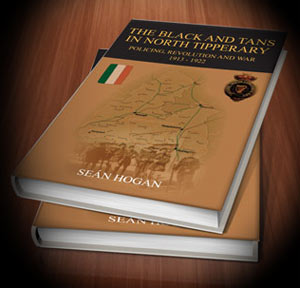 Seán Hogan, a native of Puckane in North Tipperary and the author of best-selling book “The Black and Tans in North Tipperary, Policing, Revolution and War 1913 – 1922,” will be the guest speaker at the Borrisoleigh Historical Society’s second lecture of this season to be held on Tuesday night next, December 10th, 2013, in the Community Centre at 8:00pm.sharp. Seán Hogan, a native of Puckane in North Tipperary and the author of best-selling book “The Black and Tans in North Tipperary, Policing, Revolution and War 1913 – 1922,” will be the guest speaker at the Borrisoleigh Historical Society’s second lecture of this season to be held on Tuesday night next, December 10th, 2013, in the Community Centre at 8:00pm.sharp.
Seán Hogan’s book looks at the years 1913 to 1922 and examines in detail how County Tipperary went from being one of the least crime hit police districts, to being one of the bloodiest and most terrifying areas in which to reside.
Hogan’s lecture is expected to recount the events surrounding local ambushes and armed engagements, the struggle for political power at council level and indeed within the IRA membership itself, as well as giving detailed background on those in the Royal Irish Constabulary (RIC) and Crown Forces who were murdered.
Seán will also attempt to examine the murders and other atrocities carried out against civilians during this period – carried out by both the IRA and the Black and Tans.
Admission to this event costs €5.00 and is a must for students of Irish history and lovers of factual Tipperary History in particular.
“I hate race discrimination most intensely and in all its manifestations. I have fought it all during my life; I fight it now, and will do so until the end of my days. I have fought against white domination, and I have fought against black domination. I have cherished the ideal of a democratic and free society in which all persons live together in harmony and with equal opportunities. It is an ideal which I hope to live for and to achieve. But if needs be, it is an ideal for which I am prepared to die.” Nelson Mandela.
For many South Africans, he was simply Madiba, his traditional clan name. Others affectionately called him Tata, the Xhosa word for father, but yesterday on December 5th, 2013, the world revered South African anti-apartheid leader and recipients of the Tipperary International Peace Award, Rolihlahla (Nelson) Mandela, regrettably died at his home in the Johannesburg suburb of Houghton, aged 95.
Our Video Hereunder Follows His Life And Times.
A state funeral will now be held, and the South African President Jacob Zuma has called for mourners to conduct themselves with “the dignity and respect,” that the former President had personified.
“I would like to be remembered not as anyone unique or special, but as part of a great team in this country that has struggled for many years, for decades and even centuries. The greatest glory of living, lies not in never falling, but in rising every time you fall.” he once stated.
With Rolihlahla Mandela now at peace, South Africans and indeed all residents of our planet are left to try to embody his promise and his idealism.
Go ndéana Dia trócaire ar a anam dílis.
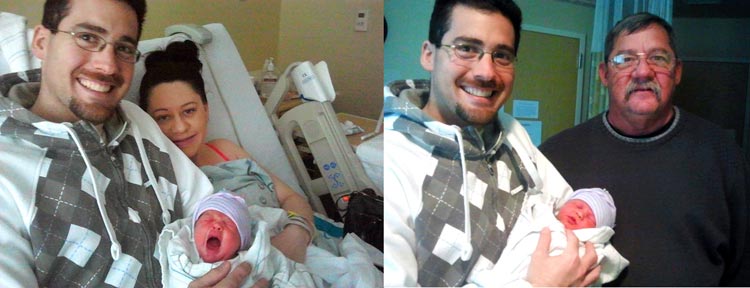
Please welcome the newest descendant to arrive with a proud pedigree direct from her ancient roots in Loughmore, Thurles, Co Tipperary.
Baby Mia Rose Hayes arrived on Sunday last, November 17th, 2013 at 8:53am.
Her dad Brenden and his lovely wife and new mum Heather, from San Jose the third-largest city in California, could not be more proud of their healthy, little seven pound bundle of joy.
Thanks to incessant searching by her Grandfather, Patrick, newly arrived Miss Mia Rose Hayes can, in the years to come, happily explore her Loughmore, Co Tipperary lineage, going back for the last eight generations, way back to the January 23rd, 1811. For it was then that Pierce Hayes of the townsland of Glogherailymore married Margaret Maher of Killanigan.
Brendan’s dad Patrick, a daily reader of Thurles.Info and shown here above in our picture, (top right), is a regular visitor to Thurles and Loughmore and indeed his son Brendan and several other family members have also made the journey to Thurles and Loughmore, all renewing acquaintances and visiting the old ‘stamping ground’ of their ancestors.
“Céad míle fáilte romhat, (Irish Translation: “One Hundred Thousand Welcomes to you.”) Mia Rose and congratulations to Brenden, Heather and of course we are not forgetting Patrick, now a very justly proud grandpa for the very first time.”
|
Support Us Help keep Thurles.info online by donating below. Thank you.
Total Donated 2026: €300.00
Thank You!
Daily Thurles Mass Livestream
|



Recent Comments