|
|
A public consultation session on the ‘Decade of Centenaries‘ 2012-23 will be held here in The Source, Cathedral Street, Thurles, Co. Tipperary at 7.30 p.m. on Tuesday, January 28th next.
Same is being organised by the Expert Advisory Group on Commemorations, which was established by the Irish Government in 2012 to assist it in its efforts to frame an appropriate approach to the centenary commemoration of the ‘Revolutionary Decade’ in modern Irish history, 1912-23.
The first part of the session will consist of a brief overview of both the work of this committee itself (Its personnel remit and to-date activities) and the broader range of commemorative initiatives involving the Irish government.
The major part of the evening will, however, be a forum in which the Tipperary public can express their opinions on what considerations the government should take into account in framing its policy towards the commemorative decade, especially in the years leading up to the centenary of the 1916 Rising.
Dr Maurice Manning, Chairperson of the group will be in attendance, as will Dr Martin Mansergh, Vice-Chairperson.
The event is free, and open to all members of the public.
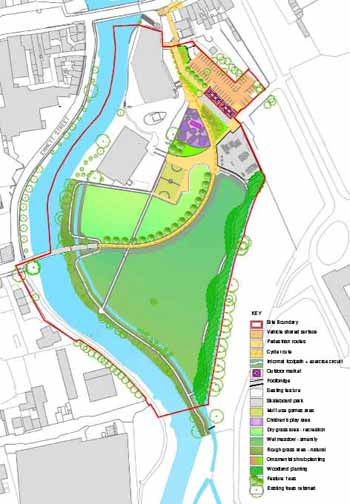 As Thurles residents are no doubt aware a new footbridge is planned, same to be built over the river Suir here in the town, from the east bank of St Patrick’s college to the west bank joining Emmet Street (The Mall) and Thomond Road, close to the “Swinging Gates.” Same is part of preliminary design proposals put forward for the new Thurles Town Park, expected to be completed using local taxpayers money, by 2015. As Thurles residents are no doubt aware a new footbridge is planned, same to be built over the river Suir here in the town, from the east bank of St Patrick’s college to the west bank joining Emmet Street (The Mall) and Thomond Road, close to the “Swinging Gates.” Same is part of preliminary design proposals put forward for the new Thurles Town Park, expected to be completed using local taxpayers money, by 2015.
So what will we call this new footbridge?
Next time you are out walking in Thurles, travelling on the right hand side from Thurles Cathedral, across Barry’s Bridge to the entrance to Liberty Square at Stakelums Fashions, note the small plaque on the south facing wall of this latter establishment.
This plaque, erected by “The Spirit of Tipperary,” commemorates the escape by James Leahy, Commandant No. 2 (Mid) Tipp-Brigade IRA, from four R.I.C. officers sent to arrest him at “Mixey” O’Connell’s pub, on the morning of March 1st 1918. This plaque however does not truly mark the spot from which Leahy made his daring successful escape. However in a statement to the Bureau of Military History (Document No. W.S. 1454.) by this Tubberadora, Tipperary native, we can be more precise with regard to a more accurate positioning as to exactly where he successfully attempted his escape.
James Leahy himself stated:
“On 1st March 1918, I was still employed by “Mixey” O’Connell in Thurles. That morning, a party of four R.I.C., including, the local Read Constable arrived in the shop and informed me that I was to be taken into custody. At that time the British authorities decided to re-arrest all the prisoners who had been previously released under the “Cat and Mouse Act,” as a prelude to the enforcement of conscription in Ireland. (Note: The Prisoners (Temporary Discharge for Ill Health) Act 1913 also known as the “Cat and Mouse Act” was an Act of Parliament passed in Britain under Herbert Henry Asquith’s Liberal government in 1913. The idea was that prisoners who went on hunger strike in jail should be released when they became weak or sick, since their bad health would deter them from continuing with previous illegal behaviour. If they failed to refrain from such activity they could then be re-arrested. The nickname of the Act came about because of a cat’s habit of playing with a mouse before eventually killing it off.)
My boss was in bed at the time the police called and I requested permission to be allowed to go upstairs to tell him that I was being sent back to jail. The Head Constable agreed to this, but sent one of the police upstairs with me. As we were coming back into the shop I opened the door at the foot of the stairs and held it open to enable my guard to go into the shop in front of me. He did so and I banged the door after him and dashed out the back door which I slammed after me.
I ran as fast as I could towards the bridge which crosses the River Suir in the town, pursued by the police. On reaching the bridge I ran down the Mall (Emmet Street) and from there I jumped into the river to get across to the college grounds (St Patrick’s College). The police in the meantime had divided their forces; the Head Constable kept on my back, two others got into the college grounds, while the fourth man was dispatched to the barracks for reinforcements. As I was half way across the river I saw the two policemen waiting to receive me on the college side and I then turned back again towards the Mall.
Continue reading Name The New Thurles Town Park Footbridge
Josephine McNeill (née Ahearne), the Irish Diplomat, was originally born on March 31st 1895, in Fermoy, County Cork. She was the daughter of James Ahearne (shopkeeper and hotelier) and Ellen Ahearne (née O’Brien). Josephine was educated at Loretto Convent, Fermoy, and later at UCD. Today in Co Tipperary and indeed in her own native Co Cork its citizens have almost forgotten her varied contribution to twentieth century Irish History.
Equipped with a BA in French and German she began her teaching career, teaching first at the St Louis Convent, Kiltimagh, Co Mayo and later in 1917, here in Thurles at the Ursuline Convent. Josephine was fluent in the Irish language and held a passion for Irish music and literature. While here in Thurles she also took an active part in the cultural side of the Irish independence movement, becoming a member of Cumann na mBan and in 1921 became a member of the executive committee of that same organisation.
It was also while here in Thurles, in 1917, that Josephine first met Pierce McCann, latter president of the East Tipperary executive of Sinn Féin and the Commander of the Tipperary Brigade in the 1916 Easter Rising. By May 1918, she was paying regular visits to Ballyowen House, near Cashel, and they would eventually became engaged just before McCann was arrested by the R.I.C. for the second time. Following this latter arrest Pierce McCann would die of influenza in Gloucester jail, possibly after it was claimed that a doctor had dosed him too strongly with strychnine on March 6th 1919 in a British nursing home.
Indeed when McCann’s corpse arrived in Dublin, amongst those who carried his coffin from ship to hearse and later to the Dublin / Thurles train, were Harry Boland and Michael Collins. In Dublin his hearse was preceded by a group of over one hundred Volunteers and was followed by another group of fifty, as it wended its way for a Mass held at the Pro-Cathedral. Following this Mass, the cortège and about ten thousand mourners walked through the city centre. On reaching the Quays it is reported that a British officer attempted to halt this cortège to allow a British military truck the first right of way. This officer together with his motorcycle are understood to have found themselves floating in the River Liffey, courtesy of a group of bystanders, because of what was perceived as a lack of respect for the dead.
When McCann’s coffin arrived by train here in Thurles, Volunteers from all over Tipperary were represented and the coffin was removed to the Cathedral of The Assumption, where it was received by the then Archbishop of Cashel and Emly, Dr. John Harty. On Sunday, March 10th, the funeral left Thurles at 2:30pm bound for buried in Dualla, Cashel, County Tipperary. Note the present McCann Barracks in Templemore, County Tipperary, remains named after him.
Later in 1923 Josephine Ahearn would now go on to marry a man, 26 years her senior, one James McNeill, Irish High Commissioner in London from 1923- 1928. James McNeill would also serve as a member of the committee under Michael Collins, latter then chairman of the Irish Provisional Government, and would also assist in drafting the Constitution of the Irish Free State. Both Josephine and James greatly resented the manner of their treatment by Eamon de Valera when the Office of the Governor General was suppressed in 1932. However later, while Minister to Switzerland, Josephine put this same anger and resentments aside, when de Valera visited Switzerland for eye surgery and indeed it is reported that she went to sit with him during this period of convalescence.
Continue reading Josephine McNeill Thurles Town’s Forgotten Diplomat
Anger has been expressed over the dumping of memorial plaques in St Mary’s Graveyard, to make way for a plaque to commemorate the Korean War.
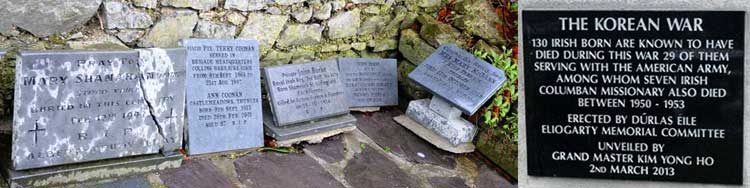
The badly worded inaccurate Korean war plaque, displaying grammatical errors, commemorates the death of 130 (Should read 159 Irish Born, 30 soldiers, seven members of the Columban order and an Anglican nun.) Irish born unnamed persons which have no known association with Thurles town, was unveiled on March 2nd last by Korean native Mr Kim Yong Ho. Later the plaque was removed and re-erected more recently, displacing at least three small plaques previously erected by local Thurles residents, whose relatives are buried within the graveyard’s confines.
No Korean War victims are buried in the grounds of St Mary’s graveyard Thurles and indeed only one Tipperary soldier Sgt. TJ O’Brien a native of Ballyvistea, Emly was killed in Korea, and his body was never recovered. The now displaced plaques, erected by relatives of persons actually buried in this area, now accuse local councillors of attempting to raise their personal profiles in time for local elections brochures, due for production before next May.
According to the inscription on the plaque, same was erected by an organisation calling itself “Dúrlas Éile Eliogarty Memorial Committee,” whose members include Local Town Councillor’s Mr Jim Ryan, Mr David Doran, and Mr Noel O’Dwyer, together with Mr John Worth (President & PRO) and Mr Pat Walsh (Chairperson).
The local Church of Ireland community who share the grounds within the graveyard complex refused to comment on the removal of these memorials, other than to state that they had been contacted by concerned and angry individuals regarding this matter and had directed same to contact Thurles Town Council. They were also anxious to point out that they had in the past totally opposed the erection of this and other such plaques, which has by their presence destroyed and desecrated an area of immense historical importance.
The Church of Ireland Community also stated that the following written confirmation was received by them on the May 11th 2010, from North Tipperary Co Council via Thurles Town Council regarding planning permission, Quote; “In reply to your e-mail, I wish to confirm that we have no record of any planning applications for permission to erect memorials in the grounds of St Mary’s old graveyard, situated at St Mary’s lane, Thurles, Co.Tipperary.”
The Church of Ireland community confirm that threats of legal action expressed in some complaints made, should now be addressed to Thurles Town Council, latter Administrators of this historic fourteenth century burial ground.
Owners of the plaques dumped claim that no permission or indeed request was ever received by the committee responsible for their removal, and also claim this is a final indignity to those who in the past were unable to afford a simple headstone marker.
Today, Thurles, Co Tipperary is a quiet, historic, picturesque, busy rural town, situated on the edge of the Golden Vale, latter the richest agricultural farmland in Europe. However on the night of January 20th, 1920, nothing could have been further from the present situation.
Tipperary, under English rule during this period, was fast becoming even more politically rebellious. On Tuesday January 21st, 1919 two members of the Royal Irish Constabulary (R.I.C,), namely Constable James McDonnell aged 56 and Constable Patrick O’Connell aged 36, were both shot dead when ambushed by a group of armed men at Soloheadbeg, some three miles from Tipperary town. The two R.I.C. men had been placed in charge of escorting and guarding a cart containing 160 lbs of gelignite and thirty electric detonators, together with two civilians, Patrick Flynn latter a Tipperary County Council employee and their horse drawn cart driver, one Edward Godfrey. A short distance from the quarry at Soloheadbeg they were halted by a group of armed masked men and the two armed police officers murdered. The shots fired here were the first retorts marking the beginning of war for independence against the then British establishment.
On Monday the 23rd of June 1919 District R.I.C. Inspector Michael Hunt, aged 46, was shot dead in Market Square, (Now Liberty Square) Thurles, County Tipperary. Hunt was hit twice by large calibre, blunt nosed revolver bullets, latter which travelled diagonally through his torso, resulting in instant death. First cousins Jim and Tommy Stapleton from Finnahy, Upperchurch, and Jim Murphy (Latter known as “The Jennett”) from Curreeney, Kilcommon, would be later named as responsible for his killing, in a statement made by James Leahy, Commandant No.2 Irish Republican Army (I.R.A.) (Mid) Tipp-Brigade.
On the 2nd of September 1919, a 48 year old R.I.C. Sergeant, Philip Brady, was shot dead in an ambush between the villages of Carrigahorig and Lorrha, County Tipperary. Sergeant Brady was killed outright and another Constable named Foley travelling with him, was badly wounded. Sergeant Brady belonged to the County Fermanagh R.I.C.Force and had only arrived in Lorrha to take up duties on the previous Friday.
 Pictured above: (Left) Cathedral Street, Thurles, Co Tipperary around the year 1920. (Centre) Constable Luke Finnegan with sisters Mary and Bridget. (Right) Constable Luke Finnegan’s now forgotten headstone. On the night of January 20th, 1920 at about 10.00pm to 10.15pm, Constable Luke Finnegan was shot dead as he walked from the R.I.C. barracks in Market Square, Thurles to his home on The Mall a short distance away. Approaching his front door he was fired on by four men. They had been standing some 10-15 yards from his front door, close to a street lamp which had been conveniently extinguished. His killers would be later named in a statement to the Bureau of Military History (Document No. W.S. 1454.) by Tubberadora Co. Tipperary born James Leahy, (Formerly, Commandant No. 2 (Mid) Tipp-Brigade) as Jerry Ryan, Mick Small and John McCarthy (Coorty) and the former James Leahy, himself.
Leahy in his statement claims: “On the night of 20th January 1921, Jerry Ryan, Mick Small and John McCarthy (Coorty) and myself, all armed with revolvers, watched for Constable Finnegan in the vicinity of his own home in the Mall. He was returning from the barracks at about 10 o’clock and was about 10 yards from his house when we fired at him. He was badly wounded and died the following morning.” (Here Leahy’s statement is incorrect: Constable Finnegan was pronounced dead on January 22nd, two days later.)
Shot in the stomach, the Constable staggered some steps to his front door calling his wife and stating “Mary, I’m shot!” Mary’s own screams could soon be heard by neighbours throughout the street. Collapsed now at his door, some neighbours rushed to assist. The Constable again uttered the words “Mary, I am done for, what will you and the babies do?”
Word of this shooting was quickly conveyed to the Thurles R.I.C. barracks and a section of the military known as the Sherwood Foresters, (Latter regimental name was based on the fact that they hailed from Nottingham and Derbyshire, England.) together with members of the local R.I.C.constabulary, appeared on the streets, armed with rifles. The R.I.C. and military now ran amok in Thurles town. They fired shots at random and went through the streets discharging shots through the doors and windows of the houses and business places of known Sinn Féin supporters. Windows in the nearby Sinn Féin Hall were also smashed and Crown Forces also fired a number of volleys down the Mall. No one was reported as injured although the disturbances lasted several hours.
This action would become now assigned to the history books as “The Sacking of Thurles”.
One of the houses targeted by the RIC that night was opposite the Ursuline Convent on Cathedral Street, then home to Denis Morgan (Irish: Donnchadh O’Muireagain). On January 15th, 1920, Denis, a known member of Sinn Féin and then a teacher of Irish and Mathematics at Thurles CBS, had been elected Chairman of Thurles Urban District Council. Watched in horror by some of the Ursuline Nuns awoken by the disturbance on Cathedral Street, the rented abode of Denis was attacked. Denis was forced to lay spread on the stone basement floor, together with his heavily pregnant wife Margaret and his five year old son Seamus, while R.I.C. bullets blazed through his windows, showering plaster and glass splinters all around. (This same Denis Morgan of course today would be best known as the grandfather of the late Dermot Morgan of “Fr Ted” Channel 4 sitcom fame.)
Continue reading The Sacking Of Thurles Co Tipperary & Fr Ted
|
Support Us Help keep Thurles.info online by donating below. Thank you.
Total Donated 2026: €300.00
Thank You!
Daily Thurles Mass Livestream
|



Recent Comments