|
|
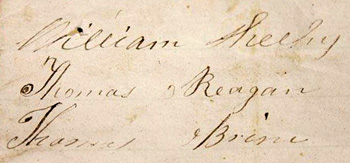 Historians have revealed that US President Ronald Reagan’s great-great grandfather Thomas was among 250,000 signatories, on the Morpeth Roll of 1841. Thomas Reagan put pen to paper in honour of George Howard, known as Lord Morpeth, latter a supporter of the then repeal laws and who fought against religious discrimination and unfair taxes, while chief secretary for Ireland. Historians have revealed that US President Ronald Reagan’s great-great grandfather Thomas was among 250,000 signatories, on the Morpeth Roll of 1841. Thomas Reagan put pen to paper in honour of George Howard, known as Lord Morpeth, latter a supporter of the then repeal laws and who fought against religious discrimination and unfair taxes, while chief secretary for Ireland.
The Morpeth Roll had been stored on a mahogany spool and held privately by Lord Morpeth’s family in a basement in Castle Howard, Yorkshire for more than a century. The Morpeth Roll is one of the few now surviving primary resources containing detail of the people living at that time in Ireland and members of the Reagan family put their signatures to the roll while residing in the civil parish of Templetenny, which includes Ballyporeen Co Tipperary. Other Signatures from the nearby townlands of Doolis, Knocknagapple and Skeheenaranky are also represented on this roll.
As a labourer, Thomas Reagan signed the Morpeth Roll in 1841, somewhere in Co Tipperary and Ronald Reagan, his great-great grandson, who served two terms as US president between 1981 and 1989, visited the village in 1984 when he was in Ireland. It was on this visit, amid unprecedented security, that the Irish people came to see the most powerful man in the world for the first and only time, face to face. President Ronald Reagan passed to his heavenly reward in 2004.
Thomas Reagan’s son Michael and great grandfather of President Reagan, would take the family name eventually to the United States and this Morpeth Roll also appears to contain the signature of President Reagan great grand Uncle Thomas. This same great grandfather Michael would marry Catherine Mulcahey, also from Ballyporeen, in St Georges Catholic Church, Southwark, London, after they left Ireland for England in 1852. The wedding would be witnessed by Nicholas Reagan, possibly one of Michael’s older brothers; however their father Thomas was now deceased.
According to the 1860 census, on November 28th 1857, Michael and Catherine both arrived in New York on the “Joseph Gilchrist,” sailing from Liverpool with three children; Thomas, John and Margaret all who eventually settled in Carroll County, Illinois.
Among other names to turn up on the Morpeth Roll are the second Arthur Guinness of the famous stout dynasty, who lived from 1768-1855 and ran the brewery and the Bank of Ireland in the 1820s and 1830s.
“Now every April I sit on my porch and I watch the parade pass before me.
I see my old comrades, how proudly they march, renewing their dreams of past glories.
I see the old men all tired, stiff and worn, those weary old heroes of a forgotten war.
And the young people ask “What are they marching for?” and I ask myself the same question.
And the band plays Waltzing Matilda and the old men still answer the call
But year after year, their numbers get fewer, someday, no one will march there at all.” – (Lyrics Eric Bogle.)
On Wednesday November 20th, the newly formed Borrisoleigh Historical Society will hold a lecture in the local Community Centre, beside the Church, in Borrisoleigh, Co Tipperary. Borrisoleigh Historical Society was formed, for the first time, back in May of this year and already boasts a local membership of over 20 lovers of Irish history. The Annual Membership fee to join this society is just €10 and the Society extend a “Céad Mile Fáilte” to everyone or anyone interested in history and researching not just local history, of which there is an enormous legacy, but Irish history in general.
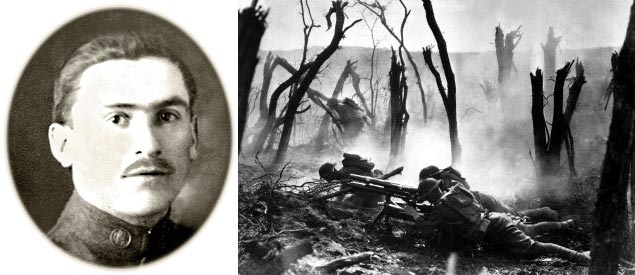 Corporal Lewis Ryan – Meuse-Argonne Offensive in the Argonne Forest region of France. The Societies next meeting, on November 20th and commencing at 8.30pm sharp, promises to be interesting, and will take a close look at the life and times of Corporal Lewis Ryan, who was born in Coarsepark, Borrisoleigh, Co Tipperary in 1890, under the heading; ” Corporal Lewis Ryan, US Army – Forgotten Soldier of WWI.”
This lecture will attempt to trace Corporal Ryan’s family links and his early life in Borrisoleigh, prior to emigrating to America in 1912, and also his life as an emigrant serving with the 77th Division of the American Army. Corporal Ryan lost his life in the Meuse-Argonne Offensive in the Argonne forest, latter a long strip of rocky mountain and wild woodland in north-eastern France, whilst leading a reconnaissance against German machine gun posts, on the 7th Oct 1918. Corporal Ryan’s body today lies buried in the Meuse-Argonne US Military Cemetery, France.
The lecture will be delivered by Mr John Flannery, latter President of Ormond Historical Society, Nenagh. Entry to this lecture is just €5 and so if you are free on the night the Society, under the Chairmanship of Michael Delaney, would love if you could attend.
Note: In another very important lecture, planned for December 10th, it is hoped to feature Mr Sean Hogan, author of the recently published “The Black and Tans in North Tipperary.” Further details of this latter event are expected to be announced later.
So make those long winter night’s shorter in the company of Borrisoleigh Historical Society, beginning on Wednesday November 20th.
“I mean, they say you die twice. One time when you stop breathing and a second time, a bit later on, when somebody says your name for the last time.” – Banksy
St Mary’s Famine Museum were honoured to receive a visit by Ms Mary Bergin recently. Now in her 90th year and educated at the Presentation Convent here in Thurles, Ms Bergin was accompanied on her visit by a comrade, Ms Eileen Forbes.
It is seldom that Museum staff have the opportunity and great honour to discuss history with a lady who has such a vivid and clear recollection of the early 20th century, but to meet someone who personally knew Kitty Kiernan, the one-time fiancée of the great Michael Collins, was something truly inimitable.
Ms Bergin regularly met Kitty Kiernan as she walked along Dublin’s Harrington Street, the former going to her place of employment, the latter on her way to meet her later husband Felix Cronin.
 Pictured above (L-R) Ms Mary Bergin, Main Street, Templemore, Co Tipperary, her comrade Ms Eileen Forbes (Corcoran), and the late Ms Kitty Kiernan and Irish revolutionary leader Michael Collins. Of course, Catherine Brigid Kiernan, better known as Kitty Kiernan (1892 – 1945) was a Co Longford woman widely recognised as the fiancée of assassinated Irish revolutionary leader, Michael Collins.
Kitty was born in Granard, County Longford and later educated in the Loreto Convent, in County Wicklow. She was the daughter of wealthy parents, Bridget and Peter Kiernan, and one of a family of seven children including twins, having five sisters and one brother. The Kiernan family were proprietors of the Greville Arms Hotel, a bakery, hardware store, timber yard, an undertakers business, together with a grocery shop and a public house.
In 1907 one of Kitty’s twin sisters died in her late teens, followed the following year (1908) by the deaths of both parents, both within a couple of months of each other. The family would be later devastated the following year (1909) by the death of the remaining twin sister.
Michael Collins, one of the principal founders of Irish State independence, and later Chairman of the Irish Provisional Government, was introduced to the bubbly and cheerful Kiernan sisters by his cousin Gearóid O’Sullivan. Gearóid was already courting Kitty’s sister Maud.
Collins in the first instance appears to have thrown an eye on another of the sisters, namely Helen, but she turned out to be already engaged. Seeing no future here he then turned his interests on the attractive Kitty. Kitty had already captured the interest of one Harry Boland, latter a friend of Collins. This interest would be however short lived and Collins and Kitty soon became engaged. They planned to marry in Dublin on November 22nd 1922, in a double ceremony to include her sister Maud and Gearóid O’Sullivan. The death of Collins four months earlier would result in only one wedding taking place with Kitty attending dressed in black.
Three years later, in 1925, Kitty would instead marry Felix Cronin, latter a Quartermaster General in the Irish Army. They would have two sons; the eldest was named Felix (Rex) Cronin the second named Michael Collins Cronin, obviously both named after her two great loves.
Kitty died of Bright’s disease (Kidney disease) as did all of her siblings, on July 24th 1945, and was laid to rest in Glasnevin Cemetery, Dublin, not far from where Collins lies. Husband Felix and their son Rex were to join her there some 19 years later.
Kitty Kiernan and Michael Collins had both kept up lengthy correspondence with each other even while Collins was still in London during the Treaty negotiations and he had written to her every day. These letters are now the subject of a published book written by Leon O’Broin entitled “In Great Haste“.
Kitty Kiernan and indeed Ireland’s worst fears would be realized when Collins was assassinated by Denis ‘Sonny’ O’Neill at the age of just 31 years, near Béal na Bláth, County Cork, on August 22nd, 1922.
Teachers, All Students, History Societies Take Note
To coincide with the University of Limerick’s launch of “The Armstrong Papers” in the East Room of Plassey House on Monday next October 21st, St Mary’s Famine Museum will feature, for one week only, (October 16th to October 23rd inc) the rare and exciting exhibition entitled; “Downton Abbey, A Tipperary Perspective.”
Larger than the exhibition shown just last year, this historic exposition also happily coincides with the popular Downton Abbey, Series 4, currently showing each Wednesday night on TV3 at 9:00pm.
The TV series Downton Abbey is set on the fictional estate of Downton Abbey in the North Riding of Yorkshire, England, home to the Earl and Countess of Grantham and which follows the lives of the aristocratic Crawley family and their servants during the reign of King George V.
The Thurles exhibition on the other hand, while showing major similarities in life at the big house, takes a look at and follows the family of the Armstrong Family of Moyaliffe, Co Tipperary, during this very same period in Irish history, which also covers the First World War and the later period referred to as the ‘Roaring Twenties,’ and later.
Some of the items on show in this exhibition can be seen in the video shown above.
The ‘Roaring Twenties,‘ is of course a term often used to refer to the 1920’s, characterizing the decade’s distinctive cultural edge. Normality had returned to politics in the wake of hyper-emotional patriotism during World War I, jazz music blossomed, the ‘flapper,’ redefined modern womanhood, and Art Deco peaked. (Flappers were the “new breed” of young Western women in the 1920s who wore skirts short, bobbed their hair, listened to jazz, and flaunted their disdain for what was then considered acceptable behavior.)
Included in the exhibition this year are Dan Breen’s revolver, William Trant’s (Dovea) revolver together with original photographs by Heinrich Hoffmann (1885 – 1957) latter Adolf Hitler’s official photographer together with Military costumes, some dating back before 1900 from the Royal Military College, Sandhurst, in Surrey, with rare memorabilia from the Gallipoli Campaign including original cigarettes purchased in Port Said (1915 -1916).
Total cost of admission to this unique Tipperary exhibition is a mere €2 per person, which also incorporates a chance to examine the Famine Museum, latter which boasts the largest amount of original memorabilia, pertaining to the Great Famine (1845 – 1849). Tours will be also accommodated at night to facilitate visiting historical societies.
Note: All Schools & Historical Societies are requested to book their tour, some hours in advance by phoning 0504-21133, thus ensuring the presence of a lecture tour guide.
The Armstrong Papers
The Armstrong Papers, soon to be launched in Limerick, contain some 50,000 items including over 13,000 photographs. These documents encompass some 350 years of family history and were donated to the University of Limerick by Mrs Susan and Mr Graham Armstrong, formally of Moyaliffe, but who presently reside in Natal, South Africa.
Thurles Town and St Mary’s Famine Museum are also grateful to Mrs Susan and Mr Graham Armstrong for their continued patronage in loaning the Armstrong Collection to this area, which continues to attract tourists each Summer season, to the town.
The Thurles exhibition opens tomorrow Wednesday and is truly a ‘must see’ for lovers and students of Irish History.
Just a thought, but may I ask a question? “Has anyone got a few quid hidden away under the Bathroom Floor, in a Cookie Jar, the Fridge Salad Crisper Drawer or under your Mattress?”
“How much do you want?” I hear you scream excitedly.
Well to be honest it all depends on an item that goes under the hammer at “The Chatsworth Fine Art Sale,” to be held in Castlecomer, Co Kilkenny on Tuesday October 8th next. The particular item which generates my particular interest is, I believe, numbered Lot 727.
 Painting of Mary Francis Power Lalor (Ryan) It is a painted portrait of Mrs Mary Francis Power Lalor (nee Ryan) formally of Long Orchard, Templetuohy, Co. Tipperary. Mrs Power Lalor is featured wearing a black lace dress with pearl and diamond necklace, (Print Size about 130 cms x 105 cms or 51 ins x 41 ins) set in its original carved gilt-wood oval frame, signed and dated 1859.
This featured individual was born Mary Francis Ryan, daughter of George Ryan of Inch House, Thurles, Co. Tipperary and Catherine Whyte of Loughbrickland, Co Down. Her father was born on July 17th 1791 and died on September 6th 1884 at the age of 93. He had held the office of Deputy Lieutenant (D.L.) of County Tipperary and the office of Justice of the Peace (J.P.) for County Tipperary.
I believe this painting should now be purchased so as to remain in North Tipperary and preferably be proudly hung in Thurles Library for all to see and contemplate.
In early 1858, Mary Francis Ryan was presented at the State Drawing Room in Dublin Castle, to George William Frederick Howard, seventh Earl of Carlisle (Lord Morpheth of Morpeth Roll fame) being then Viceroy at that time, and in October of that year at the tender age of eighteen, she was married to Captain Edmund James Power Lawlor of Long Orchard, Templetuohy, Thurles Co Tipperary.
In 1859 Mary was presented to the Papal Court, during which time spent in Rome she was greatly admired for “her unusual beauty and a singular fascination of manner.” She visited some artist studios by special invitation and was painted at this time by G. Canavari.
After the death of her husband Edmund, James, Power Lalor, on August 4th 1873, and the following year by her daughter Helen Georgiana Power-Lalor in 1874, latter from meningitis, Mary devoted her life to charitable works and in 1880 published an appeal in the leading newspapers of the time on behalf of starving children following the famine of 1879 known as the “mini-famine” or An Gorta Beag. The New York Herald donated the massive sum then of £10,000 which enabled her to feed over 52,000 starving children throughout the country.
It was in this same year that on the Thursday evening of August 21st 1879, 15 people in Knock (Irish Translation: An Cnoc, meaning ‘The Hill,’ now more generally known in Irish as Cnoc Mhuire, “Hill of Mary”) County Mayo experienced an apparition of Our Lady, St. Joseph and St. John the Evangelist, who all appeared at the south gable of the local church, together with an altar with a cross and the figure of a lamb, around which angels hovered. Two Commissions of Enquiry, in 1879 and 1936, would later accept their testimony as being both trustworthy and satisfactory.
This Knock apparition brought about a massive religious revival during this Irish famine, latter now erased and rarely remembered in Irish history. Many Christians even today believe that this visitation to the “Hill of Mary”, contributed greatly to the low number of deaths then experienced in 1879, compared to the earlier Great Famine of 1845 -1849.
Mary Francis Power Lawlor now took full charge of this fund, clothing children of all denominations, thus saving many from certain death. In 1886 Mary Power Lalor established the Distressed Ladies Fund; latter to assist poor Irish women suffering through the non-payment of rent and the then land depression in Ireland. This Fund also established in Dublin a home to care for the many poor old ladies living in garrets and cellars, which in 1887 was opened in Mountjoy Square (Then Rutland Square,). This house subsequently became known as the Power Lalor Home, with Queen Victoria as patroness, and Princess Louise as President of the Central Committee, when this fund was extended to include England.
In 1912 Mary Francis Power Lawlor took up the reins in Ireland of the International Catholic Girls Protection Society and opened the Bureau and Home for Catholic Girls in Dublin, in the same year. It is also to her that the people of Templetuohy owe a debt of gratitude for organising the building of the magnificent Church of The Sacred Heart, Templetuohy and the beautiful stained glass window, which she then had specially commissioned in memory of her late husband, with the fitting title “For The Greater Glory Of God.”
Mrs. Power Lalor died on March 26th 1913, (100 years ago this year) and is buried next to her husband in Templetuohy Graveyard.
It’s just a thought but if 100 people, including businesses and including myself, came up with €50 each, we could possibly meet the asking price (Between €3,000 – €5,000) for this portrait of one truly great Tipperary lady and take her home to her native County.
Anyone interested in venturing into this “Thurles Historic Art Investment Co-Operative Programme,” should contact me Email george.willo@gmail.com and sure who knows, it might just sell for less than its asking price.
There I go, possibly dreaming again, but in recessionary times we all must dream.
|
Support Us Help keep Thurles.info online by donating below. Thank you.
Total Donated 2026: €300.00
Thank You!
Daily Thurles Mass Livestream
|



Recent Comments