|
|
Emergency services including the Irish Coast Guard Rescue helicopter attended at Thurles yesterday morning, following the collapse of a male on the street, close to the Matthew Avenue junction with Abbey Road and Friar Street, and near to the former Park Avenue House Hotel in the town.
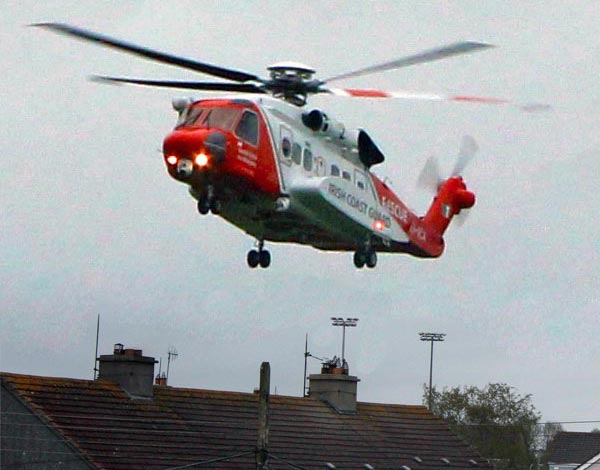 Irish Coast Guard Rescue Helicopter attending at Thurles yesterday morning, coming into land at Dr. Morris Park, in the town. [Picture Courtesy Brian Corbett.] Onlookers passing, first became aware of the incident; going to the aid of the pedestrian during the busy morning rush hour; and summoning the emergency services. Two ambulances, paramedics, an emergency services motor vehicle and Thurles Gardaí were quickly at the scene, to treat and carry out Cardiopulmonary Resuscitation (CPR) on the victim.
The Irish Coast Guard Rescue helicopter was summoned; landing in Dr. Morris Park, close to Semple Stadium. The victim was transported by ambulance the short distance to Dr. Morris Park and quickly flown to hospital.
We wish the victim a speedy recovery.
Work is well under way in relation to the clearing of the site for the new Thurles car park, situated on the ‘Money Side’, south of Liberty Square here in the town.
This development has involved a great deal of unseen, yet necessary planning and preparatory work, prior to its commencement; as Templemore/Thurles Municipal Engineer Mr Michael Tierney explained today.
All new development areas currently; even areas requiring just site clearance for a car park, must take into account fully those residing and using the area. And I am not just talking about humans, I this case I am also talking about wild life inhabitants who rightly use this area, and whose needs and well-being must also be also fairly considered. So, let’s take the case of the Thurles Daubenton’s Bat for example.
Note: Bats as we know, in general, are small, furry, intelligent animals often referred to as being like ‘Mice with Wings’. Indeed, almost one quarter of all land mammals’ resident here in Ireland are bats. Despite the often-used idiom, “Blind as a Bat”, indeed the contrary is true, as bats are far from being blind, having excellent vision and seeing perfectly well, while also truly taking possession of the night through their capability and use of sonar. Flying at high speeds bats listen using echolocation (biological sonar) and can locate insects faster than any of our much loved feathered friends; making their their appearance at dusk, when our insect activity is to be viewed in maximum throng. [And no girls, bats do not get tangled up in your long hair.]
We are aware that some seven different types of bats have been identified as residing here in our Emerald Isle. They are:- (A) The Lesser Horseshoe; (B) Pipistrelle (Latter the small common bat); (C) The not so common Natterer; (D) The Long Eared Bat; (E) The rare Whiskered Bat; (F) Ireland’s largest bats known as Leisler’s; and finally (G) Water bats called Daubenton’s, latter first described by the German naturalist and zoologist, Heinrich Kuhl, back in 1817, who named them in honour of the French naturalist Louis-Jean-Marie Daubenton.
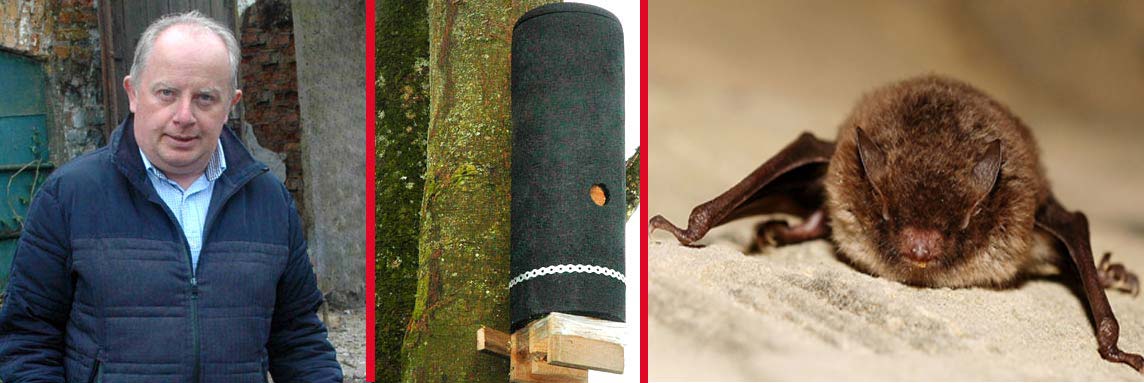 Pictured Left-Right: (1) Templemore/Thurles Municipal Engineer Mr Michael Tierney: (2) A Large Hibernation Colony Bat Box; (3) A Daubenton’s Bat. The Daubenton’s Bat (Myotis daubentonii. Irish-Ialtóg uisce.)
The Daubenton’s bat is a Eurasian bat with short ears and is thankfully considered to be increasing their population growth in many areas. More often called the ‘water bat’, this species is easily recognised at dusk, flying just a few centimetres above the surface of our River Suir, latter which runs parallel slightly to the east of this new car park amenity. This species of bat can be spotted skimming above the surface in search of midges, caddisflies, moths, beetles, daddy long-legs, mayflies, earwigs, and spiders, and may even scoop prey from the very surface of the water. While other bats feed over and around water; none hold the same close association with water as do Daubenton’s, which can even swim, should it accidentally end up in the water.
While none of these bats have been identified as currently residing in the new car park’s immediate vicinity, new Hibernation Colony Bat Boxes have been installed just in case, since the area is part of their rich hunting ground. Bats never settle individually, preferring to live in colonies, so these boxes, high in the trees, now allow for large numbers of bats to congregate together, in a dry, safe place and are ideal for use as bat nurseries for their young.
Bats hibernate in the wintertime. This is necessary since there are not many insects available to eat during our Irish winters. When they hibernate, their heartbeat slows down, while their body temperature is also lowered. This helps them to save their energy and survive a cold winter.
Yes, we as humans remain the minds and the stewards of our everyday living world, and to avoid a catastrophic loss of biodiversity, we must fully realise that our own ultimate future, as living human beings, also depends upon our greater understanding of the natural environment and where necessary we must allocate and learn to share ecological real estate.
 Photo L-R: Eilish Costello, Diana Kearney (Thurles Pharmacy), Gary Roche (President of Thurles Lions Club) and Bee Hayes (Thurles Lions Club member) who is organising this event. Thurles Lions Club are holding their Annual “Diabetic Screening Day”, which is taking place at Thurles Pharmacy, Thurles Shopping Centre, Thurles on Saturday 21st April next, between the hours 9.30am and 5.00pm.
Do take the time to undergo a very quick and simple test, as part of this Diabetic screening, and if needs be, receive further advice on necessary next steps to be taken.
Note: All are welcome to attend!
 For Mrs Maureen Armstrong, aged in her 94 year; this will be her 24th year in which she has participated in the VHI Women’s Mini Marathon. For Mrs Maureen Armstrong, aged in her 94 year; this will be her 24th year in which she has participated in the VHI Women’s Mini Marathon.
The oldest participant in this event; Mrs Armstrong is encouraging other women to come join her in the quest to raise funds for people and their families affected by cancer.
To this end, she will lead out her team of like minded females in this year’s Mini Marathon on June 3rd 2018 next, in support of the Irish Cancer Society.
Together with her daughter Martina, both ladies have set up a local walking group, called simply “Thurles Walkers”, to further encourage women of all ages to get involved and to get into training.
Mrs Armstrong is adamant that the Irish Cancer Society is reliant on donations not just to fund cancer research but also grant free support for patients and their family members.
Remember, as many as 40,000 people will be diagnosed with cancer here in Ireland this year, and it is important that no one is left to face this devastating disease alone.
Mrs Armstrong will be just one of thousands of inspirational women taking part in the Mini Marathon this year, all of whom will be raising funds for deserving charities.
Emissions from three important air pollutants increased in 2016 – Ireland’s emissions going in the wrong direction for people to benefit from cleaner air.
EPA reports 2016 emission levels for the five main air pollutants.
 The figures show that emissions of three of the five air pollutants increased – ammonia, nitrogen oxides and non-methane volatile organic compounds. The figures show that emissions of three of the five air pollutants increased – ammonia, nitrogen oxides and non-methane volatile organic compounds.
Emissions of ammonia have been increasing since 2011 and were above the specified EU emission limit in 2016 for the first time.
Emissions of two of the other air pollutants, nitrogen oxides and non-methane volatile organic compounds, while in compliance with EU limits for now, are increasing.
Emissions of sulphur dioxide continue to decrease. These were well below the required EU emission limits, substantially due to the use of lower sulphur content fuels in electricity generation and transport.
Particulate matter emissions declined in 2016. Future emissions will depend largely on the quantity and quality of solid fuel used in the residential and commercial sectors.
The EPA today published figures for emissions of five key air pollutants. These pollutants impact air quality in Ireland and further afield, causing respiratory problems, pollution of soil and surface water, and damage to vegetation.
Stephen Treacy, Senior Manager with the EPA, said, “Our figures show that emissions of three of the five main pollutants are going in the wrong direction. Higher emissions of these pollutants will cause damage to air quality and health and make future compliance with EU limits more challenging.”
This latest information from the EPA shows that Ireland exceeded its emission limits for ammonia for the first time in 2016 and emissions of this gas are increasing. The agriculture sector accounts for virtually all (99 per cent) ammonia emissions in Ireland arising from the application of fertilisers – 40 million tonnes of animal manures are used annually together with 300,000 tonnes of nitrogen in fertilisers.
“Ammonia limits have been breached due to the rapid expansion of dairy and beef production in Ireland in recent years. This underlines the challenge in designing appropriate policies that protect our environment in a growing economy”, Stephen Treacy said.
The 2016 figures show that Ireland remains in compliance with its nitrogen oxide and non-methane volatile organic carbon emission limits, though these emissions are also increasing. Transport is the principal source of nitrogen oxide emissions, contributing approximately 41 per cent of the total in 2016. Agriculture is the second biggest source, contributing approximately 29.6 per cent of the 2016 total, mainly due to synthetic fertiliser application and emissions from urine and dung deposited by grazing animals.
The figures published today show that Ireland’s level of sulphur dioxide continues to be well below the EU emission limits. The reduction in the emission of this pollutant is positive for the environment, public health and the economy. The main sources of sulphur dioxide emissions are the power generation, residential and commercial sectors. Effective licencing and enforcement by the EPA has contributed to reductions in these pollutants as well as the use of cleaner fuels in power generation and transport.
Stephen Treacy concluded: “On the positive side, Ireland has significantly cut emissions of sulphur dioxide, greatly reducing the environmental damage caused by this pollutant, via behaviour change and response to regulatory interventions. While overall emissions of particulate matter also declined in 2016, localised problems can arise because of residential solid-fuel use.”
For further detail on these figures see the EPA web published report Ireland’s Air Pollutant Emissions 2016.
|
Support Us Help keep Thurles.info online by donating below. Thank you.
Total Donated 2026: €300.00
Thank You!
Daily Thurles Mass Livestream
|





Recent Comments