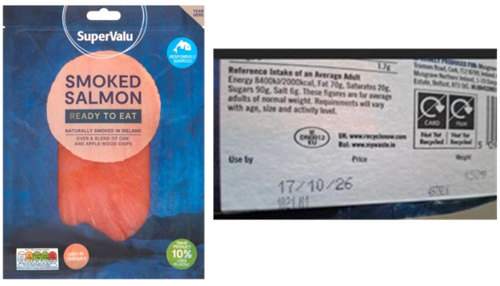
Message:SuperValu is recalling SuperValu Smoked Salmon 40g and SuperValu Smoked Salmon 150g with a use-by date of 17th October 2026 due to the presence of Listeria monocytogenes.
Recall notices will be displayed at point-of-sale.
Nature Of Danger: In healthy people, symptoms of Listeria monocytogenes infection can include mild flu-like symptoms, or gastrointestinal symptoms such as nausea, vomiting, and diarrhoea. However, in people who are more vulnerable, the infection can be severe and can lead to serious complications. People who are more vulnerable to Listeria monocytogenes infections include pregnant women, infants, older adults, and people with weakened immune systems. The incubation period, the time between initial infection and first symptoms appearing, is on average 3 weeks but can range between 3 and 70 days.
Action Required: Manufacturers, Wholesalers, Distributors, Caterers and Retailers: Retailers: Same are requested to remove the implicated products from sale and display recall notices at point-of-sale. Consumers: Consumers are advised not to eat the affected SuperValu Smoked Salmon 40g or 150g with a use-by date of 17th October 2026.
Residents of Thurles face further years of sewage concerns, unpleasant summer odours and potential flooding, with a major upgrade of the town’s ageing wastewater network not expected to begin construction until 2028.
Uisce Éireann has confirmed that a planning application is being prepared for improvements involving new and upgraded sewers and pumping stations. Subject to planning approval, procurement and no further delays, construction is anticipated to commence in 2028. For a town that has endured years of concerns about sewage discharges into the River Suir, flooding and foul smells, the announcement raises serious questions about why a permanent solution remains so far away.
Effluent identified 14 years ago – continuing to in 2026 to enter River Suir. EPA refuses to take action.
Much of Thurles operates on a combined sewerage system, where household sewage and rainfall travel through the same underground pipes towards the wastewater treatment plant. During heavy rainfall, increased volumes can overwhelm parts of the network, potentially resulting in untreated sewage mixed with storm water being discharged through overflow outlets. Blockages and inadequate drainage capacity can also contribute to flooding, with Friar Street among the areas where problems have been highlighted. Uisce Éireann acknowledges that the existing wastewater infrastructure is inadequate and requires upgrading to address environmental compliance issues and alleviate flooding.
One of the most troubling aspects of this longstanding problem is the condition of the River Suir as it flows through Thurles. For years, concerns have been raised about sewage discharges, pollution, algae and foul odours, particularly around, Thurles Shopping areas and close to The Source Arts Centre. During warmer summer months, the stench can become particularly unpleasant for residents, shoppers, businesses and visitors. Higher temperatures, reduced river flows and stagnant water can make unpleasant smells more noticeable, while lower water levels provide less dilution for pollutants.
Local reporting in 2024 highlighted complaints about untreated sewage entering the River Suir itself near Thurles Shopping Centre, alongside concerns about offensive summer odours. The River Suir should be one of Thurles’s greatest natural attractions, rather than a recurring source of environmental concern.
Will the €8.59 Million Liberty Square Upgrade Have to Be Dug Up Again? Another important question must now be answered; will the already upgraded eastern half of Liberty Square, part of a Phase 1 project with a recorded budget of approximately €8.59 million, have to be excavated again to accommodate the proposed wastewater improvements? The completed scheme included extensive streetscape improvements, new paving, road surfaces and underground infrastructure.
Hydrogen sulphide, (sewer gas) first identified and highlighted in July 2022, nowat least 6 years before being corrected.ViewHERE.
Reports have also highlighted complaints about sewage-type odours emerging from drains in the completed section of Liberty Square.
With further wastewater works now being planned, residents and businesses are entitled to know whether these projects have been properly coordinated:-
Will recently completed paving and road surfaces have to be disturbed again?
Were the wastewater deficiencies identified before the Liberty Square redevelopment commenced?
Could further excavation lead to additional public expenditure and disruption for local businesses?
There is currently no confirmation that the completed section will require excavation, but Uisce Éireann and Tipperary County Council should clarify this before the wastewater project proceeds. Such coordination is particularly important while plans for the remaining western half of Liberty Square are also progressing.
Years of Problems, More Years of Waiting The need for wastewater improvements has been recognised for considerable time. The Thurles and Environs Local Area Plan 2024–2030 identifies the importance of separating foul wastewater from surface water. Uisce Éireann commenced detailed design and investigation works in 2025 to determine the improvements required. However, a construction start in 2028 does not mean the problems will be resolved that year. Completion could extend considerably beyond that date. Meanwhile, residents deserve information about interim measures to reduce sewage overflows, flooding and persistent odours.
Thurles Deserves Better The proposed investment is welcome, but the people of Thurles have waited years for meaningful improvements. Protecting the River Suir, addressing the summer stench and reducing the risk of sewage-related flooding must remain priorities. Equally important is ensuring that future underground works do not unnecessarily damage recently completed, publicly funded improvements to the town centre. Thurles deserves a clean River Suir, a reliable sewerage network and proper coordination between major public infrastructure projects.
After years of problems and millions already committed to upgrading Liberty Square, residents deserve clear answers, responsible planning and a permanent solution.
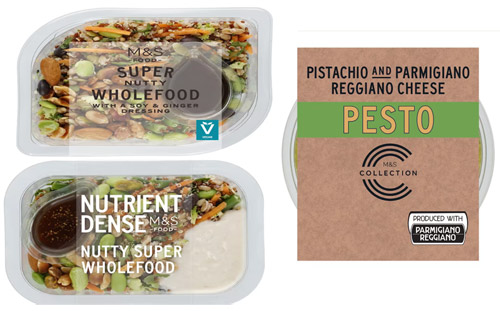
Recall of several ready-to-eat Marks and Spencer products due to the possible presence of Salmonella in pistachios.
Alert Summary dated Thursday, 8th October 2026.
Category 1: For Action. Alert Notification: 2026.62. Product Identification: Please see table below. Batch Code – Product name: Use-by date and Pack size: (1) M&S Super Nutty Wholefood with a Soy & Ginger Dressing All dates up to and including 10/10/2026 200g). (2) M&S Food Nutrient Dense Nutty Super Wholefood Salad All dates up to and including 11/10/2026 285g. (3) M&S Fresh Collection Pistachio and Parmigiano Reggiano Cheese Pesto All dates up to and including 13/10/2026 115g. Country Of Origin: United Kingdom.
Message: Greencore is recalling Marks and Spencer ready-to-eat products due to the possible presence of Salmonella in pistachios. Recall notices will be displayed at point-of-sale.
Nature Of Danger: People infected with Salmonella typically develop symptoms between 12 and 36 hours after infection, but this can range between 6 and 72 hours. The most common symptom is diarrhoea, which can sometimes be bloody. Other symptoms may include fever, headache and abdominal cramps. The illness usually lasts 4 to 7 days. Diarrhoea can occasionally be severe enough to require hospital admission. The elderly, infants, and those with impaired immune systems are more likely to have a severe illness.
Action Required: Manufacturers, Wholesalers, Distributors, Caterers and Retailers: Retailers: Same are requested to remove the implicated batches from sale and display recall notices at point-of-sale. Consumers: Consumers are advised not to eat the implicated batches.
Russian authorities today are playing down fears of a possible plague incident in Siberia after the death of 28-year-old researcher Ms Darya Shipilova, who worked at the Irkutsk Anti-Plague Research Institute.
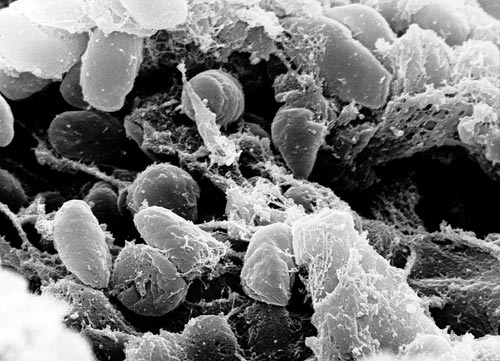
Yersinia pestis, the bacterium that causes plague.
Russian media reports initially claimed Shipilova accidentally broke a test tube containing Yersinia pestis, the bacterium that causes plague, before developing severe pneumonia and dying on October 2nd. That account has not been independently confirmed.
Russia’s public-health watchdog, Rospotrebnadzor, now says there was no laboratory accident and that Shipilova died from “pneumonia of unknown origin.” It says testing found no dangerous microorganisms connected with her work.
Yet the response has raised questions. Around 200 contacts have reportedly been placed under medical observation, parts of hospitals have been quarantined, and dozens of institute employees have been isolated. Officials in Buryatia initially said Shipilova had died of plague before changing the wording to “possibly,” while another local warning advising people not to travel to Shelekhov because of a suspected plague case was later deleted.
The World Health Organization currently assesses the risk to the wider public as low, and there are no confirmed additional plague cases. Modern plague is also treatable with antibiotics when diagnosed promptly.
The conflicting statements inevitably recall a darker chapter in Soviet history. After the Chernobyl reactor exploded on April 26th, 1986, Soviet authorities delayed informing the public and initially minimised the seriousness of the disaster. An early Soviet report even concluded that evacuating nearby Pripyat was unnecessary; Moscow did not publicly acknowledge the accident until April 28th, after elevated radiation had been detected abroad.
That history does not prove Russia is concealing a plague accident today. But when official explanations change while extraordinary containment measures are imposed, calls for independent verification and transparency are reasonable.
For now, the key fact remains:- a plague infection is suspected in media reports, but it has not been officially or independently confirmed.
The National Children’s Hospital was supposed to be one of the great public investments of modern Ireland.
Instead, it has become synonymous with spiralling costs, missed deadlines, contractual disputes and public frustration. Construction at the St James’s Hospital site began in 2016. The hospital was expected to be completed by 2022. Four years after that original target, there is still no dependable date for substantial completion.
So who is responsible? The uncomfortable answer is that responsibility does not lie in just one place. The first major failure occurred before many of today’s construction disputes even arose. An independent PwC review published in 2019 found serious weaknesses in the project’s planning, budgeting, governance and execution. Crucially, it concluded that the vast majority of the initial €450 million cost increase arose because the true cost of building the hospital had been underestimated in the first place.
That places significant responsibility on the State. Government, the National Paediatric Hospital Development Board and their advisers proceeded with an extraordinarily complicated project without sufficient certainty over design, cost and risk. The original figures proved unrealistic.The project subsequently grew from an estimated cost of roughly €1 billion to an approved overall budget of approximately €2.24 billion.
But that does not absolve the main contractor, BAM. The present dispute is increasingly about delivery. The NPHDB told the Oireachtas earlier this year that BAM had changed its projected substantial-completion date 18 times over a five-year period. Its April 30th 2026 target represented a delay of approximately 40 months beyond the revised contractual completion date of December 2022. That April deadline was not met.
Minister for Health Ms Jennifer Carroll MacNeill has since sharply criticised BAM and its parent company, saying commitments on additional resources and delivery had been inadequately fulfilled. There are also disputes over workmanship and defects. Earlier this year the NPHDB described the scale of defects identified during the completion process as unprecedented, while BAM argued that much of this represented normal snagging on a project of exceptional size and complexity. Meanwhile, BAM has submitted claims totalling approximately €983 million for disputed additional costs. These are claims, not an accepted bill to the taxpayer, and large parts remain contested. BAM, for its part, disputes the State’s account of responsibility for delays and argues that design decisions, changes and other client-side issues have affected its ability to complete the job. That means we should distinguish between political responsibility, project-management responsibility and legal liability.
For the original cost escalation and poor project structure, the State must carry substantial responsibility. For many of the later construction delays, the NPHDB and Government now place much of the blame on BAM. But the final allocation of contractual liability cannot simply be decided by politicians, journalists or commentators. Some of it will ultimately be determined through the contract’s dispute-resolution procedures and possibly the courts.
The more important question now is: what should happen next? First, BAM must be required to produce and deliver against a credible, properly resourced completion programme with measurable weekly milestones. Second, the State must rigorously enforce the contract. Valid claims should be paid, invalid claims resisted, and damages for contractor-caused delay pursued where legally justified. Third, quality cannot be sacrificed simply to produce another politically attractive completion date. This is a national paediatric hospital containing operating theatres, intensive-care facilities and highly complex clinical systems. It must be finished properly. Fourth, Government should publish a simple public progress dashboard showing completed rooms, outstanding defects, testing of critical systems and verified milestones. After so many missed deadlines, the public needs measurable progress rather than another promise. And finally, when the hospital is delivered, there must be a comprehensive independent review of the entire project. Not simply another report to gather dust.
Ireland needs to know why such a vital national project was allowed to proceed with inadequate cost certainty, why governance failed, why completion dates repeatedly slipped, which additional contractor claims were justified, and which were not. Those lessons matter far beyond this hospital. Ireland is entering an era in which enormous sums will be spent on transport, housing, healthcare, energy and other infrastructure. The lasting scandal would not merely be that the National Children’s Hospital became extraordinarily expensive and extraordinarily late. It would be spending billions more on future projects without learning anything from it. The children who will eventually receive world-class care in this hospital deserve better than political point-scoring.
Taxpayers deserve something too; an honest account of what went wrong, who was responsible and guarantees that Ireland will not repeat the same mistakes again.
This website uses cookies to improve your experience. We'll assume you're ok with this, but you can opt-out if you wish.AcceptRead More
Privacy & Cookies Policy
Privacy Overview
This website uses cookies to improve your experience while you navigate through the website. Out of these, the cookies that are categorized as necessary are stored on your browser as they are essential for the working of basic functionalities of the website. We also use third-party cookies that help us analyze and understand how you use this website. These cookies will be stored in your browser only with your consent. You also have the option to opt-out of these cookies. But opting out of some of these cookies may affect your browsing experience.
Necessary cookies are absolutely essential for the website to function properly. This category only includes cookies that ensures basic functionalities and security features of the website. These cookies do not store any personal information.
Any cookies that may not be particularly necessary for the website to function and is used specifically to collect user personal data via analytics, ads, other embedded contents are termed as non-necessary cookies. It is mandatory to procure user consent prior to running these cookies on your website.





Recent Comments