‘Fly-Tipping’ on Templetuohy to Johnstown Road, Thurles, Co. Tipperary. Photo: G. Willoughby
Ireland generated 14 million tonnes of waste in 2018 across all sectors.
Municipal waste, from household and commercial sources, amounted to 2.9 million tonnes in 2018, up 3.5% on 2017.
Ireland’s waste management practices have changed significantly in the past two decades:
Landfill disposal has fallen sharply to 14% in 2018,
Recycling rates increased steadily in the early 2000s, before stagnating at 40% and declined to 38% in 2018,
Waste sent for energy recovery has risen significantly from 7% in 2011 to 43% in 2018,
Over one third (35%) of Ireland’s municipal waste was exported for recycling or recovery in 2018 highlighting a reliance on export.
We need to decouple waste generation from economic growth and achieve higher levels of recycling and reuse if we are to realise a circular economy in Ireland.
Levels of municipal waste generation in Ireland continue to be closely linked to high consumption levels, as well as a single-use and throwaway culture, according to the Environmental Protection Agency’s (EPA) National Waste Statistics Summary Report 2018 , which includes the most recent official data on waste generation and management in Ireland.
Ireland continues to generate significant amounts of waste, amounting to 14 million tonnes in 2018. In particular, municipal waste, from household and commercial sources, amounted to 2.9 million tonnes, up 3.5% on 2017. While Ireland achieved high recycling rates in some material streams, such as glass and paper/cardboard packaging, the figures reveal some worrying trends.
Ireland’s recycling rate for municipal waste has decreased to 38% in 2018, having remained stagnant at 40% since 2014. Recycling of packaging waste has declined from 70% in 2013 to 64% in 2018. Ireland also continues to have some significant waste infrastructure deficits and relies on export for a number of key waste streams, including packaging and hazardous waste.
Dr Eimear Cotter. Director of the EPA’s Office of Environmental Sustainability, said, “A circular economy is one that is based on less waste and more reuse and recycling of materials that otherwise would be thrown away. These figures indicate that we are going in the wrong direction across a number of indicators, such as falling recycling levels. To get the most from our resources, we need to prevent waste and break the link between economic growth and waste generation. We also need to significantly increase our recycling rates to ensure that Ireland meets ambitious new EU targets in the coming years. Measures that promote better segregation of waste and also expand the range of materials that can be recycled in Ireland will be key to this.”
Over the past decade in Ireland, there has been a welcome decline in landfilling of municipal waste in Ireland, from 62 % in 2008 to just 14 % in 2018. Over the same period, the share of waste sent for incineration with energy recovery has increased substantially from 3% in 2008 to 43% in 2018, reflecting Ireland’s increased incineration capacity since 2011. While these trends indicate some progress has been made in moving waste management further up the waste hierarchy, Ireland’s stagnating recycling rates and continuing high levels of waste generation are a significant cause for concern.
Commenting on the figures, Dr. Tara Higgins, EPA Senior Scientist said, “We welcome that the Government’s new Waste and Circular Economy Action Plan sets out concrete measures to address Ireland’s stagnating recycling rates and continuing high levels of waste generation. We look forward to engaging with and participating in the implementation of the Plan to put Ireland on a path to a circular economy and bring about environmental and climate benefits.”
It was number 3 of three questions sent to individual Templemore/Thurles Municipal District Councillors, and TD’s, by Thurles.Info some 7 weeks ago, which went for the most part unanswered. The question:- “Which Municipal District Councillor is responsible for delaying the Thurles Recycling Civic Amenity, which this town so badly needs?”
[Note: Question No 2 was previously answered. View HERE.]
Thurles.Info had repeatedly pointed out that staff sent out to check who did or didn’t have ‘Recycling bins’ was a foolish idea and a total waste of tax payers money by Tipperary Co Council. Three seater couches, washing machines and motor mowers etc. do not fit into recycling / waste bins. They do however fit into car trailors and 5 door saloon vehicles; the result major fly-tipping in remote scenic country areas after dark.
This week a new Thurles Recycling Centre has at last materialised, located and easily accessible in the former Thurles Sugar Factory, in an area formerly occupied by Dinan’s Timber yard and Tipperary Pipes.
This new venture is being operated by Mr Ray Nally of the same Killenyarda Construction, and we are informed it will provide a fully regulated and compliant bring-centre, accessible to both home owners, businesses and others wishing to dispose of their waste in a proper environmentally friendly manner.
You can view the new Thurles Recycling Centre website HERE or if you have any queries requiring answers, why not give them a call on TEL: 0504 22826 or 089 6175941.
Note: The Thurles Recycling Centre Opening Hours are:- Tuesday-Friday: 08.30am – 5.00pm. Saturday: 08.30 am – 2.00 pm.
With thousands of people taking to walking in our forests presently greatly benefiting their mental health; the Irish Department of Agriculture has issued an alert, asking that walkers be on the look out for Oak Processionary Caterpillars, latter a pest which feeds on oak tree leaves, causing significant damage.
These caterpillars travel in a nose-to-tail procession (Hence their name – ‘Oak Processionary Caterpillars’) often arrow-headed, by one leader, followed by rows of several caterpillars travelling abreast.
These black and white caterpillars are hairy and are easy to observe visually. Already one nest has been located and eradicated in a Dublin Park, traced back to a recent import of oak trees which arrived here from Belgium.
Oak trees and plants remain a host for this pest, however, same are unlikely to be found on any other of our tree other than the oak.
Concerns now are that this caterpillar will moult into a moth, before then flying unto other host oak trees, to lay their eggs producing the next generation.
It should be noted that these caterpillars are also a human irritant, because of their venomous setae (hairs), which can cause skin irritation and asthma. To this end they should not be touched under any circumstances and any suspected sightings should be notified immediately by emailing plantandpests@agriculture.gov.ie
Why people are importing oak trees from Belgium into Ireland of all places; I totally fail to understand?
The National Waste Prevention Programme (NWPP) is a Government of Ireland initiative funded by the Department of Communications, Climate Action and Environment and led by the Environmental Protection Agency. Same has been operating since 2004 and delivers a suite of initiatives and supports to reduce wasteful consumption of material, water and energy resources by changing behaviours in businesses, households and the public sector. For businesses, it seeks to enhance competitiveness and reduce business costs by delivering programmes to stimulate the circular economy.
Fostering a circular economy is critically important in terms of Ireland’s green recovery, says EPA
EPA publishes the National Waste Prevention Programme 2019 report highlighting activities and initiatives which support the transition to a circular economy in Ireland.
Over €400,000 invested through Green Enterprise programme to support innovation and demonstration projects for the circular economy.
CIRCULÉIRE, Ireland’s circular manufacturing platform, established – targeting 20% reduction in greenhouse gas emissions and waste production for 30 Irish companies.
The partnership with local authorities and public bodies is building national momentum on the circular economy, including 58 local waste prevention initiatives.
Over 2 million people reached through communication and advocacy actions on food waste prevention as an effective climate response.
The Environmental Protection Agency (EPA) today released the 2019 Annual Report on the National Waste Prevention Programme (NWPP) – a Government of Ireland initiative led by the EPA. The report highlights the activities carried out during 2019 to support and promote Ireland’s transition to a circular economy.
In 2019, the National Waste Prevention Programme invested over €1.5m in driving Ireland’s circular economy. Among the beneficiaries were households, communities, farmers and businesses, who have been supported to produce less waste and reduce consumption of valuable finite resources.
Dr. Eimear Cotter, (Director EPA’s Office of Environmental Sustainability) stated, “The National Waste Prevention Programme plays an important role in fostering a circular economy in Ireland through supporting innovation and partnering with other organisations to extend our support and reach. This is critically important in terms of Ireland’s green recovery – supporting job creation, generating economic growth and improving our environment. The concept of a circular economy is gaining momentum with consumers and businesses and the EPA will continue to invest in innovation and to work with others as we progress Ireland along its pathway to net-zero carbon emissions by 2050.”
Notable achievements in 2019 include supporting CIRCULÉIRE, Ireland’s first cross-sectoral industry-led innovation network dedicated to accelerating the net-zero carbon circular economy in Ireland. In addition, community waste prevention initiatives such as public water fountains and green festivals were supported. A new focus in 2019 also involved working with the construction and demolition sector to tackle high-volumes of wastes in this critical sector.
Over 100 million tonnes of materials are used annually in Ireland’s economy. Inefficient consumption and missed opportunities for reuse and recycling lead to high waste generation and greenhouse gas emissions.
Dr. Shane Colgan, (EPA) stated, “In a circular economy, the value of products and materials is maintained for as long as possible; waste and resource use are minimised, and resources are kept within the economy when a product has reached the end of its life, to be used again and again to create further value. By preventing waste and driving the circular economy we can make the most of our resources while protecting the environment.”
Highlights from the National Waste Prevention Programme in 2019 include:-
National recommendations published on waste prevention and the circular economy for the construction and demolition sector.
Ireland’s circular manufacturing platform, CIRCULÉIRE, established – targeting 20% reduction in greenhouse gas emissions and waste production for 30 Irish companies.
Smart Farming worked on 50 farms, identifying 10 per cent greenhouse gas emissions reductions and savings of €6,336 per farm.
Innovation and Demonstration
Over €400,000 invested through Green Enterprise programme to support innovation and demonstration projects for the circular economy.
58 waste prevention projects were funded through local authorities such as public water fountains and green festivals.
Communications and Advocacy
Over 2.3 million people reached during the promotion of food waste prevention as an effective climate action; and guidance published to help businesses save €300M in food waste costs.
The FreeTrade Ireland web-service facilitated householders to exchange and reuse 8,300 items.
The National Waste Prevention Programme is a Government of Ireland initiative. The report can be downloaded from the EPA website.
“Those who do not remember the past are condemned to repeat it” – Quote George Santayana (Spanish Philosopher, essayist, poet, and novelist.)
The historic flagstones upon which Padraig Pearse read the 1916 Proclamation outside of Dublin’s General Post Office (GPO) have gone missing, possibly lost for ever to future generations.
The responsible body, namely Dublin City Council, admit that they do not know where these historic paving stones presently exist or whether they were ever reused elsewhere in its city streets.
Dublin City Council has since confirmed that following the refurbishment of O’Connell Street, sometime between the years 2004 and 2007, these historic stones were removed by the Road Maintenance Services and sent to a storage depot in Railway Street, Mountjoy in Dublin. It was planned that they should be re-used by Road Maintenance Services crews in Dublin city centre locations, where similar paving required complementing. Regrettably, the records held in Road Maintenance Services do not show where exactly this historic paving from O’Connell street was ever re-used.
Is similar destruction about to be foisted on the residents and business people of Thurles, courtesy Tipperary Co. Council?
Similar destruction may also be about to happen, courtesy Tipperary Co. Council, under the leadership of Mr Joe MacGrath(Chief Executive Tipp. Co. Co.) and Mr Marcus O’Connor(Director of Services for Roads, Transportation and InfrastructureTipp. Co. Co.).
Yes, we are referring to the possible destruction of the “Double Ditch”. We ask our readers to refresh their memories HERE.
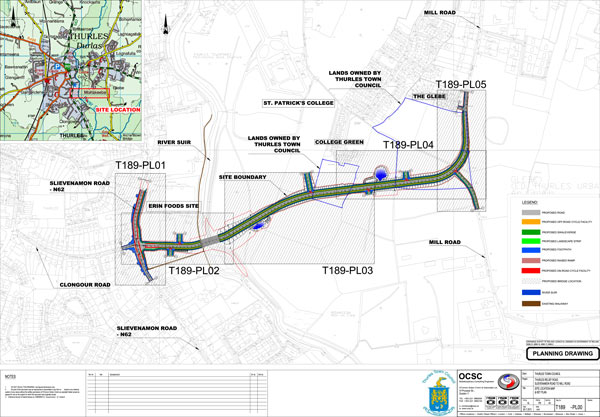
Please see Thurles inner relief road map hereunder, drawn up by Tipperary Co. Council, which appears to indicate that the “Double Ditch”, linking College Lane with the Mill Road is about to be partially at least eradicated.
We had hoped to get reassurance regarding the preservation of the “Double Ditch” and a commitment to its upgrade as a tourist attraction, when we wrote to all elected public representatives and senior Council officials, some 5 weeks ago. However, the silence emanating from all local elected politicians, including Fianna Fáil TD Mr Jackie Cahill; Independent TD Mr Michael Lowry and all County Councillors, within the Templemore / Thurles Municipal District, leave us now fearing the worst possible scenario.
We now cannot be sure what exactly Tipperary County Council is planning. We are aware Mr Joe MacGrath CE instructed his Secretary, Ms Evelyn Harty, to request that Mr Marcus O’Connor contact us over 5 weeks ago. Alas, Mr O’Connor has failed to do so.
A subsequent 4 week reminder, sent by us, to Mr MacGrath’s office received the following reply from Mr Joe MacGrath’s Secretary, “I acknowledge receipt of your email below on behalf of Joe MacGrath, Chief Executive and confirm that the matter is receiving attention”.
Prior to the formation of the present coalition government, we corresponded with Ms Josepha Madigan TD last May, who was then acting Minister for Culture, Heritage and the Gaeltacht.
In correspondence received from her, Ms Madigan stated, and I quote, “So far as we understand, there is no direct impact on the “Double Ditch” from any current development. The Department is a statutory consultee in the planning and development process, but our role in this regard is to respond to particular development proposals as referred to us by the planning authority. If there is a particular proposed development which you believe to be of concern, and you can send us details, we can review further.”
A further query was sent to Ms Madigan via Ms Helen Francis(Private Secretary to Minister Ms Madigan), which went totally unanswered.
Since then, Irish Green Party politician Mr Malcolm Noonan TD, has taken on the role of Minister of State for Heritage and Electoral Reform. While our correspondence to him was eventually acknowledged, to date no further information has been forthcoming from his office. Mr Noonan’s Private Secretary, Ms Danielle McDonnell stated: “On behalf of Mr. Malcolm Noonan TD, Minister of State for Heritage and Electoral Reform, I wish to acknowledge receipt of your recent emails in relation to Thurles / Famine Double Ditch. A further reply will issue as soon as possible”.
There comes a time when silence is betrayal.
The spread of misinformation is not achieved by words only; but also on numerous occasions by people remaining completely silent. We have contacted all elected personnel representing Thurles; requesting the answers to 3 simple questions within the last 3 months; result has been silence. This cannot be allowed to continue.
I might point out to Mr Joe MacGrath CE, Mr Marcus O’Connor and all County Councillors the Code of Conduct for Councillors, prescribed under the Local Government Act of 2001.
Need I quote directly from this document: “The public is entitled to expect conduct of the highest standards from all those involved in the local government service, be they councillors, county/city managers, other local authority staff or non-councillor members (“external members”) of local authority committees. The Local Government Act 2001 (“the Act”) sets out a new ethical framework and imposes a statutory duty on all in the local government service to maintain proper standards of integrity, conduct and concern for the public interest.“
The 3 questions which now need to be answered by Tipperary Co. Council officials; Templemore / Thurles Municipal District Councillors; Michael Lowry TD and Jackie Cahill TD, are as follows and require simple answers:-
(1). Will the planned Thurles inner relief road impinge, in a negative way, on the 1846 Thurles “Double Ditch”, which has been a right of way and a Mass Path for almost 175 years and which is the property of the people of Thurles?
(2). What are the future plans for the 1798 memorial statue [The Stone Man], first erected in Liberty Square, Thurles in 1900, and still standing there, awaiting removal prior to the new upgrade?
(3). Which Municipal District Councillor is responsible for delaying the Thurles Recycling Civic Amenity, which this town so badly needs?
Please answer these 3 questions in writing please, as failure to do so has already placed you in breach of Tipp. County Council Policy,i.e.“Tipperary County Council is committed to providing an efficient and courteous service to all our customers”.
Note Please: All answers to the 3 questions above, by August 27th, must be sent in written format by email, which you already have. All answers will be published.
We find Tipperary County Councils staff and their officials actions; in their failure to answer questions, similar to the errors made recently by Mr Michael Cawley (Fáilte Ireland – holidaying abroad); Mr Dara Calleary and Mr Jerry Buttimer’s behaviour of last Wednesday night; latter who believed there was one law for them and another law for the great unwashed – their electorate. Those who participate in decision making, same likely to impact local people, must maintain a duty to follow the regulations laid down by government.
I took a walk along the “Double Ditch” this afternoon, no effort by Tipperary County Council to resolve fly-tipping has been undertaken whatsoever, despite our request of October 2019. Dumping however, has increased and trees have been cut down, removed possible for firewood.
This website uses cookies to improve your experience. We'll assume you're ok with this, but you can opt-out if you wish.AcceptRead More
Privacy & Cookies Policy
Privacy Overview
This website uses cookies to improve your experience while you navigate through the website. Out of these, the cookies that are categorized as necessary are stored on your browser as they are essential for the working of basic functionalities of the website. We also use third-party cookies that help us analyze and understand how you use this website. These cookies will be stored in your browser only with your consent. You also have the option to opt-out of these cookies. But opting out of some of these cookies may affect your browsing experience.
Necessary cookies are absolutely essential for the website to function properly. This category only includes cookies that ensures basic functionalities and security features of the website. These cookies do not store any personal information.
Any cookies that may not be particularly necessary for the website to function and is used specifically to collect user personal data via analytics, ads, other embedded contents are termed as non-necessary cookies. It is mandatory to procure user consent prior to running these cookies on your website.





Recent Comments