Archives

Tipperary County Councillors Stress Over Japanese Knotweed

Tipperary County Councillors, particularly those responsible for the Templemore/Thurles Municipal District don’t get out much anymore; what with recovering from the mental anguish they suffered during their May 2019 local election campaign; then their fear of catching the Covid-19 virus just 11 months later and now having to cancel foreign holidays; forced to instead, spend time on ‘Staycation; during their pending 2020 summer holidays here in boring old Éire.

Possibly because of the coronavirus, no councillors have been answering their emails, since election time. Possibly because, as you our readers will be well aware, computers carry the corona virus and numerous other viruses and malicious malware.

Of course, nowadays, local councillors and even politicians require a hell of a lot more education than what was needed in the past.
In a Tipperary media report, Tipperary Councillor and little known botanist, Mr Kieran Bourke, informed the monthly meeting of the Council, that Japanese Knotweed continues to be a “vast problem” down Carrick-on-Suir way, South of the county.
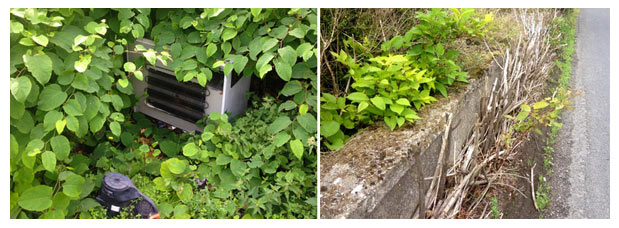
Pictured L-R. Japanese Knotweed used to camouflage fly-tipping – One failed attempt to assassinate Japanese Knotweed.
Pictures G. Willoughby

We learn that a contractor working on behalf of the Tipperary Local Authority, over the last four years, has eradicated this plant on sites listed for treatment. [Well not all exactly eradicated all, as just one picture shown above will attest.]

We learn that Transport Infrastructure Ireland (TII) has allocated funding of €11,000 to the Tipperary Co. Council in April 2020, all part of the 2020 Invasive Alien Plant Species plan. We are aware that some 17 sites on national routes around Co. Tipperary were not fully eradicated, despite receiving treatment, between the years 2016 and December 2019, with some now demonstrating signs of re-growth. [Here is one of the few occupations where personnel can get paid consistently for failure. One other occupatin being elected as a Municipal District councillor.]

While we are not aware of what botanical scientific studies, if any, has ever been undertaken by Cllr. Bourke, we would like to highlight recent qualified research, same undertaken by Principal Ecologist Dr. Mark Fennell, latter employed at the engineering firm AECOM.

As part of many years of research, Dr. Fennell’s team looked closely for evidence of the threat by Japanese Knotweed. His team surveyed information supplied by invasive species control contractors and property surveyors and had access to residential properties where Japanese knotweed was known to have been located.

His findings and that of his research team had “found nothing to suggest that Japanese knotweed causes significant damage to buildings – even when it is growing in close proximity and certainly no more damage than caused by other species”.

Dr. Fennell further confirmed that fears regarding Knotweed growing through concrete were not borne out by any real evidence. “It would break the laws of physics if it could grow through concrete, and it absolutely cannot do that. What it can do is grow through cracks in concrete, but it can’t cause those same cracks.

Tipperary County Councillors stressed out, worrying about the growth of Japanese Knotweed, can now relax on holiday. Here in Thurles local residences use this plant very successfully to hide redundant vacuum cleaners and fridge freezers, dumping same in early spring to avoid detection. [See picture above.]

While Tipperary Co. Council, through their Department of the Environment, foolishly continue to waste money using employees to call, checking on homes in the hope that they may find people who have no recycling bins; those people with these bins tell Thurles.Info that worn-out 3 seater leather couches; armchairs of various descriptions; burnt out lawn mower engines and fridge freezers don’t actually fit into any of their green waste bin. The result is inevitably, with the lack of a Recycling /Waste Civic Amenity Site, local fly-tipping will takes place, latter encouraged by Tipperary Co. Council’s inability to solve a simple basic problem.

WEEE collection days in Tipperary postponed due to COVID-19 virus.

We noted Free WEEE Collection Days scheduled for May 2020 were postponed due to the COVID-19 virus until further notice. Free disposal was offered at Civic Amenity Sites on Friday’s from 8:30am – 4:30pm and for a half day on Saturdays.
Note these Civic Amenity Sites were named as Nenagh Civic Amenity; Roscrea Civic Amenity; Tipperary: Donohill Civic Amenity; Cashel: Waller’s Lot Civic Amenity; Clonmel: Carrigeen Civic Amenity.

Wait a minute: Question: “Where is the Thurles: Civic Amenity?” Answer: “There is no Civic Amenity in Thurles”. Haven’t we told you that time and time again.

Tomorrow morning, as usual TippFM radio will grant locally elected reps; community activists; politicians, etc. speaking time on matters which they believe will give the impression that they are working for the good of their community. Time now to ask the Question, “Who is holding up efforts to provide a Waste Civic Amenity here in Thurles”. Time now to ‘name and shame‘ those involved.

Meanwhile Tipperary County Council plan to spend €48,000 or €12,000 in each one of the four Tipperary Municipal District this year to attempt to eradicate this non-native plant.

Could we not use the control methods used in Victorian times? Could the council not purchase Nanny goats, latter who love and trive eating Japanese Knotweed? The ‘Resveratrol’, found afterwards in the goat’s milk could possibly assist in aiding cholesterol, blood pressure, cancer, heart disease, age-related cognitive decline and many other health conditions which this plant can help.

Mulched Wood Chippings Littering Thurles

The image above is what met the view of residents, residing on Kickham Street, Thurles this morning.

For as far as the eye can view, in both directions, the roadway is littered with mulched wood chippings.

Motorists are being asked to take care, especially when braking.

The environmental section of Tipperary Co. Council have been informed.

Sea Eagles Released At Lough Derg, North Tipp.

White Tailed Sea Eagle

White-tailed sea eagles, 4 in number, were released back into the wild at Lough Derg Co. Tipperary, on Sunday last, by the National Parks and Wildlife Service. The release is part of a project to increase the sea eagle breeding population here the Irish republic.

A further two birds are expected to be released in the same area later this month, while four will be released further down close to the Shannon estuary.

The young eagles, collected from nests in the wild, were flown in from Norway last June with 6 held in purpose-built flight cages at Lough Derg.

White-tailed Sea Eagles are our largest birds of prey and one of the most impressive birds to observe in action in the wild. This release is seen as critical in helping support the existing population.

The first breeding pair took place on Lough Derg on the Co Clare side in 2012. Since then some thirty-one chicks have been fledged from a small breeding population of possibly 10 pairs, since their initial introduction; with one female bred at a nest on Lough Derg, now herself having produced chicks of her own, thus marking the birth of the first Irish-bred, white-tailed sea eagle.

This release of the birds comes under the Irish White-Tailed Sea Eagle Reintroduction Programme, which is a long-term initiative to re-establish once again the species here in the Republic of Ireland.

EPA – Ireland’s Packaging Recycling Rates Declining

Ireland’s packaging recycling rates going in wrong direction says Environmental Protection Agency (EPA)

  • Recycling rates for packaging are declining – from 74% in 2012 to 64% in 2018 – coinciding with a greater amount incinerated for energy recovery
  • Packaging now accounts for one-third of household waste with paper and cardboard, followed by plastic the most common type of packaging waste.
  • In relation to plastic packaging, Ireland recycled only a third of plastic packaging in 2018, which has decreased for the third year in a row.
  • Less recycling leads to missed opportunities in relation to the efficient use of waste materials and fostering a circular economy in Ireland.
  • We must reduce the amount of packaging used in the first place; improve separation of waste by Irish households and businesses; and broaden the scope of what can be recycled, by expanding Ireland’s recycling list.

31st July 2020: The EPA has today published its latest figures on waste packaging in Ireland. They indicate that Ireland continues to generate significant amounts of waste packaging, amounting to just over 1 million tonnes in 2018, remaining unchanged since 2017. Packaging includes paper and cardboard, plastic, glass, wood and metal.

While Ireland met current EU requirements and achieved high recycling rates in some packaging material streams, in particular glass, paper and cardboard, there are some worrying trends. Overall, recycling rates are on a downward trend with 64% of packaging recycled in 2018 compared with 74% in 2012. This has coincided with an increase in the quantity of packaging sent for incineration with energy recovery in recent years. In relation to plastic packaging, Ireland’s recycling rate has dropped for the third year in a row to 31%.

Dr Eimear Cotter, (Director of the EPA’s Office of Environmental Sustainability), stated, “To get the most from our resources in this area, we need to reduce packaging and reverse our falling recycling rates. Households and businesses can drive this change by avoiding over-packaged goods which sends a strong signal back to producers to innovate for reduced packaging and reusable alternatives. We must also maximise recycling of the remaining materials, and waste collectors have a critical role here in ensuring their customers segregate correctly and use the appropriate bin. To support this, Ireland’s recycling list should, as a matter of urgency, be reviewed to expand the variety of waste types that can be recycled.”

Maximising the prevention, reuse and recycling of packaging materials is an important element of developing a circular economy in Ireland which aims to reduce waste throughout the economic cycle, and ensures that materials are used efficiently. Developing a circular economy is also strong and effective climate action.

Commenting on the figures, Dr Tara Higgins, (EPA Senior Scientist) stated. “Each tonne of packaging releases greenhouse gases during extraction of raw materials, manufacture, transport and waste management process. The quantity of packaging waste generated needs to be reduced to bring about environmental and climate benefits. The Government’s forthcoming Waste and Circular Economy Action Plan provides an opportunity to set out concrete actions that will address the worrying trends highlighted in these figures and help Ireland meet challenging new EU targets in the coming years.”

EPA Welcomes New Septic Tank Grant Scheme

Environmental Protection Agency (EPA) welcomes new septic tank grant scheme, as over 50% of systems fail inspection.

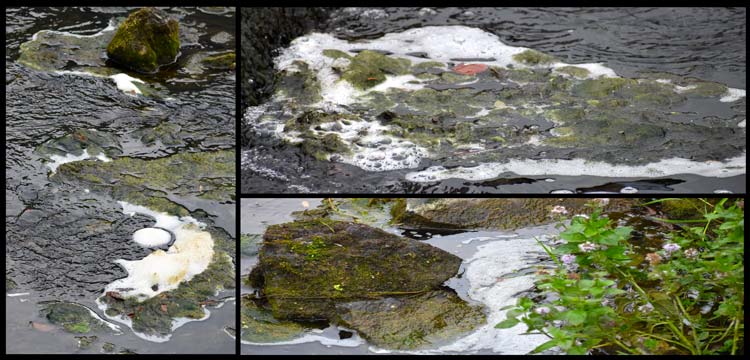
Polluted state of the River Suir, in Thurles Town Centre, Co. Tipperary, which Thurles Municipal District Councillors have tolerated for years and continue to do so.
  • There are an estimated half a million septic tanks and other domestic waste water treatment systems in the Republic of Ireland.
  • Half of the 1,160 septic tank systems inspected in 2019 failed.
  • Householders with private wells are particularly vulnerable to pollution from faulty septic tanks.
  • 27% of systems that failed inspections during 2013-2019 are still not fixed.
  • The Government’s expanded septic tank grant scheme will now help more householders fix faulty systems.

The Environmental Protection Agency today reported on 1,160 Local Authority inspections of septic tanks and other domestic waste water treatment systems in 2019. The EPA found that more than half of the systems failed inspection. A lack of maintenance and desludging was identified as a key issue. The Local Authorities identified more serious issues with nearly 300 systems, where they were found to be a risk to human health or the environment.

The EPA also reported that the grant scheme for septic tanks has recently been expanded to cover specific areas where work is being focused to improve water quality under the national River Basin Management Plan. This means that more people will qualify for a grant.

Commenting on the report, Dr. Tom Ryan (Director of the EPA’s Office of Environmental Enforcement) stated; “If you do not maintain your septic tank, it can contaminate your own or your neighbour’s well, putting your health at risk and that of your family and neighbours. It may also pollute your local stream or river. You can take simple steps to maintain your septic tank by cleaning it out regularly and by making sure it is not leaking, ponding or discharging to ditches. The Government’s expanded septic tank grant scheme broadens the availability of grants and increases the maximum grant available which is welcomed.”

The EPA also found that 27% of systems that failed inspections during 2013-2019 are still not fixed and Local Authorities need to take action to make sure householders fix systems that fail.

Mr Noel Byrne (EPA Senior Inspector) stated; “It is important that householders fix systems where problems are detected and be aware that they can pose a serious health risk. While there has been an improvement in the number of systems fixed, there are still many systems where faults are not addressed over a number of years. This requires increased engagement and enforcement by Local Authorities to address remaining failures”.