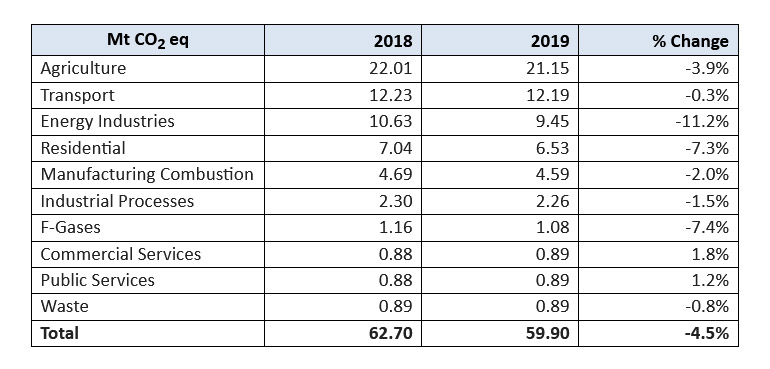
Ireland’s greenhouse gas emissions decreased by 4.5% in 2019. This is the largest annual reduction in emissions since 2011.
Despite the decrease, Ireland is still not on the pathway required to meet future targets and a climate neutral economy.
Energy Industries emissions decreased by 11% with a significant decrease in coal (69%) and peat (8%) used.
Agriculture emissions decreased by 3.9%, driven by reduced fertiliser use and lime use on soils.
Residential emissions reduced by 7.3 %, largely the result of a warmer winter.
Greenhouse gas emissions from the transport sector reduced only marginally despite an increase in biofuel use.
Full details on Greenhouse Gas Emission Inventory 1990 to 2019 are available on the EPA website HERE and the EPA Greenhouse Gas web resource HERE.
The Environmental Protection Agency (EPA), as the competent authority for reporting Ireland’s greenhouse gas emissions, has yesterday published its provisional greenhouse gas emissions for Ireland for 2019. The figures show a reduction of 4.5% compared to 2018, which is the largest decrease since 2011. Significant emission reductions are recorded for the Energy Industries, Agriculture and Residential sectors. These decreases come despite modest growth in the domestic economy of 1.7% over the year.
However, the figures indicate that Ireland will exceed its 2019 annual EU emissions allocation by 6.98Mt which makes it highly unlikely that Ireland will meet its overall 2020 targets, even taking the impact of Covid 19 on emissions in 2020 into account.
Commenting on the figures Laura Burke, (Director General, EPA) has stated:
“This much needed reduction in greenhouse gas emissions is a welcome step in the right direction. The figures show that emissions reductions can be achieved and in 2019 there have been reductions in power generation, agriculture and residential sectors. However, if the 2020s are to be the decade of climate action, this level of emission reductions, at a minimum, will be required annually. Therefore, these reductions need to be built on to achieve continual, substantial, year-on-year emissions reductions. It will take the implementation of effective measures, including all those committed to in the Climate Action Plan, to put Ireland on the pathway to a climate neutral future”.
The emission reductions have been driven by a number of factors across the sectors including:
Energy Industries: Emissions in the Energy Industries sector showed a decrease of 11.2% (1.19 Mt CO2eq) in 2019, which is attributable to a 69% decrease in coal and an 8% decrease in peat used in electricity generation. Electricity generated from wind increased by 16.0% in 2019, with renewables accounting for 37.6% of electricity generated. After 2020, a continued increase in renewable generation levels will be required to meet ambitious future greenhouse gas targets.
Agriculture: Agriculture emissions decreased by 3.9% (0.86 Mt CO2eq) in 2019. This was driven by reduced fertiliser use (down 10.1%) and a reduction in the quantity of lime used on soils (down 25.4%), which had both increased substantially the previous year. Other key drivers of emissions in agriculture, such as the number of dairy cows, continued to rise.
Residential: Emissions in the Residential sector decreased by 7.3% (0.52 Mt of CO2eq) in 2019 with the warmer winter resulting in decreased use of fuels. However, emissions per household have plateaued in recent years which indicates a need to step up energy efficiency retrofit activity to achieve future emission reduction commitments.
Transport: Greenhouse gas emissions from the Transport sector decreased slightly, by 0.3% (0.04 Mt CO2eq), in 2019. An increased demand for transport largely offset more biofuel use which was up 21.9% in 2019. Reducing transport emissions requires a blend of measures such as more cycling and walking as well as new technologies such as electric vehicles and biofuels.
Commenting, Stephen Treacy, (Senior Manager, EPA) has stated:
“These 2019 figures illustrate where our economy and emissions were heading before the COVID-19 pandemic. While, 2020 is likely to see a reduction in emissions caused by the impact of the pandemic, this does not negate the need for long term and sustained action. Focusing on climate action as part of a ‘green’ recovery offers the opportunity to respond to climate change while rebuilding our economy and generating new jobs.”
It’s called sakura season in Japan; the time when pink and white cherry blossoms signal the beginning of spring.
Photographed yesterday (November 17th 2020) a fruit bearing Cherry tree in bloom here in Thurles, Co. Tipperary.
The unique variety of cherry tree known as Kawazu-zakura is usually the first to bloom in late February, while most other variety’s come into bloom between mid March and early May.
Japan’s cherry blossom season famously begins in late March and April lasting for around two weeks, with the best places to see the blush-tinted blooms being in Maruyama Park, Mount Yishino, Himeji Castle and Fuji Five Lakes.
However, this year you only have to travel to the Pallottine Prayer Garden, Kickham Street, Thurles, Co Tipperary, where half of a fruit bearing Cherry tree has burst into bloom just this week, November 7th 2020.
The tree and this unusual delightful ‘blooming’ phenomenon can be viewed on the North facing side of the Pallottine Prayer Garden.
Can anyone please enlighten us as to why we have a Cherry tree blooming in early November? We would love to hear your explanation.
Would the fact that this tree may have been grafted at the root have anything to do with its decision to burst into bloom or is Mother Nature simply trying to cheer us up?
Food waste is costing Irish households up to €700 per year, and 68% say that food, passing its use-by date, is the main reason we throw out food.
The latest Environmental Protection Agency survey reports that only 10% of people rate themselves as being good at keeping track of food stored in the fridge. An EPA campaign highlights that freezing is a simple, effective way to manage surplus food and to reduce waste.
The EPA has launched a new campaign to encourage people to take a simple action to reduce food waste, by freezing surplus food before its use-by date.
A recent EPA survey, conducted by Behaviour & Attitudes, found that 68% of people still say ‘passing use-by dates’ is the top reason they throw out food at home. It found that 75% of the population understand that use-by dates are a deadline, and over 80% check them to ensure food is still safe to eat.
The EPA suggest that freezing food is an easy way to stop wasting food and thus save money. Food waste currently costs the average Irish household up to €700 per year.
Freezing surplus food before it passes the use-by date can help both the environment and your budget, according to Mary Frances Rochford, (Programme Manager in the Office of Environmental Sustainability) who has stated: “We are calling on everyone to support and share our Eat It or Freeze It campaign on social media, and take a simple action to stop food waste.
Irish households produce over 250,000 tonnes of food waste per year, at a cost of €700 per household. In addition, wasted food is a significant contributor to climate change – responsible for about 10 per cent of global greenhouse gas emissions. Cutting food waste reduces greenhouse gas emissions and provides real savings for householders.”
Environmental Scientist at the EPA, Odile Le Bolloch, explains: “If you don’t get to eat it, freezing food is an action we can start straight away. Over half of people do not realise that you can freeze food right up to its use-by date, but many of us can reduce our food waste through freezing. It is a great way to make food last longer – it acts just like a pause button, allowing food to be eaten at another time.”
A lot of different types of foods can be frozen, whether it’s the extra loaf of bread you bought or the cooked pasta you want to use for lunch later in the week.
The survey showed that bread is one of the most wasted foods in Ireland, and when it comes to freezing it, same is the most versatile – the whole loaf can be frozen when you buy it, or just the last few slices at the end of the bag.
You can find out how to freeze all of your favourite foods, learn about food date marking, and access resources to help reduce food waste in the home by visiting the Stop Food Waste website online HERE.
The Daffodil or Jonquil (Narcissus) is usually among the first plants to emerge, normally in early spring. Grown from bulbs planted between September and November, (Up until the ground starts to freeze), they emerge out of the soil as temperatures begin to rise in late February and early March to produce welcome bright trumpet-shaped blossoms on top of thin tubular stems.
However, this year we report that, here at least in Thurles, Co. Tipperary, daffodils are already emerging since late October, which, to use a now rarely used phrase, surely ‘Beats Banagher’.
[“Beats Banagher” – Primarily used here in Ireland to mean beyond the bounds of imagination; surprising; shocking, or an amazing occurrence.]
Note: These bulbs were first planted four years ago
What is the reason for this unusual phenomenon I hear you ask? I regret I have no answers, but maybe someone out there can explain this early premature birthing, same almost four months ahead of time.
Raw sewage from 35 towns and villages flows into our environment every day, with 33 areas unlikely to receive treatment until after 2021.
Treatment at 19 of Ireland’s 172 large towns and cities, including Dublin and Cork, failed to meet standards set to prevent pollution. This is down from 28 over the past two years.
Irish Water has no clear plan to improve treatment at 23 areas where waste water is a significant threat to waters.
Overall there are 113 areas where priority action is needed to protect public health and the environment.
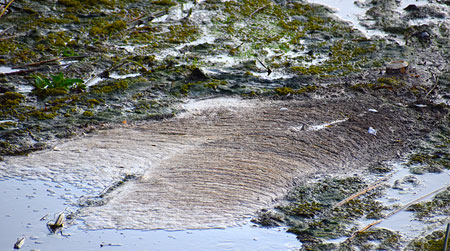
River Suir, Thurles, photograph taken close to Barry’s Bridge in the centre of the town, in Co. Tipperary
An Environmental Protection Agency (EPA) report on Urban Waste Water Treatment in 2019, released today, highlights that delays in upgrading treatment systems around the country are prolonging risks to the environment and public health.
Some improvements in performance were evident in the past year, with the removal of the raw sewage discharges from one town and improvements in treatment at nine towns and villages where waste water was the main issue.
Despite these improvements however, Irish Water has repeatedly revised its plans and extended the timeframe to provide treatment for towns and villages, including those that are discharging raw sewage.
Commenting on the report Dr Tom Ryan, (Director of the EPA’s Office of Environmental Enforcement) has stated: “Raw sewage discharges pose an unacceptable risk to the environment and public health. Two years ago, Irish Water advised it would provide necessary treatment infrastructure by the end of 2021 for 30 of the 35 areas discharging raw sewage. It has now revised this down to just two areas, resulting in significant delays in bringing projects to completion. The growing uncertainty in Irish Water’s planning and delivery of these critical projects is undermining confidence in its capacity to reduce the risks to public health and the environment in a timely manner. Plans are only effective if implemented, and the inherent uncertainty of these plans is a serious cause of concern for the EPA. Irish Water must remedy the underlying causes for the delays in delivering this critical infrastructure to ensure that raw sewage discharges are eliminated”.
Irish Water is failing to treat waste water to national and European Union standards and is falling far short of its own targets to deliver essential improvements needed to comply with these standards. The continuing issues in Dublin, which is served by Ringsend treatment plant, is of concern because it produces almost half (44%) of Ireland’s waste water. The Ringsend plant repeatedly fails the treatment standards because it does not have the capacity to effectively treat all the sewage it receives. Irish Water is upgrading the plant and advises it will be completed by 2025.
Mr Andy Fanning, (Programme Manager of the EPA’s Office of Environmental Enforcement) has commented: “These works must be a priority for Irish Water and will be closely monitored by the EPA. There is, however, no clear plan to improve treatment at 23 areas where waste water is a significant threat to waters at risk of pollution. Irish Water must clearly identify when and how it will resolve the issues at these 23 areas and plan improvement works as early as possible.”
This website uses cookies to improve your experience. We'll assume you're ok with this, but you can opt-out if you wish.AcceptRead More
Privacy & Cookies Policy
Privacy Overview
This website uses cookies to improve your experience while you navigate through the website. Out of these, the cookies that are categorized as necessary are stored on your browser as they are essential for the working of basic functionalities of the website. We also use third-party cookies that help us analyze and understand how you use this website. These cookies will be stored in your browser only with your consent. You also have the option to opt-out of these cookies. But opting out of some of these cookies may affect your browsing experience.
Necessary cookies are absolutely essential for the website to function properly. This category only includes cookies that ensures basic functionalities and security features of the website. These cookies do not store any personal information.
Any cookies that may not be particularly necessary for the website to function and is used specifically to collect user personal data via analytics, ads, other embedded contents are termed as non-necessary cookies. It is mandatory to procure user consent prior to running these cookies on your website.





Recent Comments